Luke 24:1-12 (Matins)
2 Corinthians 4:6-15
Matthew 22:35-46
The Sound of His Voice
.... nor from that day on did anyone dare question Him anymore.
In the Name of the Father and of the Son and of the Holy Spirit. Amen.
Our Gospel lesson this Fifteen Sunday After Pentecost
is about Identity and Authority
—
two subjects that were primary to Jesus of Nazareth
throughout His ministry.
If we do not accept, to a certainty, that He is
"the Christ, the Son of the Living God" (Mt 16:16),
then the Incarnation will have been in vain,
for this is the door that opens on to everything else.
Too often,
we get stuck in endless speculation and supposition
and
never break through to the immediacy and living reality of God,
Who
demands our attention
and
summons us to His Presence.
The Pharisees ask Jesus to summarize the whole Law.
As their lives are inseparable from the Law,
they are really asking,
"What does it all mean?"
"What is essence of life?"
Jesus replies,
taking the first part of His answer from the greatest prayer of Judah-ism, the Shema:
Hear! O hear, Israel! The Lord, thy God, is One.
Thou shall love the Lord thy God with all thy heart,
with all thy soul, and with all thy strength.
(Deut 5:4-5)
|
The second part, Jesus takes from one of the most cherished sayings
of the great elder Hillel,
who was born about fifty years before Him.
Hillel was asked
to recite the whole Torah while standing on one foot,
that is, what is the essence of it?
He replied,
"What is hateful to you, do not do to your fellow: this is the whole Torah;
the rest is the explanation; go and learn."
|
Jesus' answer would have been received with exultation,
for this is the jewel-like essence of the books
the Pharisees deemed most holy.
While they were still gathered,
Jesus poses a question of His Own:
|
"What do think of the Christ?"
(Mt 22:42)
|
The underlying Greek text asks
"What is your doctrine
1
concerning the Xristou
(the Christ, the Messiah, the Holy One)?"
Their answer is narrow and glib, "He is a uiós (descendant) of David."
Jesus follows by turning their world topsy-turvy,
beyond scholarly opinion,
beyond the Torah,
even beyond the Psalter which (it was said) David himself composed.
|
"If David then calls Him 'Lord' [i.e., 'My King'], how is He his Son (descendant)?"
2
(Mt 22:45)
|
In this, Jesus has crossed the line into eternity,
where God is,
Who is not time-bound but rather beholds all points of time simultaneously.
This moment is
analogous to Jesus' declaration,
|
"Most assuredly, I say to you, before Abraham was, I AM."
(Jn 8:58)
|
That is,
He has for a moment thrown back the cowl
to reveal His Face:
the Face of God.
The effect, of course, is electric,
something like the Apostles' wild surmise when Peter
declared,
"Thou are the Christ, the Son of the living God."
But this moment, beheld by the Pharisees,
is much more,
for the Son is revealed to be the Father,
and
the Father, the Son.
They are literally dumbfounded,
for no one dared to question Him anymore.
☦
When we were in Haiti,
we used to say,
everyone ought to put aside time at the end of their lives to
get right with God,
to be deeply intentional about knowing God.
Yes,
we lived in monastic community,
prayed the cycle,
and
attended daily Mass,
but I mean,
to make to dedicate all of one's daily life
to study and meditation
with the aim of knowing God.
In 2014,
we did precisely that.
Speaking just for myself,
the end of our lives has proved to be a longer period than I anticipated.
I can only assume that God wishes us to continue,
that we have not yet graduated from this spiritual "academy."
Vladimir Lossky's classic work Mystical Theology of the Eastern Church
begins with the sentence,
"In a certain sense all theology is mystical."
2
Isn't
this the essence of Christian life?
After
our daily prayer petitions God
"Thy Kingdom come"
and
"On earth as it is in Heaven."
This is heady stuff.
Where do we begin?
But He has provided us with an Icon
—
an earthbound manifestation replete with Heavenly meaning
—
so we must gain traction here on the earth.
We must be grounded in the Master Icon,
Jesus of Nazareth:
His Incarnation,
His Nativity,
His luminous life and teachings,
His Passion,
His Crucifixion,
His Resurrection on the Third Day,
the doings and sayings of the Risen Christ,
His Ascension,
His promised Return,
the Gift of the Holy Spirit,
and
the Son's declaration always to be with us.
Truly,
He has richly furnished forth a dazzling feast!
And the invitation to participate in the
Marriage of Heaven and earth,
(as we saw last week)
is not optional.
What shall we say about those who willfully do not know God at all
—
their rage,
their passions,
their blood-lust,
their selfishness,
their faithlessness in all their ways
—
it all begins with
the failure to know God.
The world,
as a consequence,
is the implacable and deadly enemy of God.
Jesus warns,
|
Yes, the time is coming that whoever kills you will think that he offers
God service. And these things they will do to you because they have not
known the Father nor Me.
(Jn 16:2)
|
So the first act of a Christian is to choose sides.
Jesus
has said,
|
"No one can serve two masters; for either he will hate the one and love
the other, or else he will be loyal to the one and despise the other.
You cannot serve God and mammon [i.e., the world]."
(Mt 6:24)
|
So choose!
Will your choice be God?
Or will you continue to cast your lot with the world?
You cannot have it both ways.
For if you are lukewarm, neither hot nor cold,
He will despise you and reject you.
3
What are we to do after we have left the world?
Yes, we have our quiet life before us:
the life of worship, prayer, study, and writing
(at least keeping a journal).
But Jesus also enjoins us
not to forget the poor:
our corporal works of mercy famously commanded
by the Lord in Matthew 25.
But the main business of our lives must be know Him,
for He is the ground of being.
There is no life unless it is rooted in Jesus,
the Man from Nazareth.
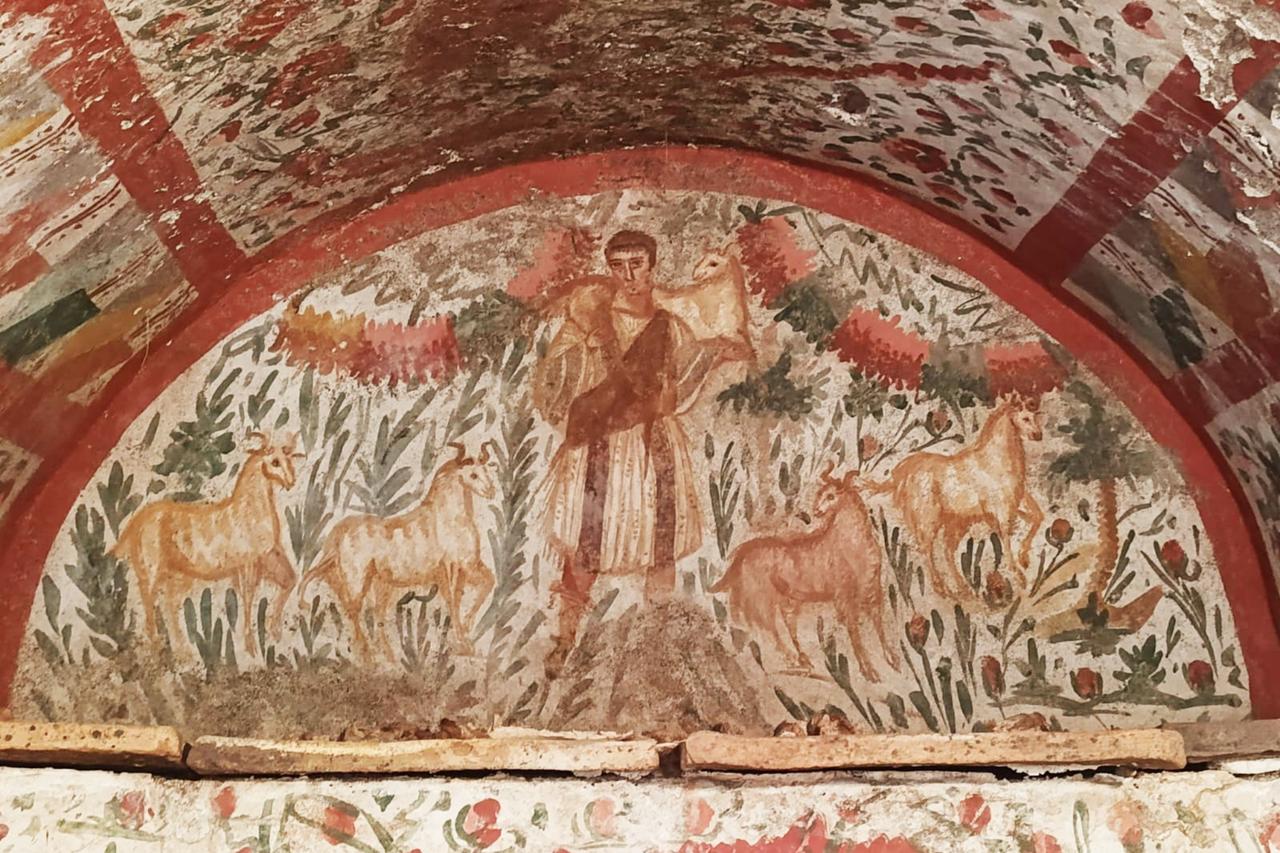
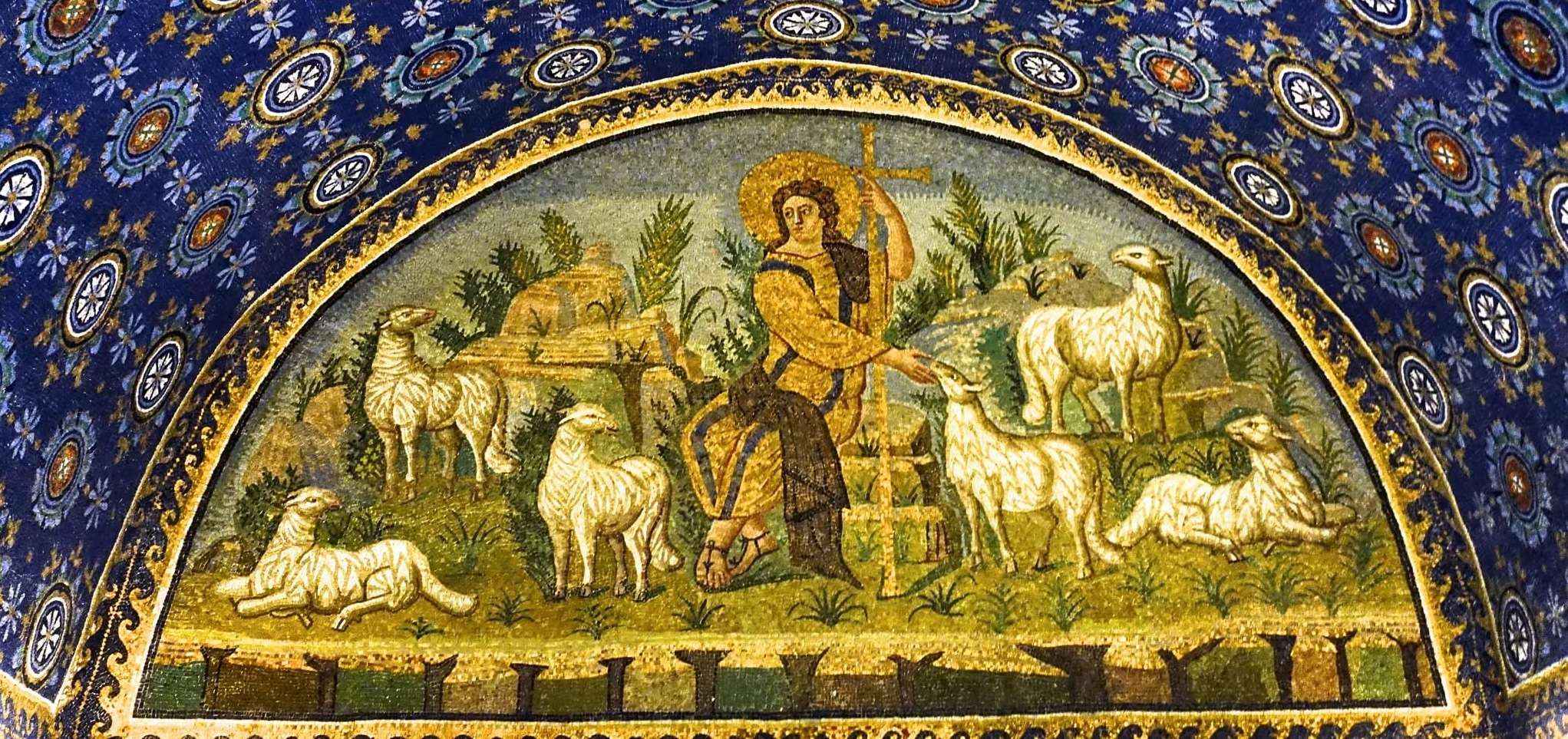
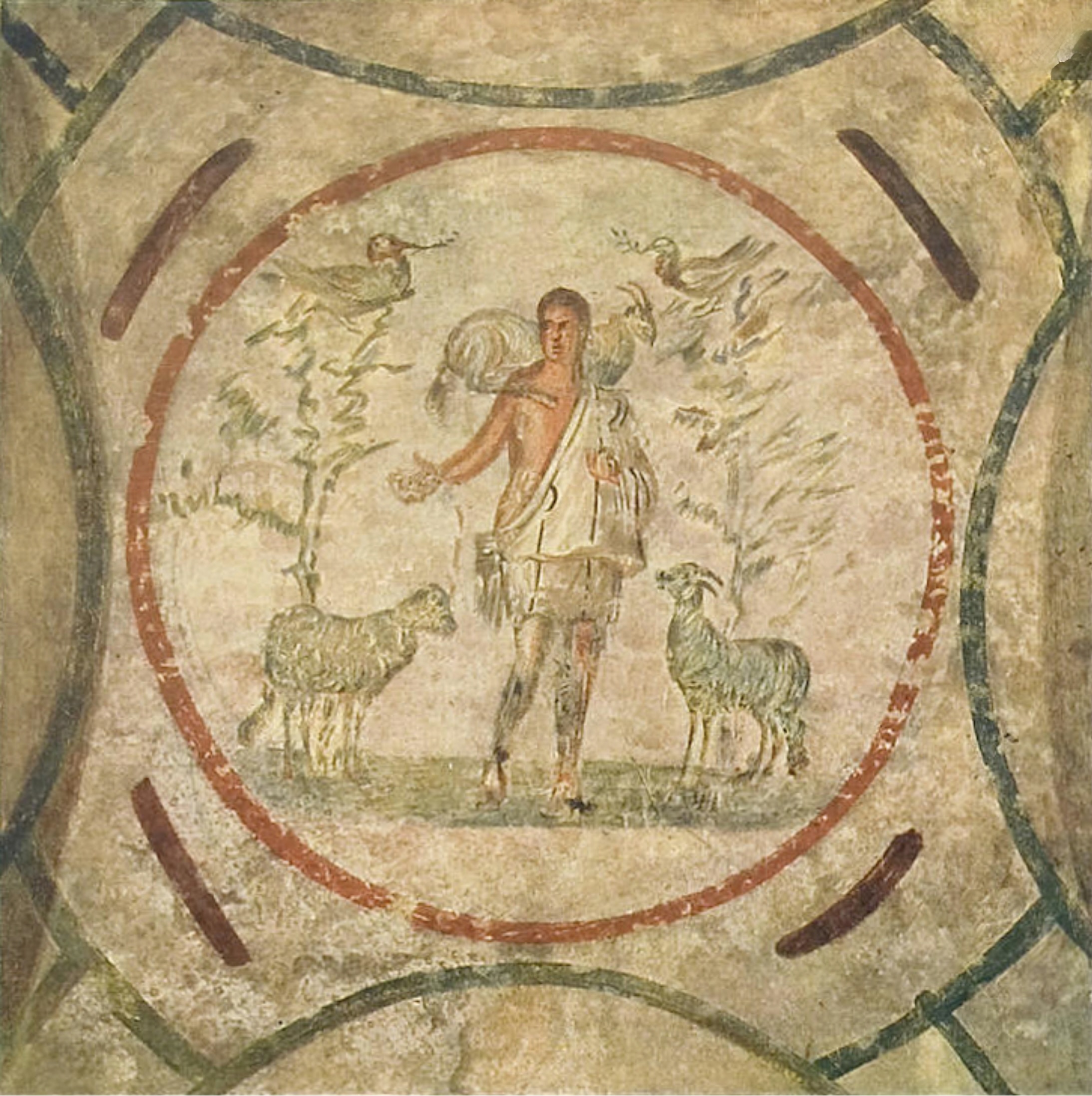
For centuries,
the earliest Christians were deeply absorbed
in a meditation on Jesus, the Good Shepherd.
This meditation goes far beyond merely flock-life
and
His rod and His staff.
Jesus sees His flock as an essence of the Kingdom of Heaven:
|
"As I said to you, My sheep hear My voice, and I know them, and they follow Me.
And I give them eternal life, and they shall never perish; neither shall anyone
snatch them out of My hand. My Father, Who has given them to Me, is greater than all;
and no one is able to snatch them out of My Father's hand. I and My Father are One."
(Jn 10:26-30)
|
The earliest images we have of Jesus
are of the Good Shepherd.
We have posted this reflection with depictions from
the second century
in Rome;
from a third-century church in Nicaea
(which itself is exceedingly rare);
and
a mosaic the fifth-century Ravenna.
We have sought the earliest collective memory of Jesus,
for inevitably this will be the purest.
I entreat you:
do not waste time reading theology
from the early sixteenth century
and
following.
Most of this grew out of the world-changing rebellion within the Roman Catholic Church.
In his profound Christology,
Roch Kereszty, O.Cist.
has convincingly shown that this theology,
from the sixteenth century to the twentieth,
is more a reflection of
its writers than a path leading to God.
4
And
do not waste time exploring the theology
of the Sacrifice of the Mass.
This came more than a thousand years after Jesus
and
His Apostles.
From it arose such innovations as
"sins were nailed to the Cross"
or
"being born again"
or
"being saved" (in a moment)
or
"being bathed in the blood of the Lamb."
In fact,
Jesus
emphatically inveighed against
such
"instant karma"
religion.
He mocked the idea of justification
through blood sacrifice.
And He declared,
"No sign will be given .... except the sign of the prophet Jonah"
(Mt 12:39, Lu 11:29).
That is,
there will be no pixie dust or magic wand religion
except the example of Jonah,
another exemplar
of
Theosis,
which is to say the hard work of transforming your soul.
This was the message of His Forerunning
and
then His signature message from the beginning:
"Metanoeite!"
(Mt 3:2, 4:7; Mk 1:5, 6:12; Lu 3:2, 5:32)
meaning
"Transform your nous,"
Or, in St. Paul's formula, "Be transformed in the renewing of your mind" (Rom 1:7).
We must go back to the
Gospel,
to the Apostles,
and
to their disciples who are called the "Greek Fathers"
because the wrote in Greek,
Jesus language.
5.
We must return to the pure springs, to the sources,
which was
the earliest battle cry of Vatican II.
We must go back to a time long before the Roman Catholic Church
(founded 1054).
This return to the Greek Fathers
is why Vatican II
was convoked.
6
The
catastrophe Pope John XXIII's death
and
the theological coup that ensued
is
too long a tale to tell this morning.
But all of that lies far beyond
(and far below)
our quest to know God,
which begins and ends with following and understanding Jesus.
Wasn't this the task He set before His disciples?
Only the Greek Fathers concern us,
for among the writers whose writings have survived,
they were the closest to the Divine radiance, the blinding light,
of the Incarnation,
when God entered the Creation as a creature
producing so great a shock
that everything forever changed.
This living memory, promulgated by the Apostles and their generations,
had not yet suffered the ravages of time
and
far-reaching tumult which followed.
We must be driven on, seeking only
the bedrock of our faith,
Jesus the Christ.
Permit me to suggest a beginning in your studies.
The first is a relatively short book,
On the Incarnation,
written by Athanasius the Great.
In my humble canon,
this book ranks in importance with the books of the New Testament.
7
Thanks be to God, the Greek original has survived.
Next is another short book,
On the Holy Spirit
written by St. Basil the Great.
8
Composed before the Church had agreed to a settled theology of the Third Person of the Trinity,
this little book
similarly has exerted profound influence in the Church's developing understanding.
Again,
the Greek original has survived.
By contrast,
St. Irenaeus' magnum opus is a work of five volumes:
Against Heresies,
written during the second century.
Sadly,
while fragments have survived of the original Greek,
the earliest surviving text is a Latin translation.
St. Irenaeus'
explanation of what happened in Eden
and
the importance of Jesus in
completing Adam and Eve's course,
modeling right conduct for mankind
(Theosis),
is foundational
to our understanding of
our faith.
I would be remiss if I did not mention
St. John of Chrysostom,
who was first of all a pastor.
Yes, he was Archbishop of Constantinople,
but his heart was with the spiritual struggles of the people,
great and small.
He did not address large-scale questions,
yet he wrote some 600 homilies and 246 letters
as well as a commentary on the Acts of the Apostles.
And this is fitting for his interest was chiefly day-to-day life
and
the problems encountered in the course of local ministry.
Because our time is brief, I can do no more that mention
the last of the Three Holy Hierarchs,
St. Gregory the Theologian.
His interests and style are wholly unlike the others.
But I promise you:
he will take you to dizzying heights
that are fragrant of the Kingdom of God.
☦
Our quest to understand Jesus and the earliest Church brings us to an irony.
Many things that have come to light,
which are
fundamental to the Christian faith,
the Fathers did not know.
The Holy Land was reduced to rubble in the years around 70 A.D.
The Pharisees fled with their books and "academy" intact
(which is why our conception of Judaism today
is so heavily tilted in their direction).
Upon these fields of stone and concrete rubble,
the Caesars ordered a new pagan lifeworld to be constructed.
During the centuries period when the Early Church Fathers were praying and writing,
the disciplines
of
archaeology,
epigraphy,
textual scholarship,
and
historiography
did not yet exist.
So we must imagine what our great exemplars would have done
were they living today.
No matter how long we labor and toil,
no matter how much we give of ourselves,
no matter how we devote ourselves to digging out the truth,
they would have done it more scrupulously, more boldly, and more courageously.
For they gave everything
—
enduring exile,
being stripped of ecclesial offices,
suffering death-threats and even sentences of execution.
They lived many, many centuries before
the
most extensive discovery of first-century (and earlier) texts in history,
the
revelation
in 1946-47
of
15,000 fragments pointing back to 850 works found in caves near the Dead Sea.
And the "most read" among these books was
the Book of Enoch,
a work about the centrality of
Theosis,
with (of course) Enoch being our first exemplar.
9
The primary purpose for these weekly reflections,
ordered by God,
was to provide "snapshots" of spiritual life at the Hermitage.
And we have done this.
We have taken conversations from our refectory,
and then
shared them with all of you the following Sunday.
These conversations have included important correctives
to our thinking and praying
such as
|
Judah-ism is not ancient but an innovation.
Judah-ism was not widely promulgated until one or two centuries before
the birth of Jesus.
Theosis, called the "sacrifices of righteousness" (Ps 50/51),
is ancient and Divinely instituted.
The timing and purposes of the Incarnation
of God
are intimately tied to these recently understood facts.
|
Mostly,
we want you to join us in the all-important life-quest of knowing God,
His will for us,
and
our common birthright to the Kingdom of Heaven.
On a personal note,
I have done all within my power to order my life to the
great task of knowing God.
I devoted twenty-three years of
formal university study to it.
But I confess that the most important insights have come
since our monastery's reception into the Russian Orthodox Church
with my ordination on St. Xenia's Day, 2018 (O.S.).
Astonishing?
Yes, I suppose it is.
But even more astonishing is the ever-fresh news, revealed by Jesus
that
God waits for us.
He waits for us at a bend in the road.
He watches for our approach.
And we must waste no time.
For dithering and wandering by the way would be to slight the Holy One Who waits,
the One Who loves us with a love and tenderness far beyond anything we can comprehend.
His utmost desire is that we know Him as our Father
and
His Son, our Eldest Brother,
as our Guide and Savior
and
that we live up to this noble birth.
Let us begin then!
The work never ends,
but
in the midst of it,
we become
little-by-little,
more-and-more like the One Who has set His Royal Image upon us.
In the Name of the Father and of the Son and of the Holy Spirit.
1
δοκέω — to consider, to think.
δόκήσις — product of thinking, doctrine.
2
The Greek noun underlying "Lord" is Kúrios,
or "King,"
which is the same Greek noun used throughout the Septuagint
to refer to YHWH.
3
Vladimir Lossky, Mystical Theology of the Eastern Church
(London: James Clarke and Co., 1957), 7.
4
"So then, because you are lukewarm, and neither cold nor hot, I will vomit you out of My mouth"
(Rev 3:16).
6
One of the foremost classicists of twentieth century
carefully analyzed Jesus' citations of the Hebrew Scriptures
and
came to the conclusion that Jesus' Bible was the Septuagint,
not the Hebrew version.
Greek was almost certainly Jesus preferred language,
the language of His disciples,
and,
indeed,
the "common coin" language of the whole
Mediterranean lifeworld.
After all,
this was a primary aim of Alexander and of his generals since
the fourth century B.C.
Cf. Werner Jaeger, Early Christian and Greek Paideia, Harvard University Press, 1961.
7
Roch A. Kereszty, O. Cist.
Jesus Christ: Fundamentals of Christology
(New York: St. Paul's Publishing Co., 2002).
8
Cf. Henri de Lubac,
Catholicisme
(Catholicism)
(Paris, 1938).
The title of this book by an acknowledged "Father of Vatican II"
promised to define Catholicism for his generation,
which might have been expected to be a survey of St. Thomas Aquinas and
his many influences.
But when shocked readers opened it,
this handy text (as it was later viewed)
turned out to be an anthology of the Greek and Latin Fathers.
8
St. Athanasius of Alexandria, On the Incarnation Bilingual English-Greek Edition (Rex Mundi, 2024).
This work survived in two versions:
the "long rescension" and the "short rescension."
The only way I know into the short rescension is
Robert W. Thomson (translator and editor),
Contra Gentes
and
De Incarnatione
(Oxford: Clarendon Press, 1971).
9
St. Basil the Great,
On the Holy Spirit
Jacques Paul Migne, Patrologia graecae,
Vol 32.
https://patristica.net/graeca/.
10
1 Enoch, Ed. George W. E. Nickelsburg and James C. VanderKam (Minneapolis: Fortress Press, 2001).