Luke 24:36-53 (Matins)
Hebrews 7:26-8:2
John 10:9-16
The Great Divide
"I know My sheep, and am known by My own.
As the Father knows Me, even so I know the Father."
(Jn 10:15)
In the Name of the Father and of the Son and of the Holy Spirit.
Amen.
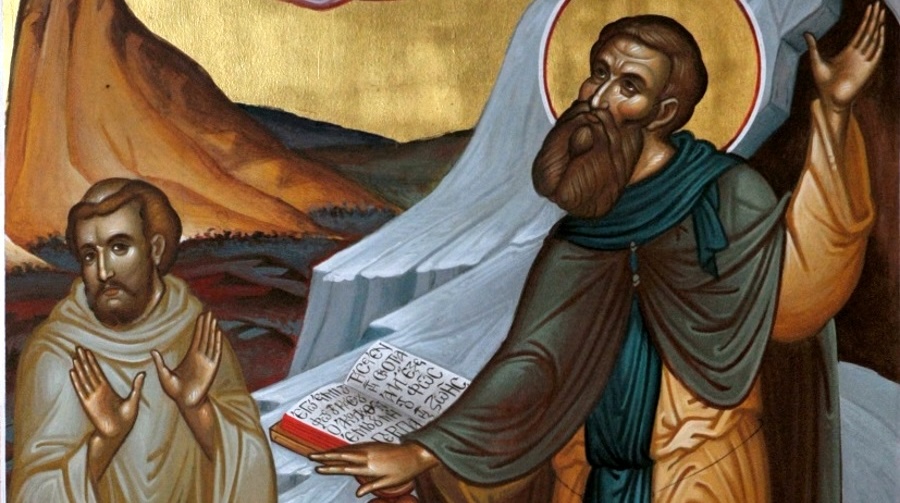
This morning we celebrate the Feast of St. Gregory Palamas,
one of only two Church Fathers to be accorded a Sunday for veneration.
This is all the more striking as
he is a very late Church Father,
living in the fourteenth century.
What then
is so singular about this saint to be so conspicuously honored?
The answer is that he stood in the breach
and
beat back an onslaught
of a ruinous horde
that laid waste to the Western Church leaving it a spiritual ruin
from which it would not begin to recover until the twentieth century.
Gregory was born into the great reordering of the world,
compared to which the Great Schism of the eleventh century and the Protestant Rebellion of the sixteenth
century are footnotes.
For the way humankind thought
and
prayed
would fundamentally change
including in Russia.
Thanks to Tsar Peter I,
Russia would endure what Met. Anthony Khrapovitsky
(founder of the ROCOR)
called "the three-hundred-year Latin Captivity."
Historians termed the period from the fifth century to the eleventh century
the Dark Ages
because of the loss of Graeco-Roman civilization
—
literature,
mathematics,
engineering.
We have lost the ability to build superior roads and harbors.
People today marvel at ancient Roman concrete.
And they have wondered why Roman harbors have not eroded
after
centuries of pounding waves have crashed upon them.
It turns out there is something in the formula for the concrete
which is fortified by salt.
That is,
their concrete only became not weaker but ever stronger when exposed to marine environments.
We could not again construct a dome such as that overarching the Pantheon (125 A.D.)
until the fifteenth century.
Over the ensuing fourteen centuries arrogant kings had charged
architects and engineers with building domes.
But they simply could not do it .... with thousands of men dying
as the stone blocks from these ill-fated attempts
came crashing down.
Of equal importance,
we had lost
Aristotle's six books of logic.
Even the Greek language was lost to the West.
Augustine, the greatest doctor of the Latin Church,
could not read the Bible
(for translations are themselves different versions,
or worse,
theological commentaries).
He could read the very words spoken by the Lord.
He could not read the Philokalia.
And he was not familiar with the great Church Fathers.
In the case of England,
reliable Greek grammars and lexicons would not appear until the early sixteenth century.
This is on the eve of the empirical revolution of the sixteenth century
and
the scientfic revolution in the seventeenth century.
It is true that Aristotle was known to some isolated monasteries
possessing fragments of his logic based on
Hebrew and Arabic translations.
These
like-minded monks
would birth an Aristotelian system called Scholasticism,
which is best understood as a rule-based technology
not very different from logic programming of today
(for example, the formal language Zed and programming language Prolog).
The important thing to note
about any technology,
is that, yes, we love to marvel at things it makes possible
which before were not possible before.
But it is no less true (though not often commented upon)
that, within its semantic sphere, a technology also make impossible,
inexpressible, unthinkable
things that were thinkable before.
This was particularly true of Aristotelian logic
because
its practitioners thought of it as
revealing hidden Divine truth.
Finally,
they had discovered the instrument that could scrape back the
encrustations of the world
and reveal the mind of God.
It is very difficult to argue with men like this.
It would not be until
the thirteenth century
when all six books of Aristotle's logic were rediscovered,
in Constantinople
and later assembled into one book,
called the Organon
(which translated is the Instrument).
It was
rendered into Latin
and quickly and excitedly
was circulated throughout the whole West.
Nothing again would be the same.
All former intellectual efforts were deemed
laughably inadequate.
And all-things-Greek became something of a cultural mania.
In England
men like Desiderias Erasmus, Thomas More, and Roger Ascham
were lionized as humanists,
meaning that mankind could again stand erect to his full stature.
My own edition of the first
English translation of the Aeneid of Virgil (London, 1987)
demonstrated that even the setting of type,
with new typefaces, was controlled author who wanted the authenticity of Greek hexameters in their verse.
You see,
the type itself conveyed metrical values.
And suddenly a book no one cared about became wildly popular.
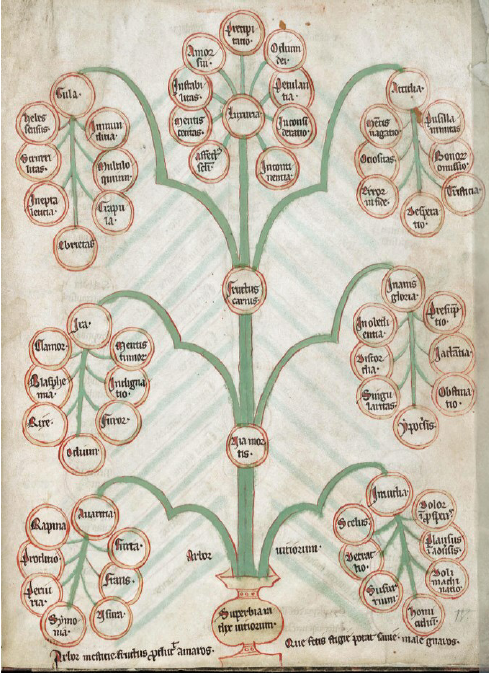
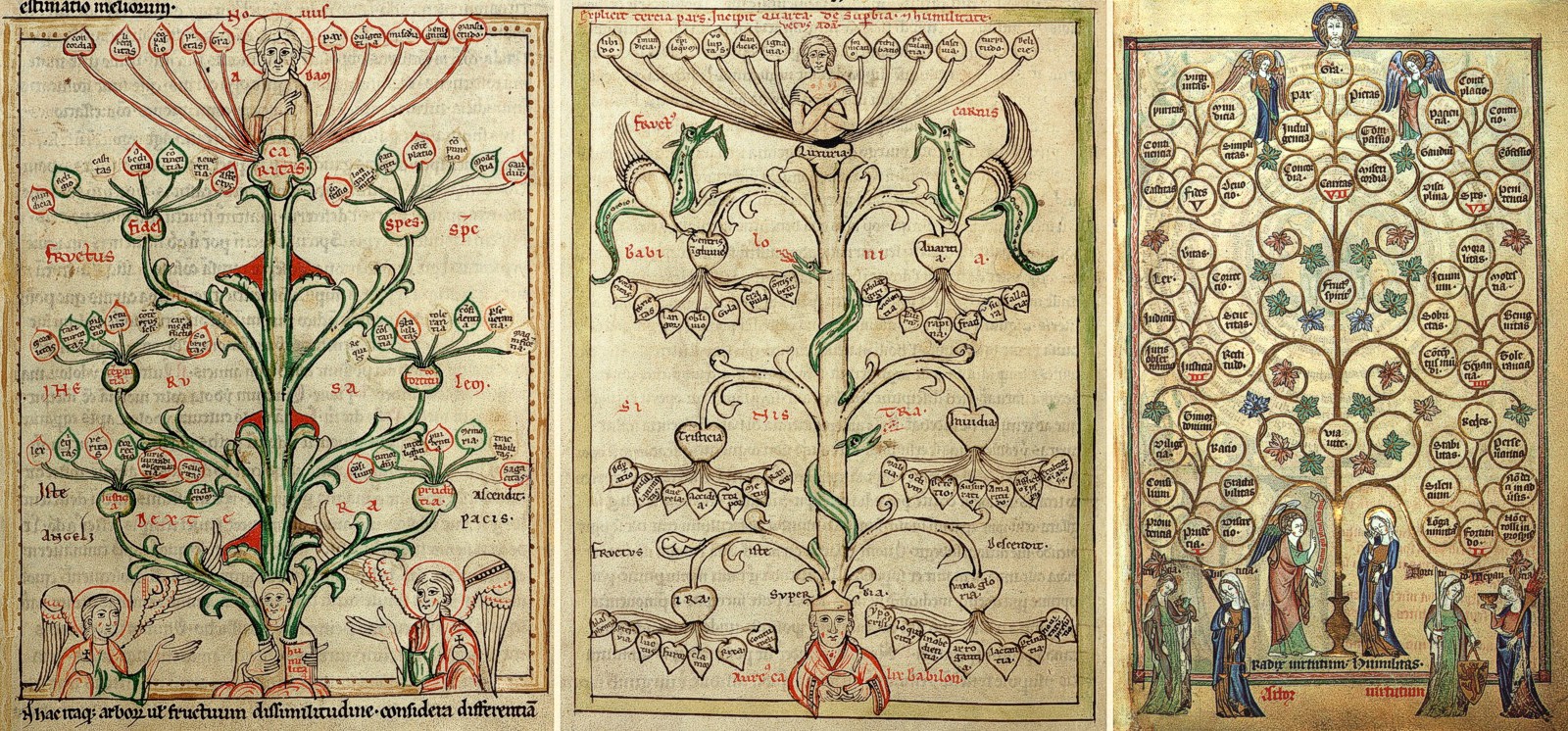
The new logic could be seen everywhere
even in prayer-books
which featured graphs and trees of hierarchical vices or virtues.
You seen these.
All of growing up in Catholic culture of the fifties can
remember those trees and diagrams of vices with all their subcategories.
Like the computing revolution of our time,
the advent of the Organon was epoch-making.
Before Aristotle,
intellectual discourse proceeded on more or less a stream of consciousness basis
with one thought giving rise to the next
organized under general subject headings.
But once the Instrument appeared,
examination and inquiry
became surgical:
topics and subtopics
were broken out.
The subject was laid out on the operating table,
and all was
atomized,
with
individual particles pinned down and then arranged in oppositions and hierarchies.
Now at last (it was thought),
we are able to see the truth.
We can imagine with what haste this technology was applied to theology
producing monstrosities which continue to bedevil us.
A prime example
was the eleventh-century theory
proposed by the monk Anselm
(Father of Scholasticism),
that Jesus
died on the Cross in order to placate the
imagined wrath of God the Father.
You know,
you devise technologies that tend to flatten the information
so it can be processed in this new way,
and
you are led
(with your blinders on)
to outlandish conclusions ....
outlandish because they proportion.
The idea
that God the Father should demand His Son's blood
is too grotesque even to think about.
But this new technology could not be resisted,
for it was deemed to demonstrate truth itself,
a Divine "truth machine."
The Organon was a colossus
steamrolling
all things to conform to its technological requirements.
Under its system
coequal with life was its opposite death
(though in reality death is no more than a material illusion).
Coequal with God was God's opposite the devil
(though in reality to God the devil is no more than a bothersome fly).
Coequal with good was its opposite evil
(though in reality God created good
while evil has no entis or being of its own
but is a perversion of God's creation of good).
And vice?
That became a whole industry of atomization and dissection
with graphs and charts and trees appearing everywhere.
Do you see?
God and God's things were eclipsed by the appearance of new thought-world
which grew and grew and grew
as its development everywhere was prized as the most important thing.
Now,
I don't mean to demean Aristotle in the least.
Our attainments in terms empiricism, science, modern law ..... indeed, our material civilization
in large degree proceeded from the Organon.
An argument could be made that Aristotle, through the Organon,
was a Father of Computer Science.
Certainly,
George Boole (who is called a Father of Computer Science)
thought so.
The great wrong here is the domains to which the Organon was applied.
My focus, here, of course, is on spiritual things.
Into this nascent world
Gregory Palamas would be born and educated.
We remember him chiefly for his Triads composed to combat
the Aristotelian Barlaam,
a Scholastic theologian and philosopher.
I believe Gregory's title Triads laid a challenge down to Barlaam
whose Scholasticism was founded on a binary system of opposites.
In fact, the form of Gregory's works
—
three sets of threes
—
both honored the Holy Trinity
while it declared war
on Scholasticism .... as if God could ever be subject to bifurcation,
as if God's mind could be atomized and categorized by the Organon.
It should have been clear from the beginning that this
new instrument was leading them into infernal regions.
The individual subjects to which Gregory addressed himself
—
Uncreated Light,
Hesychasm,
and
the more general category of
Divine essences (ousia)
and
Divine energies (energeiai)
—
are
all
artifacts of the larger project,
which was to stop Scholasticism in its tracks,
which he did .... at least for the Eastern Church.
Indeed,
the Organon, in general, was misapplied to the spiritual world.
And when that impoverished lifeworld (in the West) had crawled across a desert
(have you ever been told that Scholasticism was dry?!) ....
crawled across a desert,
fed only Aristotelian logic and Thomistic metaphysics for a thousand years,
when it came to other side,
it
asked for the water,
the living water,
of the
Greek Fathers.
In 1938
the Jesuit monk Henri de Lubac
sought to provide that water
and
free the Roman Church
from
the death-grip of Aristotle and Thomas Aquinas,
with his
landmark work Catholicism.
His readership bought the book enthusiastically.
Based on its title,
they
expected a masterful treatment of Thomistic metaphysics.
But when they opened the book,
they realized they had bought an anthology, a reader in the Greek Fathers.
He would follow this in 1950 with a reader on
that most influential Greek Father, Origen.
Under the influence of de Lubac and his fellows,
called the Communio school of theology,
John XXIII was persuaded to convoke a General Council,
called Vatican II,
which might liberate the Church from
the chains of Scholastic metaphysics.
The battle cries of Vatican II
would be
"Ad fontes!" ("Back to the pure springs!")
and
"Ressourcement!" ("Back to the sources!")
and
"Aggiournamento!"
("To the day!"
meaning
"Let us throw open the windows and let in God's light
and
Heaven's air to disperse the suffocating vapors of Scholasticism).
The only hope the Church has, these partisans felt, was to scrap it all and
start again with the
Greek Fathers.
But a devilish calamity intervened:
John XXIII succumbed from complications of cancer.
It is widely reported that his last words were "Stop the Council!"
because he saw that liberal forces within the Church were attempting to hijack
its purposes.
Seeing that their
once-in-many-centuries opportunity
laying right before them,
liberals seized the moment to turn
liberation in the cause of God
to
liberalizing the Church for their own purposes.
A few years after the catastrophe,
a member of the Communio school,
Cardinal Jean Daniélou,
was asked what happened.
He said,
I think that there is now a very grave crisis of religious life [within the Roman Catholic Church],
and that one should not speak of renewal, but rather of decadence. .... The essential source of this
crisis is a false interpretation of Vatican II. .... A false conception of freedom .... the absence of a
discipline of freedom. The restoration of firm rules is one of the necessities of religious life.
(Card. Jean Daniélou, Interview, 1972)
|
What he saw was immoral chaos .... but that is draw the curtains
of charity upon this sordid scene.
We have lived to the see tragic aftermath of this hijacking.
But we did not see it in the Eastern Church.
And this in no small part was due to the hero
we honor today,
St. Gregory Palamas.
For the past eight hundred years, Orthodox Christians
have been free of the monster of Thomistic metaphysics.
They have prayed with the good hope of experiencing God's energies directly.
And they have fared forward in their journey of theosis
knowing that they too in the end might be bathed in the light
which certain Apostles saw
on the summit of the Mount of Transfiguration.
"I know My sheep, and My sheep know me.
As the Father knows Me, even so I know the Father."
|
In the Name of the Father and of the Son and of the Holy Spirit.