John 21:1-4 (Matins)
1 Corinthian 10:1-4
Mark 1:9-11
The Gate of Life
.... Jesus came from Nazareth of Galilee, and was baptized by John in the Jordan.
And immediately, coming up from the water, He saw the Heavens parting ....
(Mk 1:10-11)
In the Name of the Father and of the Son and of the Holy Ghost. Amen.
Orthodoxy is the antidote to pop Christianity.
It is the faithful Christianity in that it hews to the early and unchanged faith.
Orthodox Christians
read and re-read the Holy Gospels,
study the documents treated as Scripture by the early Church,
and
cling always to the Church Fathers.
But as salutary as the faithful Fathers are,
lighting the path ahead,
they are not enough.
Most of them lived in the fourth century.

But in 40 A.D.
the whole Jewish lifeworld was destroyed and Jerusalem
buried beneath a rubble field of stone, concrete, and dust
sealing off most of our heritage.
And were as if God placed a holy seal upon
and
then melted the edges of the wax.
It is an astonishing fact that we are the generation
to see many basic revelations which the Fathers did not see.
Consider
that most of the documents they did not have
constitute the vast
majority of our Christian heritage.
It can only be a miracle of God
that nothing has been discovered surpasses
the transcendent splendor of the Four Gospels.
Nonetheless,
the Dead Sea Scrolls confront us with 15,000 fragments
pointing back to 850 works.
That is,
St. Athanasius and the other Fathers
who
formed the canon of Christian Scripture
did not have anything close to the complete picture.
By contras, the documents that they saw
and
which
came down to us are but a handful.
These, of course, are primary materials.
The associated scholarship
producing secondary materials
now has matured.
In 2008,
when Prof.
Yehezkel Kaufmann of the Hebrew University in Jerusalem made the following pronouncement
on the television program Nova,
my world shook:
|
"The [Babylonian] Exile is the watershed. With the Exile, the religion of Israel
comes to an end, and Judaism begins."
|
You see,
the impression I grew up with
had been that Judaism was an ancient, ancient religion
coming down us from the
mists of pre-history.
But then the Jews were deported to Babylon for two generation
and
then came back
and
then built the temple,
and
the life carried on as it had been.
But the historical truth is nothing life this.
The Judahites returned from Babylon now under Persian rule.
They returned under the supervision of the Persian governor Nehemiah
and
his "chief of propaganda" Ezra,
whose
primary language
was Babylonian (Aramaic).
We have learned that Judah-ism
was an invented religion,
invented in Babylon.
And we know that it was pleasing to the Persians.
We do not presently know what the Hebrew religion,
before the Exile,
looked like.
Judah-ism remained a cult confined to Jerusalem
for centuries,
and diverse Hebrew thought-world mostly ignored it.
It remained an isolated cult
until the Maccabees,
who used it as a weapon of war against the Romans
in their attempt to unite all Hebrew peoples.
This dates the emergence of Judah-ism across the Levant
to about a century or so before Jesus' birth!
A century or so?!
A century is nothing in the living memory of a culture.
I once paid pastoral housecalls
to a lady from Virginia
who reminisced fondly about her high school receiving the men
who had fought in the Civil War.
That is,
I participated in the living memory of scenes and feelings and beliefs
that were 130-years-old.
The Northern Kingdom had remained alienated from the Jerusalem cult
(albeit living under the yoke of temple police
with the Roman Legions standing just behind them).
And Jesus was reared in the northern part of the Northern Kingdom,
in Galilee.
This was no accident.
For His grandparents Joachim and Anna were ideological northerners
(as we discussed last week).
Yet, the Maccabees
had everywhere built synagogues
which served as
focal points of temple authority
and
headquarters for temple police.
Nonetheless, when we read the opening chapter of St. John's Gospel with our eyes
now opened,
we are able to detect
the animus felt by Jesus' disciples towards the Jews.
That is,
Jesus and His Disciples,
excepting the eponymously named Judas,
were certainly not Jewish.
What would the Church Fathers have done
had they been privy to these recent discoveries?
They would have devoted themselves night and day to the diligent study
of these new materials.
They would have reflected on the implications of this new learning.
And
they would have shared their thoughts to as wide a circle of readers as possible.
☦
Last week,
we considered key details from the first centuries.
As we approach the Feast of the Theophany tomorrow,
it is timely to say that
the early Christians first of all rejoiced in
the Lord's victory over death
and
gave thanks for
His leading His flock through dark waters
into the safe pastures of His Kingdom.
The type of this, of course, is the people Israel
being shepherded out of bondage,
guided through the Red Sea,
and
settled in green pastures.
(We encountered this allegory in our Epistle lesson this morning.)
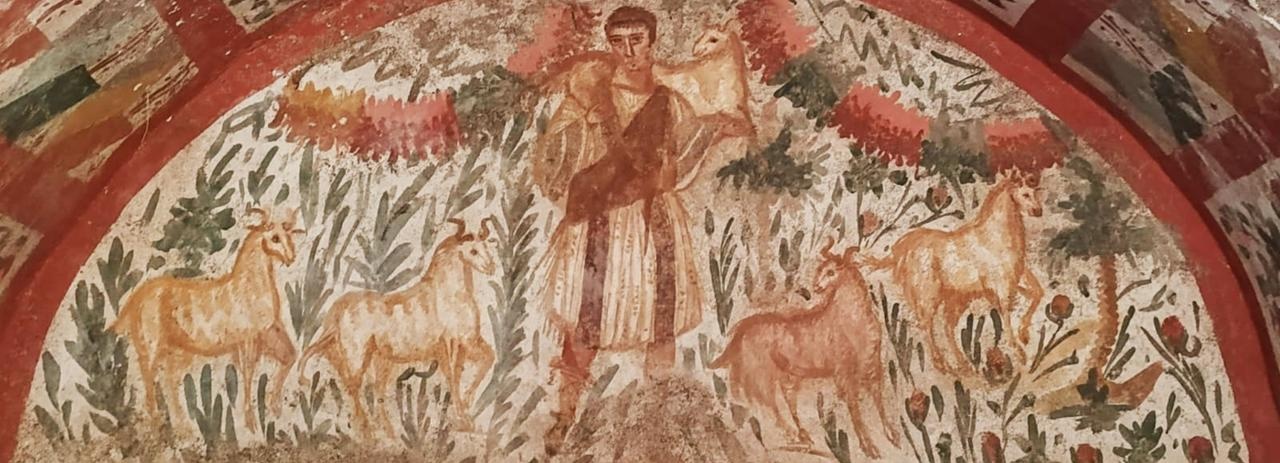
The symbolism that dominated early churches was
that having to do with Baptism and the Good Shepherd.
That is,
Christianity,
fundamentally,
means
being born into new life through the purification
and
transformation of Baptism
and
then proceeding on to life
among God's good flocks.
That is the Church's early vision.
That is what the Apostles taught.
What is noticeably absent
in these earliest worship spaces is the Holy Cross.
It would take six centuries for this devotion
to mainstream in the Church ....
the vigorous attempts of the Emperor Constantine and Empress Helena notwithstanding.
This focus on life-not-death dominated the thought of the Early Fathers.
Athanasius wrote in his landmark work,
De Incarnatione,
that the fact of the Creator touching the Creation with His
Own Person
produced a cosmic shock so great
that the télos
(the blueprint, the destiny)
of humankind was flipped from death to life.
Astonishing!
Here is our salvation!
The One more expansive than the universe
emptied Himself of His Glory
and
entered the horrible confines of our broken humanity
unalterably
transforming the entire Creation.
For His Life had entered the very composition of our lifeworld
being organically we to humankind.
He restored our lifeworld in its essence to the pristine
state of Eden.
To quote from Jesus' culture,
"One drop of wine in the sea interpenetrates every part of the sea."
Other Fathers developed this theme.
At no time did they write about atonement with God
attained through a blood sacrifice of His Son.
The idea would have seemed absurd and indecent to them.
As we went over last week,
Jesus and the Disciples did not celebrate the Passover of the Jews.
As far as we known,
they probably did not eat meat
(
as John the Baptist did not eat meat
).
If they followed any precedent at all,
it probably
would have been
the Passover of the Essenes,
who offered "the sacrifices of righteousness" (Ps 4:5).
Jesus does not teach a religion of blood sacrifice.
And the Apostles never teach it.
Indeed, Jesus, His Disciples, the Essenes, and the Hebrews who fled
Jerusalem
—
with the arrival Nehemiah, Ezra, and their blood cult
—
abhorred this practice.
Indeed, in the Parable of the Good Samaritan,
He
contrasts a religion of blood sacrifice to a religion of virtue
and
pointedly asks,
which one, do you suppose, was justified before God?
And Jesus
riotously protests in the temple,
actually beating those who sold sacrificial animals
for purposes of securing salvation.
There are numerous other examples in the Gospels,
and
I enjoin you to go out and read them.
When John the Baptist calls Jesus "the Lamb of God Who takes away the sin of the world"
(Jn 1:29),
the furthest thing from his mind is blood sacrifice
or
the Passover of the Jews which he avoided.
First of all his reference is patently pastoral.
We are to think of sheep and shepherds.
Now,
the shepherd represented the bottom rung of the social ladder.
But who were lower than shepherds?
Their sheep.
And who was least among the sheep?
The lowly lamb.
The lamb is both the image of lowest humility
as it is
the icon of innocence.
The spotless lamb.
That is,
the Baptist exhorts us to follow the Lamb,
for the Lamb will lead us to the Kingdom of God.
Jesus says you will not enter the Kingdom
unless you have the innocent heart of a child.
Then what shall we say about the Cross?
Let us take a step further into this question.
What shall we say about the Passion of the Christ?
His Passion began when He emptied Himself of His Divine Life,
whose dimensions are beyond our calculations,
and
entered the minuscule, foul-smelling, little box of our broken humanity.
That horrible confinement was brought to a climax
with unspeakable cruelty
—
spitting on Him,
stripping off all His clothing publicly to humiliate Him,
mercilessly beating Him,
torturing Him,
and
then finally murdering Him
in the most ignominious way possible.
Do you see that the Passion and Cross is an essence?
It is a distillation of the injuries and affronts
of the previous thirty-years,
beginning at His Nativity
in filthy feeding trough (a manger),
in a dark cave surrounded by the dung-stained hay of barnyard animals.
The fail to recognize God Who is before you is an affront.
And those closest to Him failed to venerate Him.
Do you recall the scene in Mark's Gospel
in which He says, "Someone has touched Me."
And the Disciples' reply is basically,
"You idiot!
Your're standing in a crowd,
and
You say someone touched You?!" ....
which insolence He passes over in silence.
I say,
He was executed in the
most ignominious way possible.
In the year 4 B.C.
—
the year of His birth
according to the Gospel accounts in which years are reckoned by the reigns of kings
—
the Roman General Publius Quinctilius Varus
pursued 2,000 Judean rebels from Jerusalem to Galilee.
And in a single afternoon,
he
crucified all of them along a roadside
stretch three miles
from the village of Nazareth.
As before each cross, as each man looked on,
his family was butchered at the foot of his cross.
The Cross then
is an instrument and image
that distills within it
all the depravity and hatred and ungodliness
of which man is capable.
This really happened,
of course.
But we see that the Cross is also a most toxic symbol.
It is an egregious
affront to Heaven.
Surely,
it expresses the sin of the world.
That is its primary significance.
That Jesus could forgive such an affront
—
For forgive them, Father ....
literally from God to God,
—
reveals the depth of the Divine Love for us.
That we had anything to do with this heinous crime
I will go into later.
Yet,
His Cross and Resurrection distill in one image,
many of the primary things we already knew
about Jesus.
To those closest to Him the Resurrection was no revelation.
They already knew
|
the gift of His Life as the most noble act in human history:
God emptying Himself, called kenósis, which St. Paul
felt was uppermost (Phil 2:7)
His self-sacrificing, self-denying love, which He taught as the highest virtue:
He Himself has nowhere to lay His head living a dying as a beggar
our failure to recognize Who He Was and Is
even putting that question to us
His suffering at our hands
in ignoring Him, insulting Him, and betraying Him
His victory over death,
raising the dead three times
and our betrayal of the One Who offered Himself as ransom
for all
|
These things were all known before His death.
His identity as God was known before His death.
As my Patristics professor said to me
(she visiting professor from Oxford to Yale),
"Jesus did not have to go to the Cross to save mankind.")
Well,
this shocked me.
I suppose it would take me ten years to come to terms with that.
I suppose it was harder for me to come to terms
with something else:
the fact that all this is still true today.
We know God to be God, and do nothing in response.
The Magi,
likely scholar-scientists from Persia who were universally respected,
venerated Him.
He evinced His Identity as Creator, creating new eyes from mud.
He evinced His Identity as Providence,
feeding the tens of thousands of people in the wilderness with a kind of manna .... twice.
He evinced His Identity as YHWH wresting order from primordial chaos,
commanding the winds and the waves.
He evinced His Identity as Law-giver,
pronouncing new laws from a mount as a kind of counter-Sinai.
He raised the dead three times.
That is,
long before the Crucifixion and Resurrection,
And He insisted on this point at Caesara-Philippi
by asking
His Disciples directly by
saying,
"Who do you say that I Am?"
Then what finally is the meaning of the Cross?
We might say that the climax of Gospels,
rendered in a kind slow motion,
now commanding the attention of all in every place
(as the Emmaus Road narrative attests),
so that everyone, everywhere,
including those who were too stubborn or too indifferent,
might know that this was God.
By the way,
this is a techique Jesus uses elsewhere.
When He wants to teach a great principle,
He first sets the stage,
and
uses rising dramatic action.
The greatest climax in the history of humanity is stage
to announce something that everyone would hear and know to be true:
this was God .... this is God.
You Sisters know that I wear a Crucifix around my neck.
I have done so for decades.
It is like a little vial containing an essence,
the essence of who we are.
But the Cross as a religious ritual?
A blood sacrifice?
The whole burnt offering of a lamb?
Jesus is never called a sacrifice in the Gospels.
And,
as we discussed last week,
Jesus' Passover was not the Passover of the Jews
and
did not include the slaughter of a lamb.
The main point,
in any discussion of the Cross or of blood sacrifice,
must be grounded in what Jesus calls Himself:
"a ransom for many"
(Mt 20:28, Mk 10:45),
which is a very different thing
(which unaccountably receives very little attention).
Before we begin a discussion of the ransom,
though,
I must adduce a principle
(saying the obvious):
God must meet us where we are
—
so lowly and so
far beneath him.
We love the verb stoop.
He must stoop down to us
because He knows us so intimately,
yet
He is transcendent God.
He must reach down at least through
our language, our culture, and our puny comprehension.
Indeed,
we cannot speak of anything in the world
or
of previous worlds since the Creation,
without owning a primary principle.
called
σηνκάταβασις
/
synkátabasis
—
literally
"with descent"
or more colloquially,
"condescension."
Our relationship to God is only made
possible through His condescension.
In a sense this one word captures both
the Creation and the renewed Creation
(i.e, the Incarnation)
and all of our intimations about God.
Our relationship with God is only made possible
through this condescension.
And He speaks into the hearts of all of His children
especially the lost and the blind.
Let us take the simple case of
God's willingness to speak into culture
and hear human ponderings
in the first century B.C. and the first century A.D.
What were the shared values of Jesus' culture?
What were its imperatives?
What was honored, and what was despised?
In general,
our understanding of
first-century culture in the Levant
is not helped much by reading the Hebrew Scriptures.
The Psalms and Major Prophets,
especially Isaiah,
were quoted.
Certainly,
Genesis and Exodus
were generally known,
but
Jesus provides counter-examples to the familiar scenes
in those two books.
As I mentioned,
He assumes the role of Creator, Order-bringer, and Providence.
Indeed,
in the Prologue to his Gospel,
the Beloved Disciple
writes a counter-narrative to the Creation found in Genesis.
This gives something away:
these books were not untouchable or worshipped.
They were freely re-written imaginatively.
The general culture, though, was dominated by Graeco-Roman
values, ideals, and sayings.
The Levant had been conquered by Alexander the Great in roughly 333 B.C.
and
would remain Hellenized until the mid-seventh-century A.D.
That's roughly one thousand years.
Everything happens in that shadow of the Classical culture.
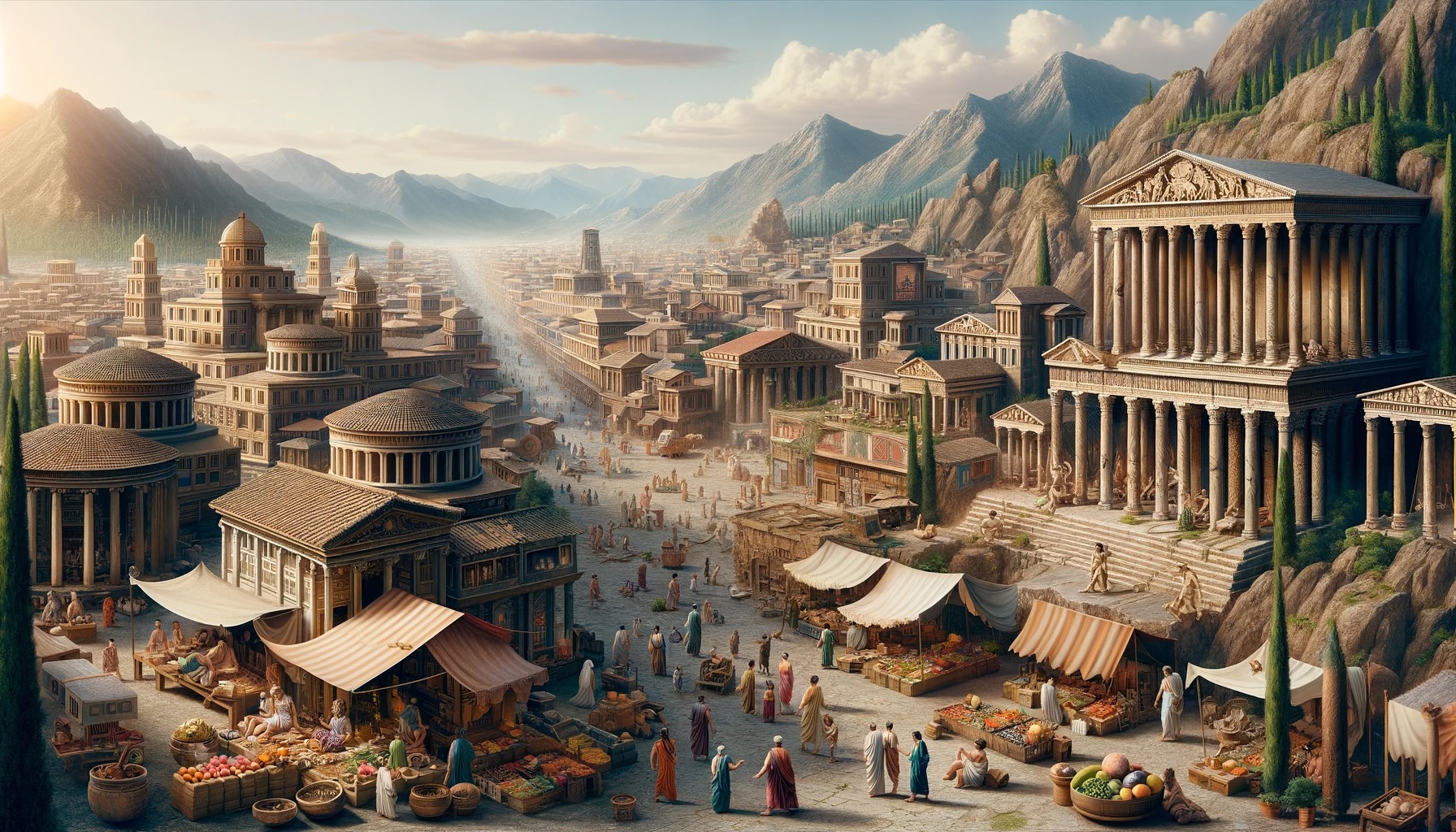
To visit the Holy Land today is to wander through the remains of Roman cities,
as the Decapolis evinces (shown here as artist's rendering).
But getting back to the first century A.D.,
the Romans were trained in Greek
and
upheld Greek values.
Judeans were also trained in the same curriculum
called
the
Paideia.
We imagine that Zacchaeus, Matthew-Levi, the wealthy young ruler, and the penitent Publican
all excelled in their youth at the gymnasiums.
Jesus and His Disciples spoke Greek
and
quoted Scripture from the Septuagint
as
Werner Jaeger pointed out a half-century ago
(Early Christianity and Greek Paideia, Cambridge, MA, 1961).
It is not clear that Jesus or His Disciples spoke Hebrew.
☦
We must try to rid overselves of images in Hollywood movies,
which often depict a shared and unbridgeable division between
the Romans and Jews.
This simply not true.
The Judeans by and large wanted their children to succeed.
And these young men attended the Greek academies
and
some of them were sent to Rome as part of their post-studies development.
This was a well-integrated society .... a thousand years .... can
you imagine.
A thousand years ago we would be living in an America
deeply formed in what we would call Indian ways and values
without the slightest hint of a European invasion centuries hence.
Foremost among these universally held values was the ideal of friendship,
which the Romans signified with the Latin word
amicitiā.
The Roman saw this as a spiritual category
touching the highest reaches of human conduct.
For example,
amicitiā
transcended the quotidian world.
It was understood to be higher than marriage
.... though marriage might aspire to attain these heights.
Jesus, too, saw
Friendship as being the highest attainment.
Is this not true?
I put it to you:
which ideal in the Gospels is more transcendent?
Gregory the Dialogist,
a sixth-century pope in Rome,
understood this when he enjoined all Christians
in his famous homily
entitled Be Friends of God!.
Consider the Divine dimensions of the Master's understanding
of Friendship.
I believe that these words and the ones following it
are most important words in the Gospels.
This is My commandment, that you love one another as I have loved you.
Greater love has no one than this, than to lay down one's life for his
friends. You are My friends if you do whatever I command you. No longer
do I call you servants, for a servant does not know what his master is
doing; but I have called you friends, for all things that I heard from
My Father I have made known to you. You did not choose Me, but I chose
you and appointed you that you should go and bear fruit, and that your
fruit should remain, that whatever you ask the Father in My name He may
give you. These things I command you, that you love one another.
(Jn 15:12-17)
|
We know, reading ahead two chapters, that
these bonds of Love in godly Friendship
will be expressed in terms of One-ness with the Son
as He is One with the Father,
what I call salvation:
.... that they all may be one, as You, Father, are in Me, and I in You;
that they also may be one in Us ....
(Jn 17:21)
|
You know, whenever I have celebrated the Holy Mass and later
when I have celebrated the Divine Liturgy,
I come to the place which is called "the Elevation,"
and looking at an icon of the Divine Supper,
I whisper a prayer,
"Ut unum sunt."
Because that is the point of the Mass, of the Liturgy, of our lives:
to become One with the Son and He and the Father are One.
Here is the highest good,
the farthest goal in the journey of life, which we call Theosis:
One-ness with the Holy Trinity in the same bonds in which they cohere.
You see,
we actually become part of the Holy Trinity.
Jesus the pioneer of our faith
has opened the Way
for us
because He is fully-man and fully-God,
and
He is a Person of the Trinity.
Therefore,
the Holy Trinity is open to relationship with
these precious creature,
which God loves so well,
called humans.
Roman amicitiā did not reach to such heights.
How could it have?
But it did express Friendship in terms of the highest good.
Cicero, one of the most widely read authors of Jesus' time,
used the Latin word
amicitiā
to express this transcendent state of life, which
.... can only exist between good men .... We mean then by the "good" those
whose actions and lives leave no question as to their honor, purity, equity,
and liberality; who are free from greed, lust, and violence; and who have
the courage of their convictions.
(De Amicitiā)
|
Are not these the same qualities St. Paul insisted upon
among Christians?
But the icon (we would say) that hovered over all
was
of "heavenly twins,"
Damon and Pythias
—
heavenly in the sense that they represented the highest good
and
twins in the sense that
Jesus and Thomas were twins,
that is,
"my other self."
The story of Damon in Pythias was among the best known of the ancient world.
No one went through the Paideia
without reading this story,
probably in Cicero's De Officiis
(On Moral Duty).
The two friends visited the city-state of Syracuse,
among the most powerful in ancient Greece
and
always an armed camp,
vigilant for enemy spies.
During their stay,
Pythias was accused of plotting against the
Tyrant Dionysius I and arrested.
He petitioned the Tyrant
that before his execution
he might travel home
to ensure his affairs were in order
and
his family provided for.
When the Tyrant laughed,
asking Pythias if he thought him such a fool,
Pythias' friend Damon spoke up.
I will stand in as Pythias' ransom
if you would
release his friend.
And,
Pythias,
said Damon,
would assuredly return and make good on the ransom.
The Tyrant agreed to this arrangement
marveling at what he considered to be
Damon's spectacular naïveté.
And then the day came.
Damon was taken to a place of execution.
Yet,
Pythias was nowhere to be seen.
Dionysius wryly commented on Damon's foolishness.
But at the last minute, a young man could be seen on the horizon
running towards them.
It was Pythias.
So amazed
and deeply moved
was Dionysius,
that he released them both and entreated them
if he might be a third having a part in so lofty and noble a friendship.
When Jesus used the term friends in chapter fifteen
of St. John's Gospel,
everyone present understood what He meant through the prism of Damon and Pythias,
for this was the universal icon
depicting lofty friendship.
And
when He said,
|
Greater love has no one than this, than to lay down one's life for his friends.
(Jn 15:24)
|
no one failed to quake before the holy story of the heavenly twins.
For here was the highest state of the virtuous soul.
Did I say "holy"?
St. Ambrose, an Early Church Father,
authorized the Damon and Pythias story
(found Cicero's De Officiis)
as reading for Christians.
Ransoms rarely die.
Slaves or soldiers or other disposable persons are never offered as ransom.
They have no value.
A ransom value lies in the prestige or greatness of the person being held.
The Latin word Cicero uses
for "ransom" is vas.
We know what a vase is
—
something precious
or
which contains something precious.
As the guard at Syracuse had descended on Pythias,
so the temple police descended on the disciples.
Significantly, on this night Jesus addresses Judas
as "Friend,"
a term rarely used in Matthew's Gospel.
The disciples begin to fight with swords,
so Jesus stands forward as the ransom.
He identifies His high value by telling the temple police that
He could call upon
"twelve legions of angels"
if He so desired.
The Gospel of St. John sets out
the ransom relationship explicitly
—
a "them in exchange for Me"
—
and
the reason for His ransom is clearly stated:
Jesus answered, "I have told you that I am He. Therefore, if you seek Me,
let these go their way," that the saying might be fulfilled which He spoke,
"Of those whom You gave Me I have lost none."
(Jn 18:8-9)
|
You see,
His Disciples have been entrusted to Him.
He cannot lose one.
And immediately we think of the Parable of the Lost Lamb:
"And when he comes home, he calls together his friends and neighbors,
saying to them, 'Rejoice with me, for I have found my sheep which was lost!'"
(Lu 15:6)
|
Perhaps no depiction of Jesus spoke more powerfully to the earliest
Church
than this one.
As we considered last week,
of the four third-century ecclesia
that have survived,
two contained no images or artifacts of any kind.
Yet,
two did
—
one in Rome and one in Nicaea,
and both preserved
depictions of the Good Shepherd
with the lost lamb carried upon His shoulders.
Jesus is taken as hostage.
The scene is set.
He is the Damon who stands in for His Disciples
(meaning by extension for you and for me
and
all lost lambs).
And now the suspense begins.
Will Pythias return in time?
All eyes
(at least in the first centuries)
are fastened upon that horizon.
As each horrific hour of Christ's Passion unfolds,
early readers ached for the Ransom's release.
But who will save Him?
He
had fed tens of thousands of people
who witnessed a Divine miracle in the wilderness.
Will they take up arms and come?
People had gathered by the thousands to feel His healing touch.
Do we see a crowd on the horizon with clubs and torches?
Who will now speak up for Him?
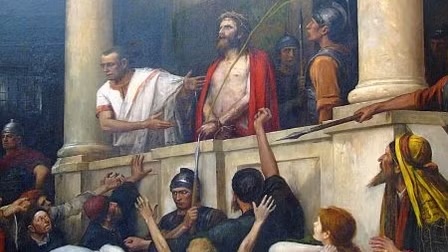
Pilate approached the crowds not once but three times
exhorting that if only one would simply raise his voice,
the Ransom would be released:
|
Again Pilate addressed them, still wishing to release Jesus, but they continued
their shouting, "Crucify him! Crucify him!" Pilate addressed them a third time,
"What evil has this man done? I found him guilty of no capital crime. Therefore
I shall .... release him." With loud shouts, however, they persisted in calling
for his crucifixion, and their voices prevailed.
(Lu 23:22-23)
|
He stood forward as a Damon.
But on that horizon no Pythias was to be seen.
Thirty-years of
our indifference towards God,
our rejection of God,
and our hatred for God
distilled into three hours.
His Divinity was revealed in three days to those who willfully ignored Him for three years.
We could have saved our ransom (Mt 20:28) by offering one word (Lu 23:22).
Instead, we offered two: "Crucify! Crucify!"
Here is the noble Damon, for whom no one would lift a finger,
standing not before the dangerous and forbidding Tyrant Dionysius I,
but before Rome's pleading governor,
the sympathetic Pilate,
who repeatedly begged anyone to say something ....
while Jesus Disciples remained in hiding.
Here is the meaning of the Cross.
The Cross signifies our cruelty, our indifference, and our fickle nature.
It is not God's Cross.
It is ours:
a Cross-roads
at which we must choose one way or the other.
☦
Much later,
during the missionary journeys of St. Paul
(Acts 28:11-12),
Luke stands in a harbor at Syracuse,
the scene of Damon and Pythias' drama.
He calls our attention
to the prow of a ship
adorned with the
Διοσκούροις
/
Dioskoúrois,
which is often translated,
the "Heavenly Twins"
or
the "Twin Brothers"
or
simply left untranslated.
Now, the ship's adornment would likely be a depiction of
the mythical demigods, Castor and Pollux,
who were believed to rescue sailors.
But this would be the literal level of meaning,
the cultural level..
The spiritual meaning comes into view when we ask,
Why would Luke divert our attention over here?
And why would he set the reference in Syracuse?
But the icon writer and Evangelist
saw a deeper meaning.
Who proclaims through these words
the following message:
the Heavenly Twins mark the banner under which we sail, and our motto is,
"Greater love has no one than this, than to lay down one's life for his friends."
|
You see, God had prepared the whole world to hear this message
which would be spread throughout all lands
by St. Luke, by St. Paul, and all the other Apostles:
Greater love hath no one ....
This is Christianity.
This is the faith of the Fathers.
And this was the faith during first six centuries for all Christians.
Now I understand that we have been reared and cajoled and even
moved to tears by another and different grisly theology,
especially in the last five hundred years.
It is seen everywhere.
We cannot do anything about it, but grieve.
But we must awaken up to the Lord of Life.
The cannot reinvent His faith.
We must claim it as it was taught for the first half a millennium (at least)
and
continues to be taught throughout Holy Orthodoxy today.
We must wake up to our holy responsibilities
—
for we are invited into spiritual warfare,
not passivity, looking for God to offer every sacrifice for us.
That is not Friendship with God .... or if it is,
this is a friendship that is all one-way,
always taking, but never giving.
But
if we should drift into this moribund mind and soul
in the face of all evidence to the contrary
—
that the Lamb must be sacrificed, so we can get our salvation;
the Lamb must be offered up, so we can bathe in His blood
—
then
it is difficult to see
how we are any
different
from those who cried out those two words
spoken in the darkest moment of human history,
In the Name of the Father and of the Son and of the Holy Ghost.