John 20:19-31 (Matins)
Galatian 1:11-19
Matthew 2:11-23
To read a Holy Gospel illuminates the soul. The mind marvels at such terse richness. What human could have chiseled these hard, jewel-like sentences? Their dignity shares the quiet of the angels. Who could have done this? The Orthodox Church holds that they are inspired by the Holy Spirit. Every Orthodox Christian is obliged to draw to them in reverence.
St. Paul took Scriptures to mean "the Law and the Prophets," which he termed "the oracles of God" (Rom 3:2). And this introduces a problem, for the Hebrew Scriptures were revised over and over again especially in Babylon during the sixth-century Exile.
We also must countenance a certain messiness in the New Testament, for almost all Christians read the New Testament in translation (though they know that translators have an axe to grind .... gentle reader, you are not among friends). We find one well-known crux in the sacrosanct Gospel According to St. John. Nearly, all English versions deliberately mistranslate the Risen Christ's examination of Simon-bar-Jonah (Jn 21), the choice of address emphasizing that he was (Mk 14:72), and would be (Acts of St. Peter, XXXV), the one who ran .... son of Jonah. Jesus three times asks him, "Do you love Me?" (using the verb form of agápe, the highest form of love, which would call "true love." And three times the translator has Peter reply, "Yes, you know that I love You" though the Greek text shows that Peter uses the verb form of phília. To get a feel for this difference, we might say that a beloved ventures that riskiest question, "Do you love me?" only to hear, with crashing disappointment, "Well, I like you as a friend." Peter limits is the duty of love as would his trade, which alone explains the Master's words when the examination is ended: "Then feed my sheep!" (or we would say, "Do your job!") adding a coda: "When you were young, you went wherever you wanted, but when you grow old, you will taken to a place where you do not want to go" (Jn 21:16).
As I say, "Messy." We long for the very Words which Jesus spoke (even the very words which the Evangelists wrote), but they remain forever out of our reach. Yet, God vouchsafes to speak to us through our messiness .... as He did at His birth. Did He not leave the perfection of the Virgin's womb to be placed a wooden feeding trough, in a cave with the dung-stained hay of barnyard animals. He manages our messiness and still approaches us in all His pristine Divinity. This is the essence of the God-man.
But even accepting the problem of translation, we must face still another layer: there is nothing called the "plain meaning" of a text (which we might call the "literal level"). For well-educated, deeply converted, and pious readers, who love God with all their heart and mind, cannot agree on what the "plaining meaning" of the passages in the Bible mean. It's not their fault, for humans and language were made this way.
Thank Heavens, we also have the spiritual level of interpretation, which saves us from all. For here the Holy Spirit meets the earnest and well-prepared student where he or she is. Here finally is the rarefied air where we can discern the direction of God's intended meanings.
Pardon me. I have taken the time to go over this because without this understanding how to approach the Bible, we shall never advance. We will be in a nighttime upon which the sun never rises.
In the Gospels there are always two views — the practical view and the Divine. For example, in the Book of Acts (which is volume two of the Gospel According to St. Luke), we see at least two perspectives portrayed: the world seen through the eyes of Saul of Tarsus and the illuminated world seen through those same eyes but opened by God. We call this second perspective "St. Paul's world." But the former view, which we might call Saul's lens, was focused according to the the Persian hybrid religion, Judah-ism. There is the brilliant world that St. Paul sees and the shadowy world seen by Saul of Tarsus. And St. Luke records the moment went Saul crosses the threshold into light: the Kingdom of God:
|
Immediately there fell from his eyes something like scales,
and he received his sight at once; and he arose and was baptized. (Acts 9:18) |
The Gospels are dominated by this two-fold perspective because the Gospels form the holy record of the Father sending His Son to gather the lost and the blind. He sends His Son into darkness of Judah-ism so that the scales might fall from their eyes so that they can see the Kingdom of Heaven. We cannot overemphasize this: the proximate reason for the Incarnation is this lostness and this blindness (Mt 10:6).
In general, God sought (and seeks) to open the eyes of all who have been made in His Image: Jew and Greek, women and men, shepherds and princes. Yet, even today we still find ourselves, especially in the West, mired in the same struggle personified by Saul-Paul: caught between the mentality of the Zion temple, on the one hand, and the marvelous light we call the Kingdom of Heaven, on the other.
Small wonder, those who were illuminated, like St. Stephen or like St. Paul, agreed that this illuminated world should be called The Way. And they called their Shepherd-Savior "the Way, the Truth, and the Life" (Jn 14:6). For this was no mere religion. This was a living, breathing, and holy lifeworld. To put a fine point on it, we call this illuminated world reality, for all else is an illusion (a toxic illusion). This is no hobby or play-thing or something we do on Sundays. Not a few golde moments when the filthy filters of worldly life are removed, but Heaven on earth. When we get home form church, Heaven on earth. We we go for walk down the sidewalks of our neighorhoods, Heaven on earth. Yes, the dirty, gritty lens calibrated to the world are still there, but we stop looking through them and see a world flooded by the God's light.
But let us return to the Shepherd-Son. By the way, since He is least of all (Mk 9:35), never lording his authority over the sheep (Mt 20:25), He appears as least among the flock. He is "the Lamb of God" (Jn 1:29).
Coming to earth, the Shepherd finds His flock in deplorable condition. They are led by murderous men who train and form their disciples in their dark practices and witchcraft (as it were). Saul of Tarsus was such a one as this:
|
"I am indeed a Jew, born in Tarsus of Cilicia, but brought up in this city
at the feet of Gamaliel, taught according to the strictness of our fathers' law, and was zealous toward God as you all are today." (Acts 22:3) |
He was representative of the problem faced by God. You see, the background story is this. The Neo-Assyrians had mostly converted the tribes of the Northern Kingdom and had herded them into a pagan darkness. For centuries the Northern Kingdom had been larger, fairer, wealthier, and more splendid than the Southern Kingdom. It was by far more populous, being composed of the Ten Tribes. Those who escaped deportation, the Judahites called collectively "Samaritans," which was the name of the region where their capital city, Shechem, was built.
With assimilation of these flocks into paganism, only the Tribe of Judah (and its younger "brother" Benjamin) remained. And now the Babylonian-cum-Persians also plunged the Southern Kingdom into that same, cruel darkness. Albeit, only one-third of the population was deported. They took only the leaders realizing that when the leaders were re-programmed, they would later control everyone else. Those who remained behind were left with their thought-world intact, and they continued in the way of the Patriarchs.
Yet, the remnant in the North, so far from Jerusalem, was the lifeworld in which Jesus would be reared. Indeed, He would live in the far-northern outpost of Nazareth, to which His grandmother had retreated. St. Anna was among three daughters born to the priest Matthan (Mt 1:15) and the youngest. The first two daughters, Mary and Zoia, would be wed in Bethlehem. But Anna would marry Joachim in Nazareth — not a Jewish, but a Hebrew stronghold.
This undestanding of Nazareth as a fortress safeguarding the old ways (figuratively speaking) is well attested. The Greek form of the Hebrew netzer means "shoot" or "sprout" (Isa 53:2), understood to be the place where the long-awaited branch from the stump of Jesse would appear (Isa 11:1). Moreover, the hill behind the village, affording broad prospects of the surrounding terrain, was seen as a watchtower, derived from the Hebrew root n-tz-r, denoting the village and hill as the one who guards or watches. Clearly, then, Nazareth was seen as the antipodes of Jerusalem, the hated place where the cult of Babylon continued to be practiced. Still, Nazareth is a most humble place, not mentioned once in the Old Testament — a place held to be of an account (Jn 1:25), "despised and rejected by men" (Isa 53:3).
Jesus' first exposures to this heart of darkness, no doubt, revealed heartbreaking scenes:
blindness
and
divorcement from God everywhere He looked.
The epicenter of this lost world was a temple built by pagans
on Mt. Zion.
Here, a house of death received
an endless procession of animals to be slaughtered.
He found the people there were chained to this cult
by compulsion of the temple police.
We have no doubt that this religion of blood
formed the mentality
of Saul of Tarsus:
|
Then Saul, still breathing threats and murder against the disciples of the Lord,
went to the high priest and asked letters from him .... that if he found any who were of the Way, whether men or women, he might bring them bound to Jerusalem. (Act 9:1-2) |
His baleful and blood-soaked mind reflected the stench-filled and shadowy corridors of the inner sanctums of the temple itself.
How quickly does meat or blood go bad? You can imagine what these warm, dark corridors of porous stone smelled like. They smelled like death. This was a vision of Hell.
Then, suddenly, the roof was torn off, so to speak. And Divine Light flooded in. And Saul fell into the hands of the Living God:
|
As he journeyed he came near Damascus, and suddenly a light shone around him
from Heaven. Then he fell to the ground, and heard a voice saying to him, "Saul, Saul, why are you persecuting Me?" (Acts 9:3-4) |
Notice Jesus does not say, "Why are you persecuting my Church?" From the time the Risen Christ had breathed on His Disciples endowing them with the sacraments and the Holy Spirit (Jn 20:22), a world appeared not seen since pristine Eden, where nothing might separate man from God. You see, Jesus is the Way, and His followers are the Ways, a seamless unity. St. Peter described this new situation,
|
.... living stones, .... being built up [unto] a spiritual house,
a holy priesthood, to offer up spiritual sacrifices acceptable to God .... (1 Peter 2:5) |
He suggests that The Way is the new Temple. The Way offers sacrifices acceptable to God, no doubt calling to mind the climactic ending of Psalm 50/51 (with an encrustation of Ezra appended to it).
Their forerunners were manifestly the Essenes, who gathered at the Zion temple to set a prophetic face against the Jews by offering not blood, but rather "the sacrifices of righteousness" (Ps 4:5). As Jesus' contemporary Philo wrote, they protested the obscene acts carried out in the name of "God."
Did I say God? Actually, the Jews did not permit that name to be even breathed, but rather only Adonai and Elohim, which means "Lord." It is vitally important to understand that the Persians had reserved this name for their god, which they called bel, meaning "Lord" in their language. It is interesting that this is a cognate of baal. Was there anyone to distinguish what god you were talking about. Well, certainly it would been acceptable to the Persians if you only said "Lord."
The Hebrews who fled from this blood cult in Jerusalem settled in Elephantine and raised a Temple of their own boldly named "the House of YHWH." Lest we ever forget, the Persians designed and built the Zion temple not because they were nice people. A surviving stele informs us that the first duty of a Persian king was to see to it that their god be duly worshipped everywhere. And Persian soldiers pursued the Hebrews to the Elephantine commanding them upon pain of death to offer blood sacrifices.
By the time the Light of the World was born, the Judah-ism cult, which had mostly been confined to Judah, was promulgated throughout Israel via a program of synagogue-building under the Maccabees, just a century before Jesus' birth. We can detect the tensions present in the synagogue within the Gospels. No matter, Jerusalem and its cult continued to be alien to the Northerners. The antipathy felt by the Beloved Disciple towards the Jews (he uses the term 66 times in his Gospel and always with a sense of hostility) is well-attested in His Gospel. But let us consider only two passages:
|
Then the Jews took up stones again to stone Him.
(Jn 10:31)
Now the Passover of the Jews was at hand, and Jesus went to Jerusalem. (Jn 2:13) |
The Passover of the Jews stands out. If it had been John's Passover or Jesus' Passover, it would have simply been called "the Passover." "The Passover of the Essenes," to take one example, was celebrated not by offering a sacrificial lamb, but by offering clean hands and a clear conscience to God. The archaeological evidence indicates that the Essenes were vegetarians, as was John the Baptist, as was Jesus was. John the Baptist did not eat locusts! It is absurd to think that a Nazirite would eat insects! He ate a kind of manna of honey and wheat.
We who live in a pluralist, liberal democracy perhaps are not capable of imagining the life-controlling tensions between these two ways of seeing: Judah-ism with its death-grip upon the people and the temple-shattering, synagogue-shattering, and finally earth-shaking movement ordained by God. But in the twists and turns of history, God would resolve these tensions. He would destroy the Temple, and He would level the whole lifeworld of Judah, covering Jerusalem with a heavy layer of stone, concrete, dust, and other rubble.
But perhaps we can imagine an ordinary Jew living during this period. He paces. He wrings his hands. He's been married for many years, following the dictates of the cult of Judah-ism. He and his wife are now baptized and members of the Way. The man asks, "Where are the sacrifices to appease the LORD being offered? What is being done to atone for my sins?"
It preys on his mind, but after awhile his wife tires of of hearing it. "You and your your blood! Blood, blood, blood! What do I care about blood sacrifices? You heard the teachers. The Way is about life, not stinking death! Why, Jesus brushed off death as it were nothing! He raised people from dead three times! Who could doubt that death had any hold on Him!"
And for that reason, the early Church did not see the point of dwelling on the Cross. Death was a non-entity for people of The Way. And the Church would continue doing so, ignoring the Cross, for five centuries. Had not the angel said from Jesus' tomb, "Why seek ye the living among the dead!" (Lu 24:5). We hear the words of the poet: "And death shall have no dominion" (Dylan Thomas).
People who so fastened up Jesus' death .... are they not backsliders? Is this not an affront to Heaven?
I have been carrying out my Christian ministry for about thirty years now. I meet with many people who insist that they are sinners. They are so unworthy. No matter how mand times they confess and receive absolution, they feel dirty. I ask them, "Don't you believe the promises of Christ?! Don't you trust the Lord of Life Who loves you?! When you are doing your level best and saying your prayers, accept the fact that you are a citizen of Heaven."
Yet this uneasy man, inured to the cult of blood sacrifice, could not sleep at night. "Who's offering the goats and the bulls?" he wanted to know. And there were hundreds and thousands of uneasy men just like him.
My imaginary wife would have been in the mainstream, though, during the mid-first-century. Here is a précis offered in The Oxford History of Christian Worship (Wainwright and Westerfield, 2006):
| Both at Dura-Europos and in the catacombs, the visual jottings of seemingly disconnected scenes serve to answer the question: Who is our God? And, by visual analogies, they express the triumph over death, of which baptism is the beginning. Blessed be the faithful God who saved the Israelites through the waters of the sea, who saved Jonah from the belly of the whale, who saved Daniel and the three youths, who provided water in the desert! Blessed be the God who, like a shepherd, finds and rescues the lost, who heals the sick and feeds the hungry! Blessed be the God who raised Lazarus from the dead, and who lifts to eternal life all that go down into the tomb of baptism! Blessed be God who will do for us the great deeds he wrought for our ancestors! (818) |
Did I say Shepherd? Only last week I read about excavations in the ancient city of Nicaea (İznik, Turkey) and do you know what they turn up? a third-century church. Do you know how rare that is? There is the third-century Dura-Europos church-house in Syria. There is the Aqaba Church in Jordan. There is the Abu Mena Basilica in Alexandria. Now this church in Nicaea. Are there any others? (Please write me if you know.) In this recent discovery, no crosses were found in the church. But they did find a large wall painting of the Good Shepherd (shown right).
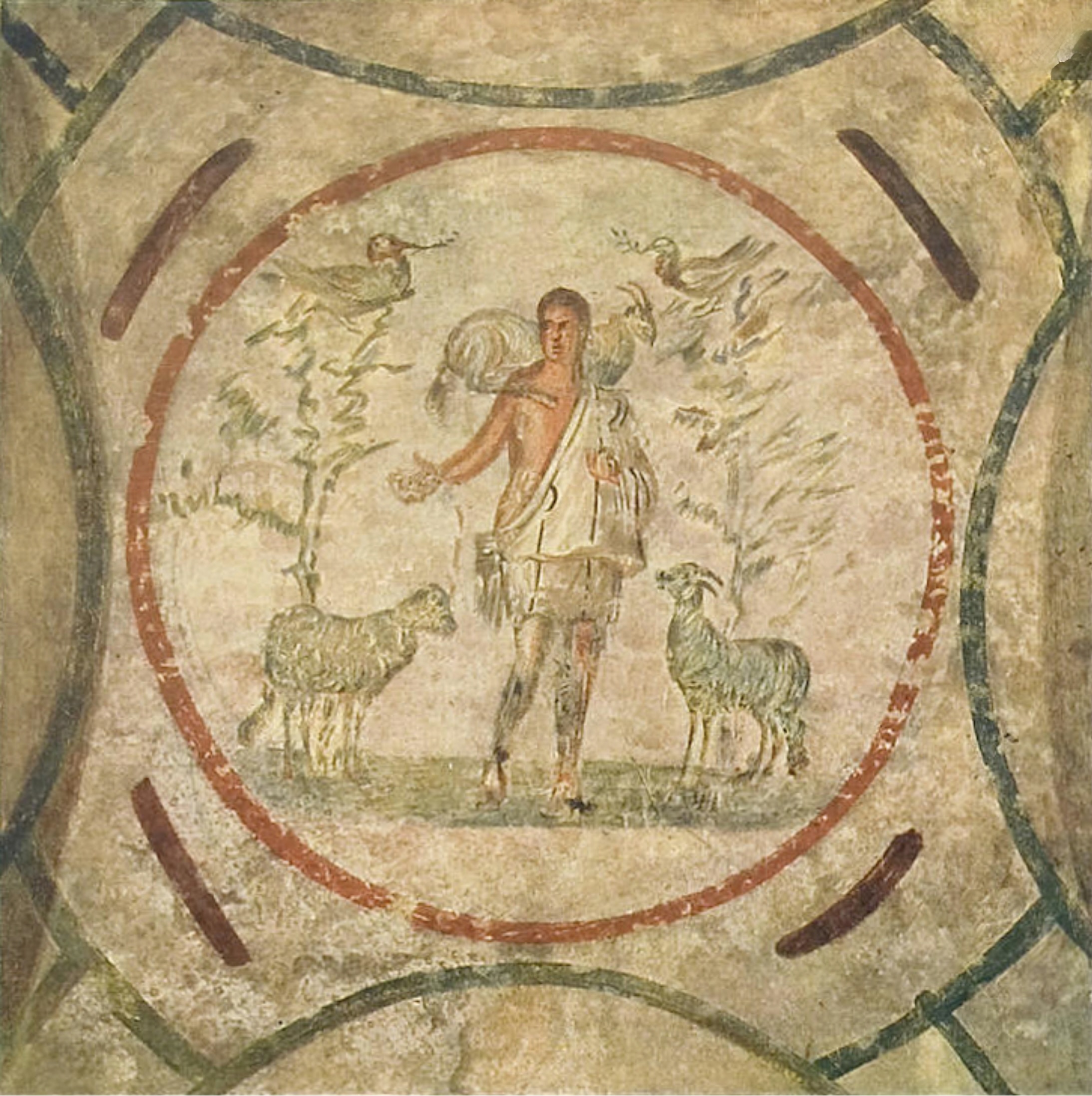
The earliest icon we have depicting the Crucifixion of the Lord
dates from the late eighth century,
one-third of the way to our century.
And the earliest image of the Crucifixion of any kind is a little decoration on an illuminated manuscript
dated from the late
sixth century.
You see, the Apostles, and through them the people, devoted themselves to the Lord of Life
from beginning.
They poured out their love
for the Shepherd
Who came down from Heaven to gather His lost sheep
(10:6).
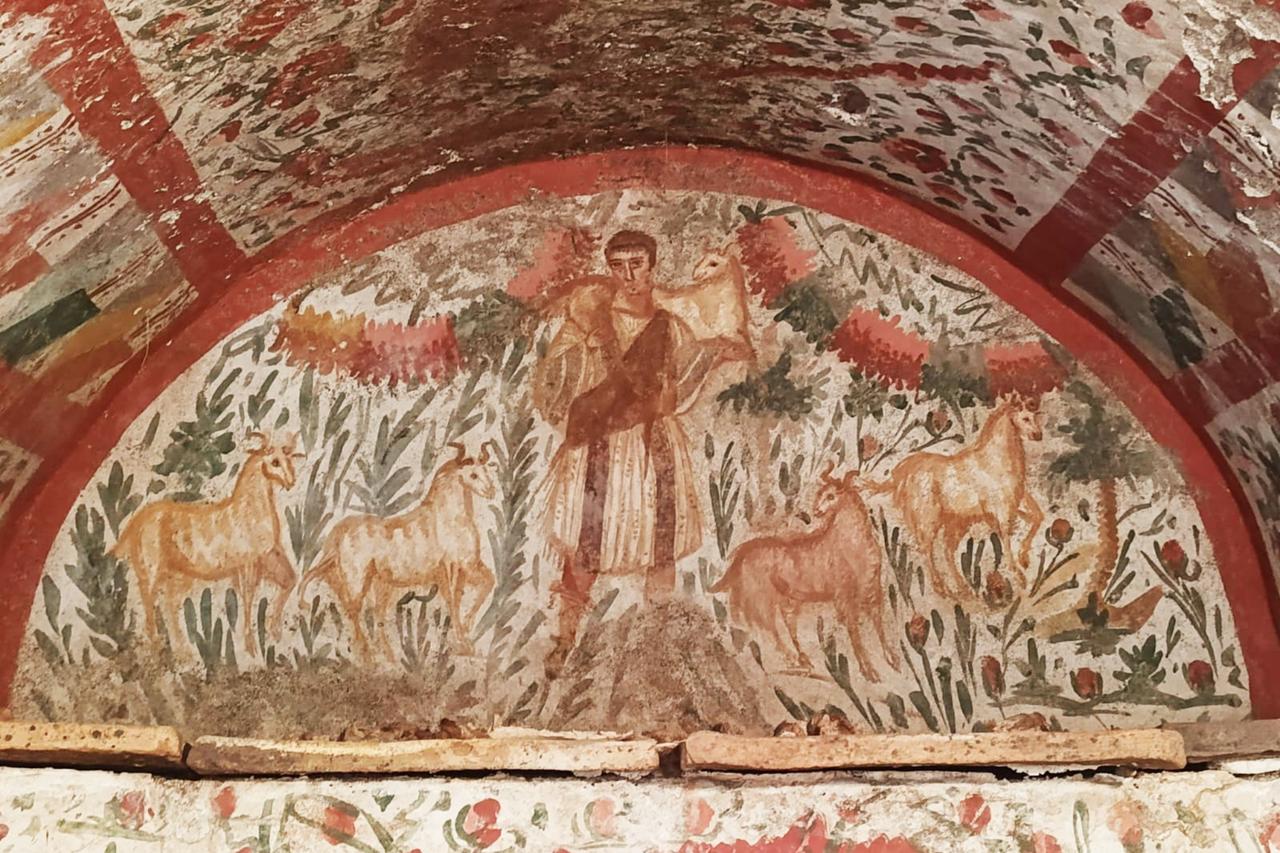
In the Catacomb of Priscilla, we also have this beautifully
preserved painting of the Good Shepherd,
circa 250
(shown at left).
We may be sure, Jesus never once taught a religion of blood sacrifice but in fact spoke against it in the Parable of the Good Samaritan, and riotously acted against it within the Zion temple itself, decrying any attempt to substitute animal blood for spiritual relationship with the Father.
Yes, He said of the bread "This is My Body" and of the wine "This is My Blood" because His central vision for us was unity — with Himself and with the Father (Jn 17:21) — an actual participation in Him Which is Their Divinity. We actually have a foretaste of when all shall be in all, when all shall be One with the Father and the Son and Holy Spirit. The Eucharist is a reality of that Unity. The earliest celebrations of the Eucharist were unity, or Agape, suppers. To imagine that He intended re-Crucifixion at the Holy Mass or "washed in the Blood of the Lamb" hymns being sung in Protestant churches would be monstrous.
Nonetheless, the uneasy Jewish men from the early Church would amass to themselves hundreds millions of men and women who would also be obsessed with blood sacrifice .... and still are in the Christian West.
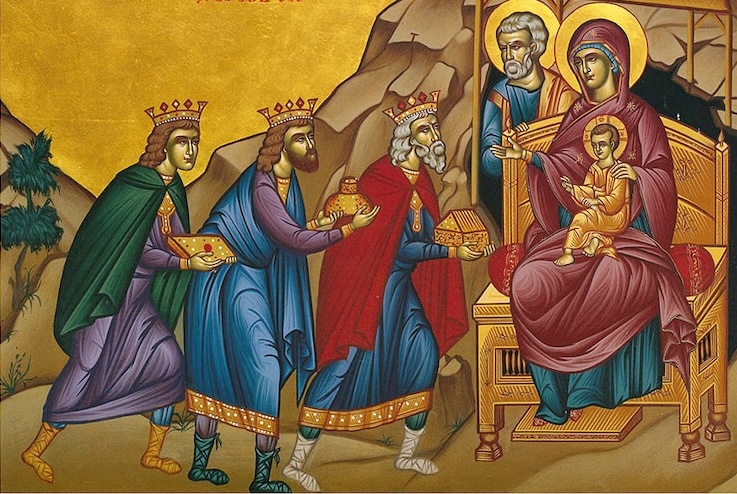
I will never forget gathering with my family at a luminous Midnight Mass at Christmas in a "Silent Night" state of soul and mind, and hearing the priest proclaim from the pulpit, "This was the Child Who was born to die!" His infallible proof for this was the gift of myrrh presented by the Magi. This myrrh, which he claimed would be used to prepare Jesus' body for burial, attested the reason for the Birth of Christ, he said. But on the face of it, to anyone educated in the field, this is far-fetched, even grotesque, something like snatching an infant from his cradle to prepare for a bloody child sacrifice. And beside his pulpit was right beside the creche!
But in fact, Father, the Jews did not use myrrh for burial preparations. The Egyptians did that. The Jews considered embalming or mummification to be mutilation of the body (as do Orthodox Christians today) and insisted on burial before sunset. And we continue to puzzle over Nicodemus' hundred pounds of "myrrh and aloes" (Jn 19:39). Do not the Gospels themselves attest this in the words of Martha of Bethany:
| "Lord, by this time he stinketh: for he hath been dead four days." (Jn 11:39) |
Myrrh was understood in the first century to signify healing or royal anointing. As Orthodox Christians believe today, myrrh streaming from certain holy icons or flowing from certain holy vessels announce the Divine Presence. It is ever fragrant of roses and the antidote to disease and death.
When the Mother of God visited our lowly hermitage (in Her aspect of a myrrh-flowing icon), we cried. We fell to our knees in devotion. For here was the Mother of God.
What shall we say of the Holy and Life-giving Cross? I have a large one worn upon my chest. I adore every image of the Holy Cross. But that subject — so deep and so broad — will have to wait until next week when we will make a start, after which I must enter a six-month sabbatical leave. For I am exhausted and must face fast-approaching County deadlines in the construction of the monastery. Withal, the Sisters and I are alone and will not succeed without the intervention of the our Loving and Caring Shepherd.
The Magi have laid down precious gifts before the Lord, our Savior and God. They have bowed deeply before Him in profound devotion. This was always their only thought and highest intention — to give their all in an act of love and then to reverence Him.
Let us also worship Him, fully understanding Who He Is, such that we can, and expecting nothing in return. For we are His people, and He is our God, Who said in His faultless teachings,
| I desire compassion and tears, not sacrifice. (Mt 9:13, Mt 12:7. Translation mine.) |