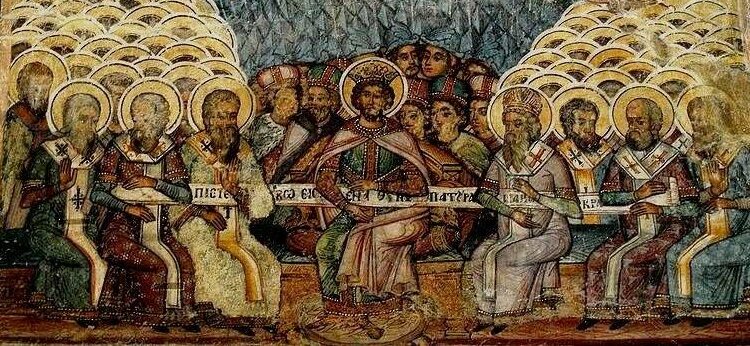
Today we remember the Fathers of the First Ecumenical Council, which is to say we celebrate the Self-revealing God and His indefatigable patience and His abiding love. For He calls the world to carry out His Divine Purposes, but His people are typically in chaos, are unfocused .... a better word would be "everywhere-else-focused" and, by that fact, are treacherous. A recent article recounting an audience with the Ecumenical Patriarch gives us a sample of this context:
| I approached the registration table .... .... and I pulled up a QR code .... I was then directed into a holding area .... [But] a parish council member told us that .... we were supposed to wait downstairs. I found out five minutes later that the parish council member was also mistaken. I was hardly shocked by the level of disorganization: "I don't belong to an organized religion — I'm Orthodox," as the joke goes. Orderliness and regimentation are Rome's fortes, not Constantinople's — and certainly not Greece's. I was further disappointed by the lack of reverence of the attendees, some of whom were texting, doomscrolling, and even talking loudly in the middle of the patriarch's homily. Yet I can't say this shocked me, either. Despite the embedded cultural piety of the Orthodox, we aren't quite the most reverent of people. 1 |
Yet, in the "orderly and regimented" West, I recall a conversation ten years ago with my Roman Catholic bishop who shared his recent retreat at a Trappist monastery. His director had told him,
| Bishop, I'm a mess. You're a mess. The Church is a mess. The whole world is a mess. And it has always been so. |
I reminded myself that chaos is the prima materia of the universe (which was also created by God). It was the stuff from which God had wrested order, and we know, even through the second law of thermodynamics, that chaos strives to reclaim the world. The world is constantly reverting back to chaos.
The seed of that chaos in the human person is not a physical principle. We may call it a psychological principle, called narcissism — the compulsion to gaze fawningly on our own image at the expense of considering others, much less God. Eleanor Roosevelt told a young woman, "You wouldn't worry so much about what others think of you if you realized how seldom they do." Do you know the lens through which most people view the world? It is called a mirror .... which lately has morphed into a smartphone, reflecting back only the world which exalts ourselves and our opinions. The other thing we do to exalt ourselves is to "take others down a peg."
These are eternal truths of the human person, or better said, the "tragic flaws," which Jesus sought to correct:
|
For whoever desires to save his life will lose it,
but whoever loses his life for My sake will find it. (Mt 16:25) |
The smartphone had not yet emerged during the third and fourth centuries, yet buzz phrases and trending opinions went viral on a world-wide scale, nonetheless. And the ancient world was not lacking for celebrities including "rock star" priests. Such a one was Arius. He had "movie-star good looks." He made feminine hearts swoon. And his self-confident manner won the support of men, who wished to be associated with them. For he possessed that greatest of world-winning gifts, the gift of trenchant speech. Why, he could distill theological complexities down to a "bumper sticker" message:
| HOMOOISIOS, NOT HOMOOUSIOS! / SIMILAR SUBSTANCE, NOT SAME SUBSTANCE! |
With swapping one letter, he had won a world. For majority of Christians on earth followed him in his beliefs. And one more thing: He had taken Jesus Christ down a peg. For Arius held that Jesus Christ was deemed to be something closer to us, not exalted as equal to the God and Father of all.
We know how this hair-raising tale ends, how the world, on the brink of apostasy, was saved by the God-bearing Fathers of the First Ecumenical Council — men who were unexciting, circumspect, not given to glib speech, and discerners of deep spiritual mysteries frequenting God's company in prayer. Yet, they saved the Church without the consent of the fickle world.
Now, those same principles and dynamics continue to be active in the human person today: the loud and overstimulated world held in tension with silence and the prayerful discernment of God. I say, silent and prayerful, for the Symbol of Faith they defined in 325, drawing on other creeds that had developed slowly over time, was not yet the Creed we say today. That Creed was officially promulgated by the Second Ecumenical Council convened in Constantinople in 381, which included teachings concerning the Holy Spirit:
|
|
The Fathers, fifty-six years, earlier simply had left a placeholder for Holy Spirit — "I believe in the Holy Spirit" .... to be elaborated on later. Did they lack a theology of the Holy Spirit? No, it was probably the case that they had too many theologies and that a refinement separating dross from true ore remained to be done.
An event central to the refining process occurred in the 370s with the elevation of St. Basil the Great as Bishop over the See of Caesarea. Upon entering his diocese he decreed that the following doxology be said at all worship services: "Glory be to the Father with the Son together with the Holy Spirit." An accusation of heresy instantly followed. His antagonists insisted that the correct form should be "Glory be to the Father through the Son in the Holy Spirit." This second form, suggesting a hierarchy of dignity and glory, from greatest (the Father) to least (the Holy Spirit), reflected Arius' teaching of subordination.
In reply St. Basil composed a landmark of Christian dogmatic theology: On the Holy Spirit (375). While he did not live to see it, this work laid the foundation stones for the Second Council's teaching on the Holy Spirit. Was St. Basil privy to some new information? No. Did the Holy Spirit steer him to a document hitherto unknown? No, that was not the case either.
But let us consider this question more generally. Could it possibly be that three centuries following the death of the Master, the Church still lacked a definition of Who He Was and still lacked a definition of the Holy Spirit, Whom He had given? Should this shake our faith? No, not in the least. For Holy Scripture is not a plainly written manual but rather a mystery. After all, St. Paul referred to the Scriptures as "oracles" (Rom 3:2). And St. Peter taught,
| If anyone speaks, let him speak as the oracles of God. If anyone ministers, let him do it as with the ability which God supplies .... (1 Peter 4:11) |
The Scriptures, and especially the Four Gospels, are incommensurably Divine. We must approach them reverently and cautiously removing our sandals for we stand on holy ground:
| For the Word of God is living and powerful, and sharper than any two-edged sword, piercing even to the division of soul and spirit, and of joints and marrow, and is a discerner of the thoughts and intents of the heart. (Heb 4:12) |
In opening the Word of God, we quake and tremble. For while we believe we are discerning It, we will discover inevitably that It is discerning us. We do not simply read the Scriptures seeking to extract information. We must encounter the Scriptures; we must enter in. And this reveals the nature of prayer. Prayer is the direct encounter of the soul with God. The soul is the master organ of one's being. According to God's purposes, the soul governs the calculating mind, governs the affections of the heart, and governs our animal passions (though an overthrow of this government in not unheard of). It is the soul which discerns Holy Scripture, and the conscience is the meeting place royal where we stand face-to-face with God.
A disquieting truth is that translations are not the Word of God; rather, they are commentaries on the Word of God. In self-defense Origen developed a technology called the Hexapla — an instrument placing six different translations in juxtaposition for each page of the Old Testament.
Moreover, the Holy Fathers agreed that the Scriptures could not be understood unless they were read on at least four levels: the spiritual (or allegorical), the historical (or literal), the tropological (or moral), and the eschatological (through the lens of Last Judgment). A fifth, or literary, sense is implied by Origen's dictum to "gloss Scripture with Scripture."
All had been revealed. And nothing written after the first century was added to the Canon. Yet, three hundred years were required to formulate a settled theology. On the Father's Relationship to the Son: They are equal in dignity and same in substance. On the Son's Two-fold Nature: He is fully God and fully Man. On the Holy Spirit's high dignity, He is to be worshiped and glorified together with Father and the Son. Much more remained to be discerned and settled. (Even today much more remains to be discerned and settled.) But three hundred years were required to get this far.
In the process of collective interpretation, certain men — we call them the Holy Fathers of the Church — have been given priority. What does the Church say about the era of the Holy Fathers? St. Symeon the New Theologian, for example, is called a Father of the Church, who died in 1022, after the Great Schism. That's almost one thousand years after the teachings of Christ.
Now, let's scale this. One thousand years before the present time would place us before the Invasion of Britain by William the Conqueror. The language spoken in Eastern Britain would have been Middle Low German. But in Western Britain, the mysterious people called the Celts. spoke a language similar to Sanskrit. Who were these people! And it would be they who established the spiritual norms Western British Isles, and Orthodoxy would still thrive in the West. I might add that those who attempt to study that lost world find it nearly impossible because so little survives of that Orthodox religion and thought-world — systematically destroyed by Roman Catholic missionaries such as St. Patrick and the Venerable Bede. So out-of-control were these missionaries, that Gregory the Great, Pope St. Gregory I, wrote a letter to the missionaries telling them to stop destroying what the Holy Spirit has done!
And this same fate confronted the great Fathers of the Church — Ss. Athanasius, Basil, John Chrysostom, Gregory of Nyssa, and Gregory the Theologian. For they wrote three hundred years after the time of Christ. Jerusalem would have been destroyed, and treasures of archaeological, epigraphal, and textual evidence had been buried under a heavy layer of rubble .... concrete, mortar, dust, dirt, sealing off these invaluable riches. That is, the great majority of the evidences surrounding the Scriptures had been unknown to the Fathers. Indeed, we today know more about the Scriptures than the Holy Fathers did.
During the Roman assault culminating in the destruction of Jerusalem in 70 A.D., most of the Pharisees had carried to safety what materials they could. Arriving to the diaspora, they elaborated upon their hybrid-Persian religion, and they eventually would develop the Rabbinical Judaism we know today. Yet, discoveries near the Dead Sea during the mid-twentieth-century revealed that the Book of Enoch, as one example, was probably the most influential work of the period. Suppressed by the Jews (i.e., not saved from the catastrophe), the Books of Enoch would become mostly unknown to Christians. To be sure, Christians had heard of Enoch:
| And Enoch walked with God; and he was not, for God took him. (Gen 5:24) |
Wow! Enoch was the first human to assumed into Heaven!
The Book of Enoch was the most influential work of this vanished world, but with its world, it too vanished.
Why did the Jews suppress it? Because it contained forbidden subjects such as angels, Heaven, the afterlife. This related body of literature is called Enochic Judaism. (which I would say is a misnomer, for these are Hebrew texts, not influenced by Judah-ism.
The proposal that Christianity was built upon Pharisaic Judaism, therefore, is patently absurd. Pharisaic Judaism is what scholars studied because it was there. You know the industry of scholarships needs as its raw materials primary sources, codices, manuscripts, tablets.
Our Eucharist does not arise from Jewish beliefs and intentions, but upon the promises of Christ in Revelation:
| "I stand at the door and knock. I will sup with him and he with Me." (Rev 3:20) |
This is the intimacy with God revealed to Abraham and Sarah, who had supped with the Holy Trinity among the Oaks of Mamre and who worshipped God through a mysterious priest-king named Melchizedek, who did not offer blood sacrifice, as the Persian Jews did, but who offered Holy Communion through bread and wine.
If the fourth-century Fathers were alive today, I believe they would be tirelessly sifting through the world-changing discoveries in the caves of Qumran. They would reverently receive these precious windows now opened onto the lifeworld of Jesus. And we can do no less than join this holy Patristic spirit of devout inquiry. For only then can we open the way for the Holy Spirit to lead us to still more brilliant insights as He led St. Basil the Great. This process we call Divine Illumination. You see, through these texts, God has appeared to us. Shall we now ignore Him?
Yes, we say all has already been revealed in one great, three-year, Divine Revelation — a blinding light too great to be understood at the time it was unveiled. Even then, it had to be received with great care. For it was not given as a public service announcement:
|
And He said, "To you it has been given to know the mysteries
of the Kingdom of God, but to the rest it is given in parables, that 'Seeing they may not see, And hearing they may not understand.'" (Lu 8:10) |
Now consider this: at the time Jesus was saying "It has been given to you to know," the Jerusalem and much of the Levant was not yet been destroyed. Many important documents of the Hebrews, that would soon become unknown to us were yet to be sealed off under a bed of rubble. When Jesus spoke of what had been revealed, these codices and manuscripts were still in circulation.
As we prepare ourselves to be laborers in this Vineyard, let us take up the formidable challenges of mastering ancient languages, becoming conversant in fields such as archaeology, epigraphy, textual scholarship, and historiography. And we must do it all with the icons of the Holy Fathers around us. For no matter how long we labor and toil, no matter how much we give of ourselves, no matter how we devote ourselves to digging out the truth, they would have done it more scrupulously, more boldly, and more courageously.
They gave everything enduring exile, being stripped of their offices, death-threats, and sentences of execution. What are we willing to sacrifice in the service of holy truth? Oh no! The loss of Facebook and Instagram followers? Oh no! The friendship of so-called colleagues and friends? Is the loss of popularity a price too high to pay?
The Fathers of the First Ecumenical Council were not timid men. They were not the sort of men who curried favor to obtain preferments. Many of them, in fact, declined uppermost preferments. Their eyes were fastened upon one thing and on one thing only:
| "Sir, we would see Jesus." (Jn 12:21) |
Shall our eyes be fastened upon anything less?
In the Name of the Father and of the Son and of the Holy Spirit.
Amen.