Luke 1:39-49, 56 (Matins)
Philippians 2:5-11
Luke 10:38-42; 11:27-28
Luke 1:39-49, 56 (Matins)
Philippians 2:5-11
Luke 10:38-42; 11:27-28
Let us venture into the partially lit shadows of the eastern Mediterranean thought-world during the first century A.D. Why the eastern Mediterranean, and why the first century? Because God chose this place — to be among the historical "people of God," and this time, when those people were inescapably mired in false religion — to enter human history as a character: Jesus of Nazareth.
Consequently, this would be the center of attention over the course of two millennia upon which many Europeans and, in the past two centuries, many Americans, have projected their imaginations. The characters, events, and institutions of this period and region would be a screen onto which an elaborate narrative would be superimposed. In fact, more than one billion people today are deeply committed to this fictional narrative. They are committed to an illusion of St. Peter, whom they say they know, their beloved uncle .... having a checkered past (which they laugh about). They speak of Thomas, who shamefully stumbled where they know they would not have stumbled and cry out earnestly, "Jesus, I believe!" But, in fact, they do not know these people at all. They are unacquainted with sacred tradition. And though Jesus homilies are replete with deep background material send us out with the implied injunction to read and to study, they prefer their own facile imaginations to hard and diligent work. (As a former college professor, I know lazy students when I see them.) That is, they have no basis for belief .... other than the shared, projected fiction.
And this is cause for profound grief. Shall we say nothing as a billion people head off a cliff, never knowing the Master, much less having mastered His teachings?! For these one billion people declare an adamantine article of faith: sola Scriptura, which is Martin Luther's judgment that only Scripture is needed to reach the required familiarity. And they follow other principles that proceeded from the pen of Luther, who wrote many great volumes of theology and Biblical commentary driven on by his many manias and chronic psychological distress (which was a consensus view of everyone who knew him).
Let us continue down the path of simple facts: Luther never visited the Holy Land. (So much of the Scriptures opened to me when I saw the contexts for Jesus' ministry.) He lived in the sixteenth century, before the science of archaeology existed. The science of historiography also did not exist. The lifeworld of Jesus was still buried beneath a rubble field subsequent to the destruction of Jerusalem in 70 A.D. and the massive rebuilding project ordered by the Caesars. So all Christians living before the age of "digs" knew almost nothing about this lifeworld. They projected their imaginations onto this great screen.
What do you get when you have no hard evidence but rather something that amounts to cherished "family stories" that have been passed down and embellished through the ages? Well, you get something like the shock in 2012 when Queen Victoria's diaries were made available to the public. Here, in deeply etched sentences, which are beyond contradiction or dispute, was the real Victoria, her marriage to Prince Albert, and the details concerning their children, which did not vaguely resemble the cherished stories.
Luther thought that the Jews were a prehistoric people descending from Abraham, for he did not hear Yehezkel Kaufmann's landmark pronouncement in 1960:
| The Exile is the watershed. With the Exile, the religion of Israel comes to an end and Judaism begins. 1 |
It turns out, Judaism is not very ancient, and as our readers know, was confined to the domain of the Zion Temple authorities until about a century before Jesus' birth.
Luther did not dare to imagine that the scribe Ezra, who served the Persian governor Nehemiah, edited the Hebrew Scriptures, adapting them to the present crushing political reality. He, therefore, accepted blood sacrifice to be the will of God (though there is plentiful Scriptural evidence to the contrary), and he proceeded on to confirm the outlandish notion that the Son of God was also to be sacrificed by God's will 2 thereby affirming the canard begun by Anselm but which never caught on in the Eastern Orthodox Church. Making this blood sacrifice the foundation for his entire theology, he struck a spark that would grow into a vast conflagration of billions of his followers ever after yearning to be "bathed in the blood of the lamb."
Living in these dark and, let's be clear, purely circumstantial shadows, Luther could not see that the Incarnation willed by God was precisely to disperse the very darkness that Luther himself habituated and loved.
Staying with the historical narrative, Luther did not live to see the discovery in the mid-twentieth century of almost one thousand separate books called collectively the Dead Sea Scrolls. A library of a thousand books! And, we might say, the most loaned-out book, perhaps the Scripture among early Christians, was The Book of Enoch, 4 which is about Theosis — the essence of our feast today. as the "Queen of Heaven and Earth" (John of Damascus) is received into Heaven, body and soul. Why, Theosis. is the very reason for the Incarnation and the heart of the Christian religion.
Mindful of the many pitfalls that are endemic to the fields of history and historiography, let us proceed with care:
|
|
The library at Qumran represents our most important picture of the early Christian, pre-Gospels thought-world. It contained all the books of the Hebrew Bible (except Esther) and many hundreds besides. These were written in Hebrew, Aramaic, Greek, and Nabatean further suggesting the diversity of the enterprise. The most attested, according the Yale Library Research Guide, are as follows:
|
Psalms: ~36-39 copies
Deuteronomy: ~33-35 copies 1 Enoch: ~20-25 copies 3 Genesis: ~23-24 copies Isaiah: ~21-22 copies Exodus: ~16-20 copies Jubilees: ~10-15 copies Leviticus: ~11-13 copies Numbers: ~6-8 copies Twelve Minor Prophets: ~8 copies Tobit: ~5-6 copies Wisdom of Ben Sira (Sirach): ~2-3 copies |
The Book of Enoch is better attested than Genesis, Isaiah, or Exodus.
New Testament scholars point out that Jesus most frequently quotes from the Psalter, Deuteronomy, Isaiah, and Exodus. When we compare this "short list" to the books found at Qumran, we find these texts in roughly the same order of frequency matching Jesus' habit of citation. But what about the Book of Enoch? Jesus does not explicitly quote from the Book of Enoch (though His step-brother does: Jude 1:14-15). But I see Enoch informing virtually everything Jesus says. And when He announces His restoration of the religion of the Patriarch as "King of Israel" (Jn 1:49), He in effect quotes from the Book of Enoch:
|
"Hereafter you shall see Heaven open, and the angels of God
ascending and descending upon the Son of Man." (Jn 1:50) |
The books I have named barely mention Heaven or angels, but this is the Book of Enoch is about. The Psalms and Deuteronomy barely mention angels or Heaven. But the Book of Enoch is abundantly full of angels, of spirits, and of the Kingdom of Heaven. The Book of Enoch is attested more frequently than Genesis, Isaiah, or Exodus. When we consider that the only two books that recur more frequently that Enoch are the Psalter and Deuteronomy (which are obligatory "reference books"), we are the more impressed with the Book of Enoch's popularity and, therefore, importance.
But why is the Book of Enoch so important to Jesus and to His first-century contemporaries? For the same reason the person of Enoch is so important. He is the first figure in the Hebrew Bible to be assumed directly into Heaven, body and soul, as a show of Divine approval and favor. He is the Holy Bible's first exemplar of Theosis. Truly, the Lord hath magnified his soul:
| And Enoch walked with God, and he was not. For God took him. (Gen 5:24) |
Is Theosis not the point of the entire Bible and the reason for the Christian religion? Is this not the point of life, indeed, of all lives since the creation of Adam and Eve? It was precisely this most high attainment, at which Adam and Eve failed, which occasioned the Incarnation of God. The Early Church Father Irenaeus wrote that Adam and Eve were impatient. 5 Born as infants, they were in a process of slow and steady spiritual development. But they acted rashly. They wanted now what they would have received later anyway (like the Prodigal Son), which is: to be like God. Bringing that spiritual development to a premature end, it would be Jesus Who would complete their course of Theosis, setting the example ever after for all mankind.
Three hundred years before the birth of Christ, the Book of Enoch revealed a "Head of Days" (cf. "Ancient of Days" in the Book of Daniel, chapter 7) and His Son, variously called "the Son of Man," "the Chosen One," "the Righteous One," "the Lord of the Sheep," "the Lord of Righteousness" ...., who shares God-the-Father's throne and, crucially, also His Pre-existence. That is, Jesus sits at the right hand of God and He existed before the Creation. Isn't Pre-existence the property which denoted Jesus as being God? Isn't that what all the early heresies were about? He existed before the Creation, for as Christians believe, He as Logos created the Creation.
According to the Book of Enoch, God the Son will enter the chaotic and unfaithful world to be a standard of rectitude and righteousness. That the unruly world will attempt to impose its most potent weapon, which is death, upon God the Son is something that will be disclosed three hundred years later.
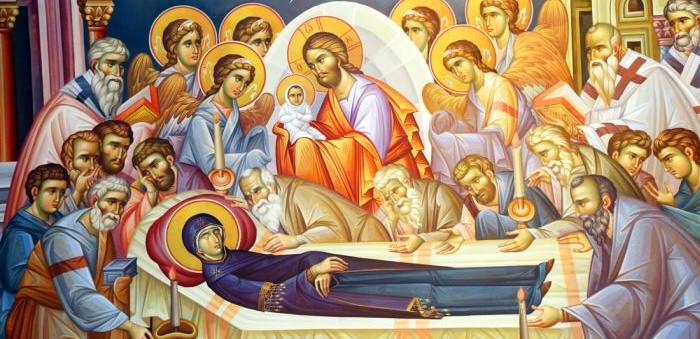
Today, let us shout from the rooftops "And death will have no dominion" as our Beloved Mother and Most Holy Theotokos departs from this dark world into Her Son's most marvelous light. As She sang so many years before:
|
For He that is mighty hath magnified me: and Holy is His Name ....
He hath showed strength with His arm: He hath scattered the proud in the imagination of their hearts. He hath put down the mighty from their seat: and hath exalted the humble and meek. He remembering His mercy hath holpen His servant Israel: As He promised to our forefathers, Abraham and His seed for ever. (Lu 1:46-55) |
As it was in the beginning, is now, and ever shall be, unto the ages of ages. Amen.
1
"Secrets of Noah's Ark" (Transcript). Nova. PBS. (October 7, 2015).
See
Yehezkel Kauffman (Ed. Moshe Greenberg),
The Religion of Israel, from Its Beginnings to the Babylonian Exile
(Chicago: University of Chicago Press, 1960).
2
The idea was first proposed by the Benedictine monk
Anselmo
about the time of the Great Schism and
has been steadfastly resisted by the Eastern Orthodox Church.
3
According to the Yale Library Research Guide,
the Book of Enoch enjoyed
"extremely high popularity in the Qumran community."
In our language today,
we would style it a runaway bestseller.
4
"1 Enoch" denotes a language version, not a subsequent volume of the same book
such as 1 Kings, 2 Kings, etc.
5
St. Irenaeus of Lyons, Against Heresies, 5 vol., Ancient Christian Writers series
(Westminster, MD:The Newman Press, 1991).