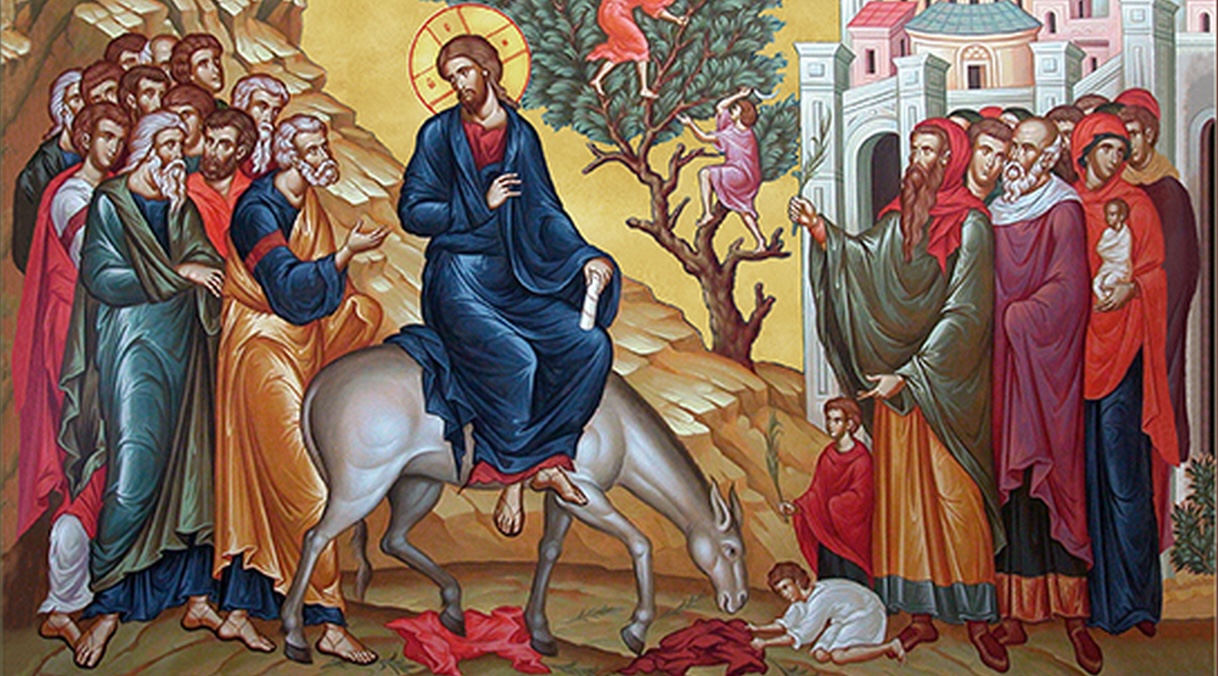
Our King stands before us. Indeed, He comes directly towards us in a royal procession. We must respond. The surrounding jubilation fills us with heightened expectation! But Who Is He? Who are we to Him? What does all this mean? Yes, there is general rejoicing. But there is also profound confusion. The days that follow will reveal just how deep this confusion runs, even to the depths of sinews and nerves, in a never-before and never-after wounding of Heaven and earth.
Jesus' entry into David's Royal City presents us with the figure of a King reclaiming the heritage of Abraham. He invokes His spiritual descent in the priestly-royal line of Melchizedek thereby questioning the Aaronic priesthood as He repeatedly had done in His parables. His intentions are clear, for He plainly declared that He would destroy this temple — the center of the bloody cult of Aaron and Moses. Never forget: the Scriptures Jesus cites from most often are not from any book in the Torah, but rather from the Psalter. And the Psalm He repeats most often is Ps 109/110:
|
The Lord said to my Lord,
"Sit at My right hand, Till I make Your enemies Your footstool." .... The Lord has sworn And will not relent, "You are a priest forever According to the order of Melchizedek." (Ps 109/110:1,4) |
This Scripture is an anthem and battle cry asserting the King-and-Priest anciently ordained by God. If Jesus had asserted a reclaiming of the Divine will from the beginning (in the First Chapter of St. John's Gospel), His Entry into Jerusalem is seen to fulfill it. And His Disciples replied resoundingly.
Jesus tells a stranger whom He saw in a vision "under the fig tree," and Nathan reflects the general excitement of all saying
| "You are the Son of God! You are the King of Israel!" (Jn 1:49) |
And here the young man invokes prophecy from another Scripture: Zechariah's prophecy of the long-awaited King entering Jerusalem and restoring Israel signified by every man sitting "under his fig tree" (Zech 3:10).
John remembers how the people cried out when Jesus entered Jerusalem:
| "Blessed is He Who comes in the Name of the Lord! The King of Israel!" (Jn 12:13) |
Again, this fulfills what had been spoken in John's first chapter:
|
"Because I said to you, 'I saw you under the fig tree' do you believe?
You shall see greater things than these." And He said, "Most assuredly, I say to you, hereafter you shall see Heaven open, and the angels of God ascending and descending upon the Son of Man." (Jn 1:50) |
.... the angels of God, familiars to Abraham and to Jacob, which Ezra had excised in his revision of Scriptures and banished from the temple cult.
The Jerusalem which Jesus enters tells the story of two different religions — beneath it, inescapably, the foundations of David's City and the way of the Patriarchs, but at ground level during the first century, the more recent city, built upon entry of the Persians with their governor in place, Nehemiah, and their temple cult installed by Ezra, who had interwoven the Babylonian-Persian cultus into the venerable cloth of Israel's traditions.
The Jesus movement was fundamentally a reclaiming of Abraham as the foundation story of Israel. Consider Saul of Tarsus, who had been an extreme zealot for the cult of Moses, but who as the Apostle Paul insisted on the primacy of Abraham in his letters: to the Galatians, to the Church in Rome, to the Church in Corinth, and to the Hebrews.
The transcendently holy and mysterious book which records this story is Genesis. Here, God ordains relationship with man as His ideal — first in Eden, where He spoke in the cool of the evening with Adam and Eve, and then later with a solitary man, Abram, who lived in the anti-place, the place opposite God's sanctity and authority: Babylon. God orders Abram to depart from Babylon. And this fact, second only to Abram's relationship with God, would define his life. We think of Abram living a princely life in Baylon (Ur of the Chaldees was considered part of the Babylonian empire). His wife had everything she wanted. Everywhere they went they enjoyed the great prestige of Babylon. But he would henceforth be Abram NOT of Babylon. He was to avoid the cities of Cain — first the Ur-city in which he was born, and then Sodom and Gomorrah — places which appear if only to make the point: not here. Abram was to keep to the cleansing wilderness, which is always already the domain of God.
Sisters, I ask you, what would the Hermitage be if it were positioned at the corner of two city streets — in my birthplace Newark, perhaps on the corner of Broad and Market Streets — instead of residing on a remote rock in the middle of the Pacific surrounded by fragrant groves of fruit trees (which is where we are)? How different! How different when you attempt to find the holiness within when you have the profane constantly screaming in your face.
Abraham and his descendants would honor the holiness of the wilderness — places where they met with angels or with God Himself. There they built altars all through the wilderness. They reverenced sacred groves. What did Abraham meet (in the traditions of Holy Orthodoxy) with the Holy Trinity? Was it not midst the Oak Groves of Mamre? They erected pillars. They made shrines of high places, where they honored God. From Abraham and Isaac and Jacob proceed the other Patriarchs called after Jacob's other name, the never-before-heard name: Israel.
God promised descendants as numerous as the stars in the night. They would be blessed, having Father Abraham's intimacy with God. They would sanctify the world with altars and icons. And angels would appear everywhere. For Abraham was not set apart as a singularity, a singularity like the high priest of the Jewish temple, who alone might meet with God once a year on the Day of Atonement. Or a singularity like Moses, the only one who durst approach God. No. He would simply be be first among multitudes dear to God — truly a prefiguring of God's vision for all humanity .... and might say the vision we were reared in as Christians.
How different this is from the religion of Judah confining devotion to Jerusalem, indeed, to the temple, and then building synagogues everywhere to promulgate their narrow religion to educate the people in their cult. The Kings of Judah sought to erase any vestige of this Patriarchal heritage, bearing the blessing of Ezra. We read in the Books of Chronicles, which Ezra wrote, they would destroy the altars built by Abraham and his descendants. And they would compose a counter-narrative of Israel labeling all religious devotions outside of Jerusalem as "idolatry." And the foundation legend most dear to Judah-ism would away shift from Genesis to be replaced by Exodus — which prefigured their climactic Exodus (according to Ezra), their cherished Second Exodus, which were their transformational years in Babylon. They come back from covered in Babylonian glory. They dress like Babylonians. They no longer speak Hebrew. They speak Babylonian (called Aramaic). For Ezra held that if you had not been part of the Babylonian "immersion," you were nothing. You were not to call yourself Chosen. He would forge a new chosen-people story which we today call Judaism — the cult of Judah, called Judah-ism.
Let us contrast Abraham's book, Genesis, from the more recent books of Exodus, Leviticus, Numbers, and Deuteronomy. These two separate corpuses are nearly unaware of each other. Abraham is mentioned only once in Leviticus. He is mentioned once in Numbers. He is mentioned nine times in Exodus and only in passing. By contrast, Moses is named 565 times in Exodus, Leviticus, and Numbers. .... and not once in Genesis.
Of far greater moment, following the Return from Babylon, the proper name for the God of Israel, YHWH, would drop out of usage in Judah (see "Yahweh," Britannica). God's Name would, in fact, be banned in Judah to be replaced by the Hebrew words elohim or adonai — ambiguous terms meaning "Lord." Did you know that the Egypt's gods were also called elohim in Book of Exodus? The Persians too addressed their god as "lord," which was bel in their language (from which we get the word Baal). An ancient inscription tells us that the foremost obligation of a Persian king was to ensure the proper worship of god. The use of Elohim or Adonais ("lord") in Jerusalem would have been acceptable to them. How we they know lord did not refer to their god Marduk? (How do we know?)
The trajectories of Genesis and Exodus could not be more different. Genesis is an episodic drama whose main theme, from Eden onward, is the struggle of humankind to achieve moral rectitude in the sight of God and thereby approval and intimacy with God .... which is the purpose of every Orthodox Christians life.
By contrast, Exodus depicts an aloof deity, whom none but Moses dare approach. Genesis is about the quest for God's company, from wilderness to unknown wilderness, and Abraham putting ever more miles between himself and Babylon. In his journey to the "antipodes of Babylon," he encounters a mysterious figure, Melchizedek, a Priest-King who does not offer blood at the altar .... but bread and wine — as I say, mysterious.
These are incommensurably holy things to Christians.
For on the night He was betrayed,
|
He took bread, gave thanks and broke it, and gave it to them, saying,
"This is My body which is given for you; do this in remembrance of Me." Likewise after supper He took the cup, saying, "This cup is the new covenant in My blood, which is shed for you." (Lu 22:19-20) |
The earthly vocation of Jesus is fragrant of the rites of Abraham, of Melchizedek, of Heaven:
| .... called by God as High Priest, "according to the order of Melchizedek." (Heb 5:10) |
You know, the Letter to the Hebrew was written to placate the Jewish party of Early Christians, who demanded that blood sacrifice be offered.
Today, we celebrate His departure from the Kingdom historically called Israel. It is a place detested by the practitioners of Judah-ism, for their control over it is partial. Jesus leaves the freedom of the open skies and the hills He roamed. He leaves the Sea of Galilee, a kind of fertile navel of the world, for the arid deserts of the south. He heads for Judah, the stronghold of a "gospel according to Moses." His disciple Peter urges Him to stay (Mt 16:21), but He replies by calling him "Satan." The occasion for His journey, His disciple John says, is "the Passover, a feast of the Jews" (Jn 6:14), clearly meaning a feast that is alien to Jesus and His disciples. The Passover celebrated by the Jews is the quintessential tale of their First Exodus, which is the theological backdrop for their cherished "Second Exodus" through the prestigious Babylon. You know, the Magi were from the East, covered in wisdom, glory .... luminous. And the transformed Hebrews returned from Persian Babylon with that mindset.
Still, the Jews, by no means, had established an ideological stranglehold on the whole Levant. Yes, the Passover had to be observed. But the Essenes (equal in number to the Pharisees) came to the temple setting a prophetic face against the Jews (as Jesus repeatedly had .... with a whip!) and offered "the sacrifices of righteousness." In the words of Philo, who knew the Essenes,
|
They have shown themselves especially devout in the service of God, not
by offering sacrifices of animals, but by resolving to sanctify their minds. (Quod Omnis, 75) |
This sounds like St. Paul, doesn't it.
But here, too, Ezra's heavy hand of revision would be felt. Consider, Psalm 50/51:
|
For You do not desire sacrifice, or else I would give it;
You do not delight in burnt offering. The sacrifices of God are a broken spirit, A broken and a contrite heart — These, O God, You will not despise .... Then You shall be pleased with the sacrifices of righteousness. (Ps 50/51:16-19) |
Right there (I would say) is the closing line of the pre-Exilic Psalm 50/51. That Ezra would have the temerity to append
|
....
With burnt offering and whole burnt offering;
Then they shall offer bulls on Your altar. (Ps 50/51:19) |
which is the present closing line in our Bibles, which shows just how heavy-handed the Jewish regime could be. For this added line contradicts the entire sense of the whole preceding Psalm.
Like the Good Samaritan of Jesus' parable (Lu 10:25-37), the holy offering of the Essenes was virtuous life, which Jesus studiously contrasts with the Levite and Priest who are willing to let a man bleed to death on the roadside rather than forego sacrifice in the temple. They fretted they would become ritually unclean.
The yearning for a return of the old ways is palpable in the New Testament. St. Peter is explicit:
|
Coming to Him as to a living stone, rejected indeed by men, but chosen
by God and precious, you also, as living stones, are being built up a spiritual house, a holy priesthood, to offer up spiritual sacrifices acceptable to God through Jesus Christ. (1 Peter 2:4-5) |
Doesn't this nail in?
If blood sacrifice is the everything and the all, then why doesn't Jesus teach His Apostle the priestcraft of sacrifice. He doesn't even mention it in His kerygma. Nor does He mentioned Himself as a blood sacrice, but rather as a ransom.
And perhaps remembering the Lord's entry into Jerusalem, Peter quotes Psalm 117/118:
|
Therefore it is also contained in the Scripture,
"Behold, I lay in Zion A chief cornerstone, elect, precious, And he who believes on Him will by no means be put to shame." (1 Peter 2:6) |
On this day, the Lord enters Jerusalem sitting astride the foal of a donkey (Zech 9:9) invoking the prophecy of Zechariah, a book which stands out for its frequent use of the Name YHWH no less than 133 times holding aloft the ideal of Genesis. What is the first thing the faithful Hebrews did when they fled to Elephantine at the arrival of Nehemiah, Ezra, and the Persians. They built a temple named "The House of YHWH" .... defiantly. Says Zechariah,
|
"His dominion shall be 'from sea to sea,
And from the River to the ends of the earth.'" (Zech 9:10) |
This, after all, has been God's plan from the beginning and all along and today: intimate relationship between man and God .... all men and God. For when Judas (a variant spelling of Judah) departs from the Twelve he is replaced by Matthias, close enough to the Greek word for disciple (that is, "everyman") that no one would have missed the point. And Judas, of course, is a name signifying "every Jew."
The people throw palms at His feet betokening Eden, the scene immemorial of this sacred relationship. And they shout,
| "Hossana! Blessed is He Who comes in the Name of the LORD! The King of Israel!" (Jn 12:13) |
Plainly, they are invoking Psalm 117/118, as Peter did:
|
Save now, I pray, O Lord;
|
The Hebrew original reads,
|
Save us, YHWH.
Prosper us, YHWH. Bless us, YHWH. YHWH is God. |
.... or according to the oracle of Zechariah,
|
"'In that day,' says the Lord of hosts,
'Everyone will invite his neighbor Under his vine and under his fig tree.'" (Zech 3:10) |
.... as Jesus brought to mind, when He called His Disciples at the end of the First Chapter of St. John's Gospel.
Says YHWH:
everyone will sit under his fig tree,
for under soaring skies
and
over the everlasting hills,
the old ways have been restored.
The One now before us,
He is the Holy One,
sitting astride the foal of a donkey,
will see to this.
And His promises are sure.
For
He is the Son of God.
He is the King Israel.
In the Name of the Father and of the Son and of the Holy Ghost.
*
While evidence abounds of a Judaism observing the requirements of Torah
after the mid-second century B.C.,
there is no evidence of a Pentateuch exerting influence over the
lives of Judeans before then.
See Yonathan Adler, The Origins of Judaism (New Haven, CT: Yale University Press, 2022)
and
John J. Collins, The Invention of Judaism (Oakland, CA: University of California Press, 2017).