Luke 1:39-49,56 (Matins)
Hebrews 9:1-7
Luke 10:38-42, 11:27-28
"True Worshipers"
And Jesus answered and said to her, "Martha, Martha,
you are worried and troubled about many things.
But one thing is needed, and Mary has chosen that good part,
which will not be taken away from her." (Lu 10:41-42)
In the Name of the Father and of the Son and of the Holy Ghost. Amen.
In this familiar Scripture,
Jesus reveals two very different religions:
The first we might call busyness.
The second let us all contemplation of God .....
relationship with God.
The first is impersonal.
The second involves adoration and,
by that fact,
examination of one's life and motives.
The "religion of busyness" had become the rule
in Judah since the return of the Babyonian Captives
under the strict auspices of the Persian Empire.
But this was not the legacy of the Patriarchs,
who, by the way, never heard of Moses.
The religion of Abraham was one of personal transformation.
We think of Abram being called out of the great city,
Ur of the Chaldees,
of going into the wilderness,
and
undergoing transformation,
even to his name being changed.
leading to intimacy with God,
which is betokened by Communion with the Holy Trinity
beneath sacred groves of Mamre.
The former signified a religion of meaningless doing;
the latter, a religion of Union with God.
This is
the basic crossroads
presented to us
in the Gospels,
so brilliantly
displayed in the Parable of the Good Samaritan.
Jesus asks, "Who is justified before God?"
Is it the offerers of incessant blood sacrifice
(represented by the priest and the Levite in the story)
or
the one who offers the sacrifice of righteousness (represented by the Samaritan)?
This was a live topic during Jesus' lifetime:
practitioners of the cult of Judah, whose procession of blood sacrifices in their Temple
never ended,
versus
the Essenes, for example, a large population of non-Judahite Hebrews,
who presented a prophetic face against the Temple,
meeting there to offering the religion of virtue and
examination of conscience.
In the words of Philo (who knew the Essenes)
They have shown themselves especially devout in the service of God, not
by offering sacrifices of animals, but by resolving to sanctify their minds.
(Quod Omnis, 75)
|
Sounds like St. Paul, doesn't it?
On the occasion of a great feast
—
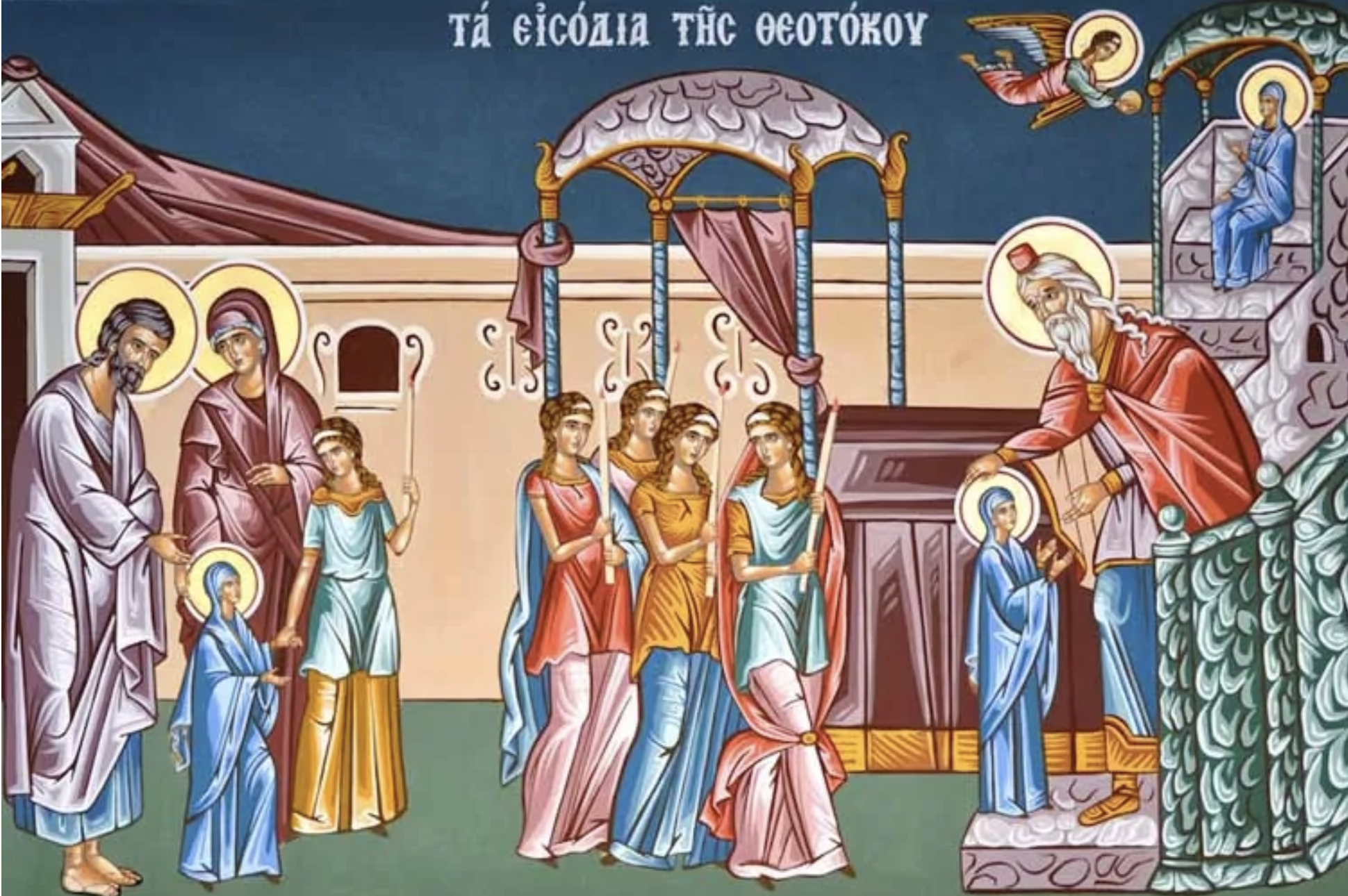
the Entry of the Most Holy Theotokos into the Temple
—
let us together face this crossroads.
With the Entry of Theotokos into the Temple,
we celebrate
the end of a whole life-world:
the true Temple of God ascending
in the very midst of the false temple.
The religion of busyness and of blood sacrifice still bedevils Christianity today.
In fact,
while the central teaching of Orthodoxy,
which is intimacy with God in the form of theosis,
the
Western Church continues to teach that the blood sacrifice of Jesus is offered in trade
for salvation.
Yet,
the Twelve Disciples of Jesus never spoke of any blood sacrifice
and,
certainly,
they did not teach the offering of blood sacrifice.
By contrast, the Early Church Fathers offered models for entering into intimacy with God
but did not mention blood being offered.
The leading Orthodox theologian of our time, Met. Hilarion Alfeyev, has said,
The teaching of the Savior's redeeming sacrifice as gratification of God the Father's wrath,
while found in individual Eastern authors, did not receive much serious support of any kind
in the Christian East. However, it was precisely this understanding of redemption that was
celebrated and preserved over many centuries in the Latin West.
(Orthodox Christianity, II. 310)
|
We understand how this cult entered into our lifeworld.
I don't mean in the nineteenth century or the eleventh century,
but
in the sixth century B.C.
The most powerful force on earth,
the Persian Empire,
subjugated the Babylonians
along with their vassal peoples.
They believed that the favor of their god,
to whom they offered blood sacrifice,
lay behind their world conquest.
They saw themselves as their god's agents on earth
assuring the well-being of his lifeworld.
And everywhere that god would receive due and proper worship.
In Jerusalem the Persians ordered a temple to be built on Mt. Zion which would house
the administrative center of their province Judah:
collecting taxes,
administering laws,
convening tribunals,
and
ensuring exact and precise worship,
which would mean
feeding their god's
insatiable thirst for blood.
Everything revolved around blood sacrifice.
A stele that has survived attests that the Persian monarch's
sacred obligation
to ensure right worship of their god
was his most important responsibility.
Writes Prof. Yihai Kiel of the Hebrew University in Jerusalem,
A close examination of the different functions of the king according to
the Old Persian inscriptions [were] first and foremost, sacrifice to
Ahura Mazda and the preservation of the cosmic and political Order ....
("Reinventing Mosaic Torah in Ezra-Nehemiah ...." Journal of Biblical Literature No.2, 2017)
|
This, of course, is exactly what we find in the revisions
to Scripture carried out by Ezra
under the supervision of the Persian governor, Nehemiah.
There would be no angels
ascending and descending upon the sons and daughters of man (Jn 1:25).
These were expressions of the religion of the Patriarchs.
We recall Abraham encountering angels,
of Jacob wrestling with an angel till dawn
and of a ladder unto Heaven,
and
of Lot's family being saved by angels for Abraham's sake.
But these were to be suppressed.
Sadducees prohibited talk of angels, the afterlife, and the
immortality of the soul.
To open the door to personal relationship with God cannot be tolerated.
Who would come to the Zion temple and pay temple taxes?
The Temple authorities alone must be dispensers of Divine interaction.
Following invasion and conquest,
the task before any imperial power was to maintain civil order:
centralized government,
centralized taxation,
and
centralized control of religion.
And these were overseen by Nehemiah
and his brilliant scribe Ezra, whose
achievement can be seen in the Persian religion
being cleverly grafted on to the existing Hebrew Bible.
Remember,
Judeans of the first century did not have "Bible study"
or marked-up Bible in their homes.
They could neither read nor write
(literary rate of 3%).
They did not watch "60 Minutes" on television
or
even know what an exposé was.
Access to holy texts was mediated by religious officials.
And Ezra's appropriation of those texts can be seen plainly
—
for example,
the last passage of 2 Chronicles is the first passage in the Book of Ezra.
But in the historical Northern Kingdom,
the Hebrew people were reluctant to accept such teachings
(yet they were compelled to travel to Jerusalem
to the monetary enrichment of the authorities).
One notable Northerner,
a Teacher from Nazareth,
called the whole enterprise into question,
wryly mocking blood sacrifice as a means to relationship with the Father
(as I have said, in His Parable of the Good Samaritan).
And,
on one occasion,
Jesus riotously protests within the Temple itself
—
overturning cages where sacrificial animals were being sold,
even beating men who sold them with a whip
that He made for this purpose.
He
cried out,
you shall not make my Father's house
a "place of trade."
We should read this phrase very carefully and not bring our
modern English idioms into the mix.
It was an
ο̄ικον έμφοριον
/
oikon émphorion.
What was being traded?
It was a vain attempt to trade blood for salvation.
And this Jesus could not tolerate.
When thousands of Jews were converted to "The Way,"
they wanted to know where the sacrifice was being offered.
Certainly, we can't rely on ourselves for salvation.
Someone needs to make a sacrifice.
And, St. Paul, who was
"all things to all men, that I might by all means make disciples,
certainly said nothing which might lose these prospects.
As Paul registered the Cross
(which would not mainstream as a symbol the faith till the sixth century)
alienated people.
And the earliest name for our religion was "The Way"
—
the Way to Heaven, the Way of theosis.
At the sixth-century B.C. arrival of these Persian agents
—
speaking Babylonian (Aramaic),
dressed as Babylonians;
and
familiars of the Persian authorities
—
whole migrations of Hebrew peoples began
—
to the south
in Elephantine of Egypt where they built a Temple honoring YHWH
(a Name which was not permitted to be said in Jerusalem)
and
to the north,
in Samaria,
where a Temple was built on Mt. Gerizim.
In the era just preceding
Jesus' birth,
the the rulers of Judah,
the Maccabees,
had taken this Persian hybrid religion,
which they called Judah-ism,
to a new level
insisting that all Hebrews be conformed to it.
But let us turn away from the society at-large
and focus on the disciples of Jesus
in a personal way.
After all,
they were not from Judah.
They were from the historical Northern Kingdom,
away from
hated Jerusalem.
Jerusalem was the last place they wanted to go!
Now tell me,
what would your prayer-life be without our Father in Heaven?
When I pray to God, I unfailingly say,
"Gracious Lord, Almighty God and Father ....."
If I could not, my entire faithlife would collapse.
It would not be enough to say abstract prayers
to a distant God.
We see a world around us alive with the Presence of the Holy Spirit.
And what would your conception of life be without a Kingdom of Heaven?
I couldn't bear having the
Bosom of Abraham taken away from us?
And at the beginning of Jesus' ministry,
all these things He proclaimed.
"You will see greater things than these." And He said to him,
"Most assuredly, I say to you, hereafter you shall see heaven open,
and the angels of God ascending and descending upon the Son of Man."
(Jn 1:50-51)
|
And who is the son of Man but ourselves?
That is,
Jesus announced a restoration of the old ways.
This what the Advent of God would be all about
—
restoring right relationship with God
which had been taken away
during the Babylonian Captivity.
And more than anything else this
is what our feast is all about
—
the Entrance of the Holy Theotokos into the Temple.
If we were asked to single out one thing that prompted God
to be born into the world,
what would it be?
The Roman Empire represented no threat to God's people.
Said Jesus, "Render unto Caesar what is Caesar's."
Done!
it would be that hateful house of blood that sought
to subjugate the hearts and souls and minds of God's people
should be expunged.
"I will destroy this place!"
Jesus said.
The whole concept was mocked by God in the Psalms:
|
Do you imagine that I relish drinking the blood of dead goats?!
(Ps 49:13)
|
It was mocked by the Father,
and
it would be mocked by the Son.
As Jesus confided to St. Photini,
the woman at the well,
But the hour is coming, and now is, when the true worshipers will worship
the Father in spirit and truth; for the Father is seeking such to worship Him.
(Jn 4:23)
|
And He said this virtually
in the shadow of
the ruin of Mt. Gerizim Temple.
Let us pause to note that this is same the teaching
which Jesus communicates to Martha of Bethany.
"Emulate your sister Mary,"
He says,
who is already worshiping in spirit and truth.
She is already as a "true worshiper."
She has aleady has arrived to intimacy with God,
which is the goal of theosis.
☦
Can we imagine
the long, bitter, lifeless winter.
The sky is gray.
The earth is hard,
yet, a little, fragile and delicate flower is seen
forcing itself up between the enormous stones of the Temple.
A breath of fragrant, warm air is detected.
These are the first intimations of spring.
The ice begins to crack.
The sound of dripping water is heard .... everywhere.
And the centuries-old oppression
begins to fall.
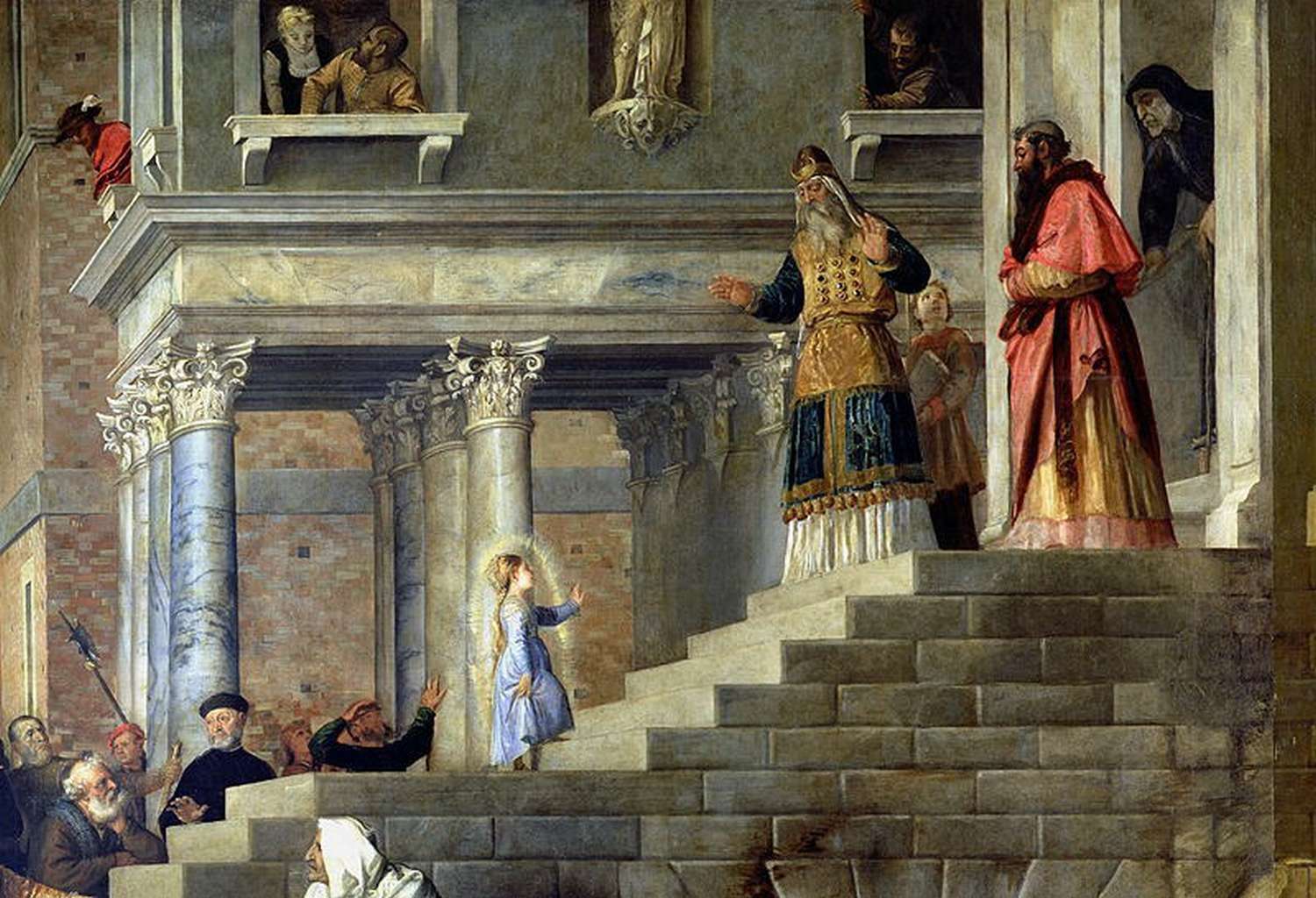
For a tender Virgin,
little more than a toddler,
has entered the Temple.
Her tender and pure feet tread the Temple's heavy steps.
Her little frame proceeds past its massive columns.
Her perfect and innocent soul ascends toward the slaughterhouse.
For she
—
this powerless, diminutive girl
—
will be the conqueror of this colossal fortress.
She will be the place,
by the grace of God,
in Whom
the vastness of the cosmos and beyond
will dwell.
She will be the new and definitive Holy of the Holies.
For in the First Temple,
the High Priest realized once a year
theosis,
perfect spiritual Union with God.
This Virgin's body in every fiber of her being
will participate with the heartbeat of God
—
literally,
"one bone, one flesh,"
her every cell,
will be intermixed with God's.
She is the perfection of Union with God,
which we in our Eucharist will faintly echo.
We participate in His Body and His Blood just
as the Most Holy Theotokos did ..... as I say, a faint echo.
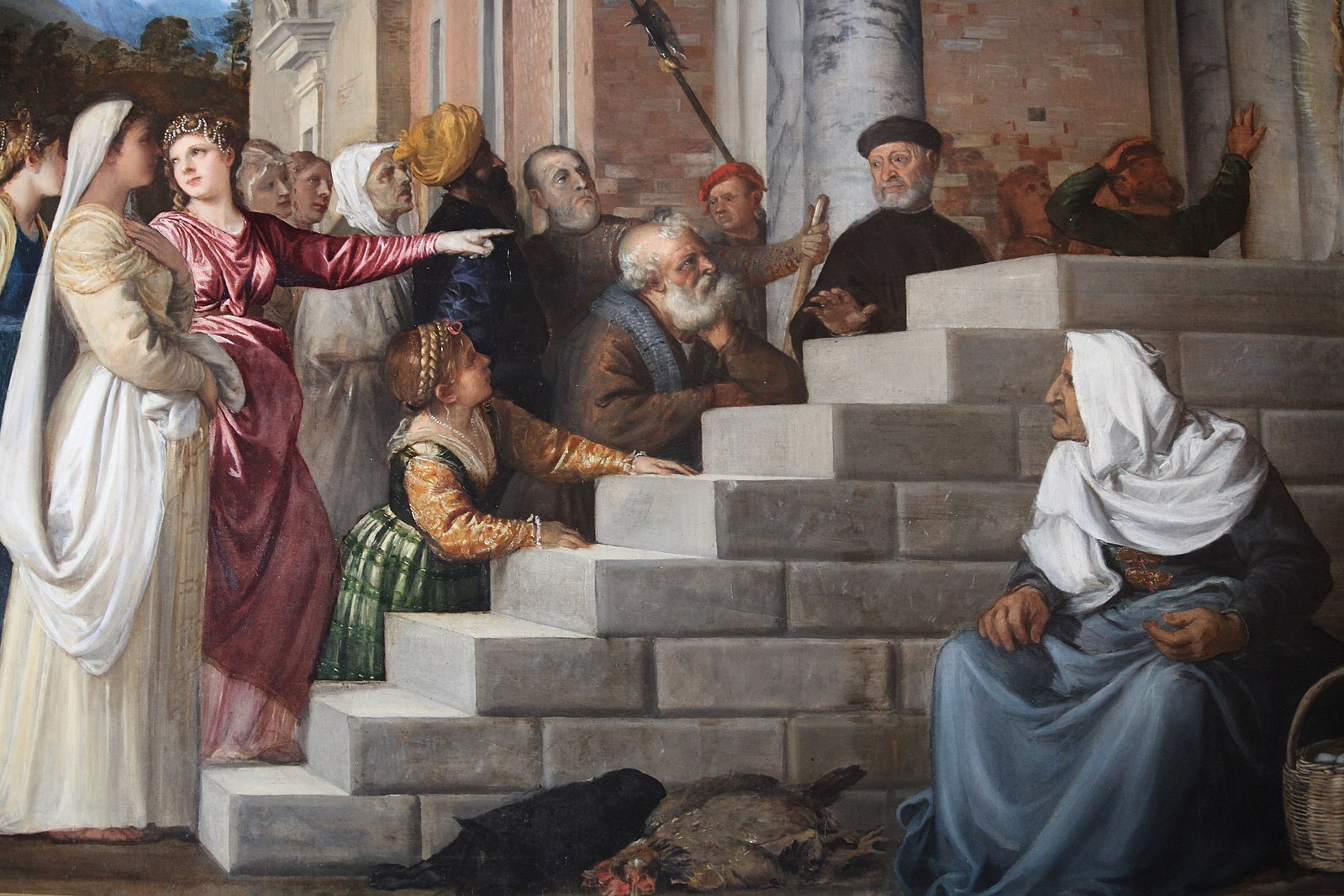
The Temple's immensity,
designed to impress a fearful people,
now had admitted One Whose lightness of being is angelic.
And in so doing they were doomed.
This would be
a foreshadowing of Jesus' death as the hook the devil swallowed,
dooming hell by inviting Him in.
The Temple stinking of animal blood that cannot be washed
from its porous stones
with its
lightless corridors,
yet
Her life from its conception and birth is one of Divine and immaculate cooperation,
shedding a kindly radiance upon all.
She will be filled with the Uncreated Light.
She is the Creation of Man which cannot fail.
She is the second Eve, Who in Her purity and in Her
perfect faithfulness will not stumble.
And She will guarantee that the second creation of humankind will not fail.
She is
immune from the Temple's deathly vapors.
And the trajectory of Her life
will be taken in every direction:
Nazareth,
Bethlehem,
Egypt,
Jerusalem,
Ephesus ....
God's Everywhere,
which is the Kingdom of Heaven.
Her presence begins
the collapse and fall
of Temple worship.
For
"God has chosen the .... the weak .... to confound .... the mighty"
(1 Cor 1:27).
And in her simple unknowing,
the Theotokos has comprehended,
mysteriously, the incommensurable Greatness of God.
She encompasses it.
As we continue our fast,
emptying ourselves before Her perfect humility,
before Her loving gaze,
Divine revelation
floods into our souls and understanding.
Let us, who follow the path of fasting, be united
to the Most Holy Theotokos
as She, a mere toddler, ascends beyond the holy of holies,
beyond the house of darkness and death.
And let us become enlightened as we follow in Her royal train.
For we too were born to receive the Most High.
The Most High overshadows us.
We too were created to become the dwelling-place of God.
And we stand at a crossroads
facing as she did:
the religion of death,
on the one hand,
and
the only Way toward Life,
on the other.
Yet, beneath Her Mantle we will never become lost or confused.
Through Her,
the Way we know,
for it is Her way:
|
"Be it unto me according to Thy Word ..."
(Lu 1:38)
|
In the Name of the Father and of the Son and of the Holy Ghost. Amen.