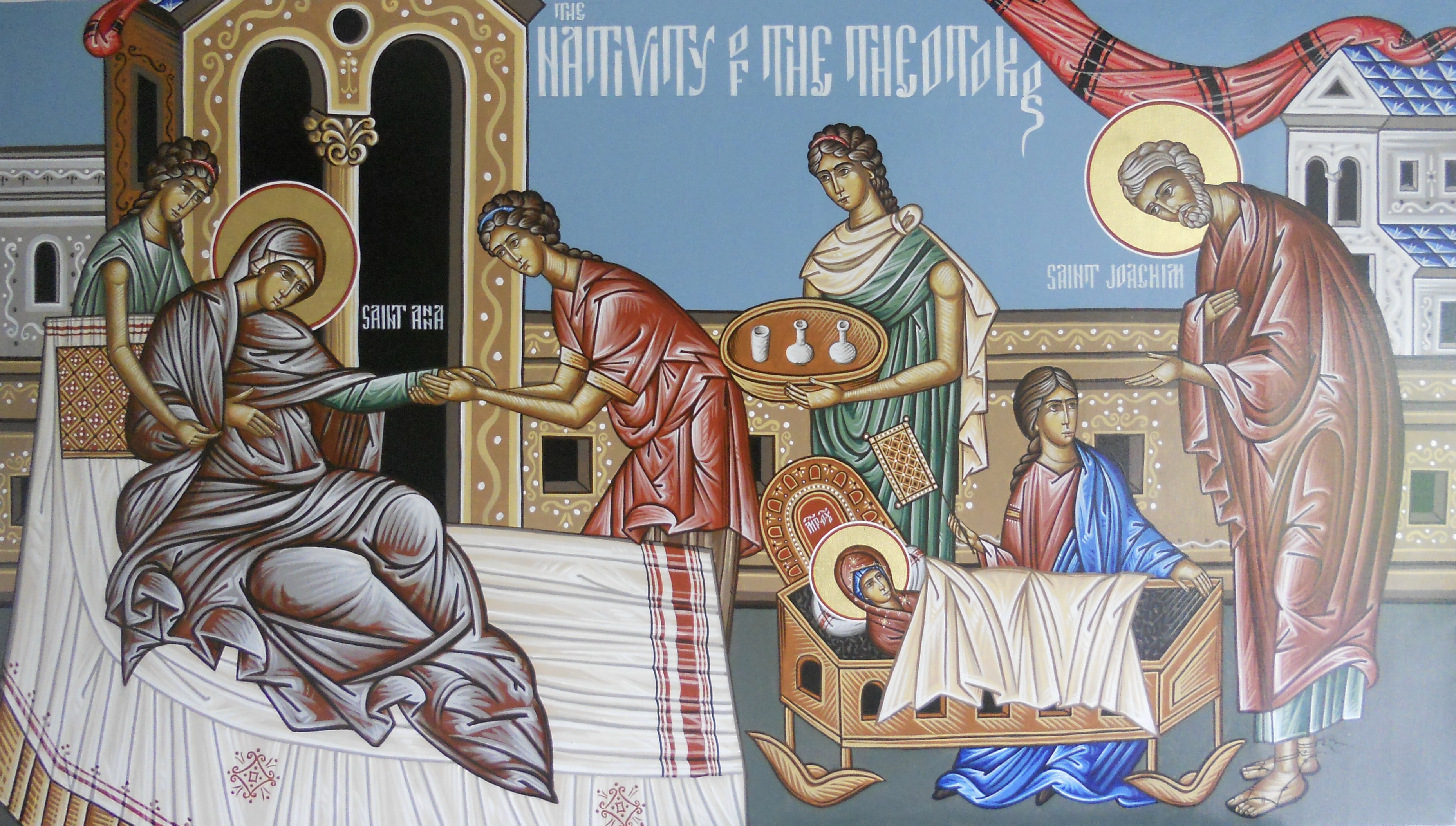
Luke 1:39-56 (Matins)
Philippians 2:5-11
Luke 10:38-42,11:27-28
Gentle Woman
Let this mind be in you which was also in Christ Jesus.
(Phil 2:5)
In the Name of the Father and of the Son and of the Holy Ghost. Amen.
Do we believe that God chose Ever-Virgin Mary to bear His Son
and
that instantly She conformed to perfection as a Chosen Holy Vessel?
This summons up the picture
of a programmed robot, which then instantly goes into acceptable action.
But life on earth is not like that.
This Child was formed within a living web of many people.
Moreover, She had the freedom and power to choose from among countless choices:
on all matters,
at all hours,
every day ..... as did her parents did, as her grandparents did, as we do.
Formation is no simple thing,
and
the conditions for arriving to spiritual perfection
(I use that word because we look to the Gospels for the
"counsels of perfection") ....
I say, the conditions for spiritual perfection take place in a mixed, and often corrupt, world.
We have read the Gospels.
The lifeworld of the first century BC and the first century AD is no different
from our own,
at least not where the vagaries of the human heart are concerned.
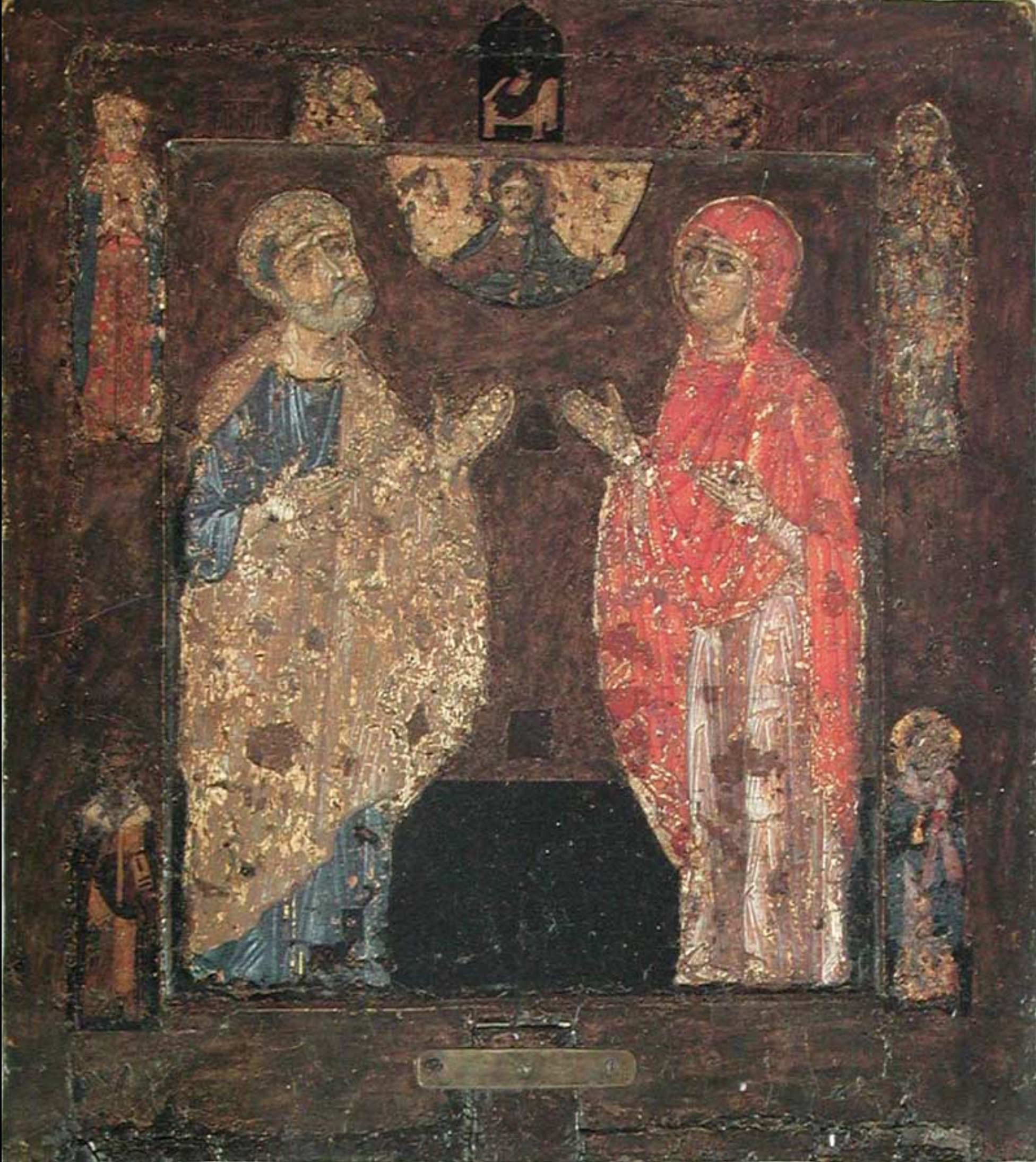
The atmosphere surrounding the Theotokos from Her birth
must be that of humility and prayerfulness.
The Russian icon posted with this reflection
is dated 1169,
a mere hundred years following the baptism of Holy Rus'.
It is redolent of lowliness and suffering.
Following a lifetime of devout life
and
married fifty years,
Mary's future father, Joachim, searched his family records and found that among
the righteous men of Israel, only he was left childless
—
cut off from the web of life.
After all, the great injunction from the Creator
to humankind was,
"Be fruitful and multiply" (Gen 1:28).
And
now enduring the catastrophe of being a "rancher" (as we would say) without sons,
he is daily reminded of the blessings he has been denied.
There is no one to help him.
Other men perceive this disfavor,
and they
spurn him.
Mary's future mother, Anna, too, is cut off from the social world around her.
"She was reproached by all the tribes of Israel" (Protoevangelion of the St. James, II.3).
So, together they pray,
and prayer becomes their unceasing, daily vocation.
As the icon suggests, they pray
to God in the Person of their Grandson
in a Divine mystery they cannot fathom.
For the Son is the Person of the Holy Trinity Whose
property is to have compassion and to hear prayers of supplication.
He is, eternally,
a Man acquainted with sorrows.
(I should pause to say that this doctrine if Orthodox dogma.)
Our icon captures the unremarkable many-to-One perspective,
that is,
of God's people praying to God.
But this morning, let us view this icon from the opposite perspective.
Let us consider it from God's point of view,
of the One-to-many.
God must search the world in order to find an acceptable entry point into human history.
He scans the earth for an acceptable couple who might rear this Child
and
a family in whose bosom His Son will dwell.
For the Incarnation must be the remedy for His
profoundly lost people.
The hour grows late.
With each passing year the situation in Jerusalem becomes worse
as Judah becomes further deformed and disfigured by the adamantine stones
of Babylonian law
and
stained with the blood of slaughtered animals ..... and upon the holy altar!
We just have just reflected on formation,
the conditions for arriving to spiritual perfection.
The formation within this little corner of the human lifeworld
is far from ideal.
The remedy must be
for God to become materially, organically, and intimately joined to the human lifeworld.
The Son of God, Himself, will say,
|
"I was not sent except to the lost sheep of the house of Israel."
(Mt 15:24)
|
This is the problem,
and
the solution is the Incarnation.
But first must come the great test of humanity:
in all the earth, are there not two righteous people?
It is a question that echoes through the Scriptures:
Abraham bargaining with God to spare Sodom (Gen 18:26-33),
the Divine conversation surrounding Job (Job 1:8),
St. Paul's declaration to the Romans (Rom 3:10),
and
now
the question of
a fitting vessel for the human birth of God.
Who knows how long He has searched for Joachim and Anna
—
this island of peace and faithfulness and lowliness
in an ocean of human arrogance, pridefulness, grasping selfishness,
and
bruising competition?
Oh yes, and they must not be trapped in this degraded spiritual formation of Jerusalem!
But what stands out
is their injuries
accepted in prayerfulness.
They have been spurned, cut off, and reviled,
and
they have accepted these things in prayerfulness.
This commends them above all.
Russians call this holy suffering, podvig,
which is nourishment giving growth to the soul.
For if God is to be our model for human life
—
He will be the greatest human born of woman
—
He must needs enter an abode after His Own Heart.
And what is His heart?
Well, the thing that stands out most
is that
Perhaps we like think of God as a great King, resplendent in armor,
His Incarnation will be
the once-for-all, incommensurable example of humility.
and
shattering His enemies with His mighty sword.
But that is not what we have in the Incarnation.
His Incarnation will be
the once-for-all, incommensurable example of humility,
to be etched on every human soul
—
breathtaking to the hosts of Heaven
and
calling all humanity ever after to fall to its knees,
crying, "O Lord, have mercy on us!"
For He must subtract His Superabundance,
more expansive than the universe,
in order to enter the narrow confines of the human person.
As our Epistle lesson for today describes it,
but [He] made Himself of no reputation, taking the form of a bondservant,
and coming in the likeness of men. And being found in appearance
as a man, He humbled Himself and became obedient to the point of death,
even the death of the cross.
(Phil 2:7-8)
|
Now, the King James translators and their successors inexplicably chose "servant" (or "bondservant"),
but St. Paul used the word
δουλος
or
slave.
That is,
as we recently reflected,
this is one who does even possess his own personhood.
Subtraction beyond subtraction.
He would not be born into a family filled with zeal for
the hybrid Persian religion, Judah-ism.
But conspicuously He
would enter human history
where the religion of the Patriarchs was still strong,
Nazareth.
Now, St. Anna was among three daughters
born to the priest Matthan (Mt 1:15)
and
the youngest.
The first two daughters,
Mary and Zoia,
would be married in Bethlehem.
But Anna would marry
Joachim in Nazareth,
not a Jewish,
but a Hebrew stronghold.
They were devout
and
spent their lives in prayerful peace,
devoted to the religion of Abraham:
of righteousness and virtue and intimacy with God
after the pattern of the Patriarchs.
Isn't this the point St. Paul makes over and over again?
God would enter their lives as He had entered the lives
of
Abram
and
Sarai.
God called our founder father away from Babylon,
and
under the conquering Persians,
Jerusalem has become a "little Babylon"
—
complete with a Persian-built temple and practicing a Persian cult.
Joachim and Anna had waited for a child into their barren years
as
Abram
and
Sarai had waited.
And they went to a wilderness as Abram and Sarai did.
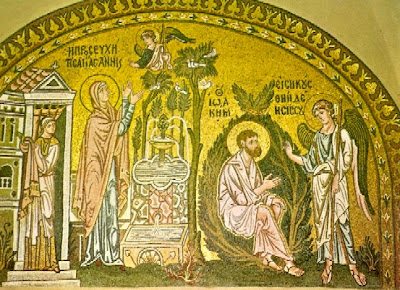
Let us hear their voices in these deserted places.
Joachim's
would be a silent prayer expressed with fasting:
|
And Ioacim was sore aggrieved, and showed not himself to his wife, but betook himself into the
wilderness, and pitched his tent there, and fasted forty days and forty nights, saying within himself:
I will not go down either for meat or for drink until the Lord my God visit me, and my prayer shall be
unto me
meat and drink.
(Protoevangelion of James, I.4)
|
Meantime, Anna gazed upon the Creation in prayerful meditation:
|
Woe unto me, unto what am I likened? I am not likened unto the fowls of the heaven, for even the
fowls of the heaven are fruitful before thee, O Lord. Woe unto me, unto what am I likened? I am not
likened unto the beasts of the earth, for even the beasts of the earth are fruitful before thee, O Lord.
Woe unto me, unto what am I likened? I am not likened unto these waters, for even these waters are
fruitful before thee, O Lord.
Woe unto me, unto what am I likened ? I am not likened unto this earth, for even this earth bringeth
forth her fruits in due season and blesseth thee, O Lord.
(Protoevangelion of James, III.2-3)
|
We celebrate Joachim and Anna
(so prominent in the Divine Liturgy)
not out of obligatory "ancestor worship"
but
because God chose these people to be the acceptable lives
through which He would draw near to us.
They are the models of the very virtues
that God commends to us:
•
lowliness
•
prayerfulness
•
hopefulness
•
patience in long-suffering
•
constancy
Joachim and Anna were nothing if not constant:
constant in their love for each other
and
constant in their love for God.
They were married for half-a-century
longing for a child.
Children were everything to them.
But they did not lose hope
nor
was an accusing word ever said.
And this gentle, devoted, and faithful love
would be the Divine world
into which the woman wrapped in silence would be born.
And she would bear the Child Who was God
—
on a silent night,
among despised shepherds,
in mean circumstances,
and
in all
lowliness.
For this is our God:
"He was despised and rejected by men,
A Man of sorrows and acquainted with grief.
And we hid, as it were, our faces from Him; .....
(Isa 53:3)
|
Let us also prepare Him room in our lowly and prayerful hearts.
Let us follow His commendable forebears.
For in the time to come,
we will not search far
to be also despised and rejected and acquainted with grief.
We will not have to scan the world for an opportunity to follow the Holy Ones.
But the world will crowd in to revile us.
All we need do is be gentle, faithful, and long-suffering.
This was the acceptable life of Abraham and Sarah,
the acceptable heart of Joachim and Anna,
and the humble obedience of their twelve-year-old Daughter
through Whom
the example of Divine Life was given
once and for all ages
—
the Life and Mind of our Lord and God and Savior, Jesus Christ.
In the Name of the Father and of the Son and of the Holy Ghost.