This morning let us go back to the basics of our faith. I wonder how often we reflect on the First Commandment. It does seem urgent in the way murder or robbery or sexual depravity does. Yes, it involves the love of God, which confronts us as an urgent question. But the rest seems foreign to us:
|
"I am the Lord your God, who brought you out of the land of Egypt, out of the house of bondage.
"You shall have no other gods before Me. "You shall not make for yourself a carved image — any likeness of anything that is in heaven above, or that is in the earth beneath, or that is in the water under the earth; you shall not bow down to them nor serve them. For I, the Lord your God, am a jealous God, visiting the iniquity of the fathers upon the children to the third and fourth generations of those who hate Me, but showing mercy to thousands, to those who love Me and keep My commandments." (Exod 20:2-6) |
If we understand the Decalogue to be our lifebelt, as right conduct at its bare minimum, keeping us safe and keeping us sane, then we must be deeply impressed that fully two-thirds of the Ten Commandments consist in this opening section about loving God. Significantly, like marriage, this is an exclusive love.
Perhaps we find the whole concept of false idols to be strange. Yes, we do make idols of things like drugs, illicit sex, and alcohol, sacrificing all that we have for them. But I mean idol in the sense of religious worship. To Whom do we pray? How do we pray? What spiritual tradition have we chosen? These are not questions we can afford to ignore. For the formal definition of Hell is life utterly devoid of God. That is, we must be certain that the God we kneel before is, in fact, the true God. Recall the proverb "the road to Hell is paved with the good intentions." It is not our intentions that matter. It is God. It is our true faithfulness. We have the responsibility of diligence.
Do you see? Our right relationship with God is everything — our only safety and stability and, yes, our only real and lasting love of which true love in this world is but a reflection. It is our greatest joy and liberation, finally we are free of the chains that constantly weigh us down and bedevil us. Life without garbage! Life without polluting influences! Life as it was always meant to be! And the loss of God? This is catastrophic in dimensions beyond counting.
But the loss of God during our lifetimes is nothing compared to the choice for a different Divinity (which inevitably is a demon). In the former case, we are estranged from God, but God is still there. There is hope of future reconciliation, of conversion. But in the latter case, all possibility of relationship is forever lost. You see, it is one thing for man to be estranged from his marriage. It is quite another thing to obtain a bill of divorcement and then marry another.
This is no imagined calamity, for this was precisely the case of things in the Levant on the eve of Jesus' birth. Several seemingly disparate and unrelated developments converged to make for a death blow to God's people — to the worship of Abraham's God, which we might call "life under Divine blessing." For where else but Eden does one converse with God as Abraham did?
The first wedge in this marriage came in the tenth century B.C. with the splitting apart of the Twelve Tribes of Israel into the Kingdom of Judah (the so-called "Southern Kingdom"), consisting of the two tribes Benjamin and Judah, and the Kingdom of Israel (the so-called "Northern Kingdom") consisting of the remaining ten tribes. The backdrop for this historical period was the colossal growth of empires, especially the Neo-Assyrian Empire in the historical area of Mesopotamia. It is, of course, in the nature of empires to conquer. And the goal of complete and permanent conquest is to reshape the client states into the images of the master.
By the eighth century B.C. the Kingdom of Israel was vanquished and its people were carried off to Assyria for "re-programming" we would say today. But you cannot exile everyone, and the deportation ceased at a level of twenty percent of the population. No doubt, the Assyrians discovered an intractable quality about the Israelites — their culture, or should I say their religion (for they are one and the same) was not centered on a specific place. Their God was everywhere. Their worship was everywhere. They built altars and erected monuments wherever and whenever they experienced theophanies, encouters with God. For their God was not a distant, aloof, and dangerous God. And their great exemplar, Father Abraham, was celebrated for his heart-to-heart conversations with God, as it was in Eden. And their ideal, nourished in the hearts of each one, was to return to Eden, where Father Abraham would receive them into his bosom.
How do you conquer minds and souls like this? You cannot. So the Israelites of the Northern Kingdom where scattered everywhere, and worshipped the God of Abraham in a thousand different places.
I would like to note in this context that Jesus restored this Abrahamic religion in the sense that He obliterated the Zion Temple and gave the Holy Spirit, returning to the original religion, enabling each person to worship God as a living stone built into a spiritual temple (Peter would say).
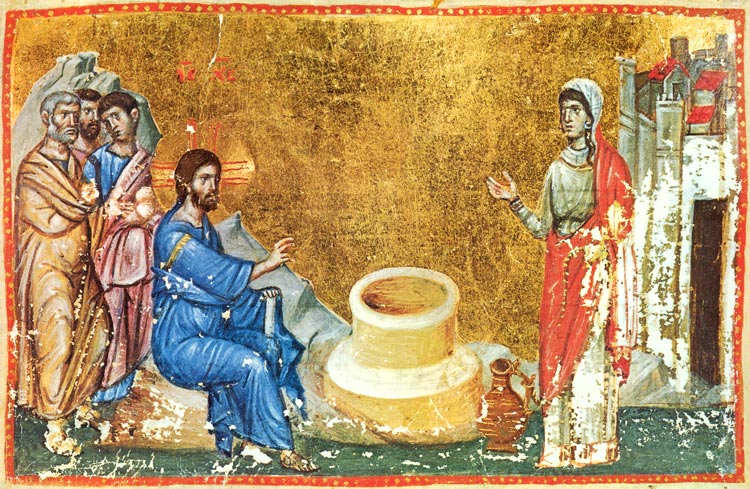
The Hebrews (those of the Northern Kingdom) madee their chief settlement around Shechem (its called "Sychar" in today's Gospel), which was their historical capital, near Jacob's Well. Did you notice the fulsome mention of the Patriarchs in the Samaritan's speech? Abraham, Joseph, Jacob, all of Jacob's children (and his animals!). The emphasis is on the Patriarchs in the North. And their ancient temple would not be far from here: built atop Mount Gerizim.
We do not have time to tell the whole story this morning, for this tale in one of many stories. But let us consider a brief summary and jump two centuries forward. In the sixth-century a new empire also centered in Mesopotamia, the Babylonian Empire, directed its armies to the Southern Kingdom of Judah. Judah's internal affairs had fallen into chaos, Amon, their king, was assassinated. And that would have convenient, for this was the eve of Babylonian Conquest. Do we imagine that partisans of Assyria or paid agents of Assyria assassinated the king? That would be plausible, for his heir to the throne was an eight-year-old boy named Josiah. And, breaking with tradition, this boy was overseen by no co-regency.
Perhaps Babylon had learned the lesson of Assyria's intractable dealings with the Northern Kingdom. This time, they first would need to prepare the ground for their planned invasion. The boy-king immediately began a program of dismantling the religion of Abraham. He tore down altars which the Patriarchs had built hither and yon. He tore down the Altar at Bethel built by Jacob. He destroyed the sacred groves like the one in which Abraham and Sarah received three mysterious figures. He obliterated the high places that reached to Heaven in filial affection and yearning. Josiah's father, King Amon, had jealously guarded these holy sites, which led to his assassination (it is said in the Book of Chronicles).
But we must ask, Why then? These holy sites have had cherished for centuries. Why on the eve of the Babylonian conquest was Amon, this faithful king, removed? Why does his heir (an eight-year-old boy) act so suddenly and radically as to destroy ancient Israel's religion? Why was no (so-called) grass-roots rebellion seen in previous centuries? After all, these sites had been cherished by all and back through the mists of time. One does not lightly tear down an Altar to God built by the greatest Patriarch, Abraham. That these were the holy sites of the old religion was the judgment of the great historian Arnold J. Toynbee in his magisterial work, The Study of History (Oxford University Press, 1961: Vol. 12, p. 425).
No doubt, some readers will protest: the Book of Chronicles condemns such cherishing as idolatry. They say Amon was an evil king and that Josiah was a good king. And the sites? They blamed it all on "Baal worship." But we must be cautious with this word Baal, for in Proto-Semitic, Ugaritic, Phoenician, Hebrew, and Greek in simply means "Lord" — roughly synonymous with adonai or elohim. In fact, we use this word "Lord" today to mean "God."
More important, let us ask the question, who wrote Chronicles? The answer is predictable: Ezra, the man exported from Persia, charged with overseeing propaganda and reporting to Nehemiah, the Persian governor of Judah. (For the Persians had supplanted the Babylonians as the latest "new empire").
The boy king did much to prepare the ground for the conquest that was soon to come. He centralized the government and the governing of religion. He destroyed all the worship sites he could that were far afield. And he claimed to have discovered a new book written by Moses! How convenient! (By the way, it depicts Moses' death, so it could not have been written by Moses.) Most important, it represents a new, hitherto unknown, god of Judah — a distant, aloof, and dangerous god. He warns you not to touch his holy mountain lest you die! Josiah's "handlers" called this book Deuteronomy, the Second Law, we might say "Torah redux." It was what we would call a "remake." And this god could only be worshipped in Jerusalem with pilgrimages to Jerusalem required at certain seasons. Conveniently, Nehemiah and Ezra then announced that a temple would be built (which by the way would also house the Persian imperial offices).
The worship they put in effect would be not be very different from the worship of the Babylonian and Persian god Marduk. This deity would be addressed by the same name as Marduk: Bel, not very different from Baal, both words meaning "Lord." Indeed, the name YHWH was prohibited: not to be uttered or written anywhere. Thus the Persian King Cyrus had thus completed his obligations to his god. It is significant that a surviving stele (plaque) lists among the foremost duties of the Persian king, the worship of Marduk. Clearly, YHWH worship had fallen out of use. A clever replacement has been slipped in.
I began by discussing the dire state of affairs on the eve of the Annunciation and Nativity. And so a coda must added. In a thought-world for centuries marked by many divergent religious beliefs, most people could afford to ignore the religion of Judah, Judah-ism. Northerners were patently antagonistic to it. Indeed, the New Testament records deep divisions among those who professed it. Even Judean where sharply divided.
But the Maccabees changed all that. They had made Judah-ism the central rallying cry in their war against the Romans. The failure to profess Judah-ism was tantamount to treason. To solidify this single-minded devotion to Judaism, in 111 B.C. the Maccabees ventured forth to Mount Gerizim and destroyed the temple, whose very existence revealed their own temple to be the counterfeit. And then they began a program of "re-education" worthy of Mao Tse-Tung's Cultural Revolution, building synagogues from Egypt to Rome promoting the "academy of Moses."
Certainly, the first-century A.D. was the all-important century. Everything that had happened in salvation history led to the burning point of the first century. God had entered His great Masterwork as a historical character, Jesus of Nazareth. Nothing in human history compares to this. But it was all-important, also, because humankind, God's highest creation, made in His Own Image, was slipping away from Him. And this slipping away was not mere estrangement, but rather another marriage being brokered. It was upon this most urgent crisis that He sent His Son into the world: to which are associated these striking words:
|
For God so loved the world that He gave His only-begotten Son,
that whoever believes in Him should not perish but have everlasting life. (Jn 3:16) |
The key phrase here is believes in Him, which is the religious commitment of the heart and mind. You see, whatever your spiritual path might have been, so long as you centered your devotion of God on Jesus .... this would be the universal remedy. This was the solution to the crisis.
The confusion of the world (then and now) is voiced by the Samaritan woman. Once she realizes that Jesus is a Prophet, she instantly asks the one question that has been burning in her heart: "where ought one go to worship God" (Jn 4:20). She understands the urgency facing everyone. Where or what finally is God? "What must I do?" We hear this elsewhere in the Gospels. "What must I do to have life?"
Jesus replies with a startling answer, for there is no precedent in the religious experience of Israel to explain it:
|
"the hour is coming, and now is, when the true worshipers will worship the
Father in spirit and truth; for the Father is seeking such to worship Him. God is Spirit, and those who worship Him must worship in spirit and truth." (Jn 4:23-24) |
If effect, Jesus announces the Kingdom of Heaven to her. It will have no geography. It will require no political allegiances. No scheduled pilgrimage feasts. It will be everywhere. Its God will not be distant nor dangerous, but rather He is to be called "Father." He is alone is the True God, and His temple will be erected in every human heart.
This is the message of our God. This is the kerygma of Jesus. now, ever, and unto age of ages. Amen.