This morning, we stay with our theme, brilliantly revealed on the Mount of Transfiguration, of encountering the Holy One. In today's lesson God's Son hears our petty concerns and then takes us instantly above the clouds scaling a Mount of Transfiguration which is our own. Perhaps I should say "scaling up," for Jesus stretches our worldly values and expectations past recognition.
We know the story: how Peter claims spiritual perfection for himself by showcasing his willingness to forgive a brother who has sinned against him even seven times. After all, seven is the Divine number, signifying absolute completeness, for in seven days God created the Heavens and the earth and then rested on Seventh Day. But Jesus responds by literally blowing up this imagined fullness, multiplying it by seventy, which St. John Chrysostom writes, signifies the "infinite and perpetual and for ever" (Homily LXI).
Perhaps we are startled by Jesus' multiplication tables and His invocation of infinity. But such things were commonplace in Jesus' time. (We have spoken of the wide variety of beliefs in the first-century Levant.) Indeed, as far back as the sixth century B.C., the Greek philosopher Anaximandros not only wrote of infinity but saw it specifically as a Divine property, calling it apeiron, meaning "that which is unbounded, that which is without limit." The Divine, he said, has no limits, no boundaries. Certainly, these ideas would have been transmitted through Hellenized academies, called gymansiums, in Jerusalem (1 Maccabees 1:14). And the great classicist Werner Jaeger tells us that they would have been present in the Jerusalem of the first century (Early Christianity and Greek Paideia, 1961). But this is merely to point to a common vocabulary among the disciples.
Ours in not the case of theoretical philosophy, however. For we have right before us the mind-bending fact of the Boundless One acting as schoolmaster for His bumptious and limited pupils. As we have said, the occasion for our lesson is Peter arrogating to himself properties of the Divine. In this, Peter anticipates our own formula, "To forgive is divine" (Alexander Pope), by eighteen centuries.
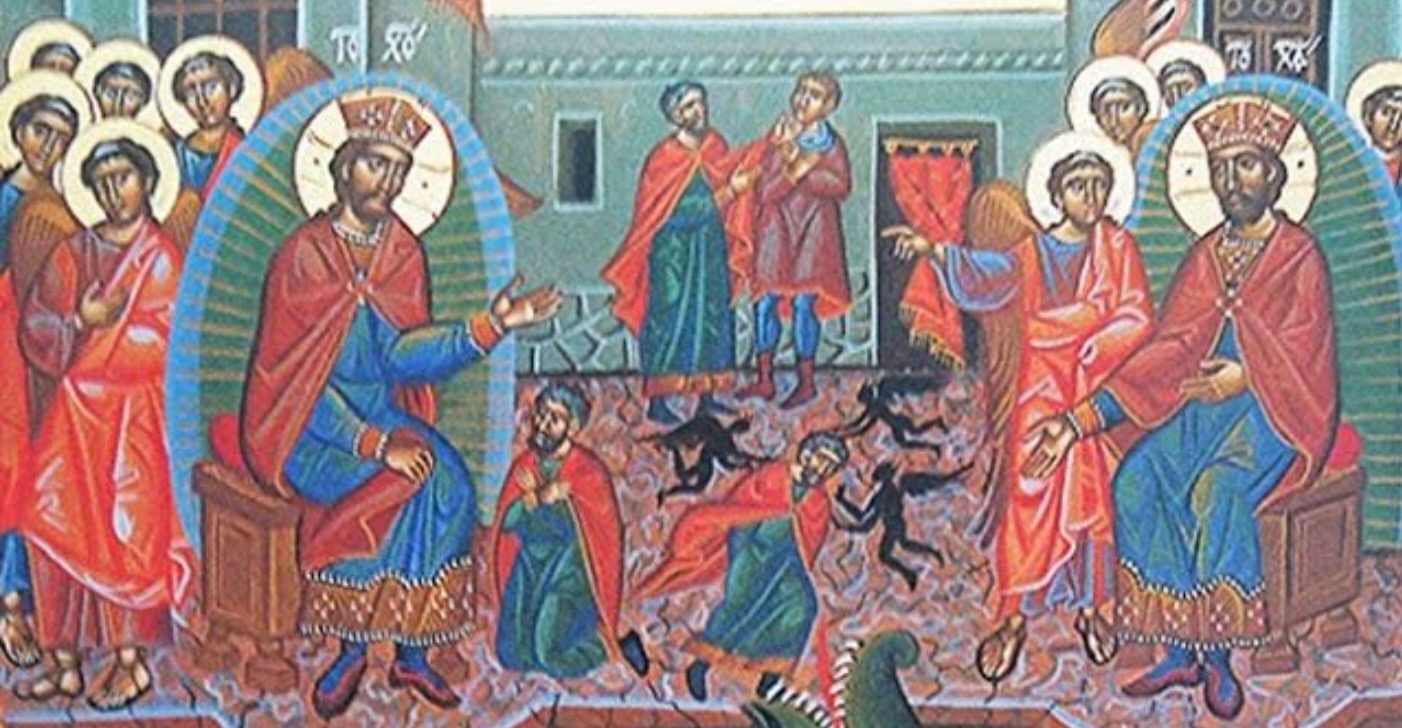
Jesus responds by confronting Peter with the Divine Itself, which is infinity. And then He follows with an illustrative parable, which we know as the Parable of the Unforgiving Servant. We are familiar with the story of the steward who is shown great mercy and who then refuses to show even trivial compassion to his fellow servant. But as edifying as that thread is — which we call the tropological level of interpretation or "the moral of the story" — it is not the main thread, which is revealed in the spiritual and eschatological levels of meaning.
Let us study this more closely. Jesus begins, "There was a certain king ....." And we instantly fill in the blanks: a kingdom, subjects, a hierarchy of life ..... Yet Jesus does not mention any of these things. In fact, He mentions very few characters and one kind of relationship with the king. This is not the nominal relationship of a subject to the king. No. He says only that "the king wanted to settle accounts with his servants" (Mt 18:23). This represents the whole scope of our parable.
Let us pause to notice that the King James translators have not been strictly accurate. For this king is not surrounded by servants but rather with slaves: δούλοι / doúloi. Aside from a later mention of the other slaves who reported back to the king and the king's torturers (who no doubt are also slaves), only the king and two slaves are mentioned as the principal characters in the tale. That the unforgiving servant and his family are to be sold only confirms the point: these people are the king's property. This is a slice of life in the first-century Roman Empire: slavery as a consequence of economic misfortune.
Now, for most people today the subject of money begs the question of social class. But I wonder if we can imagine a society where the economic "lower class" signifies loss of your personhood. In the first-century Roman Empire, it was possible to fall below the status of "independent person" and become the property of another, who could do with you as he pleased. You no longer had rights. You could not sue or be sued. You could not make a criminal complaint. Your owner had complete prerogative over you as it suited his whims and impulses. (I might add, morals do not apply here.) And whatever he did was his business. This was accepted as normal. And the most common route into this condition of life was economic indebtedness. It is a historical fact that debt could land you in prison where you would be subject to torture in order to extract payment. ("Where have you hidden this gold?!") All of these things were commonplace to Jesus and the disciples, simply part of everyday life.
So where are we? We enter a world defined purely in economic terms. The unforgiving slave is in debt to the king. The second slave is in debt to his peer. Any family members are inescapably part of this calculus. The jailers and torturers are defined by these multiple indentures. Indeed, it is the only reason they exist. We might say that a history book of this little world, as it is presented to us, could be written as entries in a ledger. Factual. Uncomplicated. A matter of arithmetic.
But then a detail is mentioned which superabundantly expands this world beyond recognition, bursting all boundaries, where all ledgers must fail: the king's slave owes him 10,000 talents of gold. While several different formulae might be applied to this calculation, none of them really matter. For 10,000 talents is roughly a quarter-trillion dollars in today's money. As one commentator has stated, such a sum would have exceeded all money in circulation in the Roman Province of Judea (Craig S. Keener, The Gospel According to Matthew, 1999). This debt was larger than the economy. With this one detail, Jesus has moved the reckoning of accounts upward by many orders of magnitude. Indeed, we are silent in the presence of this stupendous sum, which John Chrysostom rightly calls "the infinite."
Jesus disciples, and indeed anyone who reads this parable, suddenly find themselves far out of their depth. We are dumbfounded. We flounder. We ponder. And finally we say, "Who exactly is this King? What King entrusts a slave with the riches of Croesus?" And then we learn, setting our estimate much higher now, that this King can afford to forgive such a debt, implying that an infinite amount is nothing to Him. He apparently possesses many "infinities." Clearly, we are in the Presence of the Boundless One, the Limitless One, where our frail human senses fail, and quotidian reference points and scales of value no longer apply.
Yet, for all of this, we still have not reached the summit of this Mount of our Transfiguration. That comes when we consider that this King of King spends His days in solicitude for our sakes. Consider that that everyone else around Him is a slave, is a being of the lowest status. For this is our Gods. compared to Whom we are nothing ..... yet mysteriously made in His Likeness and Image. This God does not sit aloof in His Divine Splendor far beyond our seeing or comprehension. No. He stoops far below the Divine Realms and consents to grace us with His untold riches ..... and something much, much more, which is His sincere attention.
I suppose it is nothing to receive a loan from the royal household. But to receive an audience with the king or an emperor .... now that is something.
We read that He is moved by our struggles and burdens. He has compassion on us. And He grants us His love unto an incommensurable degree, forgiving all (Mt 18:27).
You see, this parable is not primarily about us and how we ought to behave (which is the tropological meaning). This parable is mostly about God. And this takes us back to a sentence Jesus uttered near the beginning of our lesson: "Therefore the Kingdom of Heaven is like ...."
What is the Kingdom of Heaven like? It turns out that the Kingdom of Heaven mysteriously is scaled to us and to our many cares. Perhaps this is not the Heaven we have expected nor the Heaven that we want, but it is the Heaven God has chosen. It is a messy place, for it attends constantly to human complications and human foibles. If this were not so, then the saints in light would not constantly hear millions of prayers each day (or should I say, at every moment?) and respond to them. It is a place of infinite compassion, of empathy, and of caring, where our foibles greatly matter to the Holy Ones.
And what of our God? Why should God have chosen a vocation of Self-denying Suffering? Why should He have sent His Son into our dangerous and striving world? He is mindful of this. He says of the evil tenants, "This is the Heir. Come, let us kill Him" (Mt 21:38). He knew what He was doing. He knows what He is doing. Yet, He does.
This past week, a doctor who regularly monitors our skin cancer, mentioned our longtime ministry in Haiti to one of her nurses, and especially Sr. Mary Anne's quarter-century oblation at the feet of the hopelessly poor. But our God has chosen for His vocation an infinite number of Haitis. He might have chosen anywhere else. But places like Gaza, Sudan, and Somalia and are always closest to His heart.
Yet, still we have not reached the summit of our Mount of Transfiguration. Perhaps our willingness to take and take and take obscures it from our view. Our preoccupations with our own ascent block it from our sight. How often, I wonder, do we think of the constant descent and sacrifice and Self-denying love of our God. How often do we consider that being human is an abject privation which for God is incommensurable.
We love to think of Him as being exalted beyond the scope of all imagination. But this necessarily implies something else: His Incarnation means that He is debased to the lowest level by that same scale. Have we not sufficient clues that His wounded ransom for our sake never ends? And has He not enjoined us to look at the marks of the nails which He shall ever bear (Jn 20:25)?
St. Paul calls this our Lord's kenósis (Phil 2:7) — that is, in order to dwell with us, He must first empty Himself of His Divinity, which is another kind of infinity, called epsilon, for the distance between 1 and 0 can never be reached. We call this the "over 2 problem," where fractions are divided by two, yielding a sequence of divisions that have no end. It is a kind of infinity, the infinity of lowliness.
Let us go back to Bethlehem, therefore. Let us go back to the squalor into which He was born. At His birth, He began a thirty-three-year passion imprisoned and tortured within the suffocating confines of our humanity. A form of torture was to be pressed down into a tiny box, your legs folded, your head between your knees, where you could barely breathe. But what box could approximate the pouring out of infinite Divinity? He "took the form of a slave" (Phil 2:7) for our sakes, for how else could He reach the last lost lamb? And He continues to choose this, for it is the only place of intimacy with us.
Why do the saints profess lowliness and humility? Why do they ask forgiveness for their part in our broken world? They do this to be close to the Holy One. For this is the place of authentic love, moment-by-moment love, sharing in our sorrows and setbacks and crises that have no end.
They choose this life, for it is the life that God has chosen. And this is the hidden path up the Mount of our Transfiguration. It is the route from sub-human existence — and the enslavement which we invite with recklessness, our unbridled passions, and our selfishness — to the superabundance of Heavenly life. Are not these, finally, the Promises of Christ?
|
"He who finds his life will lose it, and he who loses his life for My sake will find it."
(Mt 10:39)
"But he who is greatest among you shall be your servant. And whoever exalts himself will be humbled, and he who humbles himself will be exalted." (Mt 23:11-12) "..... the Son of Man did not come to be served, but to serve, and to give His life as a ransom for many." (Mk 10:45) |
Tell me, is there another, truer love than the love which sacrifices all?
The Kingdom of Heaven is like ..... a certain King Who loved us.
And His love was without limit, boundless, and unto infinity.
This is the love into which
He has invited us.
Here, truly, is godly vocation:
lowliness, humility, and not counting the cost.
In the Name of the Father and of the Son and of the Holy Ghost.