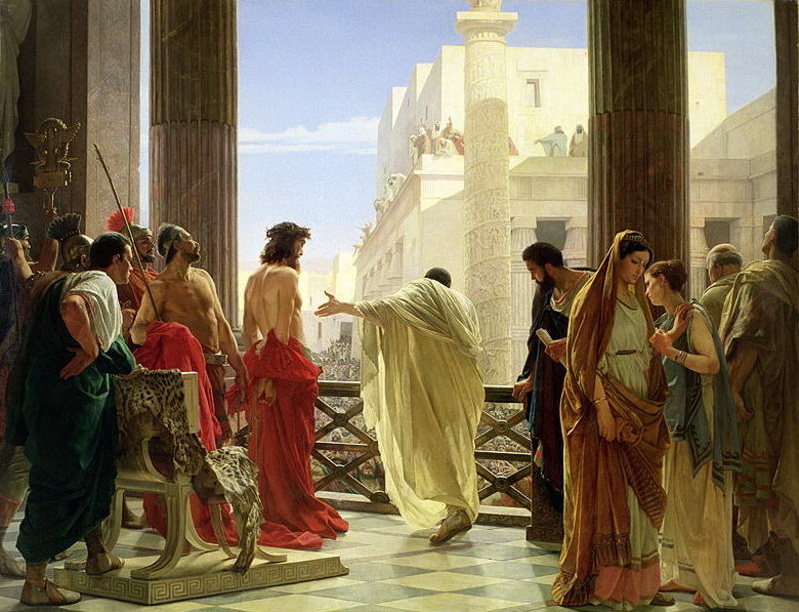
The suspense reaches a breaking point as the Roman governor pleaded with the crown not once but three times exhorting that if only one would simply raise his voice, Jesus would be released:
Luke 1:39-49,56 (Matins)
Hebrews 2:11-18
Luke 1:24-38
The Lord has died. He had been murdered. Family have received this news and have stopped all that they were doing .... all over world. And they make the sad pilgrimage to be together and to offer their obeissance and most solemn respect to their Everything and their All. They come as family — grandmothers and grandfathers, aunts and uncles, mothers and fathers, children and cousins. Everyone has gathered. And tender-hearted great-aunts and grandmothers gather together and chastely weep.
As children these most solemn days have been explained to us. After all, their whole lifeworld has stopped. Father is not at work. Mother is not out shopping or receiving other housewives in the neighborhood for a cup of tea. These are not days for exuberant play or cartoons on television.
For (these children understand) a very great Man had died, and somehow, we are responsible. Surely, then, this is not a day for ourselves, but a day that must be devoted to Him. This (we are told) is our respect and our show of love to Him, Who even in His inestimable greatness has given His life for us.
A child does not venture into theological depths — A Deathless One dying? An Eternal One trapped in our laws and physics? The Ruler of All, subject to the authority of puny men? No. A child remembers the kindness, the understanding, the friendship shown by the Lord Jesus and takes this gentle picture into his heart and cries out, "Him?! Why did He have to die?"
It was explained that because we, as a human family, had done terrible things. In fact, we continue to do terrible things. And in this world, justice, somehow, some way must have its day.
This a young boy understands. People are bad. They cheat. They drink too much. They fill the world around them with filthy language and filthy stories. Parents scream. They do unmentionable things. No one has to tell a child. A child sees it all. For a child a false image is not carefully crafted and maintained. A child see raw and unfiltered life ..... and then blubbering fathers and mothers who want their absolution.
Children are first to know about wrongness and rightness for the bad instantly stinks in their nostrils and assaults their gentle and godly sensibilities. Surely, sooner or later Father God must put a stop to this .... and in the end bad people must face Him. He will have His Day.
The prospect of the Lord's Day is not frightening in the mind of a child, but the opposite, it is reassuring, even most reassuring, securing the goodness of their world. For if the world, the world beyond all the badness, is not, at its core, good, then the intimations of beauty and truth and rightness and, yes, goodness are not to be trusted. And a child refuses to believe this. For that would mean all people in the world who are lost in this badness are right. And everyone decent and kind and godly is wrong. No. A child does not believe that .... cannot believe that. And besides, a child in his undisturbed purity, unlike us, knows the company of angels and is aware of the holy and quiet, yet overwhelming, Presence of God. Yes, God is in His Heaven. And all is right with the world. And, it makes sense even to a child, the world that is right with God is the world.
I mean, isn't Heaven finally that safe and secure place where everyone you meet has a heart full of love and whose every sense and instinct is to follow only the good. Is that not so? I mean, we do not expect tough neighborhoods in Heaven, nor hoodlums.
Yes, of all the human family, a child knows of goodness and badness. These are the most urgently true things in every quarter of his little world. And he instinctively knows that
|
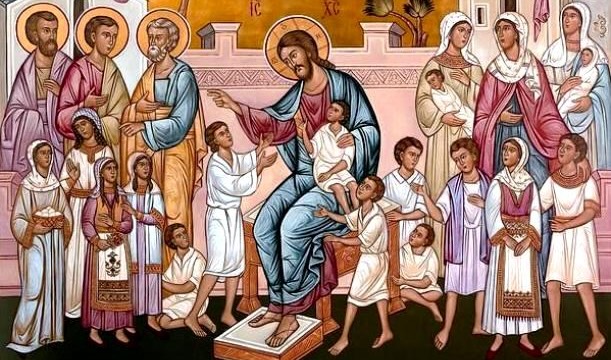
Jesus .... took a little child and set him by Him, and said to them,
"Whoever receives this little child in My name receives Me ...." (Lu 9:47-48) |
Now isn't that a royal warrant!
And
|
".... unless you .... become as little children,
you will by no means enter the Kingdom of Heaven. (Mt 18:3-4) |
Oh, yes! The Kingdom of Heaven is safe, for it is filled with little children .... of all ages.
At the same time, a child recoils from injustice. What could be an offense deeper to a child's sense of right and wrong than to be wrongly accused or wrongly punished? Why should good people be accused for Jesus' arrest and all that happened?
And this is explained to him, too. You see, Jesus roamed through the hills and seashores of the north. He became widely known and made many friends. Everyone just wanted to be near His goodness, which was so great that they could be their very best when they were near Him. Their very best. Even people who were ill were carried to Him and they were healed just standing in the radiance of His good love.
But there was one place far to the south which was the worst of all bad neighborhoods in Jesus' lifeworld. They did not believe in God there. In fact, they had invented a religion centered on bloody slaughter of thousands of animals which they learned by visiting the most wicked of bad cities: Babylon.
Yes, that same Babylon we read about in the Book of Revelation with all its blood and pollution. You see, in the mind of St. John this represented the ultimate battle of good and evil: the vision of love taught by Jesus and all who would follow Him versus the blood-sacrificing world of Babylon. This was the great battle — an ungoing war fought between Heaven and earth.
Jesus set His face to the south, therefore, and declared He would go there. He would go there to good people who were trapped. The Disciples pleaded with Him not to go. They said, "You'll be killed there!" (Mt 16:22). "But I must go there," He said. And His heart ached to see so many of His Father's flock lost and without a shepherd (Mt 9:36).
When Jesus and His Disciples entered Jerusalem there were so many good people who wanted to be near Him that a great crowd had formed cheering: "Son of David! Hosanna is the highest!" But not long after, the worst of worst bad men surrounded Jesus. Truly, He had strayed into a bad neighborhood. And the rest was inevitable. He had strayed into the toughest neighborhood in Queens or Brooklyn, the worst neighborhood in Calcutta. He had strayed into Port-au-Prince, Haiti. He was surrounded by the baddest of bad men. And quickly everyone scattered and ran, even His best friends.
And then tears started to flow from the boys eyes, and he quietly sobbed. For he knew the truth of this. When things get really bad, it's "every man for himself." Even a boy knows when you get in trouble way over your head, your friends will run. These were not tears for Jesus, you understand. These were tears for .... for everyone .... for the shame of the world .... which we call, "human nature" .... as if that explained anything.
But there was a good man there. Well, he wasn't entirely good, but he knew right from wrong, and he could see that Jesus had fallen into their evil trap. (These where same wicked men whom Jesus had come to oppose.) And the just man — He was Roman governor of Judah — tried to find a way for Jesus to escape from their trap. And he hit upon an idea. He had found an ancient law that gave the people the right to let one man go free on their holy day. You will recall that this day, in the Gospel of St. John, was what John would call, "the Passover of the Jews" (Jn 2:23, 6:4, 11:55, 18:39, 19:14).
You see, Jesus had come south to free these people from an evil power. This is called a ransom (it was explained to the boy). A least, that is the term Jesus used to describe the situation (Mk 10:45, Mt 20:28). The boy had heard about ransoms from his stories: "This was the Damon and Pythias story!.
"Yes!" the reply came back to the boy. "In fact, this story was one of the most famous stories of Jesus time: revered in the halls of the Roman senate and taught to every schoolboy in Jerusalem!"
So now the boy understood. Jesus could be freed! He could be saved! The people only had to ransom Him back: just as Damon had ransomed Pythias. The suspense now would be centered on whether Pythias will now return in time to ransom Damon.
The suspense reaches a breaking point
as the Roman governor pleaded with the crown not once
but three times
exhorting that if only one would simply raise his voice,
Jesus would be released:
| Again Pilate addressed them, still wishing to release Jesus, but they continued their shouting, "Crucify him! Crucify him!" Pilate addressed them a third time, "What evil has this man done? I found him guilty of no capital crime. Therefore I shall .... release him." With loud shouts, however, they persisted in calling for his crucifixion, and their voices prevailed. (Lu 23:22-23) |
You see, Jesus stood forward laying down His life for His friends. But in Jesus' case, no friend could be found to lay down His life for Jesus. There would be not Pythias on a horizon running toward Him.
Now, mind you, in Pythias' case, to ransom Damon he would have to lay down his life. But in the case of Jesus, no life would be required. The people merely had to speak one word. But the word they spoke would be Bar-Abbas, which means "Son of the Father," that is, "just anyone." And this "anyone" happened to be yet another bad man set loose upon the honest world.
And young man saw the horrible truth. He saw the hard grain of the inescapable truth. It was easier to remain silent and not to become involved. They did not want those bad men showing up at their door. Or sending their henchmen to arrest them. "No, it would be safe if we did nothing."
Don't we all do the same thing? Don't we all choose to protect ourselves .... and our own .... even if someone has to die for our cowardice .... even if God has to die.
I was born in New Jersey, in Newark. My cousis was in fact killed by organized crime figures. And when it comes time to testify, to say "I will speak one word," what do we do? What would you do? No one had to say anything to the boy. He looked inside himself and saw that it was so.
And he stood up. He said, "Where is my tie and jacket? It is time to go to church. At least we can begin the long, solemn work of saying, 'I'm sorry.'"
In the Name of the Father and of the Son and of the Holy Spirit. Amen.