Mark 16:9-20 (Matins)
2 Corinthians 1:21-2:4
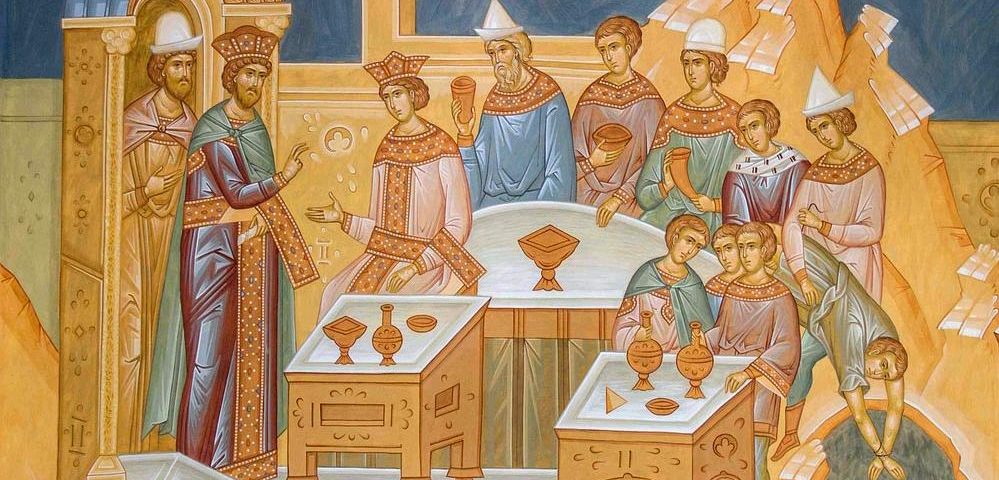
Matthew 22:1-14
Mark 16:9-20 (Matins)
2 Corinthians 1:21-2:4
Matthew 22:1-14
Perhaps it is simpler to ask, Who has not rejected God? Rebellion against God is the central thread of the Eden story. It is the theme of the first Creation, which culminates in the Lord seeing wickness and evil literally everywhere. He strain to find one righteous man.
|
Then, the Lord saw that the wickedness of man was great in the earth,
and that every intent of the thoughts of his heart was only evil continually. (Gen 6:5) |
That's all men and women. Evil is the steady stream of their thoughts and mind.
Freedom is inviolable. He cannot "ungive" this gift. His only choice is to destroy and to begin again. When the Great Flood recedes, the second Creation, so full of promise, begins with the same preoccupation with evil — featuring father-drunkenness and mother-incest and involving, at that point in this new world's history, half of the world's population: Noah, Noah's wife, and their son Ham.
God begins again with Abram of the Chaldees (in the region of Babylon) and His great-grandchildren the Twelve Tribes of Israel. But this story, too, descends into near fratricide (with a brother left to die) and, according to the Book of Exodus, bondage .... of all. The Twelve Tribes are then dragged through the wilderness grumbling and sinning. The Hebrew prophets bear witness to God's unfaithful people and confront them. And the whole sorry tale comes to climax with .... the murder of God's Son (which was depicted in last week's parable). Have I exaggerated? Is this not a faithful retelling of the Bible>?
In our own time, God is mocked, His holy ways are trampled upon, and the Creation is demonstrably coming apart at the seams.
Remarkably, this very scenario is depicted in the most attested books among the Dead Sea Scrolls (suggesting what we would call the best-seller) 1, the Book of Enoch. 2
The angels, too, bear the shame of a checkered history of rebellion, out-of-control lust, and betrayal, which is mentioned in the Book of Genesis 6:1-4 and fulsomely described in the Book of Enoch. It is, perhaps, for this reason that mankind was created: to re-people (so to speak) the society of God in Heaven, which had been emptied of perhaps one-third to two-thirds of the rebelling angels, who also continue to bear the Divine gift of freedom.
As a counter-principle, God put in the holy practice of Theosis — you know, ascent in life, thinking only of God, thinking only of His holy ways, and becoming more and more like God. Enoch is the prime example:
| And Enoch walked with God; and he was not, for God took him. (Gen 5:24) |
He walked with God. Do you see the suggestion of commonality, of harmony, of same-purpose. He kept God's pace. He conformed himself to God. And God welcomed Him and received Him to His Bosom.
It was this original spiritual journey, the central activity of all created humans (ideally), at which Adam and Eve failed, which Jesus was sent to restore. This ancient practice Jesus was sent to restore. For, as the Early Fathers have written, we did not know who we were (children of God, Who is our Father); we did not know where were going (to the Kingdom of Heaven, ideally); we did not know how to behave (according the portrait of mankind, which Jesus restored); we did not know that our salvation lay in becoming like God (sotería, the underlying Greek, which means "the way ahead has been cleared").
Other exemplars of Theosis include Abraham, Elijah, the Most Holy Theotokos, and, of course, Jesus. Certainly, all Christians must participate in this process of becoming Divine, for this is Christian life. Christian life is none other than this. Anything that falls short of this in not Christianity at all. And we celebrate a weekly ritual (you might say, a weekly reminder) of this most sacred transformation having placed within us a particle of the Divine — God's Most Holy and Precious Body and His Most Holy and Precious Blood — that He may dwell in us and we in Him. Do you see? .... becoming Divine. A saying current in Jesus' time is that "every drop of wine in the sea interpenetrates every part of the sea."
God attests throughout the Hebrew Scriptures: "I AM Holy; therefore, You shall be Holy." Doesn't that say it all? In this, God pronounces the Marriage and Heaven and earth. And if we fail, we will indeed be consigned to outer darkness. We are to be Holy. The Kingdom of Heaven is our destiny. Jesus gives the Law of Moses a second time enunciating the Laws of the Kingdom of Heaven (Mt 5,6,7), declaring thoughts much higher than our earthly thoughts and ways much higher than our earthly ways (Isa 55:8-9).
We have considered many times in these reflections, the Sermon on the Mount cannot be attained on earth .... lest you be crushed. But, as Jesus says, the world can only crush your body. It cannot crush your life (Mt 10:28).
Our lesson this morning is a condensed story of all of this. Jesus begins simply and directly:
| The Kingdom of Heaven is like a certain King Who arranged a marriage for His Son, .... |
Jesus followers would have understood instantly that the "certain King" is Father God. Anyone would, for the phrase "Kingdom of Heaven" is following immediately by the phrase "is like a certain King." And we all understand that the "marriage" He is arranging is for Jesus, Whom Peter has already named: "the Christ, the Son of the Living God" (Mt 16:16). Indeed, Jesus followers refer to Him as "the Bridegroom" in all four Gospels.
The marriage of Heaven and earth requires that relatives be summoned from everywhere. And this family is, well, like all families. There are parts of the family who style themselves "the better sort." And their relations who have not been alotted such worldly favor they ignore lest anyone notice these "lows" social connections. We learn in the course of the parable, however, that these lordlings underestimate their humble relations and have forgotten the values and ways of their King and His Son. The King is King over all. He is Father of everyone making all of us royal, all of us princes and princesses. He invites those along the highways and byways, and among the lanes and hedges. Moreover, His Royal Son is not ostentatious in His dress or manner. We learn elsewhere in Matthew's Gospel that He has nowhere to lay His head (Mt 8:20), He teaches His followers not to lord over others (Mt 20:25), and He practices a deep, intentional humility (Mt 11:29). Even when He reveals His Royal Character in procession, He says,
|
"'Behold, your King is coming to you, Lowly, and sitting on a donkey,
A colt, the foal of a donkey.'" (Mt 21:5) |
Yet, while His vesture is simple and His comportment meek, this is, by no means, to communicate laxness. There are certain requirements that can never be abridged. Needless to say, Heaven is an immutable constant, which can never bend to suit the current fashion, the current morals, or, more to the point, the current cultural delusion. Therefore, the lordlings in the family, priding themselves as "knowing better," have come to despise God and God's superstitious followers and simpletons. But the King does not consult their opinions. And in response to their disregard and abuse, even murder, of His royal servants, the King
| .... sent out his armies, destroyed those murderers, and burned up their city. (Mt 22:7) |
No doubt, this was the glaring cue that prompted the Fathers to identify this parable as a depiction of the Last Judgment. And, of course, it is.
But let us remain focused on ourselves as invited guests. Without question, God has summoned us all to the Wedding Feast. That is, we are all enjoined to take Theosis most seriously. Before coming into the King's presence, we must take our spiritual temperatures (on a regular basis). We must ensure that our hearts are right. We must watch for the symptoms of spiritual illness? But what are they? How does one know that His heart is right?
Surely, if we ignore our brothers and sisters who are without shelter, food, or decent clothing, yet we possess many and fine possessions, then our prognosis is not good. If we have been blessed with comely and fragrant gardens where our marriages might thrive and our children's souls might prosper, and fail to reverence this holy place, introducing adultery and perversion into it, then our report must certainly be grave. If we all have received the gift of a terrestrial paradise, but have despoiled it through recklessness, selfishness, and greed, then, surely, we have spiked a deadly fever from which we might not escape. If we have been granted the daily miracle and unspeakable beauty of new life, but have extinguished it, even in its pre-born nascency, then we, too, shall be extinguished. And recall that He burned down their whole city. And their crimes were far less than the ones I am contemplating.
Did you know that the second leading cause of death in the U.S. is heart disease? The third leading cause is cancer? The fourth leading cause are accidents? But of all of these together do not surpass the first leading cause, which is taking of unborn life: infanticide.
Remember, no one can surpass God's mercy. He knows everything about us yet tenderly loves us in our sufferings and repented sins. At the same time, no one is above or beyond God's perfect justice. There is no use in making excuses. For He always already knows everything about us and every context and every extenuating circumstance. And we vainly imagine that He will not notice our double or secret lives, hiding in the crowd whom we declare to be no better. In this, we only belittle ourselves further. Small wonder, the King shall approach many guests at the wedding banquet and say,
|
"'Friend, how did you come in here without a wedding garment?' And he was speechless.
"Then the king said to the servants, 'Bind him hand and foot, take him away, and cast him into outer darkness; there will be weeping and gnashing of teeth.'" (Mt 22:12-13) |
For God will not fill the Kingdom of Heaven with those whose thoughts are on evil continually. And this is the purpose of Theosis: to cleanse our thoughts and control our imaginations until our every thought is pleasing to God. Should we be distracted, then let us work the power of the Jesus Prayer, which drives out all demonic influences. No doubt, this is why St. Paul counsels us to pray without ceasing (1 Thess 5:17) and why he enjoins us again and again to control our passions, significantly naming each one.
Without question, we have come to a difficult moment in this meditation on family. For if family is the ultimate expression and experience of love, then grave breaches in family relations are most traumatic. Why can't everyone simply honor holy love and bow before it? For this is the path to the Kingdom of Heaven and to the only life worth living. Yet we must accept and already know,
| .... many are called, but few are chosen. (Mt 22:14) |
This parable is no fairy tale. The vast Table most certainly has been set. The King says, "All is prepared." And every minute of every day the Eucharist is celebrated somewhere in the world: from the bread and wine of Abraham and Melchisedek (Gen 14:18), to the Lamb's invitation to dine with us and we with Him (Rev 3:20), and as near as the Holy, Catholic, and Apostolic Church, whose bounds are infinite and eternal. Indeed, the Church in its splendor opens out on to the Kingdom of Heaven, is the Kingdom of Heaven.
The Marriage of Heaven and earth is in progress. Everyone is called. We must not fail to heed the King's summons. For He decides the acceptable season, and to ignore Him is clear rebellion. Yet, to obey Him: to live in His fragrant garden, to put on His easy yoke, to grow to be more like Him every day, in these things, we ".... [we] will find rest for [our] souls" (Mt 11:29).
Heed Him.
Follow Him.
Become Him.
As Blaise Pascal would say,
"What is the downside?
for the upside is obvious:
the Kingdom of God."
In the Name of the Father and of the Son and of the Holy Spirit.
1
The scrolls more attested,
the Psalter and Deuteronomy,
are not "reading texts,"
i.e., are not intended to be read as a narrative,
from beginning to end.
2
1 Enoch, Ed. George W. E. Nickelsburg and James C. VanderKam (Minneapolis: Fortress Press, 2001).