Mark 16:1-8 (Matins)
1 Corinthians 16:13-24
Matthew 21:33-42
Mark 16:1-8 (Matins)
1 Corinthians 16:13-24
Matthew 21:33-42
Do you believe spirituality to be no more than vague, personal emotions? You know: "Everyone has their own truth." Do you think that morality and faithfulness to God are fictions or personal delusions? If that is so, then you are dangerously out-of-focus. Look around you! See what rebellion against God — the failure to reverence our sacred duties, and the abandonment of His great work — has cost us. For surely His Creation is an ongoing and living thing with all of His creatures participating in it. Is not the interdependence of each created thing and our inborn heart for this work obvious?
The earth is literally melting — with the collapse of Himalayan glaciers only just beginning and the Poles rapidly disintegrating into water. Did you know that our oceans are rising at a speed of .23 inches per year and steadily gaining. New York City is perceptibly sinking with parts of Queens and Brooklyn moving downward 4.5 millimeters per year. Warm ocean-surface temperatures have always been our engines that spawn hurricanes and cyclones. But once limited to certain areas like the Yucatan Peninsula, they are literally everywhere across the seven seas. And ruinous storms must now be countenanced as a new and deadly fact of life. Our oceans are choked with 200 million tons of plastic, and we have discovered microplastics beginning to show up in our veins and arteries and slowly filling our brains. We once sang, "What have they done to the rain" in protest of radioactive particles. Now, the rain distributes tiny plastics over all the earth. Heat domes are quite literally cooking people alive across the globe. And we have just lived through our first man-made pandemic.
All this has been caused by our runaway animal passions including greed, neglect, selfishness, corruption, willful perversion, and a depraved indifference to human life. That is, our failure to be diligent stewards of the Creation, faithful spouses and parents who raise faithful stewards, and to accept the vocation of self-sacrifice all comes at a price. The bill is now coming due .... and it is stupendous.
Not long ago, a book was discovered in a cave by the Dead Sea among a library of almost a thousand volumes: the Book of Enoch. It turns out to be one of the most read books in this vast first-century library, which includes all the books of the Hebrew Bible (save Esther). And Enoch addresses our situation precisely: a whole world coming apart at the seams, together with the failure of the seasons and the heavenly bodies, all due to rebellion against God and abandonment of our posts as faithful creatures.
Does this have our attention? I tell you, this and much more than this, will come to dominate all of our attentions in future. Where shall we go? What shall we do? There is no other place, and there is no other way other than God. Let us go to Him, for He has been waiting for us. He has been watching for our approach (as it were) from a bend in the road. And there is much to confess and many tears to shed. But in the end, He will forgive us: "For a broken heart and a contrite spirit, O Lord, Thou wilt now despise."
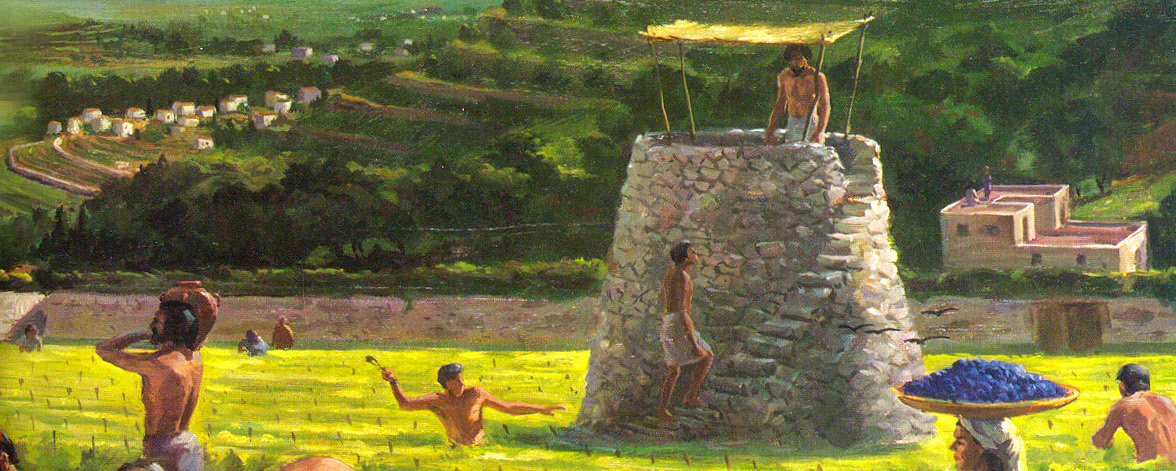
But let us enter this morning's reflection through the gate of our Gospel Parable. Do you know what the word sanctify means? Yes, it has come to mean "to make holy," but that is not its root meaning. At its root, sanctify means "to set apart" implying a very important (and evidently immutable) fact of our human lifeworld: the fact that our world is unholy. In our Gospel lesson this morning, we learn in a thinly veiled allegory that God has come into our dangerous world, that He has planted His Own Vineyard, and that He has bounded it off: He has set a hedge around it and has built a watchtower within it. The message is clear: the world must be pushed back, and the world bears watching. For this dark place is irretrievably the implacable enemy of God, encroaching if it could and seeking to undo all that God has done .... and ultimately to murder God Himself.
There are those who will retreat into fantasy singing nursery rhymes like, "He's got the whole world in His hands" or "The Man Upstairs is in charge" or reassuring themselves with nostrums like, "God is in His Heaven — / All's right with the world!" 1 But when Robert Browning wrote these oft-repeated lines, he put them in the mouth of an innocent girl living in an interior world of God and His goodness. Meantime, the world Browning depicted in the poem, surrounding this innocent, is a corrupt and dangerous place. As for the world God actually has on His hands, teetering on the edge of disaster, there is nothing God can do about it. Have we not seen large-scale catastrophes that God did not stop? He can only do what He has done in the past when His beloved Creation has crosses the point of no return: He can extinguishes it. For
|
The heaven, even the heavens, are the Lord's;
But the earth He has given to the children of men. (Ps 115:116) |
And this gift He cannot "ungive" for that would be to betray Himself. Every son and daughter of God, from the archangels to the infant born just this minute have been granted the Divine gift of absolute freedom. It is a tragic fact that most humans use this gift to rebel against God. Certainly, the angels of Heaven rebelled long ago causing a large proportion to be condemned to eternal punishment (Lu 10:18). Each of God's first created humans rebelled. And directly after the Flood, His second creation was polluted by father-drunkenness and mother-incest. Rebellion against God is the most common fact of life.
Without question, God seeks the world to be a Divinely lighted place, a place after His own heart. He desires that it be righteous and just, but it cannot be Divinely lighted nor truly righteous unless it is free. Only goodness that is chosen and defended and protected possesses that nobility that can truly be called Divine. Else, all is bust a shallow, and ultimately dead, puppet show with God cast in the role of pathetic Puppet Master.
No holy book that I know of is more centered on this dilemma than the Book of Enoch, truly a book for our times. 2 In a library of almost a thousand volumes discovered near the Dead Sea in 1946, 3 this book outnumbered all other "reading texts" (to be read sequentially from beginning to end) including our own favorites: the Genesis, Exodus, Isaiah, and all the other prophets.
Let us bring this into focus with the question, which books did the Apostles consider to be holy? Yes, there was the Hebrew Bible. But the four Gospels had not yet been written, nor the Pauline Correspondence, nor the Catholic Letters. They heard Jesus quoting from the Septuagint, 4 whose books (except Esther) were found in the caves at Qumran (written in Hebrew, by the way). Indeed, the books most frequently quoted by Jesus — the Psalms, Deuteronomy, Isaiah — occur in Qumran in roughly the same frequency (i.e., number of copies). Yet, the Book of Enoch is everywhere to be found in the mind of Jesus. For His mind was profoundly rooted in the Kingdom of God: a Kingdom of angels, of spirits, and of afterlife .... all subjects which the Zion Temple authorities banned.
Do you see? He does not quote from Enoch as He quotes from other holy texts (though His step-brother Jude does quote from the Book of Enoch). Rather, everthing Jesus says and does arises from the sensibilities of the Book of Enoch.
But why was everyone so fastened upon the Book of Enoch? Because this Book alone addressed the main subject before us (and before everyone always). It is the story of God's precarious Creation coming apart at the hands of faithless creatures. Pick up the Bible. Open it to page one. You will not have to wait long before you read about God's beloved Creation spinning out of control. The mind of man was on only evil continually, and there was no remedy, we find.
Yes, He made angels to be Divine, but they abandoned their own nobility choosing instead their animal passions — a fact mentioned in Genesis 6:1-4. And what do we read about there? Well, I will say this politely. Angels of Heaven abandoned their posts to have romantic relations with the daughters of men. The Book of Enoch is about the world becoming undone because of this lust and animal desires? (Sound familiar?)
But how can this original goodness be evil? No power ever created evil? But evil does not have to be created. Evil is the choice to turn goodness away from its own good purposes. Yet, if we and the angels do not have this power to pollute God's goodness, then the Creation fails lacking that sentient and holy motion we call life. Only God can create life; but we have the power to dishonor it .... or worse, to pervert it.
The Book of Enoch is named for first person in Genesis to have achieved Theosis, a reaching up for the ultimate goodness, which is be like God.
| And Enoch walked with God, and he was not. For God took him. (Gen 5:24) |
This is the highest goal of the human creature and the purpose of created life: to become like God. The Book presents a struggle between goodness, in the persons of Enoch, the archangels, and other faithful creatures, and the unfaithful creatures, including evil angels and even the seasons, winds, stars, and other heavenly bodies. You see, everything in God's Creation is organically connected to one thing: life and its freedom.
No doubt, this falls strangely on our ears. How could angels turn their backs on their Divine natures and descend into animal lust? Surely, this would constitute an anti-Theosis — the subtraction of the Divine part overwhelmed with low, carnal desires. The world literally recoils at such a prospect, devolving into chaos as the angels defect to earth pursuing their lusts and passions. For even the universe (in this third-century B.C. work) is composed of innumerable angels, all of whom possess free will — truly, a living world created by the Living God.
Do you reject such a picture as impossible? Remember, that no less a Divine Creature than the Risen Christ insisted that Thomas place his fingers inside the Lord's bodily wounds. And we commonly see the Risen Christ eating with His followers. And what does the Lamb on His throne say to us all?
|
"Behold, I stand at the door and knock. If anyone hears My voice and
opens the door, I will come in to him and dine with him, and he with Me." (Rev 3:20) |
"If anyone hears this knocking ...."? This surely is an insistence on physical experience. And we must accept that physical experience is a Heavenly property. Are we not resurrected body and soul?
The only remedy in our drama is to counter this anti-Theosis, which transforms Divine beings into lusting animals, with God's Theosis, which is the steady blooming of God's fairest flower: the unfolding of the Divine creature already set within us all. These holy seeds are within, but we must water them and cultivate them.
Did not Jesus again and again urge us to shed our worldly selves? "Metanoeite!," His Forerunner cried from the wilderness. Literally, "Be transformed in your nous!" (in the highest part of your soul). And at length Jesus revealed His Own Divine white and glistening Nous first on the Mount of Transfiguration and then as the Risen Christ.
God seeks to fulfill His Creation with such as His Son. His Son is merely the Exemplar. But the main thing is that we must follow. Does not Jesus say this repeatedly? "Follow me." I suppose we could say that this is for our benefit. But that is the least of it. Following Him is the only way to transform a catastrophe into God's Heaven.
His vision is choosing a world of righteousness and kindness. His Son has opened the Way showing us what and how we are to be. Else, the world grows darker with each passing day. Look out the window! At our command, it grows darker, even throughout the expanses of Heaven's Kingdom.
We say in our despair, "At least there is always Heaven!" But Heaven is organically wed to earth. If no one choose to be holy, then what happens to Heaven or to Heaven's God? If the angels defect what happens to Heaven? If everything and everybody God created turns against Him, what will happen to God. Well, God is inviolable, but it is obvious that the One thing God does not wish to be is Solitary albeit with the Company of Two.
We must choose! I am not a street preacher standing on a crate at the corner of Broad and Market Streets urging the world to repent! No. We are standing on the edge of a catastrophe! Which side are you on? Do you spend your waking hours pumping your body with dopamine? A prominent Stanford researcher describes the smartphone as a hypodermic needle injecting more and more and more dopamine.
Almost twenty years I was asked to chauffeur some teenagers in my Suburban. I looked forward to listen in on what they discussed, what interested them. But instead I beheld eight young adults staring at the lighted rectangle each held in their hands, doomscrolling.
God has planted the Vineyard
within each of us.
Build a sturdy hedge pushing the world back,
and
set a tower within it to protect what is most sacred,
which is yourself.
It is up to us to be
the Kingdom of God
and
to teach godly life to our children and grandchildren,
staying with them,
encouraging them,
and
being all that men and women can be for them,
for their sakes.
That's God's kind of love
—
the love of absolute self-sacrifice.
This is the only defense between ourselves
and
a chaos which, otherwise, finally will overwhelm everything and all.
In the Name of the Father and of the Son and of the Holy Spirit.
1
Robert Browning, Pippa Passes (1841) in The Poems of Robert Browning, Vol. 2 (Longman's Annotated English Poets, New York: Routledge, 1991).
2
1 Enoch, Ed. George W. E. Nickelsburg and James C. VanderKam (Minneapolis: Fortress Press, 2001).
3
Scholars have suggested that the Dead Sea Scrolls were texts confined
to an apocalyptic cult,
but there is no evidence of these.
Are we to believe that a thousand books,
stored in arid caves where the parchments and paper would be protected
from mold and bacteria,
were piled up for a small cult?
Moreover,
scholars have suggested that these fanatics also lived in the caves,
again without any evidence.
Isn't it more reasonable to assume only the library was stored in the cave
for safekeeping
and
the readers dwelt in villages?
I propose that this library was intended for all respectful readers.
4
Werner Jaeger, Early Christianity and Greek Paedeia (Cambridge, MA: Harvard University Press, 1961).