John 20:19-31 (Matins)
James 5:10-20
Luke 4:22-30
John 20:19-31 (Matins)
James 5:10-20
Luke 4:22-30
Where is this place?! Is this scene from Gad?! For the Gadarenes were so lost in their spiritual blindness, that they forced Jesus off of their shores though He displayed His Divine powers to them. No. Irony of ironies, this is Nazareth in the far North. And judging from our epigram this morning, Jesus was not manifestly in step with the people of the synagogue. But we must remember, the first synagogues were built by the Maccabees in the second-century B.C. for the sole purpose of promulgating their religious cult in Judah of the historical Southern Kingdom, called Judah-ism. The synagogues, therefore, wherever they were built were strongholds of Zion-temple belief. The rulers of the synagogues were appointed by the Sadducees (as far as we can tell).
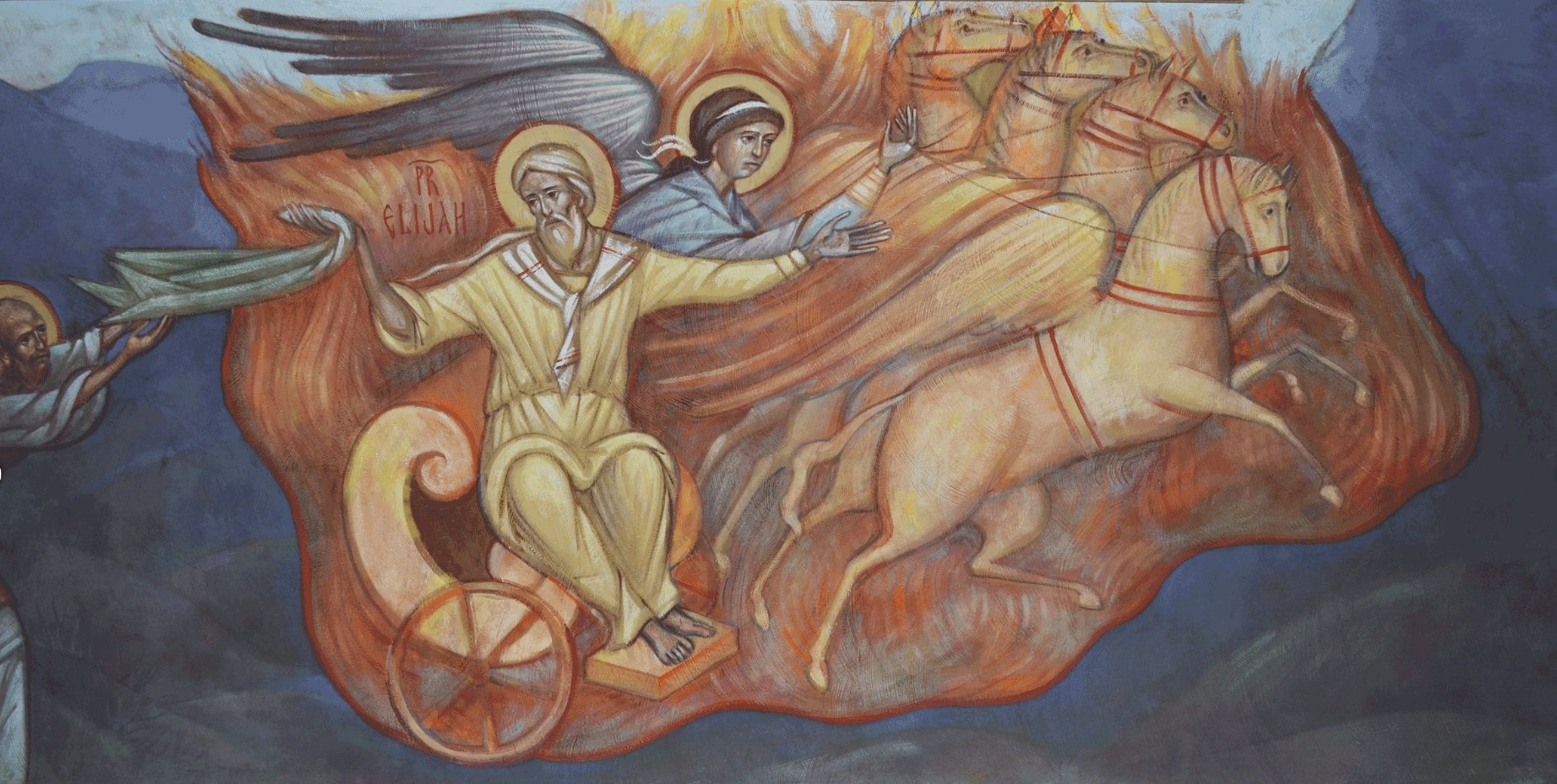
This morning, in light of all this, we observe the feast of our greatest Old Testament prophet, Elijah, called the "Father of Prophets" by St. Ephrem the Syrian, who never heard of Judah-ism, for Elijah preceded the Return from the Babylonian Captivity by three centuries. Elijah is also our oldest prophet by lights of the historical record. And we might respond, "The ninth century B.C.?! That's almost a thousand years before the birth of Jesus! What do we have to do with this?" But what is a millennium to the Ancient of Days? "But, beloved, do not forget this one thing," writes St. Peter, "that with the Lord one day is as a thousand years, and a thousand years as one day" (2 Peter 3:8). More to the point, Elijah is not a distant figure to Jesus. Why, Jesus considers Elijah to be very present, as we shall see in a moment.
Elijah healed, prophesied, raised the dead, and was received body and soul into the Bosom of Abraham. (Sound familiar?) His religion was not ritual offering. He enjoyed relationship with God praying to Him without ceasing and receiving direction from Him every day. That is, He was very like Jesus of Nazareth in almost every respect. Yet, there is an important difference: neither Elijah nor Elisha nor any of their contemporaries had ever heard of Judah-ism. The religion of the ninth century was that of the Patriarchs — Abraham, Isaac, and Jacob — who also had never heard of Judah-ism.
We have meditated many times on the two religions of the historical Northern and Southern Kingdoms and how the Son of God rescued the lost sheep of the House of Israel from spiritual blindness lest they finally and forever be lost to God. Yet, if we discern the subject before us more carefully, perhaps the ninth-century Northern Kingdom is afflicted by the same Babylonian religion that nearly annihilated the Southern Kingdom. For Baal worship, introduced by Jezebel to Ahab, with its deep roots in Mesopotamian religion, shared the same Babylonian heritage as did Judah-ism. You see the pattern: the true religion is worship of YHWH, and in Elijah's time as in Jesus' time, Mesopotamian religion intrudes. Is not this the master theme of both time periods?
The precise parallel between the Prophet Elijah opposing the false religion of his time and the Son of God opposing the false religion of his time explains the central importance of Elijah to Jesus. And it is sobering that the word baal and the words elohim and adonais, used to address the Zion temple deity since the time of Ezra, mean precisely the same thing. They mean "Lord" or "Master." And the Persians, who became the masters of Babylon in Jesus' time, used the word bel for the same purposes. (Note the presence of bel in the name of the queen of the Kingdom of Israel.) Meantime, Elijah served only YHWH. And we cannot forget that upon the Return from Babylon, many Hebrews in Judah must have faced the same shock as their ninth-century counterparts did in the Northern Kingdom. For the Returnees entering Jerusalem spoke a strange language, Babylonian, dressed in a strange garb, and they proposed a Babylonian religion. Many fled to Elephantine so they could build their own temple, called "the House of YHWH."
Now, this historical background is hard for Orthodox Christians to accept, much less to receive in their hearts and cherish. Yet, they willfully ignore the truth about Christ at their peril. Understandably, they grew up being told (as we were) that Judaism was ancient, that Abraham was Father of the Jews. But in the latter twentieth century, that opinion began to change on the basis of sound scholarship in several fields. 1 And now, especially in the past ten years, the weight of evidence is undeniable and overwhelming. 2
But I am certain that if the Church Fathers were alive today, they would now tirelessly be sifting through these recent evidences. These are precious and undeniable and coming in from several fields and subfields shedding Divine light on these most-important centuries — the centuries leading up to and following upon the Advent of God. But in the fourth century A.D. how could they know? The first-century lifeworld of Judah was consigned to darkness, sealed off by impenetrable rubble, concrete, and stone dust following the Roman destruction of Judah and following Roman construction of a pagan culture on top of it. The Hollywood movies did not make the sequel. The lifeworld of Judah was flattened, and a small version of Rome was built on top.
The Pharisees responded to this general destruction of their temple and homeland by departing for a diaspora with their texts and lesson plans intact and in order. Unopposed, they continued to cast an enormous shadow, the cult of Judah-ism, over the religion of the Patriarchs. You know, perhaps the greatest achievement of the Pharisees is that we now think of the Southern Kingdom as towering over the North, which was many times its better, larger, and having about three-fourths of the Hebrew population and accounted to be a world power. 3 Judah-ism, after all, has survived. Do you know that history books are written by the survivors.
Discoveries in the Dead Sea caves famously included a well-preserved, complete scroll of the Book of Isaiah, which was to one side to the Judah-ism project. And the big surprise at Qumran among its tens of thousands of scrolls and fragments was the evident "runaway bestseller" (judging by the number of whole versions which the fragments pointed back to): The Book of Enoch, which described a Kingdom of Heaven, angels ascending and descending, and the afterlife — all subjects that were banned by the Zion temple authorities.
The innovation of Judah-ism was detested by Jesus, the Apostle John, and the rest (attested especially in the Gospel According to St. John). So, here, we mark the great divide: the South devoted to Moses, whom the historical Southern Kingdom held to be the greatest prophet; the Southern religion distinctive for its offering of blood sacrifice and its idolatry of laws; and the whole characterized as "the customs which Moses delivered to us" (Acts 6:14). You recall that the temple authorities said this immediately before murdering St. Stephen. "The thing about your Teacher, Jesus, they told Stephen was that He wanted to destroy this place and take away the customs Moses gave us."
On the other side of this "Continental Divide" lay the Northern Kingdom, which had instituted Baal worship by other of the Queen and King. Nonetheless, the old ways were still present, being upheld by Elijah and his protegee Elisha, who prized the sacrifices of righteousness and life's goal, which was Theosis. The great exemplar was, of course, Elijah, who was perfect in virtue, who did not offer blood sacrifice, and who entered Heaven body and soul in the fulness of his spiritual maturity.
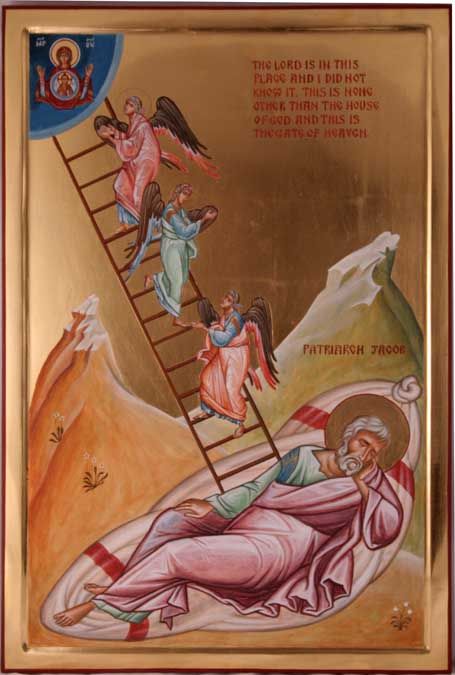
As Elijah had never died, the Hebrew people expected his return at any moment to restore the old ways. Yet, Jesus has a monumental announcement to make, an earth-shattering announcement. Who has ears, let him hear! Jesus announces that Elijah has returned, which must have had an electric effect upon the Eleven Disciples reared in the historical Northern Kingdom, like unto His announcement, "You shall see angels ascending and descending upon the Son of Man" referring back to the old ways of Patriarchs. He says,
|
"Assuredly, I say to you, among those born of women there has not risen one greater than John the Baptist ....
And from the days of John the Baptist until now the Kingdom of Heaven suffers violence, and the violent take it by force. For so all the prophets and the law prophesied until John. And if you are willing to receive it, he is Elijah who is to come. He who has ears to hear, let him hear!" (Mt 11:11-15) |
Jesus begins with words that surely will command attention, we would say, "fighting words": Among those born of women, none greater than John the Baptist?! But surely none is greater than Elijah! .... or Moses if you are from the Southern Kingdom. But listen more closely: Jesus proclaims that John the Baptist is not a prophet like unto Elijah. He does not announce that the Forerunner heralds the coming of Elijah. He says that John the Baptist literally is Elijah. Elijah, having lived these many centuries in the company of God is now preaching among God's people here. Withal, he continues in the company of God, that is, in the company of God the Son.
Well might we begin the new era (Anno Domini) renaming our years, "1, 2 3 ..." Well might we set a monument, for here is the long-awaited return of Elijah, who heralds nothing less than the Advent of God. Truly, the general plague upon the Judah-ites is blindness! Small wonder, it is blindness, both literal and spiritual, which Jesus most frequently heals.
But those who continue to claim Judah-ism as the basis for our Orthodox religion, have they not reprised the blindness of old, have they not reclaimed it as their own? Our legacy is not a tradition of blood sacrifice as the Western sacrifice of the Mass implies as the Protestant "bathed in the blood of Jesus" implies. You see, supporters of this idea adduce the "Epistle to the Hebrews" as proof of our blood-sacrificing heritage. But we need to understand that this title was added by Judaizing Christians during the second century in order to firm up their claim that Christianity was just a variant of Judah-ism. And this nameless epistle was plainly written for a specific audience, the Jews. (I suppose its second-century expositors grasped for a higher dignity by saying "Hebrews.") And never forget St. Paul's words, St. Paul who wrote this nameless epistle. Paul also wrote,
|
"I have become all things to all people so that by all possible
means I might save some." (1 Cor 9:22) |
Whenever St. Paul writes, you have to refract his words through this filter. This is a truth about St. Paul: he pitches his messages to the "likes and dislikes" of whichever audience he addresses. We must first ask whenever we interpret an epistle of Paul (really, when we interpret anything), "Who is the audience?" The audience is very important clue concerning the meaning of any epistle, book, or document.
But back to the main point.
We were
bequeathed
two Christianities.
The first is
Enochic Christianity, whose great Patriarch is Abraham,
which emphasized the practice of virtue,
and
whose aspiration and goal is the Bosom of Abraham,
which is the intimate company of God.
And
its greatest Teacher,
is Jesus of Nazareth.
The Christianity of Enoch.
The other is Jewish Christianity, whose great Patriarch is Moses, which emphasizes blood sacrifice (until about 70 A.D.) and idolatry of the Law, and whose aspiration and end was ..... well, it was debated by Pharisees and Sadducees. They couldn't agree on what it all added up to, eternally speaking. Its greatest teachers were the Pharisees .... and the Orthodox rabbis of today. 4
But all this is carefully and elaborately laid out in Jesus' Parable of the Good Samaritan, which clearly presents these two religions. First is featured a Northerner who practices virtue and is justified before God. Second, we are introduced to Southerners, Zion temple officials who offer blood sacrifice, who slavishly follow the Law, and in the end are derided by God.
Notably, these two religions do not converge, but rather diverge. The traditions of Abraham, Elijah, and John the Baptist would become Orthodoxy: the sacrifices of righteousness and Theosis. Any attempts to blend the two religions result in the grotesque. Let us try an thought experiment. Do you believe that John the Baptist called Jesus "the Lamb of God" — the humble one, the gentle one, the spotless one, the blameless one — with the idea that He should be slaughtered to effect our atonement with God? The notion of it is hideous at first blush.
At least for today, let us all set our gaze upon Elijah. Through perfect obedience, Elijah made himself an acceptable vessel to God. Isn't that the goal of daily life: to be an acceptable vessel so that God can use us. The Sisters have strived for decades, and they have succeeded in becoming acceptable vessels. And God filled Elijah with power and grace by that same measure, and God used him. For he was humble, carefully obedient, and faithful to God. He is the source for Jesus unforgettable saying: "Who sets his hand to the plow and looks back is not fit for the Kingdom of God" (Lu 9:62).
As Jesus models the high point of Theosis on the Mount of Transfiguration, we would expect none other than Elijah, the other great exemplar of Theosis, to meet Him there. But what are we to make of Moses, who will be forever notorious for his disobedience at Meribah. Why should Moses be there? As we have seen, Jesus was born into a world of two religions: the religion of the Patriarchs and the religion of Babylon, which is Judah-ism. No question the Jews regarded Moses as their greatest prophet.
As aside, I should add that Moses did not bring Babylonian religion to Judah. Ezra refashioned and revised Moses' books during the Exile. We took a close look at this revision three weeks ago with our reading of Psalm (51/52). If you are looking for a spokesman for your cause, you can't up with the a better pitchman than the confidant of God.
Nonetheless, Moses was notorious for his disobedience, but the Jews held him to be their greatest prophet. And we see traces of the cause for Moses' assumption into Heaven in the Biblical passage describing St. Michael claiming Moses' body from the devil (Jude 1:9). Suffice it to say, God meets us where we are. He must needs condescend, He must stoop down from Heaven, in every matter concerning humans. This is St. John Chrysostom's great point: God cannot do anything with humans unless he first condescends. And He does. The Prophets were written first, the Law was written second.
Withal, our journey starts from here. Let us say it begins today. And Theosis is our Way, our tradition. Jesus enjoined us not to be slavish followers of the Law of Moses. And we must never become idolators of our own tradition. Orthodoxy is the tireless commitment to the original, the true, and the uncontaminated. We are to follow the Holy One, the Pure One, the Lamb of God, Who shakes us from our slumbers and heals us of our stubborn blindness.
Sir, we would see Jesus (Jn 12:21)
and
then bend every sinew and nerve
in a living faith
that we might
understand Him,
that we might know God.
For
He alone is the Way, the Truth, and the Life.
In the Name of the Father and of the Son and of the Holy Spirit.
1
Yeheszkel Kaufmann, The Religion of Israel (Chicago: University of Chicago Press, 1960.)
2
See, for example,
John J. Collin, The Invention of Judaism (Berkeley: University of California Press, 2017).
and
Yonathan Adler, The Origins of Judaism (New Haven, CT: Yale University Press, 2022).
3
Israel Finklestein, The Forgotten Kingdom (Atlanta: Society of Biblical Literature, 2013).
4
By contrast to Orthodox Judaism,
Reconstructionist, Reform, and to some degree
Conservative Judaism have developed
in it several strands to become the "virtue religion"
of the "good Samaritan,"
approved by Jesus.
This is attested in Yiddishkeit with the common approbation mensch,
meaning "righteous."
And it is seen in the highest honor the State of Israel confers upon a non-Jew:
Righteous Among the Nations (Hasidei Umot ha-Olam).