We live in a fog. In Eden, we lived with God — with perfect Truth and Clarity. But ever since, we have been striving to regain that clarity. Isn't this the purpose of all our searchings? Isn't this the purpose of our universities? The official seal of my college included the Latin words Deo ac Veritate ("For God and Truth"). And then I spent seven years occupied with graduate studies at a university whose motto was the Latin Lux et Veritas ("Light and Truth") with the additional Hebrew words Urim v'Thummin, which referred to a kind of dice mentioned in Exodus, to determine God's answers to yes-or-no questions. You see, the principal object of all our seekings is to learn the perfect knowledge known only to God. And this is humanity's restless and never-ending quest. That we do not understand this — even believing that human knowledge supplies an alternative to God — is just more fog.
Up until roughly the mid-twentieth century, we were fastened on the word evolution meaning that this quest was linear: "all things are evolving," we would say, that small, adaptive changes are occurring in organisms or sciences or technologies or even ideas, always giving rise to truer versions of these things. This was our idea of Progress: one generation standing on the shoulders of another,
By contrast, the present era is in love with the word disruptive finally catching up to break-throughs made about sixty years ago. Forward progress, it is now said, is made through a disruption of current orthodoxies, the overthrowing of present ideas. Do you see a disruptive force around you? Quick, buy stock in its manufacturer or creator, for over here the fog is lifting, and truth will surely follow. At present "AI" is the standout instance of a disruptive force.
This basic change of our understanding of progress — from evolution, which is slow, steady, and linear to disruption, which is revolutionary and non-linear — occurred in the mid-twentieth century with the publication of Thomas Kuhn's book, The Structure of Scientific Revolutions, instantly celebrated as a landmark. 1 Kuhn said that scientific development is not linear or accretive. Rather, the history of science is the the history of science is a history of shipwrecks: great, hulking theories going down in icy waters with all hands lost. In many cases, nothing can be salvaged. Everything is lost.
An example of this is the theory of the Ptolemaic universe, which had been universally accepted for about 1,400 years yet was found to be 100% erroneous. Nothing about it was true. And it was overturned in a moment, a disruptive moment, with the publication in 1543 of Copernicus' heliocentric theory. It is from Kuhn that we get our phrase "paradigm shift" — the old is discarded root-and-branch, and the new is embraced and becomes the underpinning of everything (in that region of knowledge).
The most fundamental disruption in human history, the ultimate paradigm shift, was the Incarnation of God. With this cosmic and life-altering event, everything in the Creation changed forever — the meaning of human life, the purposes of being born and dying, the whole direction of the human lifeworld.
"But wait!" I hear the critic saying. "Nothing changed. Men still die and rot in a grave."
But the Incarnate One replies,
|
In My Father's house are many mansions; if it were not so, I would have told you.
I go to prepare a place for you .... and receive you to Myself; that where I AM, there you may be also. (Jn 14:2-3) |
And the Apostle Paul says:
| Now faith is the substance of things hoped for, the evidence of things not seen. (Heb 11:1) |
You see, This is one of the startling truths of science: all the so-called discoveries (the vast majority of which remain undiscovered) were already, are already, will be already there. All truths are already present and have been since the Creation of the world. What we are discussing this morning — from life-changing antibiotics to our sublime God — is the present human position, which is life in an endless fog.
But our God decisively cut through this fog as a navigator and guide. St. Athanasius wrote, everything was unalterably changed at His Conception, when God became Man. 2 To be precise, everything was re-made, created a second time. The telos of the human lifeworld flipped from withering finitude and death to eternal life with God. In this, what had been true from the beginning, Man becoming God, had been renewed. The early Father, Irenaeus, wrote that the destiny of Adam and Eve was they were to mature to the fullness of God, in that sense become God. And, as in Eden, the completion of this Divine work, lies with us — our faith in things unseen, our trust in God, our conduct of life. It all happened in a twinkling — as the Creator, the Logos, became organically wed to the Creation. This is the never-to-be-surpassed disruption of everything.
In the eons-long drama of God's peculiar people, historical forces were already converging at ground level. For always the purposes of God must strive and struggle against the ways of the world, which at the turn of the first century were rooted in the Zion Temple. In a mockery of God, Solomon's Temple had been rebuilt in the image of the worldly ambitions of man, captured in the word Babylon. St. John the Divine describes the final conflict in his Apocalypse — God, His Logos, and the angels opposing a mysterious dark power, which St. John calls Babylon (Rev 14:8, 16:19, 17:5, 18 passim, 19:1).
In the Gospels we see this struggle expressed as the sacrifices of righteousness (God's holy cause) versus the sacrifices of blood (Man's senseless striving). And the classic text meditating upon this opposition is the Northern Kingdom vs. Southern Kingdom tale called the "Parable of Good Samaritan." Here, a crossroads is set before us: the blood sacrifices of the Levite and the Priest versus the sacrifices of righteousness seen in the self-denying love of the Samaritan, being an Image of the Lord's own kindly sacrifices for us. For all Northerners were derisively called Samaritans by Judah-ites. But we have reflected on this most important text several times in past years.
It is this always-urgent conflict between God's expectations for virtue versus the practices of blood sacrifice, which occasioned Jesus' only expression of unrestrained rage (baffling centuries of New Testament commentators, I might add). You know what I mean: Jesus approaches those selling animals for blood sacrifice and says, "You have turned my Father's House, implying communion with God, into a place of trade (Jn 2:15). What is being traded? Blood in exchange for atonement with God.
But this crossroads had already been set before us in the Scriptures, at the heart of the centrally important Psalm 50/51:
|
Create in me a clean heart, O God,
And renew a steadfast spirit within me. Do not cast me away from Your presence, And do not take Your Holy Spirit from me. Restore to me the joy of Your salvation, And uphold me by Your generous Spirit. Then I will teach transgressors Your ways, And sinners shall be converted to You. Deliver me from the guilt of bloodshed, O God, The God of my salvation, And my tongue shall sing aloud of Your righteousness. O Lord, open my lips, And my mouth shall show forth Your praise. For You do not desire sacrifice, or else I would give it; You do not delight in burnt offering. The sacrifices of God are a broken spirit, A broken and a contrite heart — These, O God, You will not despise. Do good in Your good pleasure to Zion; Build the walls of Jerusalem. Then You shall be pleased with the sacrifices of righteousness. (Ps 50/51:14-19a) |
Here the ancient psalm ends.
This holy text is rightly held aloft and venerated by the Orthodox Church as the foundation, beginning, and echoing song of the journey of Theosis. For who can even start down the road of becoming holy, sincerely striving to consecrate one's life to God, with unclean hands and a guilty conscience? Until one's conscience is clear, until one's heart is right, until the spirit within us has been renewed, we simply cannot approach God, much less pray to Him. For He is holy. Therefore, we must be holy (1 Peter 1:16, Lev 11, 19, 20, 21, 22).
But this psalm — plainly stating that "the sacrifices of God are a broken spirit, a broken and contrite heart" — rankled the Babylonian scribe Ezra, who was secretary of the Persian governor Nehemiah. As we plainly see, Ezra's heavy-handed reply was flat contradiction, as he boldly appended his own verse: "the sacrifices of God are bulls, goats, and whole burnt offerings!" (verse 19b).
Now, Ezra's dilemma was understandable (if execrable). 3 For if the people accept that God desires only virtue, how would he be able to institute the Persian religious system of blood sacrifice? Nonetheless, we plainly hear the heartfelt, aching petition,
|
Ρυσαί με εζ αιμάτων ο Θεοσ ο Τηεοσ Θσ σωττηρίας!
/
Rusai me ez aimaton o Theos, o Theos ths soterias!
Rescue me from blood, 4 O God, the God of my salvation! |
And God heard this plaint, and moved to amend this grievous wrong, sending His Son into human history. This is the historical background for Jesus calling His disciples according to St. John. For these were all men rooted in the old ways, the ways of the Patriarchs, who were the model of virtue and righteousness. These were men of the historical Northern Kingdom of Israel who revered the Patriarchs excepting the eponymously named Judas (var. Judah).
Now, the North had been the traditional "diaspora" for the Hebrew peoples fleeing their Babylonian-speaking overlords, and especially a village to the far north, Nazareth. Did you know that Nazareth was the place where Jesus' grandparents had sought refuge. You see, the priest Matthan (Mt 1:15) had three daughters, two of which would marry in Bethlehem, just outside Jerusalem. Only Anna would reject Bethlehem and would marry her husband Joachim in Nazareth.
The scene is now set for the world's most disruptive revolution: God's third Creation of the world, but this time a spiritual one. God's part in this was to rearrange the earth itself (through the fury of the Roman Empire) ending forever the cult of Babylon in the hated Zion Temple razing the Jewish lifeworld to the ground.
Let us remember that the words Judah-ism and Jew refer to a Babylonian cult planted in the geography of Judah. For the ancient religion of God's people we use the term Hebrew. 5
The principals in this holy cause are three men. The first, of course, is Jesus of Nazareth — Who renews the earth, Who reveals the Kingdom of Heaven, Who gives a new law, Who teaches intimacy with the Father as the true and original religion, and Who (as Athanasius puts it) sits for the defaced and disfigured portrait of humankind, showing us what we are to look like, what our true identity is, and where we are headed. (As an aside, is it not clear that in our era, the era of widespread fantasy and illusion, the main problem confronting our young people is the crisis of identity?)
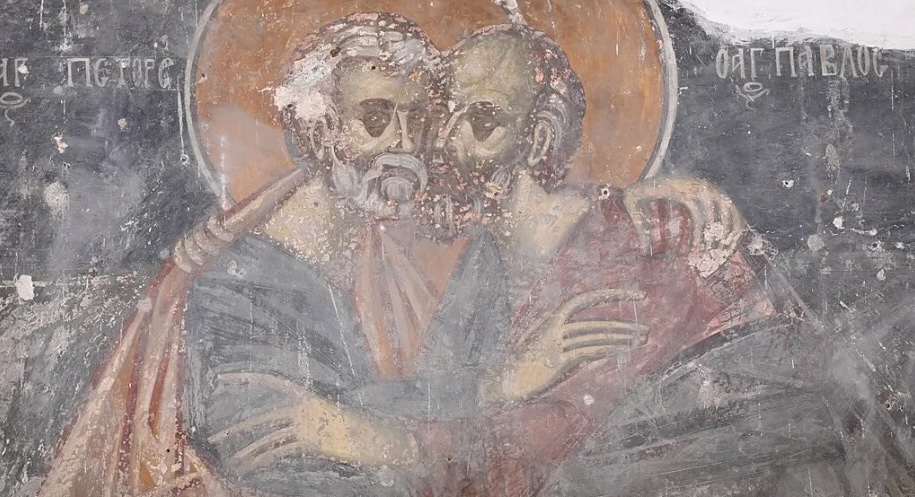
The other two, men whose feast falls on this day, are God's chosen pioneers. First is the Apostle Peter, who was a simple man of practicalities and a true Northern man, who hated Judah-ism (the practices of Judah) and Jerusalem.
Second is Saul of Tarsus, renamed the Apostle Paul. He had been the foremost apostle of Moses — a man committed to Jerusalem and the Temple, studying at the feet of the venerable Pharisee Gamaliel (Acts 22:3), and "concerning the righteousness which is in the [Mosaic] law, blameless" (Phil 3:6). But he would become the foremost apostle of Abraham, the exemplar of the pure religion of God — the religion of a life set apart from the cities of man, a life of intimate relationship with God, and a life of righteousness.
Peter and Paul declared that it was vain to search for God in histories and traditions. For God is always already now, here, always, everywhere: living stones built into a spiritual house (Peter), living parts of God's own Body (Paul). And together they laid the foundation for what we now call Christianity.
The earliest written materials of our tradition we owe to St. Paul, who wrote fourteen books, styled Epistles. Here, he laid down the earliest instances of Christian theology, ethics, and codes of conduct. The earliest Holy Gospel we owe to St. Peter, reduced to writing by an amanuensis (perhaps John Mark) and called the Holy Gospel According to Mark. Fully 89% of this Gospel can be found in our second Holy Gospel, attributed to Levi-Matthew. And Peter left us two epistles, the first of which provides our core ecclesiology — a gathering of kings, as Jesus said (Mt 19:28), in a Kingdom called Heaven.
We could say that together they wrote more than one-third of the New Testament, but the earlier point is more important: they set the cornerstone (chosen by God and precious) and the foundation of our faith. It would be they, appointed by God, who showed us the way through bloody darkness and endless fog into God's most splendid light and, before the Zion Temple was destroyed, before the cult of Babylon had been swept utterly away, they described a new and magnificent Temple of God, which had always already stood among us, ever since Eden, made of the only building blocks that are permanent and the only material that is holy — the living stones of God's precious humans.
It was the Apostles Peter and Paul who would conduct us and guide us to the unseen Kingdom, to become one with the invisible Father. And these are the words which proceeded, through Peter, from the Holy Spirit:
|
But you are a chosen generation, a royal priesthood, a holy nation, His own special
people, that you may proclaim the praises of Him Who called you out of darkness into His marvelous light; .... (1 Peter 5:24) |
1
Thomas Kuhn, The Structure of Scientific Revolutions (Chicago: University of Chicago Press, 1962).
2
St. Athanasius of Alexandria, On the Incarnation Bilingual English-Greek Edition (Rex Mundi, 2024).
3
Our historical background for this
is a Persian stele
from the period informing us that the foremost duty of a Persian king
is to ensure proper worship of their god.
And we remember the self-congratulatory words of his near predecessor in Babylon,
King Nebuchadnezzar II:
"Never has Marduk [the Babylonian god] eaten so well!"
4
The primary meaning of αιμάτων / aimaton
is simply blood, the "blood of animals or humans."
5
Cf.
Yonathan Adler, The Origins of Judaism (New Haven, CT: Yale University Press, 2022).
Shaye J. D. Cohen, The Beginnings of Jewishness (Berkeley: University of California Press, 2001).
John J. Collin, The Invention of Judaism (Berkeley: University of California Press, 2017).