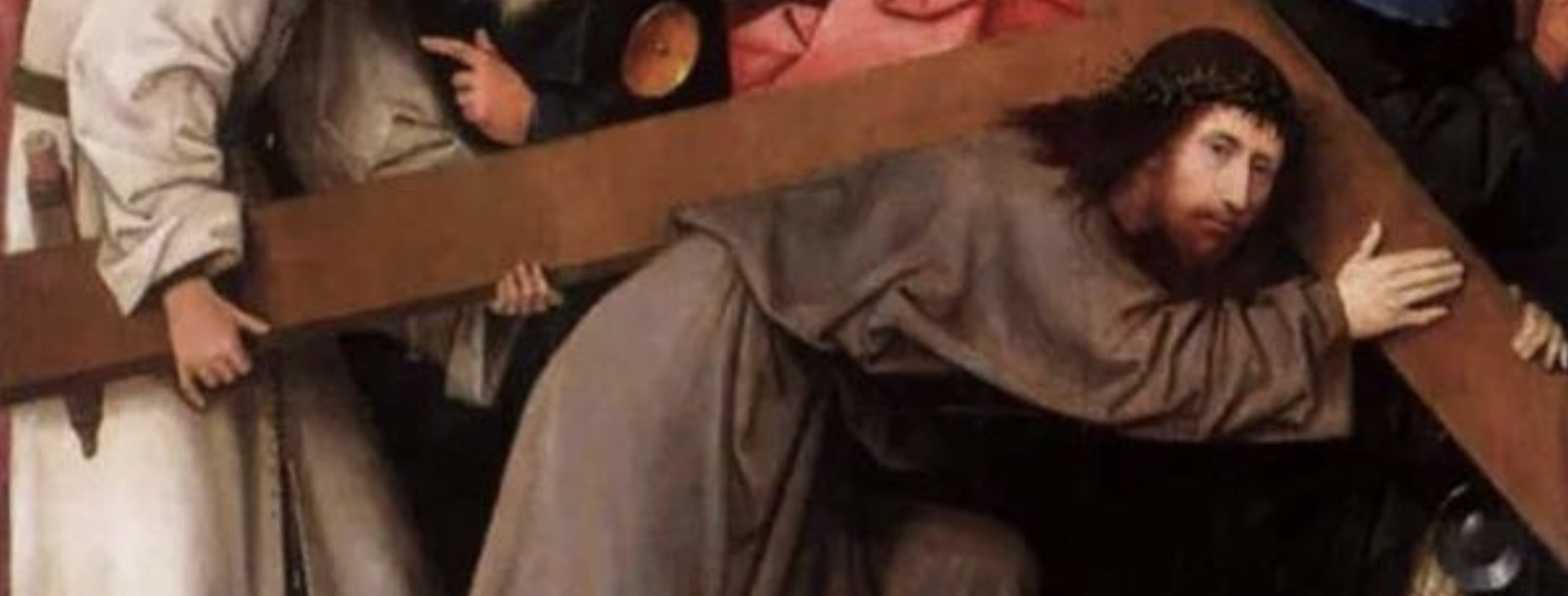
To take up your cross, we recall each Passiontide, was an obligatory part of Roman crucifixion. In this, the condemned man played a role in his own execution. A latter-day version of this gruesome ritual is still practiced in the form of a man being compelled to dig his own grave. But carrying the heavy cross, even the eight-foot-long, horizontal crossbar (the patibulum) was on a different order altogether. Have you ever worked on a construction site and been asked to move 6" X 10" X 8' beams? This would have been nearly impossible for a beaten and depleted Man. The gruesome spectacle of this same man, carrying this burden for hours, making His way, to the place of execution outside the city was cruelty in the extreme. In Roman Judea, this would have been a common sight during periods of unrest, for under Roman law crucifixion was the penalty for treason or rebellion.
Of course, from the point of view of the faithful Jewish Zealots (a political party) the cross would have been seen as the final, defiant, and glorious act crowning a life committed to patriotism. In that sense, the Zealot took up his cross every day from the time he he had first committed to the cause — a kind of morning prayer, psychologically to take up his cross.
I hasten to add that Jesus was no Jewish patriot, for an identifying badge of the Zealots was their refusal to pay Roman taxes. In opposition to this refusal, Jesus famously preached,
|
"Render therefore to Caesar the things that are Caesar's,
and to God the things that are God's." (Mt 22/21:21) |
Moreover, the familiar slogan of the Zealots, "No Emperor but God," would have been heard as a tragic irony as the King of the Universe stood right in their midst. No, Jesus had no part in this. In fact, Biblical scholars generally agree that among the Twelve Apostles was a defector from the Zealot party, Simon the Zealot. In that sense, the "House of Jesus" (school of thought) would have been seen as a rejection of the Zealots and an alternative to it.
This is the world in which Jesus preached and taught. His audience understood the phrase take up your cross and the difference Jesus intended. Yes, it signified "being completely committed" but not to the world, be it a Jewish lifeworld or a gentile. It signified a world apart as the other sentences in this passage affirm:
|
He who loves father or mother more than Me is not worthy of Me.
And he who loves son or daughter more than Me is not worthy of Me. And he who does not take his cross and follow after Me is not worthy of Me. (Mt 10:37-38) |
Do you see? This is no family activity. This speaks to the life choices (or death choices) of the individual. It is an imperative addressed to each person's heart.
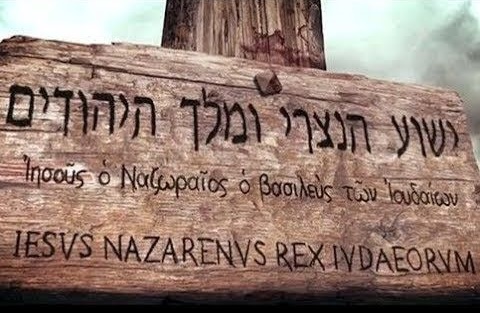
Crucifixion was mostly reserved for Jewish Zealots, and Jesus would be fitted up for the charge of treason. For though He had told Pilate that His Kingdom was not of this world (Jn 18:36), the Sanhedrin averred that Jesus had set Himself up to be a dangerous rival to Caesar, with tens of thousands being attracted to His marvelous teachings and works. And this goes some way to explaining the plaque which Pilate ordered to be affixed to Jesus' Cross (Jn 19:19),
| JESUS OF NAZARETH KING OF THE JEWS |
Can you see the intended tableau set before the world to consider: a helpless, naked beggar, utterly vanquished by the power of the Zion Temple enforced by the Roman military who had subjugated the world. Set against Caesar's golden laurels (worn upon his head), Jesus wears a crown of thorns plaited by Roman soldiers and coronated by the same mocking men. Directly above His head a imperial declaration inscribed in Greek, Hebrew, and Latin underlining its universal character declared in ironic tones, Here, O citizens of Judah, is your royal king!,
Let us stand at the foot of this Cross and see what the people there would have seen. We imagine a much-traveled and well-seasoned Roman soldier who had taken all this in. He had been present to witness all that had happened. He had watched Jesus being stripped and tortured. He had watched Jesus as He endured their insults and blows. He was there when Pilate pleaded with the crowd three times asking that someone offer a word in favor of Jesus. Here was the proof that it was true that every one of Jesus' followers had abandoned Him. The silence following Pilate's plea proved that Jesus had not a single supporter.
Our Roman soldier had been told by the Jews, whose religion was centered on the written word, that no teaching of Jesus had been written down — no Talmud, no Targums, no disciples to carry forward His "academy." He could easily understand the despair in the words Jesus Himself had uttered:
| My God, my God why hast Thou abandoned me? (Ps 22:1) |
Awed by this despair, the soldier cries out in response, "So even His God has abandoned this 'King of the Jews.'"
But a devout Pharisee nearby corrects the soldier. "No, He is actually saying a much longer prayer. For example, when we hear the word 'Shema,' every Jew stands in awe and reverence as a prayer of many lines resounds silently in his soul. No. This one phrase only begins Jesus' utterance."
The soldier asks, "Well, what is this longer prayer Jesus is saying?"
The Pharisee replies, "He is prophesying that all the earth and a people yet to be born will fall down and worship Him."
The soldier takes all this in: the humiliation, the utter defeat of this itinerant preacher, His present state bereft of every disciple and leaving behind not even a scrap of paper. We will soon be thrown into a nameless grave (as far as the soldier knows). He takes in all this in, and he looks out from atop this hill and sees fanning out in every direction the invincible Roman Empire ruled from an "Eternal City" (Tibullus, Virgil, Ovid). And he laughs. He thought a moment ago he had grasped this drama of the absurd in its fullness. But with this new information, now scaled to whole worlds and historical ages, he sees that he had not understood at all. For this was ludicrous beyond anything he had ever heard. And again he laughs.
How could he know? How could he conceive of a nation far more powerful than the Roman Empire, gathering its awesome strength nearly two millennia later, whose length and breadth boggles the mind. Let us now imagine the soldier climbing into one of the chariots of this land which could reach unbelievable velocities. Let us imagine him driving throughout this country which stretches on and on for says, taking the full measure of its towns and cities. And in each, seen from a distance, perhaps from the brow of a hill, he would behold its largest and most imposing buildings, crowned with spires reaching dizzying heights. They immediately stand out.
And he asks, "What are these structures bespeaking such towering authority and power?"
And he is told, "Do you remember that naked, abandoned beggar, hanging on a cross? These are places where people gather week by week, some every morning, to worship Him .... nearly a half-a-million churches in America.
Is it not sobering to consider that you and I are that people yet to be born mentioned in Ps 22/21. It is we who have fulfilled this prophecy compassing "all the earth." Truly, through the World Wide Web, even this humble hermitage, this impoverished place, of two elderly nuns and one frail priestmonk, facing ceaseless chores midst mud and ever-advancing jungle, carry on this ministry, which reaches tens of thousands of Christians every week in twenty-five countries. Do you see how outlandish is Christianity? The remote and the impossible are God's stock and trade. Yes, the earth has fallen to its knees in adoration of this reviled and abandoned beggar, who revealed a Kingdom of God.
We at the Hermitage left the world decades ago in search of that Kingdom. For Jesus does not pray for the world, but only for those who belong to God (Jn 17:9-19). We have taken upon us His yoke which turns out to be a cross. And though we did not fully understand it (nor do we understand it yet), taking up the cross everyday has kept us clean of the world that is always invading. Our crosses have sanctified all that we do. And our crosses have sustained us as we live to one side of the world, which reviles us. And we cannot understate that: reviled by Christians and non-Christians, reviled by the Orthodox and non-Orthodox.
As we "get to the bottom of things," yet we still have not grasped the life-giving properties of the Cross, by which we are both condemned and saved. And we follow Jesus under this sign because He has commanded. That is all we need to know.
We might say, this life makes no more sense today than it made to our imaginary Roman soldier about two thousand years ago. Taking up your cross daily and following the Lord will not lead you to acceptance and popularity, will not win approval, will not secure financial independence, much less to riches or fame. For the Son of Man had nowhere to lay His head. And everywhere He was reviled. Do you recall His visit to the lost tribe of Gad with staves and jeers.
He was born among outcasts in a cave, midst mud and barnyard animals and their dung-stained hay. His only crib was an old, wooden feeding trough, which, no doubt, stunk of mold and bacteria. Can you imagine what becomes of vessel holding water and feed, which is then stored in a warm, dark cave?
He would hail from reviled Nazareth and even there would be rejected. Truly, He got to the bottom of things.
I read that see that Christianity is said to be declining. But that is possible, for God and His Kingdom do not decline. What pollsters really mean is that people are fickle. And during the past twenty years, the number of those who identify as Christian has dropped from about 80% of all Americans in 2007 to about 70% in 2026 (Pew Research Center). During that same time, the population segment that grew most rapidly is called the Nones. The Sisters' faces brighten, but I do not mean those kinds of Nuns. I mean N-o-n-e-s, people who believe nothing. I am glad that they have been granted a category in this respected study.2 For the choice of None and Nothing represent a formidable decision: the decision to reject Almighty God and all its consequential sequelae. And while the "Nones" may not realize it, they have committed themselves to a deep form of religious formation, the formation of nothing-ness, called nihilism. And their eternal portion, therefore, will be precisely what they have chosen, which is .... nothing and nothing-ness. For that which is not of God, Who Alone Is Everything, can only be Nothing, Vacancy, Desolation.
Look around you. Do you see this vacancy written across their faces and expressed in their life choices? Their faces are wan and gray. Their lives are weary and worn down. All who have progressed in this formation are anxious and depressed. In fact, depression represents 99% of all mind-brain ailments in the U.S. and is the leading cause of disability for the age group 15-44.2 But if the Nones are a minority at present, how can I propose this connection to depression and anxiety, which in some age groups is nearly universal? I will answer this question with a different question. How many people who profess Christianity are Christian? How many pick up their crosses every morning? How many follow the Lord closely in everything that they do? How many would the Lord recognize to His disciples? Do you recall His chilling words?
|
"Lord, Lord!" You call me Lord .... I say that I never knew you!
Get out of My sight!" (Mt 7:21,23. My translation.) Ού μα̃σ ὁ λέγων μοι Κύριε Κύριε .... εισελεύσεται! Ουδέποτε έγνων υμα̃ς αποχωρει̃τε! |
To those who are shocked by this, I ask, have you not read that the God of All invited everyone to the Wedding Feast of His Son (Mt 22:1-14), which is the Marriage of Heaven and earth? Many guests came to the banquet in full confidence of their worthiness, but there they were noticed by the King of Heaven, for their hearts were not right. And they were consigned to "outer darkness where there is wailing and gnashing of teeth," says Jesus (Mt 8:12, 22:13, 25:30). Did you know that bruxism, or teeth-grinding, is a leading symptom of anxiety and depression?
But He has given those who have requited His love
a magical shield,
a Divine protection,
which insulates them against this life of emptiness,
devoid of meaning,
and
ruled by random passions and impulses.
This shield is equal to every adversary and tempting demon,
never losing its power,
for it,
mysteriously,
is one and the same with the Cross to which was nailed Pilate's proclamation of His Kingship:
the Holy Cross.
The Holy Cross
was planted deep in the earth of the world's
hatred and corruption and treachery.
It was man's dagger in the very heart of the Creation,
which was God's dazzling, miraculous, and life-abundant gift to us.
And man's reply to this gift of life,
which we ourselves could never create,
was death,
our only pretense to such mind-bending power.
You see,
we cannot create life,
but extinguishing it fills us with a thrill.
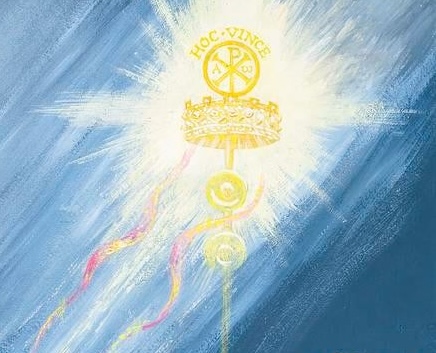
Ever-after, a great power and might is granted to those who contemplate the meaning of all this and take up and put upon them this Cross. "In this Sign you shall conquer!" St. Constantine the Great (whose feast day we celebrated Wednesday) would say, you can read it in the all-knowing and sovereign Heavens above:
| In hoc Signo vinces. |
The Master enjoins us to pick ours up daily and to carry it faithfully and hold it up as our buckler and our shield. For the world is a most dangerous place. And He prays, not for the world, but for those whom the Father has placed into His hands, which it turns out, is everyone. And those who love Him begin each day by picking up their crosses.
What was the most striking thing about Haiti? I was asked by the deacons and priests of the Roman Catholic Diocese of Portland, where I had served. I replied the one standout thing is the radiance of the people. I do not mean the living saints of God, and, truly, they were radiant. I mean the people. The churches are alive with their faith. Every Sunday they put on their very best clothes, which were immaculately clean. Their sincerity is palpable once the Holy Mass begins. And when Jesus appears and the consecrated host is held high, you see tears streaming down their faces. You see, these these people are cast down by others, but they are not downcast. They are filled with hope, and of all the people on earth, they gladly bear their crosses everyday. And their devotion to the Crucified One is unsurpassed .... at least in the wide world that I have seen.
Let us take up our Crosses
and wear it where all can see.
Are we not a royal child of the Most High God?
And
are we not a
brother or sister of the First-born of all Creation?
And are we not joined to a vast fellowship
in every part of the world?
It is called the Kingdom of God,
and
each subject in this splendid Kingdom
is marked as Christ's own,
first and foremost
because they are children of the Cross.
In the Name of the Father and of the Son and of the Holy Spirit.
Amen.
1
Pew Research Center. "Religious Landscape Study: 2023-2024."
2
Kessler RC et al. "Prevalence, Severity, and Comorbidity of Twelve-Month DSM-IV Disorders
in the National Comorbidity Survey Replication (NCS-R)."
Archives of General Psychiatry, 2005 Jun; 62:617-627.