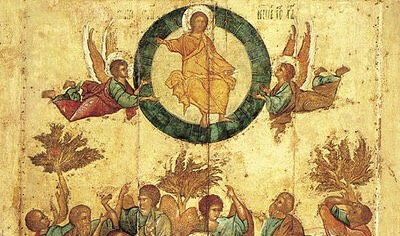
Mk 16:9-20 (Matins)
Acts 1:1-12
Luke 24:36-53
Lightness of Being
They were terrified and frightened, and supposed they had seen a spirit.
(Lu 24:37)
In the Name of the Father and of the Son and of the Holy Ghost. Amen.
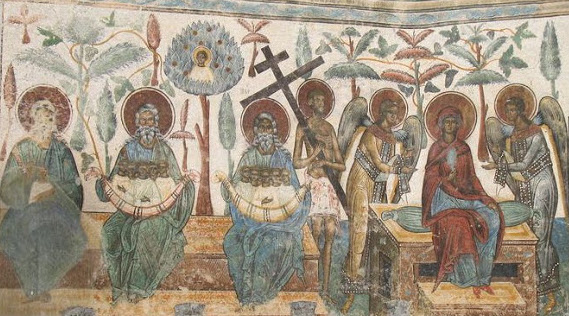
With the Ascension of the Lord,
we celebrate the completion of "failed Adam's" course
by the "New Adam."
According to the Early Church Father, St. Irenaeus,
Adam was created as an infant to model for his posterity
the right and good path of maturity fulfilling his Image which was God, His Creator.
Thousands of years later,
God was born into the world,
to "recapitulate"
Adam's course,
but this time completing it.
The four Greek letters constituting the word ADAM correspond
to the cardinal directions of the compass,
which in turn point to the Cross,
which is the compass for all humanity
pointing "True North"
and
the Way
back to Eden,
which is the Bosom of Abraham,
which is the Kingdom of Heaven.
The history of mankind has been a struggle between
men who would pervert God's plan
and
those who would enshrine their own lives in it.
We call this former group the "sons and daughters of perdition,"
for they are lost
and
can no longer see the Kingdom of God,
nor find their way back to it.
The latter group,
the assembled Ekklesía,
has been transformed into images of the pristine Adam and Eve,
which we call "the Way."
For the Kingdom is constantly coming into the world welcoming
the faithful sons and daughters of God.
The Ascension of the Lord marks the completion
of Adam's course.
It will now be left to us to follow Him in His Exemplary Life.
The Gift of the Holy Spirit will lead and guide us (Jn 26:23).
The Master will be with us until the end of the age (Mt 28:20).
But the real and substantial work has been done.
The path to Eden has been opened.
And we have been taught all things necessary to follow Him
in our own journeys of
Théo̅sis.
At the center of this struggle between rebellious perversion and faithful goodness
is a question of blood.
That syllable falls on our ears as alien and unwelcome.
But, you see, the ancients believed blood to be the material substance of the soul.
Thus,
God's covenants with
His human creatures
and
the decrees of the first Church council
center of blood.
Remarkable!
What didn't they tell me this in CCD or Sunday school?!
Today, on the Feast of the Ascension,
let us consider
what
the Incarnation of God during Jesus' earthly lifetime had been about.
We have considered that Jesus was sent by the Father because
the Kingdom of Heaven had become utterly lost to God's people.
Heaping high many thousands or tens of thousand of corpses
—
of bulls and goats and doves
—
the people could no longer see God through this bloody haze,
nor find their way back to God.
You have heard that St. Athanasius wrote,
the portrait of mankind had become disfigured.
We no longer knew what we were supposed to look life,
which is daughters and sons of God.
We no longer knew where we were supposed to be going,
which is the Kingdom of God.
This catastrophe began in Babylon
though the Twelve Tribes from the beginning had
struggled against idol worship,
which equates to sacrificial offerings of blood.
Do we get that?
Idol Worship = Blood Sacifice
They are one and the same.
But it would be Babylon that marked the watershed:
the death of the religion of Israel,
revealed to Abraham,
and
the birth of a new hybrid-religion required by Mesopotamian overloads called Judah-ism.
1
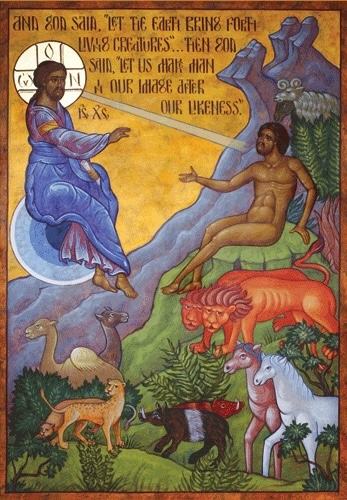
We know that the religion of God revealed in Eden was completely alien to blood lust:
|
And God said, "See, I have given you every herb that yields seed which
is on the face of all the earth, and every tree whose fruit yields seed;
to you it shall be for food. Also, to every beast of the earth, to every
bird of the air, and to everything that creeps on the earth, in which there
is life, I have given every green herb for food"; and it was so. Then God
saw everything that He had made, and indeed it was very good.
(Gen 1:29-31)
|
The Babylonian Talmud (from which Jesus quotes)
was explicit on this point:
Adam was prohibited from eating meat.
The Noahic Covenant,
again,
centers on the prohibition on blood-shedding,
including
the lower animals:
|
"Every moving thing that lives shall be food for you.
I have given you all things, even as the green herbs.
But you shall not eat flesh with its life, that is,
its blood. Surely for your lifeblood I will demand a
reckoning; from the hand of every beast I will require it,
and from the hand of man. From the hand of every man's
brother I will require the life of man."
(Gen 9:3-7)
|
Do you see how how these phrase and concepts morph into each other in this passage?
Whether in animals or in man,
ensouled life
is the subject.
The related thoughtworld of Antiquity
is expressed with precision by Aristotle,
tutor
to
Alexander the Great,
who laid the foundation (Paideia)
for that thoughtworld in the Levant
and
in
the rest of the world.
Aristotle wrote that we behold life as three orders of souls,
each being a subclass of its predecessor:
|
In plants the Vegetative Soul governing growth, reproduction, and (most important for our purposes) nutrition
In animals the Sensitive Soul governing mobility, sensation, and perception, and, in some animals, memory, imagination, and voluntary motion
In humans the Rational Soul governing self-consciousness, thought, and prayer & contemplation
(De Anima, Books II-III)
|
Yes,
God seems to make the concession,
permitting the generations of Noah to eat meat,
but this blatantly falls far below the Divine ideal,
falls far below the Creation as it was known in Eden.
I freely call the Hermitage the Kingdom of God,
the Bosom of Abraham,
Paradise,
Eden.
We strive to live as the pristine Adam and Eve.
St. John the Forerunner,
whom we have called
"the man of Eden,"
refrains from meat.
He was a Nazarite,
a man who forswore meat through unbreakable, solemn vows.
His diet consisted of the perfect food of honey cakes.
The Greek word for this manna,
ένκρις (énkris),
sounds very much like the Greek word for locust,
ακρίς (akrís),
so
we have been handed the ridiculous image of the man of Eden preying on insects!
Jesus and the Apostles refrained from meat to the extent that they were
fish-eaters.
(We have already proposed that Jesus did not slaughter a lamb at
the alien Passover,
which St. John styles "a feast of the Jews" (Jn 6:4).
He says, "This what the Jews do.
This is not what we do."
The
Essenes attested a different Passover, which was celebrated as offering sacrifices of righteousness (Ps 4:5, 50/51:19).
Later,
the subject became
of paramount concern at the Council of Jerusalem (48-50).
Indeed, three of the four Council "decrees" (called collectively the Apostolic Decree)
were these:
abstain from meat polluted by idols,
abstain from the meat of strangled animals,
abstain from consuming blood.
Is not blood, then, what this Council was about?
Again we note that idol worship is equated to the offering of blood sacrifice.
Strangled animals were singled out because they were full of blood.
Their blood had not been drained.
This struggle was writ large across the culture of Classical Antiquity:
those who practiced the "sacrifices of righteousness"
and
those who were idol worshipers.
For with
the emergence of the Way,
with God's destruction of the hated temple which had become
an animal-sacrifice factory,
and
with Jesus'
clear
teachings on this subject,
the fog has lifted to the extent that we see in a clearer light:
Jesus' rage in the temple
directed at the sellers of animals to be sacrificed.
For these men had cast the Father in a role indistinguishable from an idol
receiving blood sacrifices.
Is this not crystal clear?
Remember,
the Zion temple was built under Mesopotamian (i.e., Persian) supervision.
Ezra had revised the Scriptures to the satisfaction of a his pagan overlords.
The proper Name of God, YHWH, was not to be mentioned.
The Jews used the terms Elohim and Adonai meaning "Lord,"
which was precisely what the Persians called their god.
Hebrews fled to Elephantine (an island on the Nile River)
and built their
own temple.
Do you know what they called it?
The "House of YHWH."
These poor Hebrews were then
pursued by the Persians,
who demanded that blood sacrifice sacrifice be offered in their temple.
You know, people have buttonholed me at receptions following Eucharist
saying,
"Father, you see, the Name of God was so holy that it could not be written or said."
I replied,
"Is that so?
And is this why a multitude of pious Hebrews fled
from Persian Jerusalem,
built a house of YHWH,
and wrote the proper name of God all over their walls?"
No,
God's proper Name was suppressed because
to voice it clearly indicated that the Jews were not worshiping
the Persian god.
This struggle continued to the time of Jesus' birth and lifetime
and
is seen at the center of
the early Church's
formation.
But following the ways of the Forerunner and His Christ,
we know Christian life
to be
a refuge from the madness of meat and blood.
Christian life is gentle,
it is mindfulness,
it is occupied in daily prayer,
its spaces are filled with silence,
its nuns tread softly,
and
they look back on a life
spent kneeling among the poor.
They have
their minds well-filled with Scripture,
and,
as these weekly reflections reveal,
their
thoughts are ever-fastened upon Heaven.
What does Jesus say to such people
who practice the sacrifices of righteousness?
What does He say to them?
He says,
"You are not far from the Kingdom of God" (Mk 12:34).
The Ascension of the Lord is our enduring icon of that lightness of being.
It is our cynosure, our Polaris, our uttermost goal.
We ought to think on it always.
(And we do.)
The Christ has ascended.
And nothing on earth might claim Him.
Nothing might pull Him earthward.
The Accuser searches in vain for a just charge to lay at the feet of the Christ.
For to journey towards Divinity
is to practice blamelessness and self-giving love,
becoming light as a feather.
I recall a Quaker preacher who preached on this theme.
He imagined that a Shaker chair
lacked the weightiness of the world
such that an angel might be seated.
The saints and apostles
have arrived to this lightness of being,
to this stage of
Théo̅sis.
They all are changed
experiencing their own Divinity,
rising above their previous fears and desires,
and
filled with that thing called
dumamis
which is Heavenly power:
|
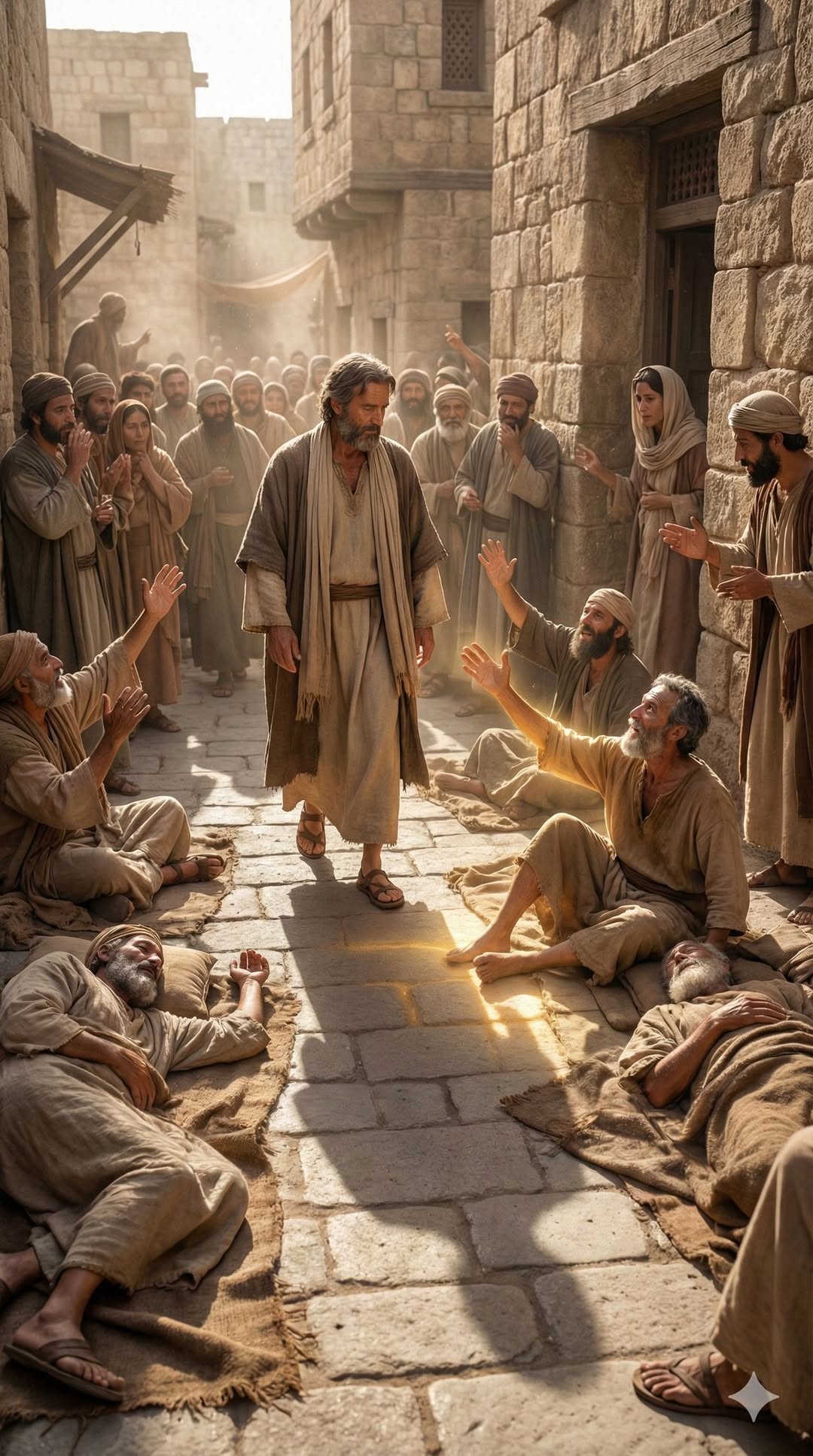
Insomuch that they brought forth the sick into the streets, and laid them on beds
and couches, that at the least the shadow of Peter passing by might overshadow
some of them ....
(Acts 5:12-16)
|
.... and be healed.
And this
And God wrought special miracles by the hands of Paul:
So that from his body were brought unto the sick handkerchiefs or aprons,
and the diseases departed from them, and the evil spirits went out of them.
(Acts 19:11-12)
|
We have a thread of cloth upon our Altar.
It is from a garment worn by St. Anne,
the mother of the Mother of God.
We believe that drawing near to it is to draw near to holiness.
This is the doctrine underlying all holy relics.
St. Peter's shadow,
handkerchiefs and aprons that had touched St. Paul's person,
the words of their prayers,
the laying on of their hands ....
manifestly, power and blessing is falling and filling the nascent Church
with
the qualities of Heaven.
Yes, the fulness of God's plan is unfolding.
And all was carried along
on a wave of Divine grace.
But with the influx of the Church's new members,
noisy with their vain, former beliefs
and
adamantine demands,
the Ekklesía became heavy with the
the world's confusion.
Look back.
Is this not the central drama of human history?
In its innocence, Eden was indistinguishable from Heaven.
But with Eve's and then Adam's consent to restless ego and passions,
humanity descended into recriminations,
wrong desires,
even blood lust.
In its brief age of blamelessness,
the Flood-cleansed world
shone in its pristine beauty,
fragrant of the morning of the earth.
But with Noah's consent to drunkenness and his wife's consent to incest,
all purity and sanctity was lost.
God always flees abominations.
And the clouds hung low obscuring the Kingdom of God,
and
man grew hot in his full-blooded passions.
What precisely were the early martyrs charged to do?
They faced a trial whose consequence was life or death?
Of what did that trial consist?
They were required to offer blood sacrifice to a god.
What were the Hebrews before them charged to do?
They were required to make blood sacrifices in the Persian temple
called Zion.
And what was the Council of Jerusalem really about?
It was about blood
as it decrees reveal.
We are caught in a struggle between the heaviness of our over-heated bodies
and
a lightness sufficient to ascend to the Kingdom of God.
Yet,
still many Christians imagine that Jesus must be sacrificed like a bound animal
in order to secure our salvation.
Could their be anything more offensive than this idea.
Over and over again,
Jesus' Blood is demanded
as I hear echoes from the Gospels:
"Crucify Him!
Crucify Him!"
Do you mean the gentle Jesus of ethereal sensibilities
Who ascended to the Father Who Is Spirit?
You want to sacrifice Him?
The gentle Jesus who taught us
Théo̅sis.
Nowhere is the Gospels is blood sacrifice mentioned as something
to which
we need to pay attention ....
except to hear Jesus inveigh against it.
But,
dear people,
Jesus had already opened the way ahead with His Gracious Life.
He had completed the course of Eden with power and grace.
And
He had taught
through His Parable of the Good Samaritan
and
proclaimed in the temple angrily,
"Not blood sacrifice but the sacrifices of righteousness!"
Nonetheless our tradition has enshrined the demands of the Judaizers.
The compromises struck by the early Church are with us still.
And the mentality of offering blood for salvation
has paralyzed the religion of God,
which is
Théo̅sis.
Do you see?
If Jesus has done it all for us,
then
why do we need to do anything?
In fact there is strong tradition in Christianity
which says,
"I can't do anything.
He did it."
Far worse that this,
our God grieves,
He grieves with every next demand for sacrificial blood to be extracted from His Son.
Rather,
when we encounter
the Son of God,
He wishes to sup with us.
That's the Blood He has in mind:
to dwell in us
and
we in Him.
This is the Wedding Feast of Heaven and earth,
the Supper of the humble and blameless Lamb.
And through this
He teaches us humility and self-denying love.
For following His ways
and
living His kind of life,
we may
enter the gentle spaces of godliness
—
our minds resting in Him
and
our eyes cast ever upward
anticipating the happy reunion with our Beloved Lord.
Let us live the life of mutual godly affection,
by which we are known as His disciples.
Let us get on
with the completion of our own courses
unto
Ascension.
With His help,
and
by helping each other with the quality of love
He taught us,
we are bold to trust the promises of Christ,
even the Ascended One.
And
at the end of our several journeys
we shall
experience
the weightlessness of Him Who loves us,
Who has prepared a place for us.
If it were not so, He would have told us (Jn 14:2).
In the Name of the Father and of the Son and of the Holy Ghost.
Amen.
1
Yeheszkel Kaufmann, The Religion of Israel (Chicago: University of Chicago Press, 1960.)