"Sexual sin drags more souls to Hell than any other." This was the pronouncement of the Most Holy Mother of God as she appeared in Fatima, Portugal in 1917 before 70,000 witnesses including scientists, journalists, and determined atheists who were bent on debunking such things .... 70,000 who then witnessed the Dance of Sun with terrifying balls of fire. 70,000 witnessed this.
Now, we say the Seventh Commandment proscribes adultery, perhaps suggesting that everything else is left to our discretion. But isn't every sexual sin adultery? Doesn't every sexual sin adulterate our souls and bodies, pollute us? Jesus counted sexual fantasy as an instance of adultery (Mt 5:28).
And what about the sin of idolatry? Do we not bow before sex as a god, devoutly worshipping its images for hours and hours in the form of pornography? Is it not on our minds everyday as we roam about the sidewalks and street, airports, stores, restaurants? Do we not dishonor family by desecrating the holy rites which God has ordained to be practiced only by a husband and wife?
Do we not steal, even murder, by robbing a young woman or young man of the gift of their purity, which, once despoiled, can never be offered again? Something that we don't talk about at all, is that when a boy or girl is molested, usually within the context of family, this forms them. It changes them. One father I read that his son had become irretrievably sexualized. He cannot walk down the streets without fastening his eyes upon the female form and responding sexually. By a choice not his own, the demon has entered him in precisely this way and will now deepen his hold. We don't discuss this (to our everlasting shame) because of embarrament.
Which form of covetousness is more common than desiring a married woman or a married man? You might be surprised at how common this is, but a priest is not.
It is right that St. Mary of Egypt should be our last meditation before we turn our eyes to Jerusalem and behold the Holy Cross, which is the distillation of all our self-aggrandizing cruelty and implacable ego. Yes, the Cross is about us, for we the faithful did not come forward to claim Jesus as our ransom but instead chose Bar-Abbas. For we must be absolved of our crimes against others, against ourselves, and against God before we can enter the intimacy of weeping for His passion. I say intimacy .... Jesus is not an impersonal, though potent, talisman that we raise up in order to claim forgiveness. Forgiveness is something that is most intimate. We approach the person we have wronged, face-to-face, baring our souls. We confess our sins before them. We humble ourselves before them. And we pray longingly for their compassion and absolution. Forgiveness is a most intimate act.
Unsympathetic legal scholars point to certain twentieth-century Supreme Court decisions as bringing about the ruinous trend in American society called the tyranny of the minority. We assume in our democracy that if we all decide something ought to become law, it becomes law. I come from Northern New England. In many small towns, we have direct democracy, major decisions are decided on an up-or-down vote. That's democracy. Winners win; losers, lose. Yet, in California not so long ago a plebiscite was held to decide on the state requirements for marriage, that is should be reserved to one woman married to one man. The vote carried in favor of traditional marriage. But this was not enacted in law. In fact, the opposite happened. The same thing happened in Maine. Why? Because the minority was not being protected. But isn't this in the nature of democracy. The will of the majority is carried out. The will of the minority is not carried out.
Consider the ruling in favor of Madalyn Murray O'Hair, which banished prayer from public schools. The majority desired public prayer in public school and, indeed, in all public gatherings. But this is nothing compared to other privations suffered by the majority — including holy marriage, the sacred family, and the rearing of our boys and girls in safety and decency .... all sacrificed to protect the rights of imagined oppressed minorities. How publishers of pornography? Shouldn't they be be procected? And, indeed, they have. What about drug pellars? They too are slowly being granted protections under law.
All of this proceeds from the dubious assertion that each person has his or her own truth. Do you see, if you remove morality, if you remove a standard for what is right or wrong, doesn't society quickly devolved into a free-for-all?
But Orthodox Christians are very stubborn of this subject. We hold that there is one truth set within us at birth, one truth that guides us all our lives (and forever), one truth which is the meaning and purpose of our lives. And no one manages to escape it, for finally there is nothing else. When you strip away the pornography, when you strip away the drugs, when you strip away the fake values, there is only one thing left: God and His Way.
The pattern has been set for all of us. All of us begin in a garden of innocence, where we granted a wonderful closeness and intimacy to God. We call this place Eden.
At some later time many elect to leave this Divine company and purity, choosing instead the world of sensuality. This happens (according to the National Institutes of Health) at the age of 15 and 16, across all ethnic groups and both genders. Eventually, many become enslaved to their desires. For example, in the U.S. 92% of all women, that's of all ages, and 99% of all men have used pornography. Incurable, sexually-transmitted diseases have become epidemic .... pandemic in the cases of HSV2 and HPV. And every domain of our culture — from public schools (including Kindergarten) to television to the public library — has become eroticized. We call this place Egypt, for "in the land of Egypt, .... we sat by the flesh pots, and .... we did eat .... to the full" (Exod 16:3).
Staring at these flesh pots (or computer screens) incessantly, we discover that we have become altered. Our thought have become polluted. We can't control them. We have contracted incurable diseases literally. And we find that we are no longer in control of our actions. We do that thing that we don't want to do, and we fail to do that thing that we want to do. We call this possession.
Yet, in this feverish trance, deep within us survives a longing to return to purity. Happily, this longing too is inescapable.
We want to enter the Kingdom of the Heaven, but we cannot. How can we enter most pure Heaven with diseased bodies and minds possessed by demons? You Sisters recall the conversation I had out on the back porch in Haiti with Ned Wentworth. I asked him about the rough neighborhoods in Heaven. He said, "Oh, Father. There are no rough neighborhoods in Heaven." That's right, because in our roughness we are not permitted into Heaven. This is the point of the King's wedding banquet where the guest, no longer having the garment of purity, is cast into outer darkness where men do wail and gnash their teeth (Mt 22:13). That outer darkness is not a penalty. It is the only place that is compatible with the personal darkness we have chosen and habituate and become. For viciousness, by definition, is the outcome of habitual vice. We call this inevitability.
But how do we wash away this filth? We enter the three-fold path and become baptized. We call this place the Red Sea. The turning point — the metanoia, which Jesus commanded with the first word of His ministry (Mt 4:17) — begins with immersion in the waters of baptism. We take solemn vows before God to repudiate the devil and all his works. But the real work still lies before us. We must leach out the disfiguring toxins which we have acquired. We call this place of purgation the forty-year-wilderness.
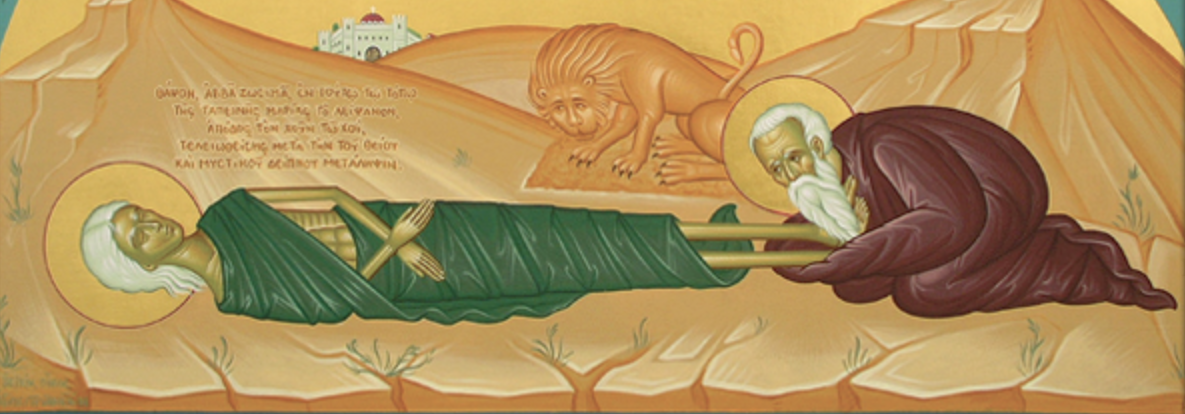
And this is where we meet St. Mary of Egypt: in the desert of purgation. Now, she is from Egypt, the archetype of sensuality. At age 12 she gave herself over to the demons of unbridled sensuality. She says,
|
"I was born in Egypt and when I was twelve-years-old, I left my parents and
went to Alexandria. There I lost my chastity and gave myself to unrestrained and insatiable sensuality. For more than seventeen years I lived like that .... To me, life consisted in the satisfaction of my fleshly lust." (Vita) |
Nothing is said about her faith nor even her belief in God. So we assume Mary, like most of our children today, was not raised in a godly home. But then she encountered the hard boundaries of the inescapable:
|
"When the Holy Feast of the Exaltation of the Venerable Cross of the Lord arrived,
I went about as before, looking for young men. At daybreak I saw that everyone was heading to the church, so I went along with the rest. .... I was trying to enter into the church with all the people. With great effort I came almost to the doors, and attempted to squeeze inside. Although I stepped up to the threshold, it was as though some force held me back, preventing me from entering. I was brushed aside by the crowd, and found myself standing alone on the porch. .... I worked my way into the crowd, and again I attempted to elbow people aside. However hard I tried, I could not enter. Just as my feet touched the church threshold, I was stopped. .... I alone was not allowed in. (Vita) |
Left alone outside the enclosure — alienated from God, alienated from others, and (she realized) alienated from herself. She was not consigned to this perdition as a punishment. This was her natural element by choice. She did not realize that she was lost. She did not see anything wrong with her life, that is, until she encountered the only real.
You know, we live in a general delusion. We celebrate fantasy and illusion on social media and in our many entertainment. We believe things that simply are not true. And we do not believe things that are most true .... such a God and His angels. But Mary encountered the only real. She had encountered God. And in that godly light she saw herself (for the first time since she was twelve) as she really was.
|
"The grace of the Lord then touched my heart. I wept and lamented, and I began to beat my
breast. Sighing from the depths of my heart, I saw above me an icon of the Most Holy Theotokos. Turning to Her, I prayed: 'O Lady Virgin, Who gave birth in the flesh to God the Word! I know that I am unworthy to look upon Your icon. I rightly inspire hatred and disgust before Your purity, but I know also that God became Man in order to call sinners to repentance. Help me, O All-Pure One. Let me enter the church. Allow me to behold the Wood upon which the Lord was crucified in the flesh, shedding His Blood for the redemption of sinners, and also for me. Be my witness before Your Son that I will never defile my body again with the impurity of fornication. As soon as I have seen the Cross of Your Son, I will renounce the world, and go wherever You lead me.'" (Vita) |
She has entered the monastery of the mind and spirit. She approached the gate of this wonderful monastery, which is accessible to all, and she has offered herself to religious life. And Being accepted as a penitent, Mary heard the Most Holy Theotokos direct her to baptism and thence to the wilderness, where her toxins could be slowly purged:
|
"'O Lady, You have not rejected my prayer as unworthy. Glory be to God, Who accepts
the repentance of sinners. It is time for me to fulfill my vow, which You witnessed. Therefore, O Lady, guide me on the path of repentance.' "Then I heard a voice from on high: 'If you cross the Jordan, you will find glorious rest.'" (Vita) |
And she was baptized:
|
"At sunset I reached the church of Saint John the Baptist on the banks of the Jordan.
After praying in the church, I went down to the Jordan and washed my face and hands in its water. Then in this same temple of Saint John the Forerunner I received the Life-Creating Mysteries of Christ. Then I ate half of one of my loaves of bread, drank water from the holy Jordan, and slept there that night on the ground." (Vita) |
She entered the desert and lived on a kind of manna:
|
And she said, "I had with me two and a half loaves of bread when I crossed the Jordan.
Soon they dried out and hardened. Eating a little at a time, I finished them after a few years." (Vita) |
She had, like the people Israel, entered the Sinai wilderness:
|
When I began to eat bread, I thought of the meat and fish which I had in abundance in Egypt.
I also missed the wine that I loved so much when I was in the world, while here I did not even have water. I suffered from thirst and hunger. I also had a mad desire for lewd songs. I seemed to hear them, disturbing my heart and my hearing. Weeping and striking myself on the breast, I remembered the vow I had made. At last I beheld a radiant Light shining on me from everywhere. After a violent tempest, a lasting calm ensued .... a blessed Light encircled me, dispelling the evil thoughts that troubled me. (Vita) |
This is commonly reported in confession. After temptations subside, some penitents report a next tier of temptations: they long for the forms of temptation recollecting the thrill they once felt. But let us see the positive side of this: when we remove ourselves from temptation, after a while we no longer are tempted. And just the memory of past indulgences fills us with revulsion. That is, we see things as they are.
Indeed, her wilderness period lasted forty years plus seven by the time she related her story to a monk of Palestine named Zosima. Gradually, she was emptied of all filthy longing. And she returned to that semi-Divine life, which is our natural state:
|
Again she made the Sign of the Cross over the Jordan, and walked over the water as before,
and disappeared into the desert. (Vita) |
The journey of St. Mary of Egypt is our common journey. Its elements include a pristine garden signifying our blameless youth; a landscape of alienation signifying our departure from God; Divine encounter, where we meet with God in our perdition; rejecting the culture of death, which is our metanoia; and our departure from the world, which is our cleansing wilderness. The Early Church Fathers have called this the three-fold path of purgation-illumination-union. It follows our baptism.
Mary's life is not a wild or forbidden story to be read, wondered at, and forgotten. It is the definitive story of our time. For which of our children is not plunged into Mary's world (after she was twelve)? Eden, the place where all of us began, is the Bosom of Abraham, which is the Kingdom of Heaven. Jesus says we will not enter unless we have the heart of a child (Mt 18:3). Most of us have drunk from the poisonous cup of sensual Egypt. And if you fail to take avert your eyes from Egypt's fleshpots, the Master says,
| "It is better that you lose one of your members than that your whole body be thrown into Hell" (Mt 5:29-30) |
As for making a commitment to God, condemning the sensual life, this is the hallmark of Jesus' ministry. This is what it is all about! "Metanoeíte! Make a complete turn-round!" We enter a period of preparation. We die to our former life. We are ready to be reborn into new life. And we are baptized.
Upon His own baptism, Jesus went directly into the wilderness to encounter the evil one for forty days. The wilderness is where St. Anthony the Great went and where St. Athanasius followed him. You remember that contra mundum was his device.
Great Lent has been devised as our desert. We cleanse ourselves of the world's poisons, not for forty years, but for forty days. Next week, we shall enter Jerusalem as Mary had. We shall stand at the place of the Cross as Mary did. The hard boundary of exclusion, which Mary encountered, is still with us though it is invisible. For are we ready to stand before God? Are we ready to stand before His gaze of perfect justice? Are we ready to see ourselves as He sees us, remembering every detail .... but also with eyes of love. But love is not instead of justice. You know, when we truly love someone we embrace them with all of their stories, not just the ones we like.
It is well that we practice these questions. For, before long, we shall encounter that hard boundary which no longer is left to us. I suppose when we get older, we become aware that that hard boundary could come at any moment. No one escapes it. As our perfect-seeing and perfectly wise God was with Mary of Egypt, may God be with you and with me.
In the Name of the Father and of the Son and of the Holy Ghost.