Luke 24:12-35 (Matins)
Hebrews 11:24-26, 11:32-12:2
John 1:43-51
Good Fellowship
Philip said to him, "Come and see."
(Jn 1:46)
In the Name of the Father and of the Son and of the Holy Spirit.
Amen.
We begin down the path of Great Lent.
We tread a clay path
reminding of us of our
clay feet.
But this was not always the case.
From the time we first opened our eyes to this world
as newborn infants,
our souls have yearned to soar Heavenward.
For that is our true and, finally,
our only home.
Now, Sisters I do not know if you experienced this,
but when I was a very young boy,
I had dreams at night of flying
—
feeling the pressure of the air under my wings,
going down the slide in the schoolyard,
coming off the bottom,
and flying away.
I perceive that is our natural element.
But the sovereign of this world
and
his vast demonic legions
have sought to clip our wings,
or worse,
to dull our desire to take flight,
or still worse,
even to forget there is such a thing as blue sky and Heaven.
For
those blessed climes were once their only home,
And misery loves company.
The members of the Hermitage Community long ago aspired
to learn the art of flight,
whose first step is to renounce the world
and
the world's gravity.
Do you know this gravitational pull
which grounds all attempts
to attain lightness of being?
Do you know the powerful attraction of worldly life?
In our case,
the first steps away from this toxic attraction,
(which at first seemed inescapable)
lay
in simplifying our lives
back to the essentials:
taking no more of the world than we truly needed,
and to banish from our lives the
technologies of television, pop music, and unredeemed internet
used as instruments to brainwash us.
This tradition of simplicity is deeply enshrined in a spirituality:
it is called Franciscan.
And each of us independently sought out a Franciscan community:
Sr. Mary Anne in 1962,
Sr. Mary Martha in 2004,
Fr. Columba in 2006.
These past sixteen years,
our present community has clustered around our superior minister,
Sr. Mary Anne,
well known as a local saint in the dense hills
of southwest Haiti.
Soon after being forced back to the United States,
we undertook the longtime aspiration
of a pilgrimage
to
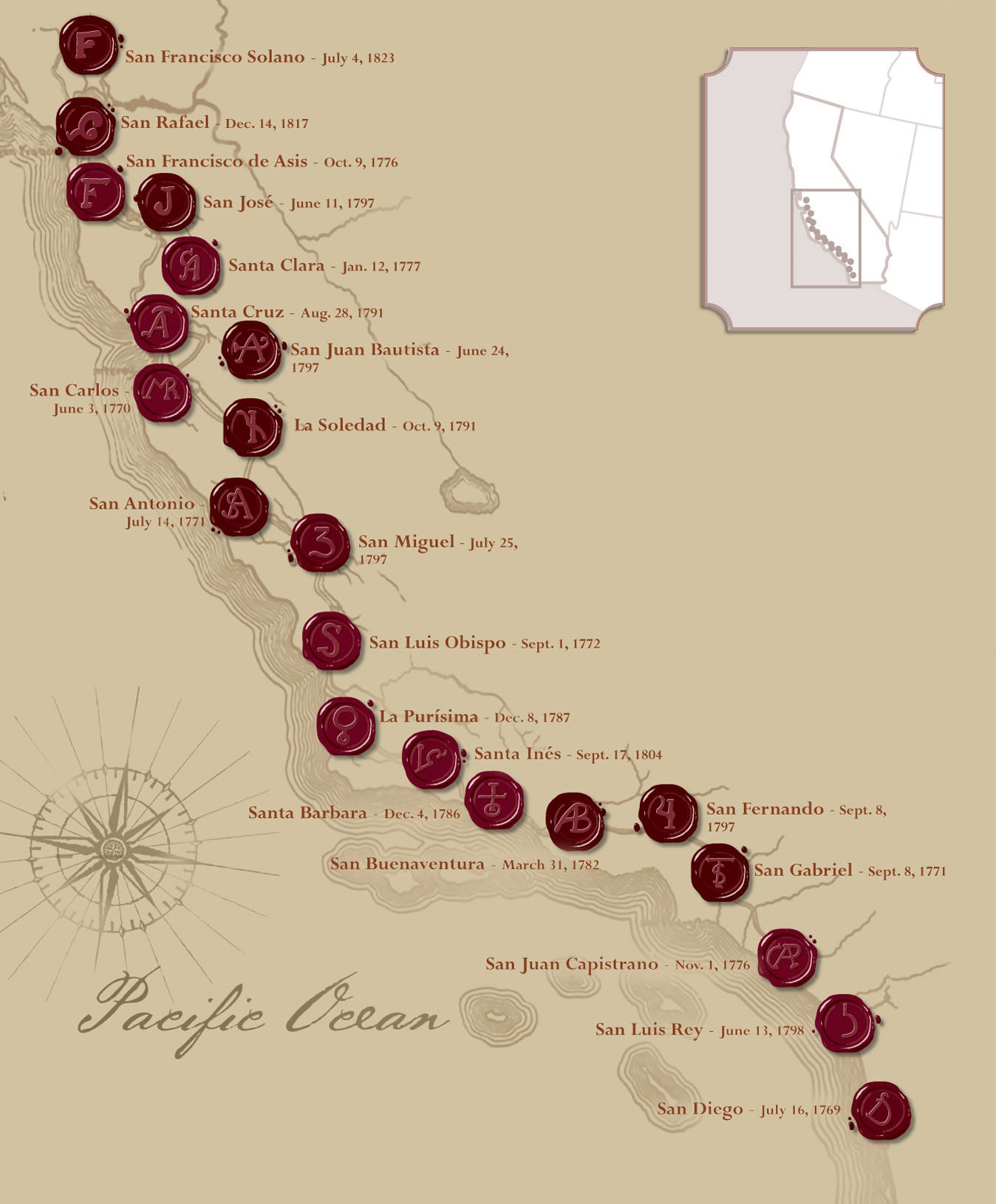
the twenty-one Franciscan missions
first established in 1769 in San Diego
and
then being founded
up the California coast
to
the San Francisco Solano Mission built in 1823.
Now, such a pilgrimage is not the work of a day.
Each night we rested wherever we
ended the day.
One night
—
the date was
August 14, 2016
—
we checked the local newspaper
for a church to celebrate the Feast of the Holy Assumption of the Mother of God.
"What divine timing," I said.
"A Holy Assumption Monastery
resides right here in this town."
So we set off the next day to be present for their patronal feast.
We
were warmly greeted by their Abbess, Mother Melania.
As we arrived hours in advance,
she showed us
the heart and jewel of their community,
which was the chapel.
I stepped inside this holy space peering into the darkness
looking for a lighted sanctuary lamp somewhere near the Altar,
so I would know
whether to genuflect.
I turned to Mother and asked,
"Is the Lord present?"
She did not answer right away.
I will never forget her reply:
"We have good fellowship here."
Slowly,
I began to realize that we had not visited a Western Catholic community,
but an Orthodox Catholic community.
The name, Holy Assumption Monastery, had fooled us.
But I accepted her gentle invitation and entered into the midst of this promised fellowship.
In so doing, I stepped out of this world and into another.
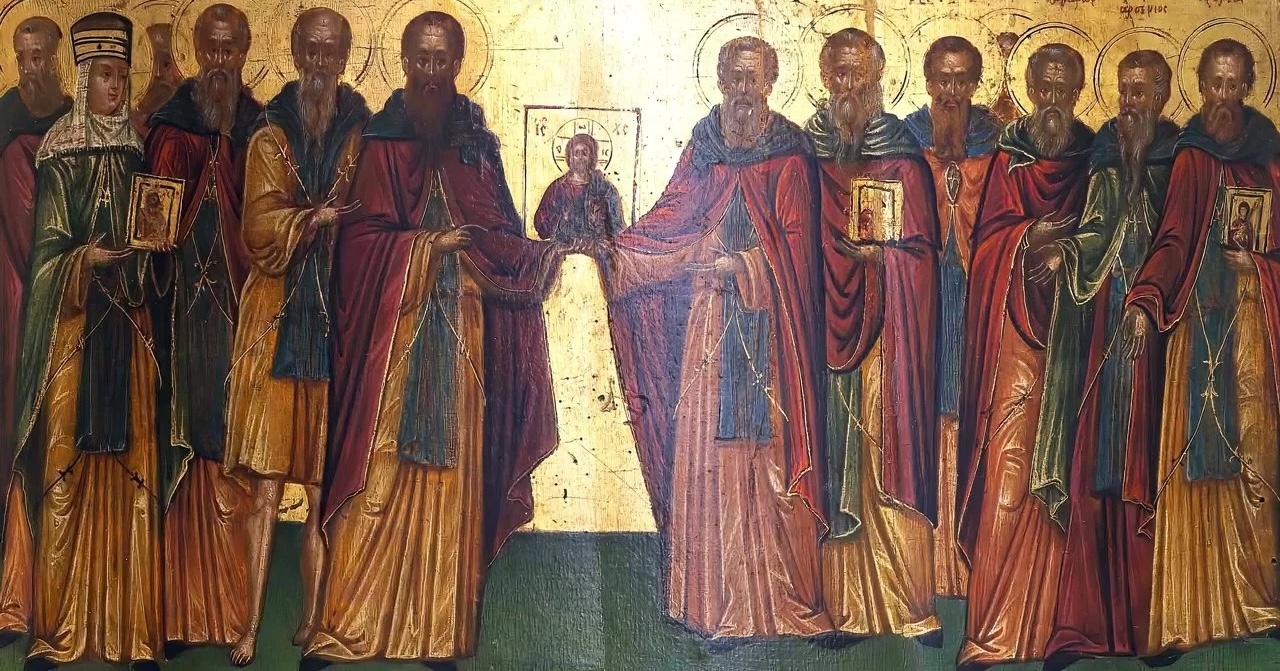
For all around me and receiving me warmly (I felt) were the saints,
whom I already knew
—
truly, "a great cloud of witnesses."
I stood before each in turn, venerating the life-size icons.
In particular, I remember St. Tikhon of Moscow, whose relics were also present,
and I felt his inviting presence.
He had evangelized the Americas,
and
in particular the so-called Biretta Belt around the Great Lakes
where I had encountered his influence.
Here was a spirituality very different from the one that I had known
—
which was overwhelmingly focused on the Blood Sacrifice of Christ.
In fact,
I had always called the Eucharist "the Holy Sacrifice."
But the spirituality now before me was focused not on death, but the life of Christ,
the life of the saints,
and
the good example and traditions the Lord had instituted for all of those
who chose to follow His supernal command:
|
"Take up your Cross, and follow Me."
(Mk 10:21)
|
Before us stood saints of every description,
born in places scattered throughout the world.
Most them did not even share the same language
during their earthly journeys.
But they did hold one thing in common:
they had chosen to obey His command and to follow Him.
Later,
I thought,
the members of our Franciscan community
also shared this essential and defining quality.
We also could make a just claim to this vast fellowship,
each of us having chosen
to burn down his or her whole world
and
to follow the One Who had no place to lay His head.
Here truly was good fellowship,
not an individual conception
—
in its worst form expressed as
"me and Jesus"
—
but
a fulfillment of both Great Commandments
and,
together, an obeisance before the God and Father of all.
You see,
Jesus came to earth to love us and to be loved by us:
all of us together,
Our Father Which art in Heaven.
Yet, God's people had become enslaved in a Babylonian-Persian
spirituality of blood sacrifice to
a distant and forbidding figure.
But with Jesus
the old ways would be restored
eloquently expressed in the first chapter of St. John's Gospel,
which we read from this morning:
".... hereafter you shall see Heaven open, and
the angels of God ascending and descending ....
(Jn 1:51)
|
Heaven?
Angels?
These were subjects forbidden by the Sadducees.
The old ways ....
the ways of conversations with God in Eden;
of intimate revelations to Abraham;
and
to Jacob,
angels that you actually saw and touched.
Jesus had brought all back with a vengeance,
for vengeance is a Divine property (Deut 32:35).
But this "Day of the Lord" would be different
than the one described by the Prophets.
It would be intimacy and love and life as we never imagined it ....
but as God had imagined it and ordained it from the foundations of the world.
Each day
we advance in our journey to be formed in the life of the Master.
We help each other even as we exam our own consciences in the struggle
to remain true to Him.
Banished is the idea that "He died for my sins,"
which
He never taught.
And born is the idea,
His idea,
that
|
"No longer do I call you servants, .... but I have called you friends."
(Jn 15:15)
|
Salvation is a journey.
Its Greek original
σωτερία
/
sotería
means "to make a safe return home,"
in that sense,
salvation is less about having a "ticket punched"
and
more about having the way ahead
cleared of dangers.
It does
not refer to the sacrifice of an afternoon,
however
significant that sacrifice was.
We cannot be "saved" in a moment.
Jesus of Nazareth did not teach a magic-wand religion.
St. Athanasius wrote that, with His Incarnation,
the way ahead was unblocked.
But it is still left to us to complete our journeys.
There is no pixie dust.
And
|
"no sign will be given .... except the sign of the prophet Jonah."
(Mt 12:39)
|
Our sign, our Divine acceptance and approval,
will be the miracle of our conversion,
our transformation of mind in Christ Jesus,
St. Paul says.
Would you like to be converted?
Would you like to make a journey from
eternal deadness to light and life,
as St. John says?
Do you seek good fellowship?
For the road ahead is long and at times dangerous,
and
the saints know the way.
The Father will not bless you for approaching Him
covered with Jesus' blood.
He will not bless you for covering yourself with the blood of His Son.
For the Kingdom of Heaven is not an admission pass.
It is about being.
It is a state of conversion,
of transformation (Rom 2:12),
which has been in process since you
first said "Yes" to the world
and
then, with regret,
said "No."
At that moment He was waiting, watching along a roadside.
Each of us does not lack for a map to make this holy journey,
for the destination has been etched deeply in our minds and our souls
from the time we first opened our eyes to this beautiful world.
Our destination is our own innocence and the loving, trusting heart of the child,
which is the undying love of God
and
the love of our fellows who are always there loving us
and
pulling for us.
The whole world was once young and innocent and ruled by our God Who is Love (1 Jn 4:8).
And
the comely blooms and fragrant trees of that innocent world continue to provide
goodly shade,
like the Oaks of Mamre,
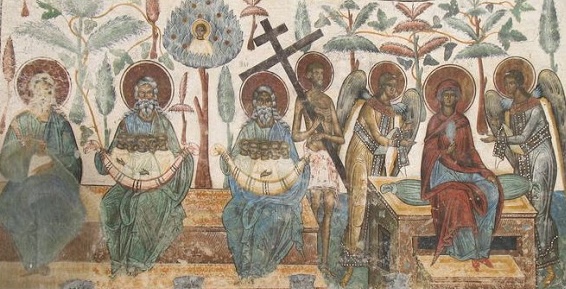
in that place known as the Bosom of Abraham.
It is the Bosom of Divine Hospitality,
the Bosom of our only Family,
and
the Bosom of our Father, Which art in Heaven.
In the Name of the Father and of the Son and of the Holy Spirit.