I say "demonic." For the Church was not rocked by controversy concerning widespread failure to keep other commandments. Look out the window today. We have come to a point where people think that keeping the Sabbath is practiced only in monasteries.
Our world is an indefinite series of masks, not of pasteboard, but of Divine composition. Everywhere we look we see material representations of a reality that constantly lies just beyond. And this is the world's inimitable design pointing to Heavenly perfection but never attaining to it, shimmering with otherworldly beauty yet remaining just beyond reach, like a constantly receding rainbow.
Still, where God's human creatures are concerned, there is another, deeper aspect of the Creation which God has prepared for human comprehension. Contemporary physics proposes parallel or alternate universes called multiverses. Christians must not resist these ideas as threatening modernism. For the door opening from the greater life has been witnessed right here and then it is not right here. Those who have received visitors attest that they just appear from "thin air" or from a door opening from nowhere. They are vivid, solid, and seemingly material, like the Risen Christ, Whom the Apostles "looked upon, and our hands have handled" (1 John 1:1). Or, as C.S. Lewis described it: one micro-second you are passing by fur coats in a wardrobe; the next you are standing in Narnia.
In fact, the "multiverse" is not new. As an aspect of the Created Order, it has been "from the beginning" (1 John 1:1). Even the human apprehension of it can be traced back to the ancient Greek philophers. In The Republic (380 B.C.), Plato proposed that our world lies in darkness. It is opaque. But another universe, full of light, lies just beyond it, which is the fullness of "reality" to which we might break-through. Certainly, I have heard many Christians describe the Kingdom of Heaven in this way, as random "breakings through" into our dim, quotidian world and through which we glimpse the Glory of God.
Such things are basic to the human condition. We are haunted by this shimmering quality and so were our ancient ancestors. Perhaps this goes some way toward explaining the appearance of Christian icons ..... and the mania that ignited iconclasts in the eighth and ninth centuries, and Soviet atheists in the twentieth century, to destroy them with a demonic vengeance.
I say "demonic."
For
the Church was not rocked by controversy concerning widespread
failure
to keep other commandments.
Look out the window today.
We have come to a point where people think
that keeping the Sabbath
is practiced only in monasteries.
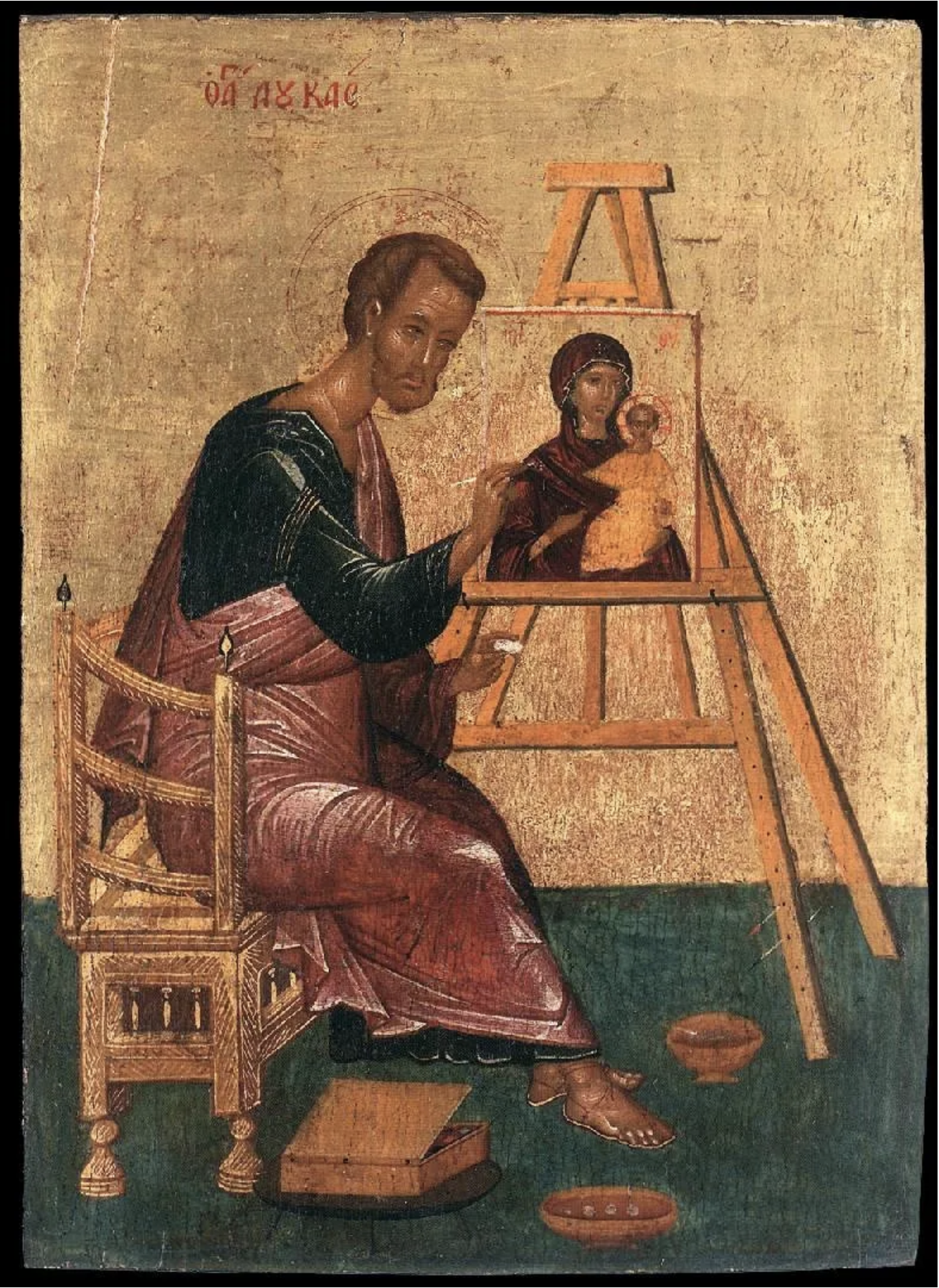
Moreover, the case alleging icons to be idolatry is patently a weak one. The Evangelist St. Luke was a painter of icons. The Early Church acknowledged that gold images of the Seraphim adorned the Mercy Seat. And there is an all-important precedent, for the Early Church cherished Holy Icons, seen even in the Catacombs.
Perhaps the answer to this mystery lies not so much in theology but in history. Iconoclasm coincided with the rise of Islam, which forbade all icons. For example, when the Emperor Justinian II ordered the Image of Christ to be stamped on the front of Byzantine coinage in 695, the Caliph Abd al-Malik, ruler of the Caliphate to the Empire's East and Southeast, was furious. We would call this "an international incident." For Islamic territories (though disunited) stretched to the east as far as Kandahar, to the north as far as the Caucasus, and to the south as far as Yemen and the Indian Ocean. By 634, the whole Levant, including Syria, had become Muslim. And the unstable Roman Empire could ill afford a general war on all fronts.
Meantime, the Western Roman Empire since the early fifth century had disintegrated due to the rising power of invaders on the Empire's borders, chiefly the Germanic tribes to the north. In 476 the Germanic king Odoacer deposed the last Western Roman Emperor. The succeeding centuries would become a free-for-all among rivals.
Assaults on the Eastern Roman Empire in the eighth century seemed to be following the same plot line. During the winter of 717-718 an armada of 1,800 Muslim vessels descended upon Constantinople, threatening to spread the Islamic ummah westward to Europe. The military hero who won the day was Leo III the Isaurian (r. 717-741), the new Emperor of the Eastern Empire.
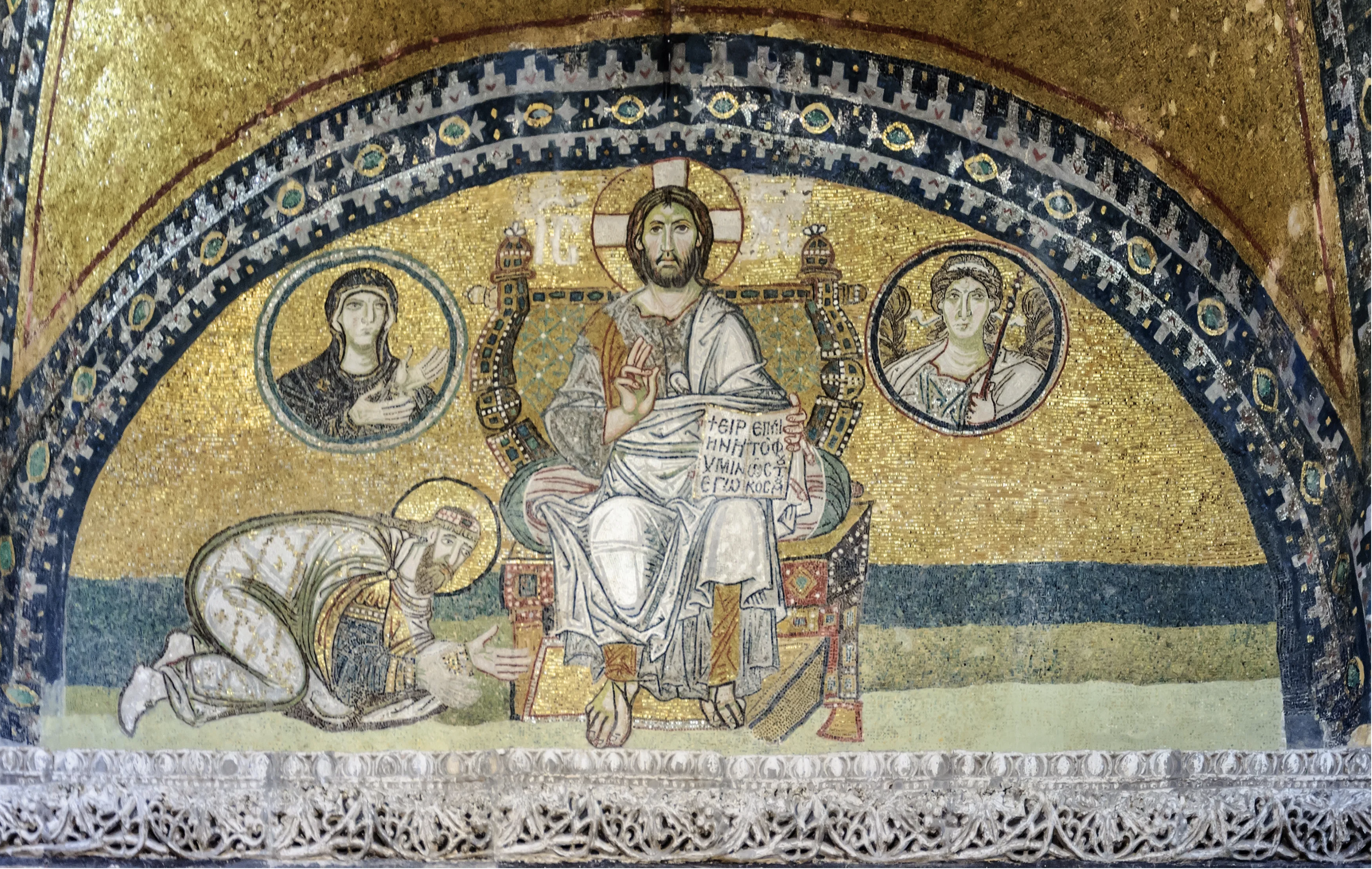
Now, Leo was by nature a military man through and through. And as he surveyed his newly acquired Empire, he saw it only in terms of military soundness. Uppermost among his complaints was the Church, which (from his point of view) had been lavished with untold riches, enjoyed egregious privileges, and, most important, sapped the Empire of military manpower. For the population of monks by the turn of the eighth century had surpassed 100,000, and they were loyalties laid not with the Empire, but with a Kingdom not of this world. And He could plainly see them prostrating themselves, even kissing, Images of this rival Emperor and His otherworldly Court. Moreover, this counter-culture, composed of fabulously wealthy estates, was exempt from taxation — a double-blow to the Roman war machine. The time had come, the emperor decided, to pull the plug on all these screen and smartphones (as we would say) and wake up these people from their "unwholesome trance."
When the Patriarch of Constantinople, ironically named Germanus,
resisted the removal of icons,
he was deposed and then exiled.
So the fight had to be led from without.
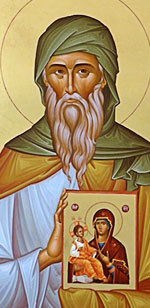
St. John of Damascus (c. 652-749)
had written extensively in defense of icons.
And he was beyond the reach of the Emperor
as a monk of the great Monastery of Saint Sabas
in Palestine
—
a land controlled by Muslims.
John Damascene's argument was a tour de force.
The first icon painter, he argued in effect,
was God the Father,
Who painted the first Icon before all ages.
But we must not say that the Father created the Son,
for that would be to make Him a creature.
We say rather that this creative power arises from the Divine Nature:
|
In former times God, Who is without form or body, could never be depicted. But now
when God is seen in the flesh conversing with men, I make an image of the God Whom I see.
I do not worship matter; I worship the Creator of matter who became matter for my sake,
who willed to take His abode in matter, who worked out my salvation through matter.
Never will I cease honoring [fr. proskynesis] the matter which wrought my salvation!
(On the Holy Images, 1.16). |
John is careful to contradistinguish "worship" (latreia) from "veneration" (proskynesis).
Seeing the allies of God being lined up against him, both inside and outside the Empire, and calculating the profound backlash that was gathering like an enormous ground swell, Leo III retreated.
He was succeeded by his son the Emperor Constantine V (r. 741-775), who saw himself as a theologian. He arrogated to himself the title of "priest" or "bishop" appointing iconoclast bishops, who would serve as an ecclesiastical army stripping the Empire of icons. But he became distracted with a coup attempt from his brother-in-law marking the beginning of a long period of instability. His successor would rule for two years. And the next after that for five years, and he would be blinded under orders of his mother Irene and imprisoned and then died from his infected wounds.
Irene would reign for only five years, but in that time she managed to convoke an ecumenical council, the Second Council of Nicaea (seventh in the sequence of universal councils). As we know, this Council would issue decrees protecting icons down to our own time.
Worldliness in its way is comforting. Nothing is required of us. We just drift along in a numb sameness each day pursuing the unchallenging and unrevealing familiar.
But somehow we arrive to a place where we do not know who we are. Suddenly, the familiar is not so comforting. In a moment of introspection, we might say, "My life has been wasted." And we are strangers to ourselves.
But God does not forget us. He calls. And we must respond. Otherwise, we commence living not life, but living death. We answer, "I am here, Lord." And life begins.
This re-wakening, this coming to know things as they are is "icon life." No longer are we content to live, as Plato put it, in the dim cave. But we have broken-through to the Kingdom of light. And the familiar? The familiar no longer reassures. And the hospitable now becomes inhospitable.
F. W. J. Schelling (who began his university studies specializing in the Early Church) put it like this:
| That which should have remained hidden but has come to light. |
And he appended a word to it Unheimlich, which he defined as "the un-secret."
The literal translation of the German Unheimlich?, "unhomely," says more: the familiar has become unfamiliar. The comforting has become unsettling. And what we saw as an uneventful world has suddenly become the threshold to revelation. The pasteboard mask falls away opening on to paths of God's making. And what formerly had appeared to be randomness, now on further reflection makes meaning. Above all, in God's meaning-bearing world, there are no coincidences.
It is the work of Christian life to go beyond surfaces into God's deeps. The initial steps one takes in entering the monastery, is to turn your back on the once-comforting world and to follow the saints in light. It is a life of inner reflection, of prayer, and of mystery, and of revelation. You will have begun the last great adventure, which is to follow God.
But if we choose the quotidian familiar, mistaking it to be the "safe bet," we shall find that it changes hideously in our very hands, becoming a grotesque. William Faulkner's short story, "A Rose for Emily," depicts a young woman who cannot bear to let go of the familiar in the person of her father who has died. She keeps his corpse at home in secret, desperate to cling to sameness, and dedicated now to appearances. But the truth will out.
Or let us consider the family at the center of the iconoclast controversy, the Isaurian Dynasty. Their history reads like a Greek tragedy full of grotesques, such as the king who eats his own sons secretly baked into a pie prepared by his avenging brother. Familiar and reassuring domesticity has given way to the surreal and bizarre.
In the Isaurian world, and in ours, chaos lurks beneath the surfaces. After all, isn't this irretrievably the final state of all material life? The essence of the material world is withering finitude. But the essence of the Divine is life. Jesus' words to His Father (Jn 17:2) is the basis for our ancient prayer, "To know You is eternal life."
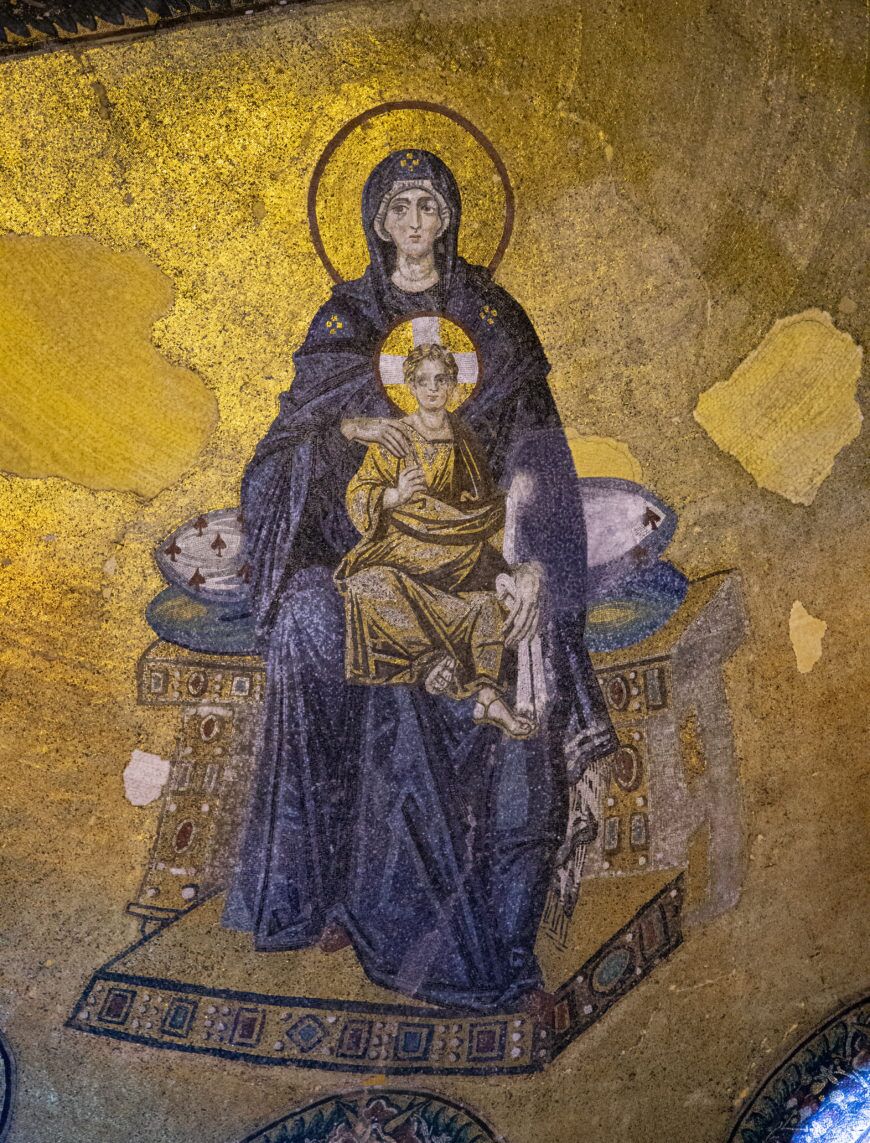
Icons are not art.
They are not the comforting familiar.
They are instances of Schelling's Unheimlich.
They are the un-secret.
They are the eyes of eternity looking out upon an unredeemed world
and
on the world's desperate attempts
to paper over the unspeakable
and
to domesticate the unutterable.
And in our grave sins vainly eradicating the holy (as if we ever could) — whether in the form of eighth-century iconclasm or from Soviet atheism smashing icons and murdering 100,000 clergy or in our own time mocking and desecrating the Eucharist in giddy spectacles before billions — we seek in the throes of our desperation to smash through the mask of life, like wounded animals, like a living soul lashed to a dying dog. But be sure of this. The sober eyes of eternity watch. They continue their holy witness. And they mercifully set before us a mirror that we might see the vain truth about ourselves.
But the eighth century and its strivings have vanished like a dream, and all empires turn to dust. But the eyes of the Holy Ones continually look upon us from their windows of Light. In the poet's words,
|
An aged man is but a paltry thing,
A tattered coat upon a stick, .... O sages standing in God's holy fire As in the gold mosaic of a wall, Come from the holy fire, perne in a gyre, And be the singing-masters of my soul. Consume my heart away; sick with desire And fastened to a dying animal. It knows not what it is; and gather me Into the artifice of eternity. (William Butler Yeats, "Sailing to Byzantium") |