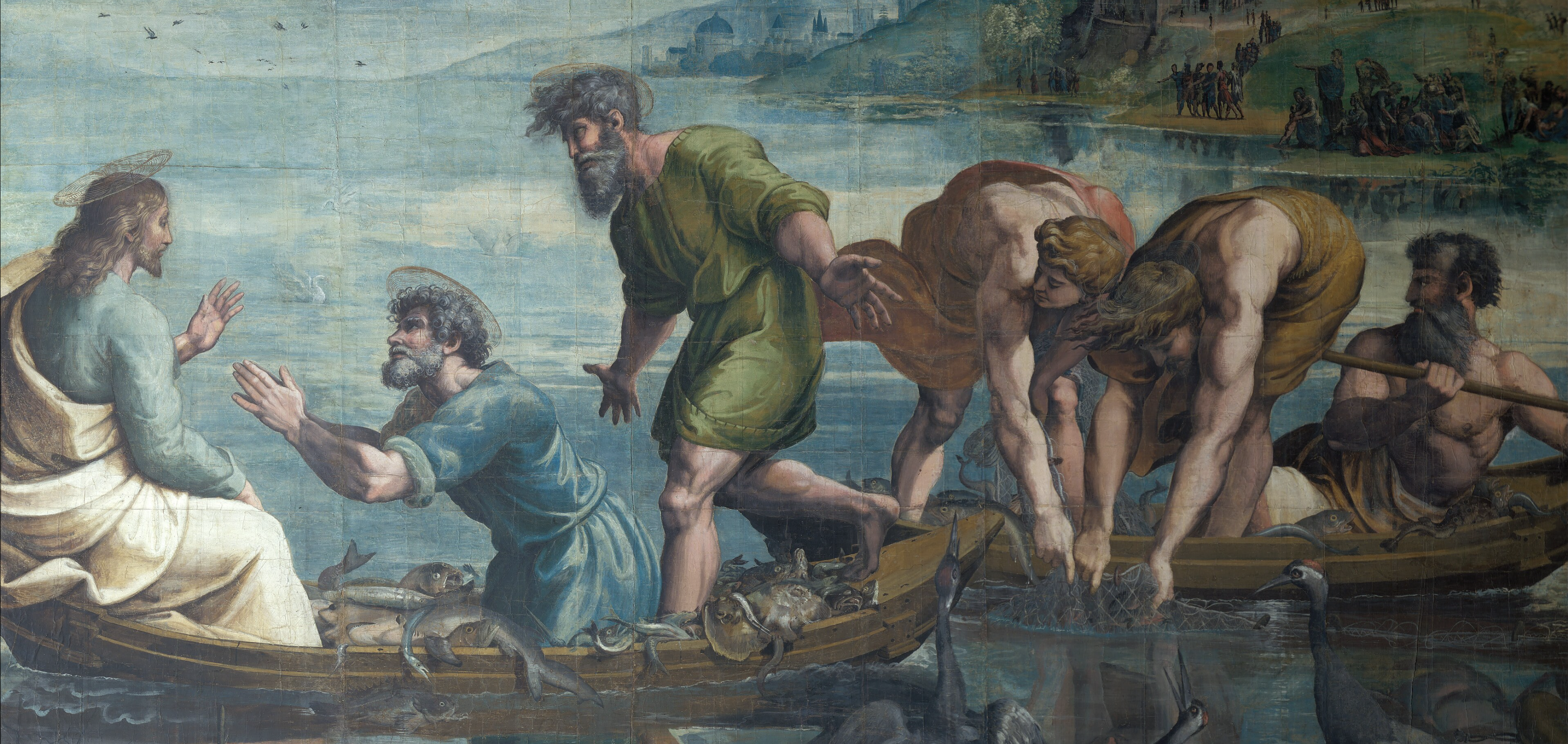
In the Gospels of St. Mark and St. Matthew, the language is the same, yet it is different:
| "Follow Me, and I will make you fishers of men." (Mk 1:16, Mt 4:19) |
Do you hear St. Luke's tone? "You will catch men!" It is more direct. Bolder. Are not these few, spare words spoken urgently. And this is appropriate, for the Son of God has been sent on a rescue mission, and now He is putting together His rescue team. The scale of the operation is breathtaking. The difficulties will be many. For the whole of Jerusalem and Judah have become lost sheep along with those they have brainwashed. And this particular "lost-ness," which Jesus likens to blindness, means that they will not cooperate.
What bait will these seasoned fishermen use? The plan Jesus outlines is simple, and it never varies, revealed from the beginning of the all three Synoptic Gospels. First, a command is issued:
| Metanoeite! (Meta + nous) |
"Be transformed in your soul and mind!" Second, urgent information is then announced:
| "For the Kingdom of Heaven is at hand." (Mt 4:17) |
What?! The Kingdom of Heaven! (Mt passim) The Kingdom of God! (NT passim) And it has drawn near?! First-century people hear this in roughly same spirit as soldiers hearing of the near approach of a vast host intent on their destruction. This is what Old Testament scholars call "the Apocalyptic."
People today often tune out at the sound of this word, but this fundamentally is what the New Testament is about. We receive the news that the Almighty is coming. He has a herald presaging His approach. His Forerunner says,
|
"His winnowing fan is in His hand, and He will thoroughly clean out His threshing floor,
and gather the wheat into His barn; but the chaff He will burn with unquenchable fire." (Mt 3:12, Lu 3:17) |
invoking the prophet Jeremiah:
|
And I will winnow them with a winnowing fan in the gates of the land;
I will bereave them of children; I will destroy My people, Since they do not return from their ways. (Jer 15:7) |
And the New Testament comes to a climax with a book called The Apocalypse, in which God, in the end, destroys His enemies, while holding His friends harmless. That is, from the first to the last, the New Testament is about this cosmic moral struggle. And its final book brings everything to a resolution. This is not merely the last book of the Book of books. It is the end of the age (Mt 28:20).
Within this frame, we hear constant echoes of this motif: a farmer gathering wheat consigns the tares to the fire (Mt 24:30), a shepherd separates the sheep from goats (Mt 25:31-46), angels sort through good fish and bad from a great catch (Mt :47-50), which leads us back to our Gospel lesson. Not all the fish caught in this enormous draught will be desired. In fact, many or most will be rejected. For the Kingdom of God has drawn near. Its Prince is perfect. He is holy. He is magnificent. And present before Him is an imperfect, unholy, and un-magnificent world. This is the essence of the "Day of the Lord" tradition. As we read two weeks ago:
| "For the day of the Lord is great and very terrible; Who can endure it?" (Joel 2:11) |
Jesus describes to Pilate the essence of worldly kingliness, which is power:
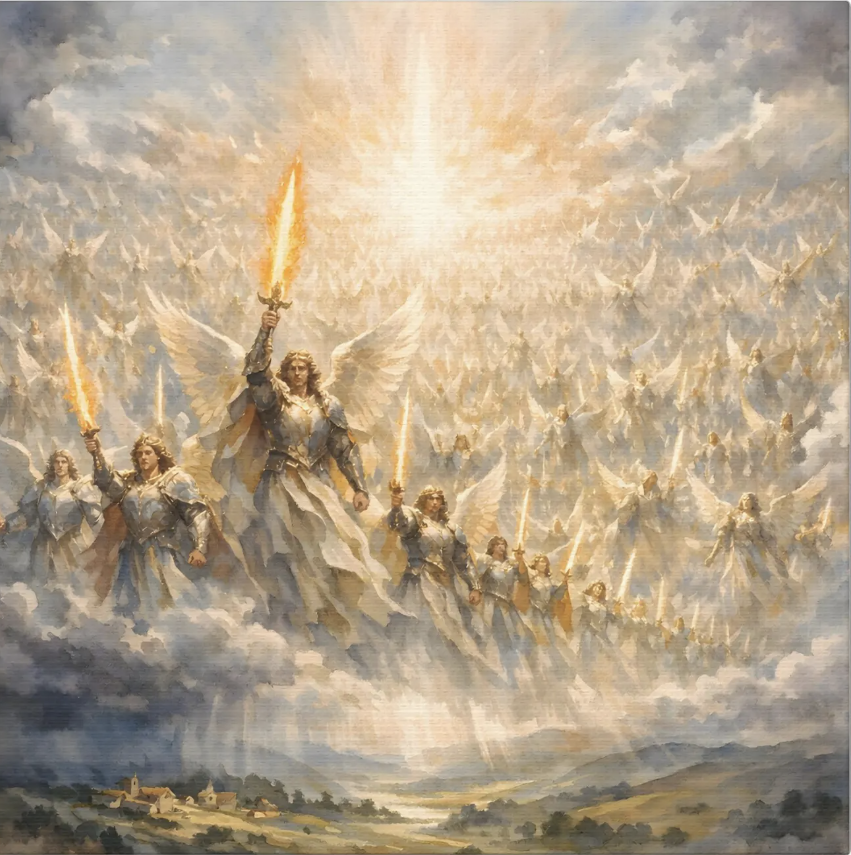
| Or do you think that I cannot now pray to My Father, and He will provide Me with more than twelve legions of angels? (Mt 26:53) |
More than twelve legions? This is an army of perhaps 72,000 and composed of large, awe-inspiring, formidable angels. As the Lord constantly says, this is the near background.
He might have added, "Do I have your attention?" But Jesus habituates the awful silence of a dread sovereign. Is not it remarkable that the most Powerful Figure in the history of the world does not reveal Who He Is in plain language? But He is not long-suffering. As He reminds us from time to time,
| "O faithless and perverse generation, how long shall I be with you? How long shall I bear with you? (Mt 17:17) |
Many believers today are apt dismiss these "hard Gospel passages" as artifacts of allegory. You see, these harsh things are only ideas, not realities. We are not to take them literally. Certainly, the "meek and mild Jesus" would not be associated with such things! But they do not understand that this endlessly patient and ineffectual "Jesus" is an invention of the modern period. And I think the novelist John Updyke has struck the right note: "Let us not mock God with metaphor!"
Yes, the Bible is to be read as allegory. This was common knowledge at least from the time of Origen. In fact, St. Paul's fellow Apollos deployed it before that. And the Fathers agreed. But it is also to be read literally and tropologically (that is, it has a moral). These three levels of interpretation simultaneously.
They did not need to mention a fourth level, which is the eschatological level, from a Greek word meaning "last things." For the whole Bible is soaked through with it. We see must see everything through the lens of the Last Judgment. Indeed, it is implicit in every action and every story and in every instance of life, for all things must come to an end. This can never be far from our minds. And it is the subject of today's reflection.
From what precisely are the lost sheep of Israel being rescued?
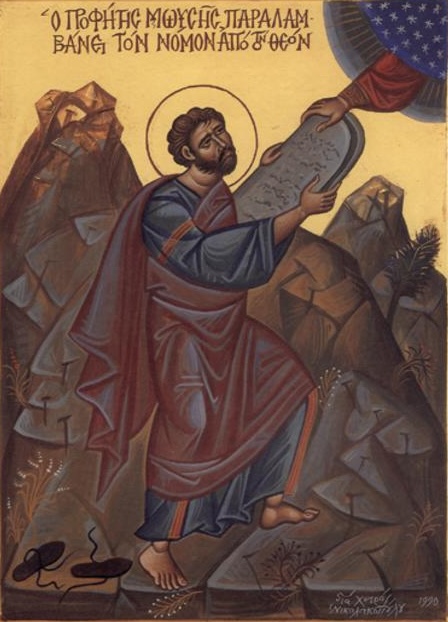
To answer this, let us go back to the Ten Commandments:
|
"I AM the Lord your God, who brought you out of the land of Egypt, out of the house of bondage.
"You shall have no other gods before Me. "You shall not make for yourself a carved image — any likeness of anything that is in heaven above, or that is in the earth beneath, or that is in the water under the earth; you shall not bow down to them nor serve them. For I, the Lord your God, am a jealous God, visiting[c] the iniquity of the fathers upon the children to the third and fourth generations of those who hate Me, but showing mercy to thousands, to those who love Me and keep My commandments. "You shall not take the name of the Lord your God in vain, for the Lord will not hold him guiltless who takes His name in vain. "Remember the Sabbath day, to keep it holy. Six days you shall labor and do all your work, but the seventh day is the Sabbath of the Lord your God. In it you shall do no work: you, nor your son, nor your daughter, nor your male servant, nor your female servant, nor your cattle, nor your stranger who is within your gates. For in six days the Lord made the heavens and the earth, the sea, and all that is in them, and rested the seventh day. Therefore the Lord blessed the Sabbath day and hallowed it. (Exod 20:2-8) |
This is mouthful, yet I have not even begun the part most people think of. I could recite it in less than thirty seconds. But the main point about the commandments, is not living within decent bounds. The main point about the commandments is God.
For why should we obey His commandments? Because, He, Our God, has commanded us to obey them, attested by the Son of God (Mt 19:17). Why, then, do so many disobey? The answer is simple: because they do not believe.
If you want to a visual image of general disobedience of the commandments ..... I suppose you have to be our age ..... we knew a world where every street was quiet on Sunday. Every store was closed. I have shared with you the memory of a town nearby where I grew up, Ocean Grove, NJ. Its citizens put chains up across the streets so that everybody could follow the commandment and rest. Look down any street in town today, and you will plainly see that nobody pays these commandments any mind.
Seventy-percent of self-described Roman Catholics
do not believe the Lord is Present in the Eucharist.
What do they believe in? Oh, to be sure, they take their opinions. These they hold to be sacrosanct and place far above all else. And woe to you if you challenge those opinions.
Needless to say, no one and nothing — not our responsibility to our children, not our holy and unbreakable vows to our spouses, not concern for our good reputations — can turn back the manifest power of the passions which the commandments are intended to govern. Nothing can turn these back except God .... if there is a God, says most people.
But God did not (and He will not) persuade us with an invasion of warlike angels from the Highest Heights. Jesus said, "neither will be they persuaded though one rise from the dead" (Lu 16:31). (And He ought to know, having raised the dead three times.) Jesus said, "no sign will be given .... except the sign of Jonah" (Mt 16:4, 12:39; Lu 11:29). That is, persuasion must come, not from without, but from within — a transformtion of the nous (soul), which the Forerunner had announced from the beginning.
The blindness Jesus was sent to heal is the blindness of distraction. It is the blindess of setting your sights on something else. The practitioners of Judah-ism already believe that they believe. They learned elaborate systems for worshiping god in Babylon and established institutions under the guidance of Ezra, who reported back to Nehemiah, the Persian governor Judah. A vast factory of worship was put in place consisting of animal slaughter and associated prayers carried out by an army of hundreds of Levites and priests and enforced by a constabulary of temple police — all centralized in Jerusalem. In fact, in the century or so before Jesus' birth, they had built up a complex of many parts encompassing blood-sacrifice, propaganda taught through a network of synagogues, and learned "academies" to attract promising young scholars. (after the fashion of Greek philosphers walking about with a train of disciple behind them).
God could very well walk into their midst one day, and they would not know Him. They are too absorbed in the systems and writings and outward rituals with which they have replaced God. It is obvious that God is alarmed at this development. He is alarmed. For He sent His Only-begotten Son.
A priest I know was recently confronted with a plain miracle placed vividly before his eyes. But this only served to ignite his anger extorting a stream of profanities. You see, this miracle must not exist! For it interfered with his view that there are no miracles, only "fairy tales" cherished by uneducated and superstitious people. This is his worldview. This what organizes his mind and soul. Miracles would point back to the literal reality of God and the Holy Ones. You see, in the modern view religion consists in the great arc of liberation. We must be liberated from the chains that have held us down for centuries. We must throw them off and enter the common struggle for rights. We claim the right to abortion. We claim the right to chemically and surgically mutilate confused teenagers. We claim the right to redefine family (that precious sacred building block of God). We claim the right to euthanize the lonely and addled elderly .... and a whole raft of other rights, which have moved front and center in the liberal churches.
I read piece just yesterday about a church I knew very well — St. Paul's, Darien, Connecticut, which was an Episcopal church but also a charismatic church, where people encountered the reality of God. They experienced the descent of the Holy Spirit.
Do you know where Darien is? Greenwich, Darien, Westport, Southport, these are wealthiest towns in the U.S., where billionaires live. But they had encountered God, and fell to their knees. On Sunday, 1,500 people would show up for worship. (Priests asked, "Where would we put them all?"). And what caused St. Paul's, Darien to explode? The reality of God.
And this is what our Gospel lesson is about. Peter falls to his knees and prays before Jesus, Who, he realizes, is the Living God, right before him!
It caught my attention, this news story. It would catch the attention of any former Episcopal priest. For they were bulldozing the place. People no longer came to church on Sunday because the reality of God no longer fit in with the cultural reality ..... you know, of same-sex marriage, of casual sex expected on every date, and general permissiveness. God no longer fit in.
And if God should show up in human form challenging the new cultural reality, why, then, we'll put Him in jail .... on a charge of "hate speech." I hear politicians of that stripe declare that they must be elected .... for moral reasons. And the greatest irony of all: they locate the "great Satan" as the One Holy Catholic and Apostolic Church. And they identify the Holy Scriptures as "hate speech."
I fear that many conservatives view me as immoderate (or I suppose a more polite term would "eccentric"). For they do not speak out. Some even defend the liberal position as a matter of forbearance or charity. I suppose I am uncharitable when it comes to speaking plainly about these evils. But wasn't this the course that many followed when Jesus was arrested: "Let us see what happens next. That would be the prudent course." But this is not the time for waiting and seeing what comes next. Waiting is the devil's game.
Have you heard the story of the three little demons sitting for their oral exams before graduating from the academies of Hell? They are to be examined by none other than "the prince of the power of the air" (Eph 2:2). Satan walks in. They are in awe. He turns to the first little demon and asks, "What will you do if I loose you into the world?"
The little demons replies, "I will tell them there is no Heaven."
Satan retorts, "What?! No Heaven?! They have been given luminous children. They have known the depths of faithfulness in love and marriage. They have been granted glimpses of the Almighty and His angels. No Heaven?! Ridiculous! Dismissed!
Satan then turns to the second little demon and asks, "What will you do?"
He says, "I will tell them there is no Hell."
Satan's face glowers with rage. "No Hell?! Is Hell not everywhere to be seen? These people have known war and annihilation. They have endured betrayal from those they trusted most. They have watched their children die of hideous disease. Oh, yes. They know Hell well enough. Dismissed!
Finally, Satan turns to the third little demon and asks "What will you do?"
And the little demon's self-confidence is obvious. He sits composed and self-assured. And he utters a single sentence, "I will tell them .... there is all the time in the world."
"Yes,"
says his Infernal Master.
"Yes,
that will do.
Proceed."
In the Name of the Father and of the Son and of the Holy Spirit.