While we're at it, let us expand our meditation to ask, "How many souls are held captive by this same enemy? How many of your loved ones? Your children? Your grandchildren? Perhaps your spouse. How much would you pay in exchange for these souls? For that matter what would you give for all the souls around you?"
This particular proposition (what we would call a thought-experiment) was a common one throughout the Greek-speaking world from Roman Britain to Arabia and certainly throughout the Levant of Jesus' time. For it contemplated something most sacred: amicitia, which was thoroughly examined by Cicero in his treatise, De amicitia, written in 44 B.C. 1 We might assume this to be an essay on friendship bringing to bear our own modern assumptions about this familiar class of relationship. But we would be wrong. For the word signified none of the trappings of friendship as we know it. Amicitia denoted a perfection of love attained between two excellent souls, who had reached the loftiest level of human nobility. The subjects were usually two men, but gender did not come into it. For amicitia had to do with the life of the soul, expressed not sexually but transcending physical experience, and certainly far, far above worldly lust. By Jesus' time Cicero's De Amicitia had become a staple of first-century Paideia taught in all the academies (they used the world gymnasia of the Roman Empire. And there is no reason that the gymnasia, of the Levant established in the first century B.C., should be counted out.
But it is Cicero's second treatise on amicitia, written the same year, entitled De officiis (Concerning Duties), which interests us this morning. This work was regarded by "Cicero himself .... as his spiritual testament and masterpiece" 2 and was to become one of the most widely read books in Western history. Certainly, De officiis would have been prominent in the curriculum of any gymnasium. For which academy would not have required young men to read the foremost book concerning moral responsibilities? And the centerpiece of this celebrated work was the story of two young friends, Damon and Pythias.
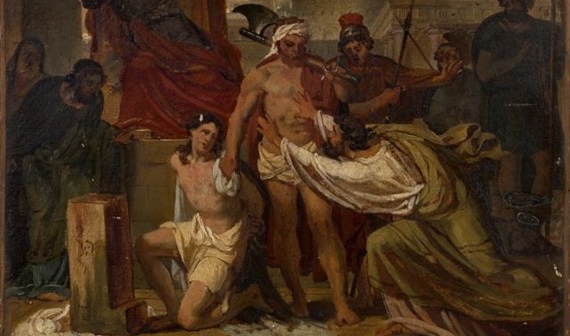
The two friends, both disciples of the philosopher Pythagoras, traveled to Syracuse together. During their sojourn, Pythias was charged with plotting the overthrow of the Tyrant of Syracuse, Dionysius I, and was sentenced to death. He petitioned Dionysius to first permit him to say farewell to his family in Greece. Dionysius laughed at the request and asked Pythias if he thought the rule a fool. But his friend Damon stepped forward saying he stand in as ransom for Pythias. Dionysius was astonished at the folly and, wanting the entertainment to continue, granted the request. But Pythias, having faced many obstacles, including pirates, was delayed in his return. The day came for the sentence of death to be carried out, Damon was taken to the place of execution. Dionysius declared that he had correctly evaluated the calculations of the human psyche and then ordered the execution to commence. But at the last minute, Pythias could be seen at a distance running to save Damon. Seeing the brilliant nobility of these two young men, the Tyrant of Syracuse released them. For the world could not be deprived of two excellent souls such as these.
In the Acts of the Apostles, St. Luke related that their missionary journey had brought Paul and his companions to Syracuse for a few days in ship bearing the figurehead of the Twin Brothers: St. Luke wrote,
|
.... we sailed in an Alexandrian ship whose figurehead was the Twin Brothers,
.... And landing at Syracuse, we stayed three days. (Acts 28:11) |
That this is significant need hardly be mentioned. The "twin brothers" with reference to "Syracuse," of course, represented the highest ideal of Christian life and the loftiest principle which Jesus taught:
| "Greater love has no one than this, than to lay down one's life for his friends." (Jn 15:13) |
Damon and Pythias are twins in the sense that all Christians are twins — indistinguishable as sons of the Father and younger siblings to the Eldest Son.
But there is another layer. The underlying Greek word for twin brothers is ( Δισκούροις / Diskoúrois, ) was also associated with the myth Castor and Pollux, drawn from Greek mythology. Castor was mortal, his brother immortal. So Pollux was given a choice: he could spend the rest of eternity among the deathless gods, or he could empty himself of his own glory giving a portion of his divinity to Castor. Both men, being semi-divine, would henceforth never be separated spending half the year in Hades and half the year on Mt. Olympus. That is the Castor and Pollux story evinces yet another example of ransom.
Ransoms rarely die. Slaves or soldiers or other disposable persons are never offered as ransom. They have no value. A ransom value lies in the prestige or greatness of the person being held. The Latin word Cicero uses for "ransom" is vas. We know what a vase is — something precious or which contains something precious.
As the guard at Syracuse had descended on Pythias, so the temple police descended on the disciples. Significantly, on this night Jesus addresses Judas as "Friend," a term rarely used in Matthew's Gospel. The disciples begin to fight with swords, so Jesus stands forward as the ransom. He identifies His high value by telling the temple police that He could call upon "twelve legions of angels" if He so desired.
The Gospel of St. John sets out the ransom relationship explicitly — a them-in-exchange-for-Me — and the reason for His ransom is clearly stated:
|
Jesus answered, "I have told you that I am He. Therefore, if you seek Me,
let these go their way," that the saying might be fulfilled which He spoke, "Of those whom You gave Me I have lost none." (Jn 18:8-9) |
You see, His Disciples have been entrusted to Him. He must not lose one.
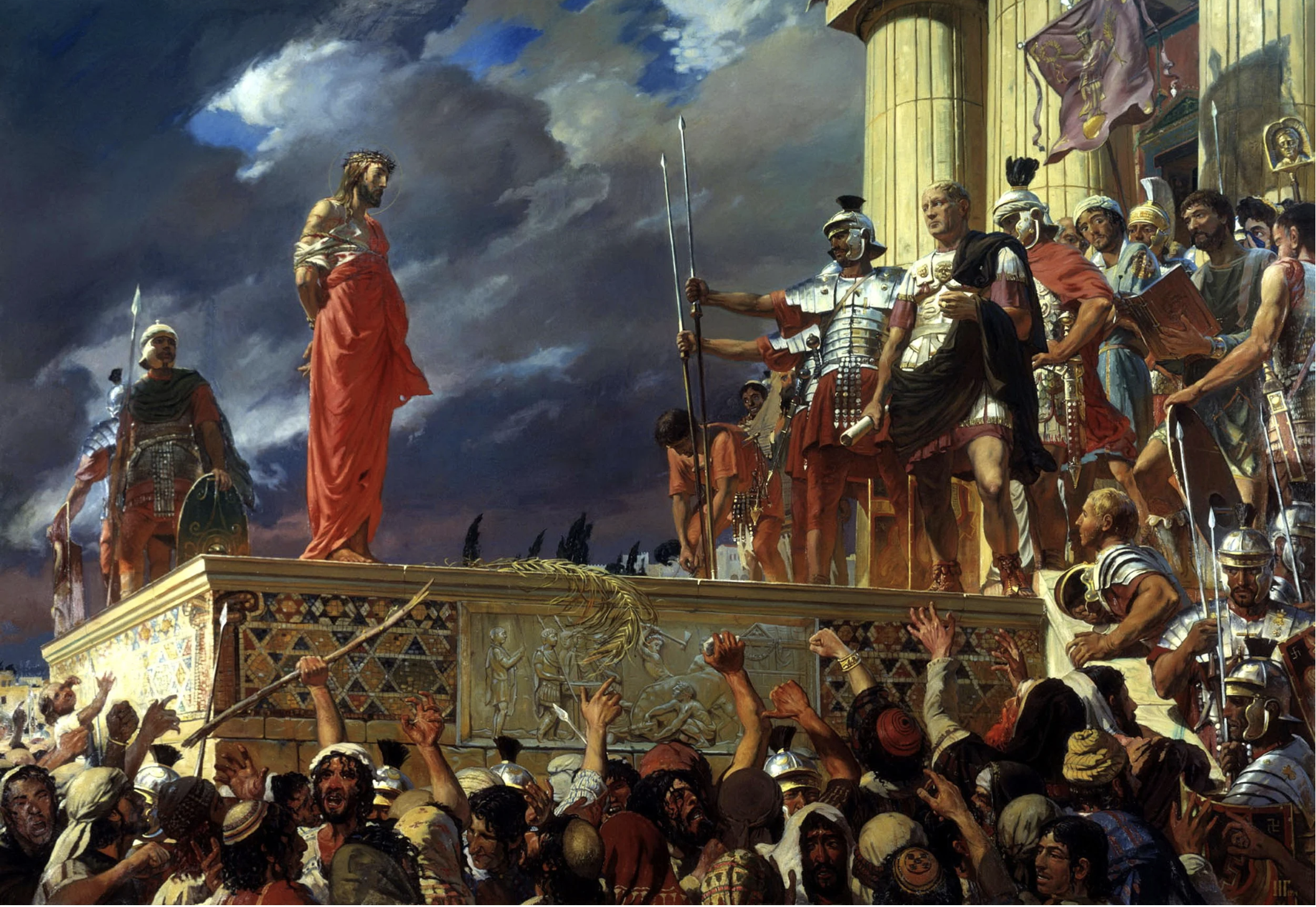
Pilate approached the crowds not once but three times
exhorting that if only one would simply raise his voice,
the Ransom would be released:
| Again Pilate addressed them, still wishing to release Jesus, but they continued their shouting, "Crucify him! Crucify him!" Pilate addressed them a third time, "What evil has this man done? I found him guilty of no capital crime. Therefore I shall .... release him." With loud shouts, however, they persisted in calling for his crucifixion, and their voices prevailed. (Lu 23:22-23) |
Our Lord stood forward as a Damon. He stood forward for us. But on that horizon no Pythias was to be seen. No person would utter even a word for Him.
Thirty-years of indifference towards God, of rejection of God, and of hatred for God distilled into three hours. His Divinity was revealed in three days to those who willfully ignored Him for three years. We could have saved our ransom (Mt 20:28) by offering one word (Lu 23:22). Instead, we offered two: "Crucify! Crucify!"
Here is the noble Damon, for whom no one would lift a finger, standing not before the dangerous and forbidding Tyrant Dionysius I, but before Rome's pleading governor, the sympathetic Pilate, who repeatedly begged anyone to say something .... while Jesus' Disciples remained in hiding.
Here is the meaning of the Cross. The Cross signifies our cruelty, our indifference, and our fickle nature. It is not God's Cross. It is ours: a Cross-roads at which we must choose one way or the other. By tradition the Cross is the archetypal compass of the world, for the cardinal directions on the compass, spell (in Greek) the four letters "A D A M" — the "old Adam" he has set free and the "new Adam" who had completed Adam's course.
And here at the end He sets in place the final detail of His great and exemplary work of Theosis, the model that will be imitated forever after, and this precept above all: "Greater love has no one than this ...." And having completed His Masterpiece, the portrait of mankind that had been defaced, 3 He utters His three last words: "It is finished."
And what is the meaning of this Masterwork? What is the greatest and noblest attainment of the human soul? As Luke suggests, it is the banner and symbol under which we sail, the credo by which we live eternally, and the work we must complete if we are to hear those longed-for words, "These are my sons and daughters in whom I AM well pleased." We take heart from the Master's magnificence. We resonate with the injunction of Pope St. Gregory the Great: "Be Friends of God!"
According to this obscene and transparently grasping scheme, believers need do nothing to attain the Kingdom of Heaven. "Holiness of life" turns out to be a vain fantasy, said Anselmo. And a horde of selfish people followed him .... by the billions in the centuries that followed crying, "All I have to do is believe that Jesus is Lord, and I'm in"!
Perhaps anticipating this ugly development, Jesus stepbrother, the Bishop of Jerusalem, replied, "Even the demons believe .... and tremble!" Belief must be followed by the strenuous works of Theosis, for, completing his thought, James wrote:
|
But do you want to know, O foolish man, that faith without works is dead? ....
a man is justified by works, and not by faith only. (Jas 2:22) |
And the noblest works of all are the offering of ourselves as a living ransom for others. Let us give of ourselves that others might have life. Let us deny ourselves that the least among us might live. For a cardinal teaching of the Master was this one:
| "He who finds his life will lose it, and he who loses his life for My sake will find it." (Mt 10:39) |
Let us pick up our Crosses, therefore, and follow Him, follow Him to the uttermost extreme .... which turns out to be the Kingdom of Heaven. Let us follow Him Who was the noblest Ransom of all.
But who should we believe? James and His Stepbrother had advice concerning this paramount question, as well:
|
"You will know them by their fruits. Do men gather grapes from
thornbushes or figs from thistles?" (Mt 7:16) |
The Benedictine religious order of this time was overtaken by a homosexual mania together with its inevitable follow-on: the rampant abuse of boys. And this was spilling over onto the parish churches. But you can read about it in a book from this period, a book written by a different "Damon," Peter Damian, who later became a Doctor of the Roman Catholic Church. 4
About this same time, the Church of Rome broke with the ancient Holy Catholic and Apostolic Church, which was founded by Jesus and the Apostles. Many other innovations flooded in, too, and the Roman Church set down a road of rationalism and legalism that would persist almost a thousand years, fatally forming her and shaping her spirituality and finally bringing her to the sad state in which she is plainly seen today.
Yet would the imperishable Church be preserved,
faithfully and devoutly preserved,
in the Eastern Roman Empire
and
later
in the countries where it was founded,
and
then in much of the Eastern world.
It needed to add the word Orthodox to its name
to indicate its purity and authenticity.
Nonetheless, to be sure,
it is that same "Catholic Church"
that St. Ignatius of Antioch,
(a disciple of St. John the Apostle)
attested in his Letter to the Smyrnaeans.
Antioch,
an ancient patriarchate of the One Holy Catholic and Apostolic Church.
In the Name of the Father and of the Son and of the Holy Spirit.