Today's Gospel lesson is called one of the "hard Gospels" presenting us with one of those cues. How many sincere and faithful Christians have walked out of church the Sixteenth Sunday After Pentecost shaking their heads? "This doesn't sound like Christianity!" they might mutter. "In fact, this sound like a harsh critique of capitalism: 'The rich get richer, and the poor get poorer.'"
|
"For to everyone who has, more will be given, and he will have abundance;
but from him who does not have, even what he has will be taken away. And cast the unprofitable servant into the outer darkness. There will be weeping and gnashing of teeth." (Mt 25:29-30) |
These three sentences violate our cherished notions God's of mercy and charity. What is going on here?
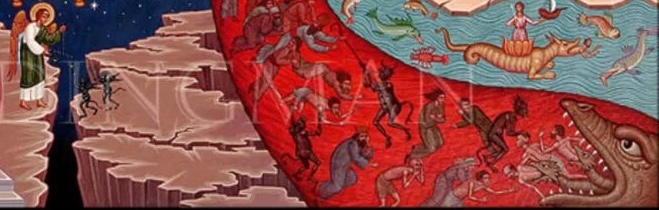
We recognize these "hard sentences" as concluding the Parable of the Talents — by any measure an outlandish tale. That the same tale should begin, "For the Kingdom of Heaven is like ...." further suggests that ordinary reference points will not do. Then discovering that this tale includes the proximity of Hell tells us that "We are not in Kansas anymore."
Last month, we read a related parable, the Parable of the Unforgiving Servant (Mt 18:21-35), which featured a loan of talents equaling a quarter-trillion dollars. The steward of that tale is panicked. He cannot repay so great an amount. In earthly terms, the sum is beyond comprehension. And yet, it all depends. If it has been squandered, yes, it is certainly unpayable. But if it has been managed wisely, the sum is right here, readily available, and with interest. In this sense, today's parable is a sequel of the other.
A "talent of gold," worth between 4 and 5 million dollars today, seems to have been a phrase commonly used in Jesus' time, something like "the riches of Croesus," proverbial. But our reference points — the Kingdom of Heaven, the possibility of Hell, and the gold talents themselves — move us well beyond the subject of accounting, indeed, they move us out of the world. The talents must signify something far greater. Isn't this obvious? When we encounter the fabulous, then we know we are in a fable.
On reflection, though, while the servant calls His Lord "a hard man," a Judge Whose justice is perfect, reading the parable we must also say that this Lord displays a love and a mercy which are infinite. For He has freely entrusted vast fortunes to all three servants and rewarded two of them. Let us consider this morning's Gospel, then, to be a meditation on "God's grace."
What is grace? In the West it is thought to be something objective: a commodity, we might say. For example, "O Lord, grant me the graces to pass through this temptation unharmed." You see something is descending from above protecting me, giving me strength.
Like the talent of gold, grace is difficult to comprehend. In the East grace is understood to be Almighty God Himself. Not a commodity, but something that has never been created, in fact. As soon we will pray,
|
"Thou, O Boundless Christ, filling all things,
Bearing life more fruitful than Paradise, Brighter than any royal chamber." (The Divine Liturgy) |
You see, grace is an instance God's Self-giving, surpassing all objects, surpassing all commodities. Not in the same class or kind. Something altogether different or Other. Grace moves us far above and beyond the quotidian world. God's gift of grace grants to us even God's Own Person and Power. We become like the Son of God: pre-existent, subsisting in the Holy One before the world was made. For grace is a word that invokes God's Uncreated Energies, as we read in St. Gregory Palamas' Triads. 1
In this (Uncreated) Light, suddenly the two parables, bizarre by the world's standards, become in a sense familiar. They are meditations on our daily strivings and yearnings in the form of Theosis. Did you notice during the parable?
|
"Well done, good and faithful servant; you were faithful over a few things,
I will make you ruler over many things. Enter into the joy of your lord." (Mt 25:21) |
You see there is ascent .... Theosis. And they provide precious insights into the very Nature of God.
You know, God created us because, in His love, He seeks the fullness of family. I have noticed that those people who say, "I want a large family!" are those who have been invested with grace. They see God's blessing and abundance in the world, and they want to participate in it, even be an instance of it. But people who say, "I don't think I want children," tend to be flinty and selfish people.
Yes, He is a Society of Three. Thoreau wrote, "I had three chairs in my house: one for solitude, two for friendship, three for society." 2 Why, then, Father God already has everything He needs! But He wants an abundant family, like Paradise teeming with beautiful life. And He created us, as His children .... that is, to be like Him. He looks forward to the day when He can entrust us with significant gifts of His Own Nature.
This morning we read from the Holy Apostles Convent literal translation, which emphasize that the "certain man" is able gauge the present capacity of each servant: "to each according to his strength." 3 This is all about a Father raising children, which is what Theosis is.
In today's parable, He gives five talents to one man, two to another man, and one to a third man. How does He know we are ready to receive such a priceless gift — God's Own Person, God's Own Power, God's Own Nature? He observes them like a devoted Father. But truly, He cannot know until they have acted, for they are free to choose what they will do next. 3
But in God's choosing we would do well to consider: God desires us to be vigorous in our faith, not let His gifts die within us. as we learned from the man who buried his loaned talent in the ground. He is bound and cast "into the darkness, the outer one," for there is no point in going on. His gifts have died within him. Passivity, it turns out, is deadly.
As a parish priest occasionally I was asked about supplicatory prayer: "Father I pray and pray for things I need, but nothing happens!"
"Tell me more," I would say.
One woman said that she would lay on the La-Z-Boy recliner in her living room. This was her oratory, and would spend hours in prayer here. For her, prayer was synonymous with supplicatory prayer .... asking for things.
I told her, "Now, I don't rule out your being attended by angels in your living room. But it is much more likely that you must get up, go out, and roll your wagon forward. The Holy Spirit will guide those wheel in the right direction. But you must roll the wheels."
This is a bit like the old manual steering. Do you remember? If you got in the truck and tried to move the steering wheel, you found that nothing would move. For in those days, the front wheels would not turn left or right until you rolled them. Spiritual life is the same way. Unless you make your way forward, God cannot guide you. You must roll the wheels.
I told my parishioner, "You know, there is something to the bumper-sticker advice: 'Expect a Miracle,' 'Envision of Miracle.'" And one more thing: God's understanding of your needs might not match your own. So please be discerning to the form of God's answers to your supplications."
I was listening to a preacher on the radio yesterday during my regular Friday trip to Hilo to pick up 1,000 lbs. of fish (for our compost). He said, "I asked God for love. And He presented me suffering people because He wanted me to learn love, to exercise love, to grow strong in love. And then I would have love."
God expects us to exercise our faith. We must go! We must do! We must see what He is setting before us! It will not happen in the La-Z-Boy recliner.
Sr. Mary Anne and I were out looking for a piece of stone I might use for a vanity I am building in the bathroom of the podvoria. From a distance, we ruled out a certain vendor, Stoneworks, because their website depicted posh living. "This is for millionaires," we said. We were looking for a remnant of granite leaning up against the building out back. But we went anyway. We went. We did. We saw. And there we met an extraordinary man who wanted to talk with us about the Greater Life. As it later turned out, he made a gift to the Hermitage worth $1,400. We just don't know what will happen next. We must give the Holy Spirit room to do the next extraordinary things. It turns out, we really don't know anything.
I went for medical tests in Honolulu last week and saw a young woman in the airport wearing a T-shirt that read, "God is still writing new chapters for your life."
I said, "I like your T-shirt. But, remember, these chapters are a co-authorship: God proposes the choices He wants you to make, but you must choose them."
Allow me to share my understanding of "to everyone who has more will be given" and "to those who have not, even the little they have will be taken away." During the late 1980s, my life suddenly changed. God proposed a new and very different chapter for my life. He proposed a new book for my life! And as I went forward, I discovered that this new chapter had a "magical" quality. For I had entered (I later realized) a "call experience." God was calling me away from everything I was doing. He was asking me to burn down my whole world. He had something completely new. And you know God is not kindly disposed to compromises. "Be not lukewarm but rather hot or cold" (Rev 3:16). I interpreted this new world to be the priesthood, and I was right. During those coming years, the rules of normal expectation were suspended. The old rules did not apply. The world around me suddenly seemed abundantly rich with Divine meaning. I beheld "impossible" coincidences. I was granted glimpses of the Divine world and Holy Ones. I lived as if my every motion and decision were consequential. I was in constant conversation with God as a form of prayer.
And I recall saying (in my spiritual immaturity), "O Lord, why have You wasted these marvels on me? I already believe! I have never not believed! Shouldn't they be given to someone who really needs them?"
I did not yet understand the meaning of today's Gospel. What is more, I understood a different Gospel lesson with greater clarity, too (the parable about the rich man and Lazarus):
|
"If they do not hear Moses and the prophets, neither
will they be persuaded though one rise from the dead." (Lu 16:31) |
More to the point, I understood the hard saying, "to the one who has not, even the little he has will be taken away."
Do we marvel at 10,000 talents or 10,000 X 10,000? But this is nothing. This is pocket change when compared to God's Own Person being entrusted to us, God's Own Person dwelling within us, God's Power residing within us. And the ones who do not take God seriously, surely, even the little faith they have will be smothered by their many distractions and will vanish. The little they have will be taken away. And suddenly two parable that had seemed bizarre, now seem familiar, even predictable.
God seeks men and women who have hearts for God. His hope is that they will mature to have hearts like God's. And here are the inner workings of Theosis made clear in the parable today, which is no longer bizarre but clear and clarity itself.
You know, Hell is not a punishment. It is what we have wanted all along. It is the sum of our own desires. Truly, what we have been longing for all our lives — the trend of our minds from minute-to-minute, the content of our daydreams, the preoccupations of our secret hours — these will determine our eternal home. If we have desired God and are filled with thanksgiving for the many blessings He bestows, then we shall have God: first as one talent, then as two, then as five, and gradually all as we have capacity within us. As we have a heart so large that we fear it will burst. That is the heart that is finally large enough to love God.
If our longings are not for God, then we shall have spiritual vacancy. And where is that? It is the dwelling place of those who have rejected God if only by indifference. God surrounded them with His love and mercy all their lives. But what is that? Their desires led them them into a society of the many who are indifferent to God.
We know that God is our Mother-Father because He showers us with cares and blessings and loving thoughts devoting Himself to us in all hours .... as if we paid it any mind. Isn't that the picture of a father and mother and their children?
What is that place permanently divorced from God? It is devoid of light. It is devoid of love. It is devoid of any vestige or scintilla of the One Who Alone Is Life, our Loving and All-merciful God.
In the Name of the Father and of the Son and of the Holy Spirit.