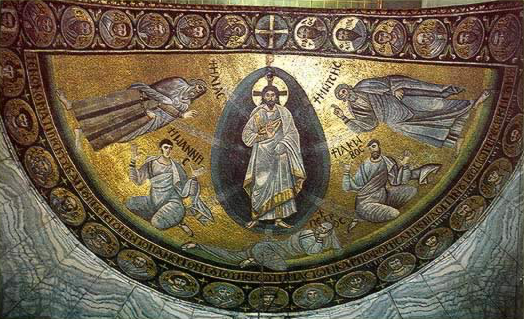
Luke 9:28-36 (Matins)
2 Peter 1:10-19
Matthew 17:1-9:2
Luke 9:28-36 (Matins)
2 Peter 1:10-19
Matthew 17:1-9:2
The question "Who do you say that I AM?" and the definitive revelation — by God the Father, no less — of Who Jesus Is are intended as a pair, what literary scholars call "bookends," beginning and then ending an important theme or question. But the question goes far beyond Who Jesus Is, though, for the goal of His Incarnation is to reveal who we are and where we are going. The fate of the world depends on getting this right, even the fate of God's great aspiration to create a world of righteousness from our as-yet unworthy desires and lazy dispositions.
What was the answer to the question? What was the outcome on which so much depends? It has not been decided still. And we play a crucial role in deciding that outcome. Will we trek up into high mountain passes? Will we finally and forever walk away from unworthy life? Will we accept the mantle and responsibility of being a child of God and Jesus Own sibling? Each day we go deeper (and hopefully higher) into these rarefied climes, and even the angels of Heaven are standing by serviceable to assist us when the going gets tough.
This morning we enter upon, or rather ascend, into high mountain passes, high above the world, where the true, the abiding, and the real are countenanced face-to-face. Thousands of years ago, inaccessible mountain summits were reserved for the sacred and unapproachable: the dwelling place of the deathless gods, writes Homer. And by Jesus' time no man had ascended to the highest peak of Mt. Olympus.
Only two hundred years ago, certain alpine peaks still remained beyond human skill or capacity. And these stirred the imagination of men. Shelley, for example, wrote these lines of the still-unconquered French summit of Mont Blanc:
|
Mont Blanc yet gleams on high: — the power is there,
The still and solemn power of many sights, And many sounds, and much of life and death.... .... The secret strength of things Which governs thought, and to the infinite dome Of heaven is as a law, inhabits thee! And what were thou, and earth, and stars, and sea, If to the human mind's imaginings Silence and solitude were vacancy? — Mont Blanc, 127-129, 139-144 |
Once a year we ascend the Mount of Transfiguration with Jesus and three of
His fellows
—
Peter, John, and James
—
which Biblical commentators have styled His "inner circle."
But, specifically, which mountain did they climb?
Let us first ask the question,
where are they on their progress through the breadth and depth and many heights of ancient Israel?
In Matthew, Chapter Sixteen,
we find the group in Caesarea-Philippi.
After their long, hot, dusty journey,
I propose
they would have taken their rest seated upon
the smooth stones around Paneas (modern Arabic Banias)
midst
near the cold headwaters of the Jordan.
The cooling mists there would have refreshed them.
Moreover,
this whole region was understood to be a place of extraordinary spiritual power.
Here was the dwelling place of Pan,
the god of all things not ruled by particular pagan gods
(we would say, "nature,"
but that post-industrial construct did not yet exist yet).
That is,
the concept of a god that is everywhere
must have intrigued the Son of the One God.
Here, too,
the Romans built the soaring white temple
to Caesar Augustus,
whose title included divi filius,
"son of the divine,"
further intrigued the True God's Son.
Now, where else in "the region of Caesarea-Philippi" (Mt 16:13), which is our sole Biblical clue, would Jesus have chosen to ask His disciples (and us) the greatest question:
| "Who do you say that I AM?" (Mt 16:15) |
Would He not have set the scene, directing His followers to look upon these claims to Divine power and then confronting them with the question of questions? Remember, it is belief in Jesus as Lord and God, which begins our salvation (Jn 3:16).
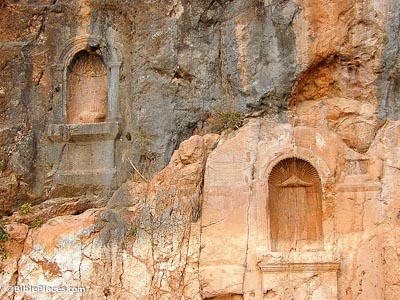
As they gazed upon this most imposing sight, at the Temple to Augustus Caesar, at the Grotto of Pan, and at surrounding cliff with little booths carved in it for the display of other deities, the minds would have been elevated to ultimate questions. It is then that Jesus asks them in grave tones,
| "Who do say that I AM?" (Mt 16:15) |
And in a fit of inspiration, Peter blurts out:
| "You are the Christ, the Son of the living God." (Mt 16:16) |
I say, "fit of inspiration" but this is Jesus' observation:
|
"Blessed are you, Simon Bar-Jona! For flesh and blood has
not revealed this to you, but my Father Who is in Heaven. (Mt 16:17) |
Not long afterwards, Peter would be dismissed as a son of Satan. That is, far from being the rock of foundation, Jesus styles Peter a "stumbing block (σκάνδαλον)" (Mt 16:23). Nonetheless, in a mad moment Peter had distinguished himself, and this golden memory, to be sure, he again and again would recall and cherish.
After this they restored themselves with rest and nutriment for a period six days (Mt 17:1) preceding the next ordeal. Before lay them a most arduous task — the long and difficult trek up to the summit of a mountain. of "a high mountain" (Mt 17:1), which was immediately above them, for Paneas lies at the foot of Mount Hermon, (which is actually a cluster of peaks). This name, according to its Semitic root hrm, means "consecrated," even "taboo" and was long regarded as a place of sacred power. 1 Jesus does not invite everyone to ascend the holy mountain, only His inner circle, who, as we shall see, are overwhelmed by the experience.
Let us pause here to ask the awkward question, "Why then does Orthodox tradition center on Mount Tabor?" which is more than sixty miles away. Mt. Tabor is first proposed as the Mount of Transfiguration, by the influential Origen and then echoed by St. Cyril of Jerusalem and St. Jerome. But at an elevation of 1,886 feet, it does not meet the requirements of the Gospel description, which is "a high mountain." Even our everyday experience disqualifies out Mount Tabor. The mountain at whose foot the Hermitage lies, could scarcely be called be thought of as "halfway to Heaven," is much higher than Tabor at 2,500 feet, and we commonly see the over-65 crowd biking over it. Not exactly a world apart.
Mount Hermon, with its three peaks, rises above 9,000 feet, stirring the soul to imagine the outer precincts of Heaven. Luke records that Jesus "robe became white and glistening" (Lu 9:29). Indeed, one's beard would turn white and glistening in these icy climes. More important, perhaps, is Mt. Hermon's proximity to Paneas, where Peter would have noticed the "booths" cut into the cliff outside the Grotto.
|
"I will make booths, one for you and one for Moses and one for Elijah."
(Mk 9:5, Mt 17:4, Lu 9:33, Revised Standard Version) |
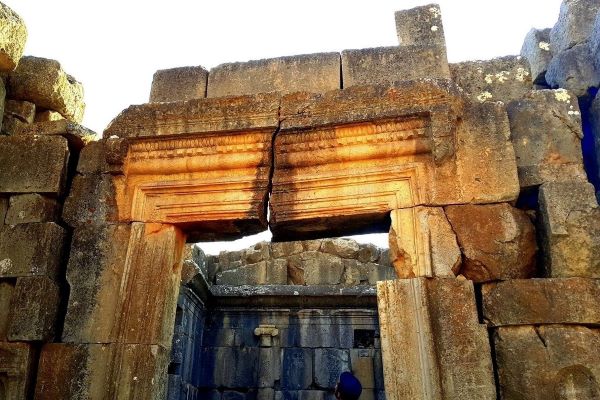
Hermon, as its Semitic root attests, was understood to be a consecrated place,
a place set apart for God.
A temple Qasr Antar
(KAHS-r ahn-TAR),
built just after Jesus' time
was situated on Mount Hermon at 9,232 feet.
And it bears an astonishing inscription in Greek:
| According to the command of the greatest a[nd] Holy God, those who take an oath [may proceed] from here. |
"Proceed from here"?! at 9,232 feet? To where? Or should we say where else, but the Kingdom of Heaven. The greatest Enoch scholar of our (or any time), George W. E. Nickelsburg, pointed out that this demand for an oath is attested in the Book of Enoch (1 Enoch 6:6) 2, revealing Mount Hermon to be understood as the threshold between Heaven and earth. 4
These are no incidentals or scholarly niceties. Jesus is modeling for His Inner Circle the culmination of the life of Theosis, which is a transformation leading to intimacy with God, and also fellowship with the saints in light — in this instance, the historical Northern Kingdom's greatest prophet and the historical Southern Kingdom's greatest prophet. As many have noticed, Moses and Elijah are the personification of the Law and the Prophets.
But I would prefer to emphasize a more important point: they are the deathless ones, the ones who were assumed into Heaven without tasting death. Recall that in the Letter of Jude (written by James' brother and stepbrother to Jesus) St. Michael contends with the devil over Moses' body (Jude 1:9). In my belief this is the most authoritative statement we have concerning the death of Moses.
We began this morning with the Jesus' flat declaration that some who hear His voice ....
|
".... will not taste death before they see that the Kingdom of God has come with power." |
He then is transfigured before the eyes of Peter, John, and James. They hear (dare I say it?) the palpable voice of God the Father (presumably in Greek). And then two figures appear: Elijah and Moses, who like the other two Figures, are deathless ones. 3 Here Jesus confides an urgently important aspect of Theosis to His followers: the great crossroads which lies before the sons and daughters of men is a choice between union with God and ghastly death. God has no part in the filthy world. He is Holy, and the invitation offered to us to become Holy. All else is worthless and rotting death.
As we enter the culmination of our journeys of Theosis, as we pass through high mountain passes into the sacred, and our vesture and even ourselves begin to glisten. Have you not seen the radiant light emanating from the face of the saint?
At the end of journeys, let us offer our final prayers asking the assistance Enoch, the first to be assumed into Heaven. For Enoch's journey was so pure, so Holy, that the Book of Genesis has no worldly thing to say about Him:
| Enoch walked with God; and he was not, for God took him. (Gen 5:24) |
The rest is silence.
By the grace of Most High and the assistance of the deathless ones,
may we walk with God and seamlessly pass into His marvelous light.
It is a choice, always a choice:
the world, with its fleeting pleasures, or eternal God.
Who do you say that He is?
In the Name of the Father and of the Son and of the Holy Spirit.
1
"Literary, epigraphic, and archaeological evidence
from the Bronze Age to the Roman period indicates that
over a long period of time
the region around Mount Hermon was sacred to Canaanites,
Israelites, and non-Israelites of the Graeco-Roman period,
and
Christians."
See George W. E. Nickelsburg,
A Commentary of the Book of 1 Enoch,
Chapters 1-36; 81-108
(Minneapolis: Fortress Press, 2001), 239.
2
Ibid.
3
The only place in the Bible where the
bodily death of Moses is reported is Deuteronomy 34:5-6,
purported to be written by Moses,
who scarcely could have related his own death and burial.
That is should assert that Moses was buried in a place
so obscure
that "no one knows his grave to this day" (Deut 34:6)
is not credible,
for
which places are more venerated in the Hebrew tradition than
the graves of the Patriarchs?
And could no one even know,
much less fail to venerate,
their most important forebear?
4
This oath, taken by the lower ranks of angels
charged with watching the earth and its creatures,
turns out to be from a dark chapter in the history of Heaven and earth.
But read on in The Book of Enoch
(1 Enoch, Ed. George W. E. Nickelsburg and James C. VanderKam, Minneapolis: Fortress Press, 2001: 24).