John 21:15-25 (Matins)
1 Corinthians 9:2-12
Matthew 18:23-35
John 21:15-25 (Matins)
1 Corinthians 9:2-12
Matthew 18:23-35
Who does not drop what he is doing and listen intently? For the Lord Jesus speaks of the Kingdom of Heaven. He likens it to a certain King, and Who could that King be except it be God? The thought of being summoned by Caesar and then commanded to stand before the Emperor of the Roman Empire would be an overwhelming idea. But what Jesus proposes is far beyond Caesar. Or the thought of standing before Jove, king of the deathless gods, would also be overwhelming. But, again, this is nothing compared to what Jesus has in mind.
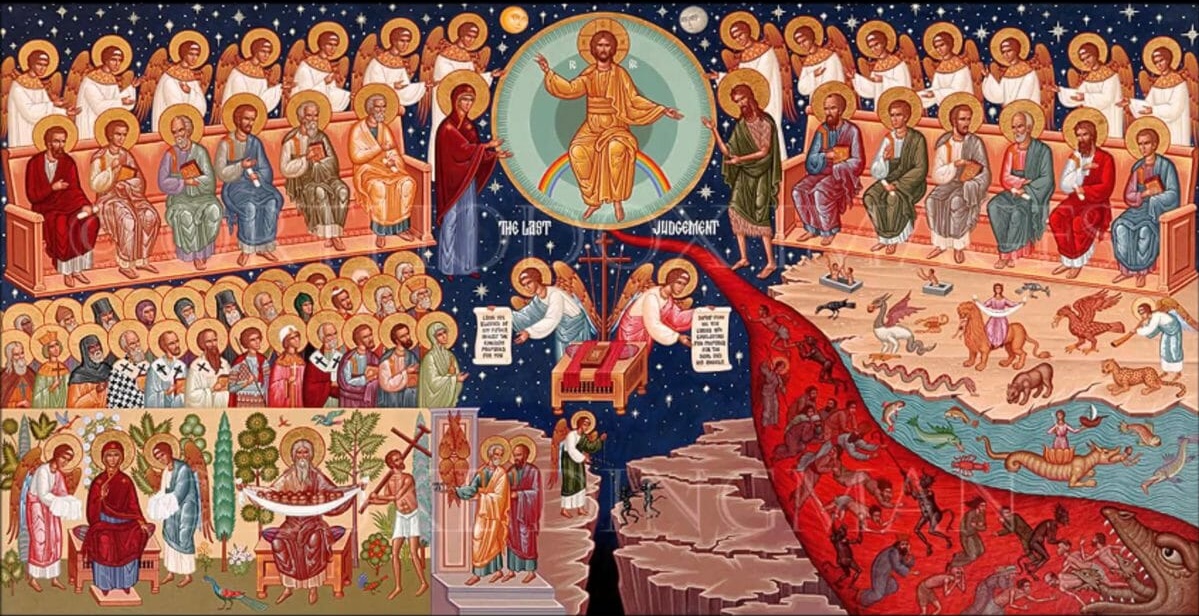
This morning, we contemplate being summoned before Almighty God, King of the Universe and Maker of all. When we arrive, we find that others have been summoned, too. We are told that there will be a "settling of accounts." What could be more ominous? God alone knows everything about us, far more than we ourselves know. For our selective memories have suppressed or altered the true picture as we go back over the many years. And over these years, God has been trying us .... often finding us wanting. Yes, God has been testing us all our lives, taking our spiritual temperature as any caring parent would. And only Father God remembers, faultlessly remembers. Every detail is alive before Him, as fresh as if it had just happened. And these details repeat becoming long-inured habits. When did these habits begin? How many details are we talking about? And in His love, in His high hopes for us, many of these details are offensive to Him, some overwhelmingly offensive. For our God is Holy. And He has said, we His children must also be Holy.
Calculating the multitude of our sins, the countless recurrences of individual sins, and the depth of pain they have caused our Holy God, we must conclude, especially late in life, that our debt is incalculable. Then we must fold into this reckoning the fact that everything precious we own, even our own live, we owe to Him, our Father (Jesus tell us).
And among our greatest sins .... is the thought that we could do all in absolute secret. For this is deceit of the highest order and a denial of who we really are. Indeed, living such a double life, can we know which one is the real "me." It is also the first sin that drops away as we stand in God's waiting room, for there can be no defense.
In this morning's parable, the first man who must stand before the King has long been accumulating a debt that is impossible to grasp: 10,000 talents of gold, which is $50.5 billion on this week's spot market. Instantly, all our categories fail as we attempt to comprehend this, another clue that we have entered into the otherworldly and the Divine. I say "long been accumulating," for certainly this King, famous for His wisdom, has not simply lent $50 billion.
We have often noticed in these reflections that, in all His doings with humankind, our God must stoop down far below His accustomed thoughts and actions. This is an organizing principle in the thought of St. John Chrysostom, in Greek, sugkatábasis from the verb συγκάταβαίνω As I say, this is where God's love must begin. For He cannot love us, He cannot even think about us, unless He first demeans Himself.
Like the Prodigal's father, He will not become our familiar as we might enter brothels, gambling dens, or sordid bar rooms. Yet, He stands at a distance watching all, abhorring all, and wincing at each new turn. Nonetheless, in His faithful love He continues to witness all that we do and everywhere we go. Despite this, He continues to love us. Truly, only a Father (or Mother) could love like this, not walking away to spare themselves.
Later, and for our sakes, He remembers everything. And this is our accumulated indebtedness. It is for ourselves that He has done this, for we cannot advance upwards, towards Him, until these things have been set right. Our relationship with Him cannot be whole until this record has been honestly admitted and resolved.
The word atonement is not helpful here, for it objectifies these things. It isolates them as if they were rotting garbage in a pail which has nothing to do with us. It must simply be "taken out." No, this garbage is us. Irretrievably, it is what we have done, and we must own it.
Now, surely it is commendable that we have made a new and better life, but this is not the whole point. Our regrettable offenses continue to fester, contaminating us. We must take hold and deeply regret what we have done. Like the Prodigal, we must come to the place of true contrition with tears starting from our eyes. It is only from this place that we can be cleansed through absolution. And this is the point of standing before God (or before His priest). Confessing to ourselves will not bring us to this crisis point. It is only when we confess what we have done before another, in mortifying detail, and declare, "This is mine; I own this; I did this!" that we are able to break through to a blistering honesty, which extorts tears. From here we can be released from our longtime burdens. We can once again enter that sacred place where our soul meets with God.
But until then, how can we enter this place? How can we even pray until we are absolved? For God knows and you know that there is something unsavory, something you first must take care of, before heart-to-heart communion with God can be contemplated. Like filthy secrets in a marriage, you cannot venture into real intimacy and sharing with your spouse until you are cleansed of all that offends holy sanctity.
What do these sins over a lifetime amount to? They are the impediment to eternal Heaven. What you pay to erase that stinking obstacle? Billions? Trillions? Quadrillions? Jesus tells us that this value is beyond payment:
|
"For what profit is it to a man if he gains the whole world, and loses
his own soul? Or what will a man give in exchange for his soul?" (Mt 16:26) |
But our parable includes another level of debt — not our indebtedness to the King of Heaven, but the tractable and manageable debts we owe to one another. In the case of our parable this morning, a fellow servant owes the steward one hundred denarii. Now, the denarius, a coin minted with an ever-decreasing fraction of silver, was the object of derision. It was constantly being devalued by the Roman authority. Yet, it was typical payment for a laborer's daily wages. One hundred denarii, therefore, was not nothing. Yet it was payable providing your creditor agreed to a payment plan.
That is, if the incalculably debt might be addressed by way of our contrition to God, and God's mercy, then the debts we owe each other also might be set right by way of a debtor's sincerity and our godlike mercy. Theosis is defined as a journey whose aim is to be like God. And this goes to the heart of the Mystery of the Incarnation. As St. Athanasius has written, the portrait of humanity had been defaced, so we did not know what we were to look like. But Jesus Christ provided the model for the portrait's restoration. 1 And ever after, we have had an exemplar Whom we are able to imitate.
With Theosis we can never see the longed-for goal. Yet through Jesus we know the direction ahead. We cannot attain to the inestimable grandeur of God, but we can be like God in His mercy. And God's Son has provided a precious gift this morning in this parable for showing us the way.
A priest of the Orthodox Church of France (my oldest friend) recently pointed out that only a few, brief passages of Scripture are devoted to sexual sin, but a large proportion of the New Testament and the Old concern the very great matter of our treatment of the poor, which always goes to the living heart of mercy. Certainly, when we speak of the portrait of humankind being defaced, we must admit that our unwholesome sexuality and unfaithfulness are not to so lightly dismissed. But let us hear the Master's last word this morning concerning mercy:
|
"And his Master was angry, and delivered him to the torturers until he should pay ....
So My Heavenly Father also will do to you if each of you, from his heart, does not forgive his brother his trespasses." (Mt 5:24) |
The average man or woman today would say in shock,
"But this cannot be the meek and mild Jesus!"
Yet, we must reply, "Yes, this is Jesus.
This is the Jesus we commonly encounter in the Gospels.
If we believe that grave sin is dangerous,
then
failing to know our God and Final Judge is catastrophic.
In the Name of the Father and of the Son and of the Holy Spirit.
1
St. Athanasius of Alexandria, On the Incarnation Bilingual English-Greek Edition (Rex Mundi, 2024),
51-53.