John 21:1-14 (Matins)
2 Timothy 2:1-10
John 15:17-16:2
John 21:1-14 (Matins)
2 Timothy 2:1-10
John 15:17-16:2
Do you hear this?! Jesus prophesies that the bloody worship of the Jews will keep moving towards its logical extreme: human sacrifice, reminiscent of Baal worship. Elsewhere "Jesus taught an innumerable multitude of people so [great] that they trampled one another":
|
"For there is nothing covered that will not be revealed, nor hidden that will not be known.
Therefore whatever you have spoken in the dark will be heard in the light, and what you have
spoken in the ear in inner rooms will be proclaimed on the housetops.
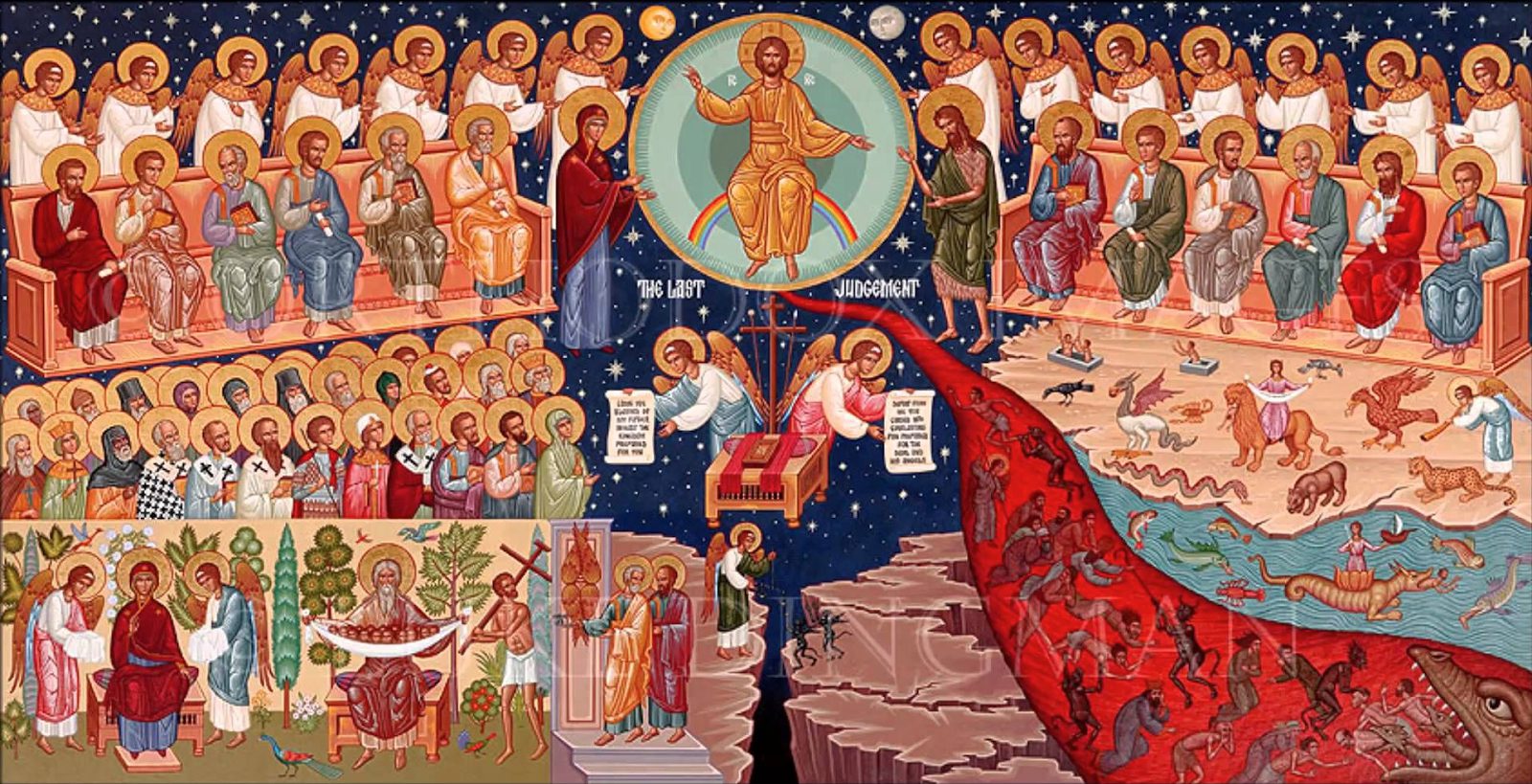
"And I say to you, My friends, do not be afraid of those who kill the body, and after that have no more that they can do. But I will show you whom you should fear: Fear Him who, after He has killed, has power to cast into Hell; yes, I say to you, fear Him! (Lu 12:15) |
The lost sheep of the House of Israel, having committed to blood-sacrifice so long ago, are moving inexorably toward a bloody reckoning. "Things fall apart; the center cannot hold" (William Butler Yates, The Second Coming). This thought-world, so hateful to God, must be destroyed. Not the whole world, mind you, but the Jewish lifeworld. Truly, the reversal that the Incarnation had promised, we might say, "the metanoia," with the true worship of God being restored, is all nearing completion. And Enochic religion — the religion of the Kingdom of Heaven, of angels ascending and descending upon the sons and daughters of men, of the surety of eternal life — would be reclaimed and lived once again. And the words,
| "I AM the God of Abraham, Isaac, and Jacob." (Gen 17:23, 26:24, 28:13, 50:24; Ex 3:6) |
would once again be sovereign and final. God the Son would put a finer point on it challenging false gods and idols everywhere for all time:
|
"Let not your heart be troubled; you believe in God, believe also in Me ....
.... I AM the Way, the Truth, and the Life. No one comes to the Father except through Me." (Jn 14:1,6) |
Emphatic? I think so.
 This primacy, this singularity,
enraged the Roman emperors,
who jealously guarded their gods.
The most severe Roman persecution to be suffered by Christians
was on account of this rage
known as
the Diocletian Persecution
(early fourth century).
But that term actually is shorthand,
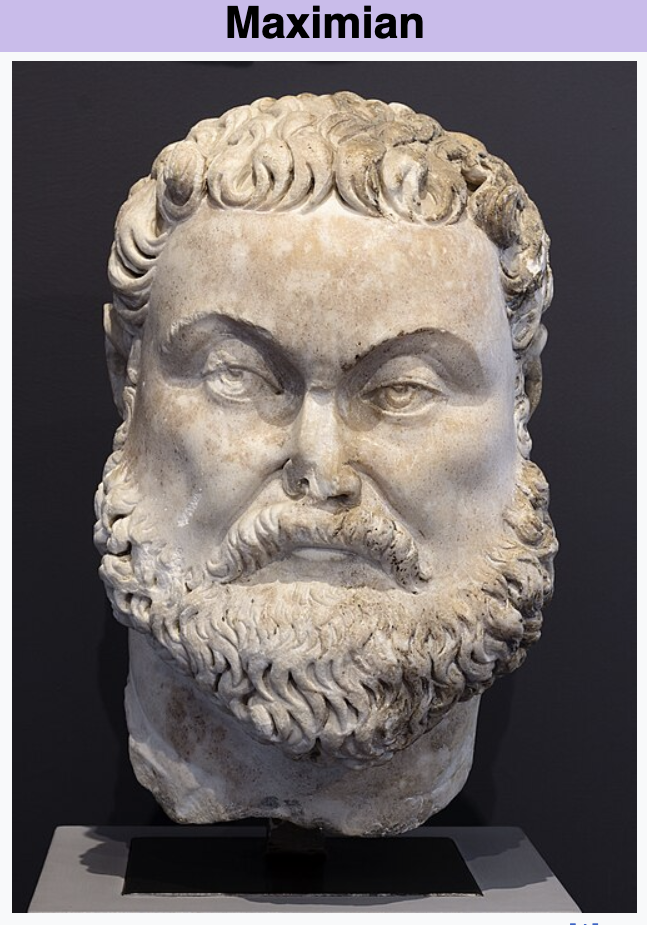
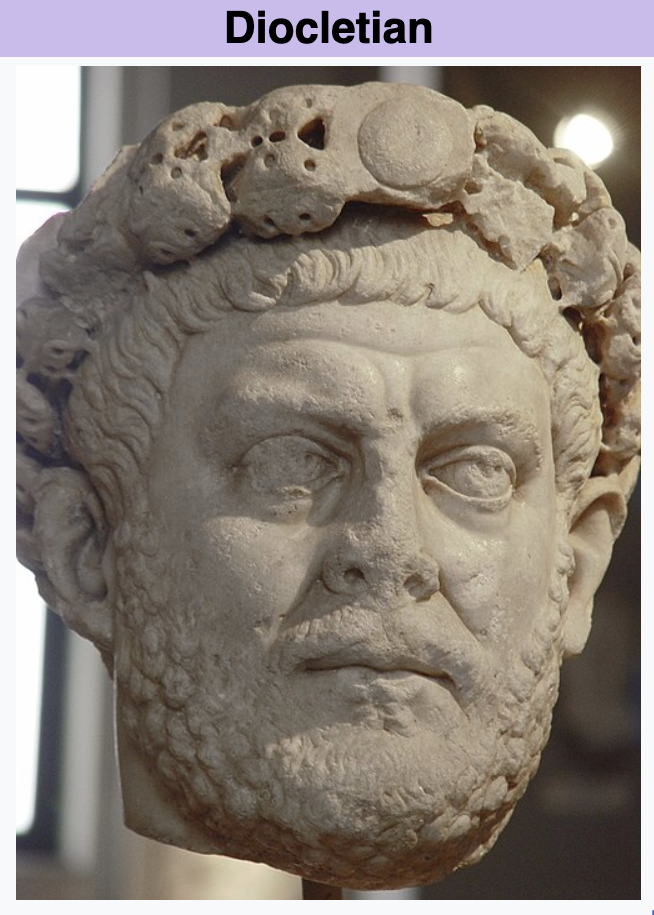
for Diocletian (r. 284-305) ruled with a co-emperor, Maximian (r. 286-305),
a general who scorched the earth
and took
no prisoners.
It was said that "Diocletian was the brains and Maximian the brawn,"
expressed among their several imperial titles:
Diocletian was to be styled Jovius (Jove, the king of the gods),
and
Maximian, Herculius (Hercules, Jove's "strong man" subordinate).
These names hold our interest, for they reveal a deep personal
commitment, even identity, with the pagan gods.
Outlandish?
Well .... you see, within their inner urgings
they had it right
—
to be like God
—
but they suffered the wrong orientation.
For theirs was a kind of
Theosis,
but a perversion of
Theosis.
You know,
like Satan worship these days,
with all the rites turned upside-down
and
the prayers said backwards.
This primacy, this singularity,
enraged the Roman emperors,
who jealously guarded their gods.
The most severe Roman persecution to be suffered by Christians
was on account of this rage
known as
the Diocletian Persecution
(early fourth century).
But that term actually is shorthand,
for Diocletian (r. 284-305) ruled with a co-emperor, Maximian (r. 286-305),
a general who scorched the earth
and took
no prisoners.
It was said that "Diocletian was the brains and Maximian the brawn,"
expressed among their several imperial titles:
Diocletian was to be styled Jovius (Jove, the king of the gods),
and
Maximian, Herculius (Hercules, Jove's "strong man" subordinate).
These names hold our interest, for they reveal a deep personal
commitment, even identity, with the pagan gods.
Outlandish?
Well .... you see, within their inner urgings
they had it right
—
to be like God
—
but they suffered the wrong orientation.
For theirs was a kind of
Theosis,
but a perversion of
Theosis.
You know,
like Satan worship these days,
with all the rites turned upside-down
and
the prayers said backwards.
Into this dangerous world was born a son to an illustrious pagan family in the Roman Province of Bythinia and Pontus, in particular, the city of Nicomedia, about fifty miles east of Constantinople. His name was Panteleon (b. 275), translated literally "among all lions," but no doubt intended as "first among lions," a name chosen by his pagan father.
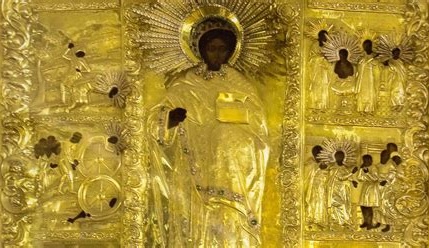
Today is the feast of St. Panteleimon, healer, unmercenary, and great martyr. He is particularly close to the Russian Orthodox Church as the namesake of the Russian Church's only monastery on Mt. Athos and the place where Panteleimon's head has found peace and is venerated. We remember him each week during the Proskomedia in the seventh particle of the third prosphoron.
As we have seen, this was a tumultuous period for Christians. Panteleon's mother, St. Eubula, catechized her son in the faith but died when the boy was still young. He soon fell into the orbit of his pagan father, Eustorgius, and conformed to the world. His father saw to it that he received a first-rate education, and eventually he would study under the renowned physician Euphrosinos. The boy quickly excelled mastering all that was set before him, and before long he came to the attention of the emperor Maximian (284-305), who planned to appoint him imperial physician.
Meantime, the hieromartyrs Hermolaos, Hermippos, and Hermocrates, (whose feast day we observed yesterday), who had survived the Massacre of the 20,000 in the year 303, were living nearby in hiding. By twists and turns, Panteleon became acquainted with St. Hermolaos, who picked up where St. Eubula had left off, and soon the young man's heart burned within him as before. In time, Panteleon made himself a vessel acceptable to God, which the Lord then filled with power and grace. One day the saint found a dead child on the street bitten by an asp which lay right beside the still-warm body. Stricken by the sight, Pantoleon prayed ardently to the Lord Jesus that the child might be revived and the snake destroyed. And it came to pass exactly as Panteleon petitioned. Right then, he resolved to be baptized. Soon another miracle was done through Panteleon, this time before the eyes of Eustorgius, his father. And they both were baptized by St. Hermolaos with Panteleon choosing to alter the spelling of his name slightly: Panteleimon, but rendering an almost opposite meaning: "all-merciful" (pan-eleison). That is, his new name referred both to God and to the one who had become God's vessel and favored instrument.
The saint would become a veritable font of miracles as God's chosen instrument, inevitably pagan physicians around him were shown to be, by comparison, incompetents. Who would want to go to them with a serious ailment. The all flocked to Panteleimon. His rivals bitterly complained, and their complaint came to the attention of Maximian, who rightly interpreted all this as belittling the pagan gods. But when a paralytic was healed right before the emperor's eyes, he could stand it no more and ordered the healed man to be executed on the spot .... and Panteleimon to be fed to wild beasts as a spectacle to be enjoyed by pagans. But the animals came up gently and licked the young man's feet fulfilling Eustorgius' unintended prophecy: he would indeed be "first among the lions." The spectators cried out, "Great is the God of the Christians!" Can you picture this in a great circus (like the Colosseum in Rome)? A roar went up: "Great is the God of the Christians!" And the emperor was enraged and ordered the soldiers to stab as many of these people as they could. And he ordered Panteleimon's head to be cut off.
So the soldiers led the saint to an olive tree and bound him. One soldier struck him with a sword, but the sword became soft like wax. Soon a voice was heard from above, which all heard, summoning Panteleimon to the Heavenly Kingdom. The soldiers fell to their knees instantly, begging forgiveness and refusing the emperor's command. But Panteleimon admonished them not to rebel against God, and with tears in their eyes, they gave the saint a parting kiss and removed his head. The body was thrown into a great fire but remained unharmed. Relics of the passion-bearer were distributed throughout the world with his head finding rest many centuries later in that same Russian Orthodox monastery on Mount Athos.
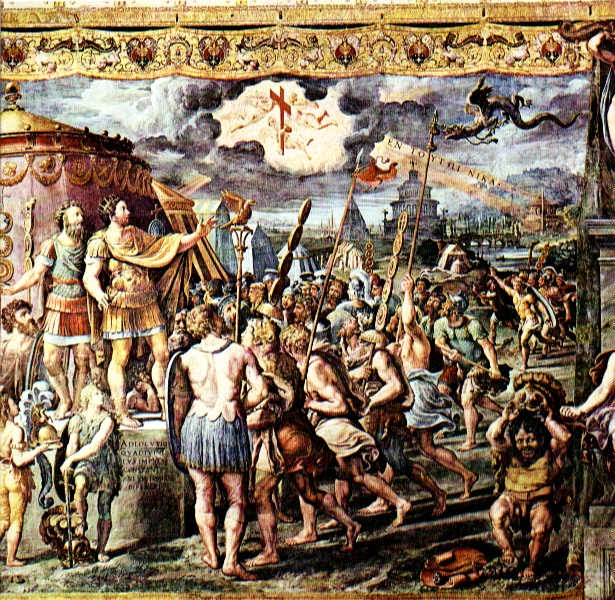
And how did God respond to these emperors who would play gods?
They would encounter a God-chosen vessel
at a place called the Milvian Bridge.
Perhaps we no longer hear the power of this phrase,
but the ancients who heard it would now have the hairs on their arms standing on end:
the Milvian Bridge,
where the world was forever changed in an afternoon.
Only a few few year's after Panteleimon's execution, Maximian's son Maxientius took the field in arms on October 28, 312, a red-letter date, for on that day Constantine I and all his army (according to Eusebius) looked up and saw emblazoned across the sky a great Cross with words written on it (in Greek):
| Εν Τούτω Νικα / En toúto Nika / By this Sign, conquer! |
Constantine, of course, did conquer. The next year he would issue the Edict of Milan decriminalizing Christianity forever. And he would become the sole ruler of the Roman Empire in 324.
Let us offer our festal prayer to the Greatmartyr and Healer and ask shall we be "first among the lions" or shall we be "all-merciful"? Now, we shouldn't dismiss this as a rhetorical question for our God needs both. He needed Constantine the Great to be first among the lions and to show no mercy to his stubborn and fierce pagan adversaries. And in so doing the Christian faith became possible. God also needs all-merciful vessels like Sr. Mary Anne and Sr. Mary Martha, who would go into the dangerous fourth world and lay down at the feet of the poor. God needs both.
Therefore, let us pray, let us watch, and let us listen for God's holy promptings, for only by knowing our vocation will we respond as God would desire. Yet, in every case, the question directed to you and the question that has been so hard for everyone is, Which do you want? Do you want God? Or do you want the world? There is no middle way. And the Gospels attest that Jesus is disturbed at attempts to have it both ways. The Lamb on His Throne declares:
| "So then, because you are lukewarm, and neither cold nor hot, I will vomit you out of My mouth." (Rev 3:16) |
In the Name of the Father and of the Son and of the Holy Spirit.