John 20:11-18 (Matins)
Hebrews 13:7-16
John 17:1-13
John 20:11-18 (Matins)
Hebrews 13:7-16
John 17:1-13
Following Pentecost, apostles sent by God along with false, self-styled apostles streamed out of Jerusalem, especially to the great cities to the south and west. They did not plead the cause of God so much, for the nascent Church did not lack for interest or members (as we learn from the Acts of the Apostles). But, as St. Paul lamented, the narrative of what had happened, of what God had done, and the content of Jesus' teachings were being corrupted by fanciful re-tellings.
This was complicated by the fact that doctrine tended to be tightly linked to geography. One said, "what the Greeks believe" or "the beliefs of Asia are." In this way the Gentile world tended to pair "the Way" with Judah-ism. Reading the Pauline Correspondence, we infer that the countryside was overrun by self-appointed, Jewish apostles. St. Paul warned, "Beware of dogs, beware of evil workers, beware of the mutilation!" (Phil 3:2). And then he presents his own credentials, not only as a Jew but as a "super-Jew":
|
If anyone else thinks he may have confidence in the flesh, I more so:
circumcised the eighth day, of the stock of Israel, of the tribe of Benjamin, a Hebrew of the Hebrews; concerning the law, a Pharisee; concerning zeal, persecuting the church; concerning the righteousness which is in the law, blameless. (Phil 3:4-6) |
That is, any wandering teacher who evangelized the Gentile lifeworld had better have his credentials in order. And if the Way proceeded from Judah, then an important credential on foreign shores would be one's Judah-ite qualifications. Notably, St. Paul argues from the Hebrew Bible:
|
But I fear, lest somehow, as the serpent deceived Eve by his craftiness,
so your minds may be corrupted from the simplicity that is in Christ .... For I consider that I am not at all inferior to the most eminent apostles. (2 Cor 11:24) |
The Greek phrase here (dripping with irony), which St. Paul actually wrote, was ὑπερλίαν απόστλων / huperlían apóstlon more literally translated as as "super apostles." Paul must push back against these men coming out of Judah spreading false doctrine and attempting to extort new believers. Some of these men were cynical con-men (some things never change).
We, who are much closer to the details, realize the irony. A purpose of the Incarnation was to cleanse the Hebrew lifeworld of the relatively recent innovation of Judah-ism. The Son of God sought to restore the religion of Eden and of Abraham, Isaac, and Jacob, together with its beliefs in Paradise, angels, and intimate relationship with God, all of which were banned under the Sadducees, who ruled the Temple. You see, the ideal of the Sadducees, persisting to our own time, was an idolatry of the Law. This cult had included blood sacrifice, but God had destroyed the place of sacrifice. So persisting on to our town time was an idolatry of the Law (which St. Paul goes on and on about).
Who would know better than "the Apostle to the Gentiles" — who had been Saul of Tarsus but now was Paul of God — that the war being waged was between God and the evil one, the deceiver — in particular, apostles sent by the prince of the world versus apostles sent by God. And this is still true of Christianity with its many versions born of schism and ego and the passions which flesh is heir to. And this is especially true in America with its feverish pace of innovation: Jehovah's Witnesses, Mormons, Seventh Day Adventists, Christian Scientists, Pentecostalists, Unitarians, Holy Rollers, Pietists, Quakers, Shakers, and list of schismatic splinters goes on and on. Yet, if Jesus' teachings are not rightly understood, how does one make his or her journey to the Kingdom of Heaven? You see what it is at stake. We like to think of ourselves as "open minded," but in this case we are playing with fire.
We say we are saved on account of God's famous mercy. Yes, He is God and Father of all, but He has certain requirements, and we His children must not take these lightly. "It's okay to color outside the lines," one of my Roman Catholic bishops used to tell me .... a man who fell into the fire.
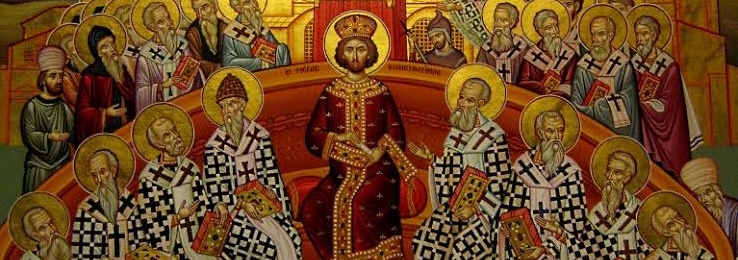
Yes, the Six Ecumenical Councils marked the scenes of bygone wars. And while different saints battled for truth in different places at different times, they really are one war: the world's unremitting war on Heaven. We are living through a particularly hot period of rebellion right now. But here the stakes are even more basic — not a debate among different versions of Jesus but acceptance of God at all.
The millions of souls in hands of the evil one are boldly manifest: chronically filthy language, holy sexuality degraded to cheap thrills, indecent pictures and videos in the hands of children, rampant drug use everywhere, and, the common occurrence of infanticide. Does not the evil one run rampant in a field of victory?!
There is one telling detail. In all of these things, there is a feverishness. All are compelled by some unwholesome driving wheel. For these people are no longer in control of themselves. We use the word addicted, but the fact is, we do not really understand addiction, and certainly cannot "cure" anyone with a remission rate of 7% and no guarantees against relapse. This is something for which we have a word, which is a placeholder for a question mark. We do not understand addiction. I propose the obvious and well-attested term is possession: surrender of your will, you find yourself doing what you detest and doing it over and over again. Self-degradation is evident even self-degradation unto death. And, of course, grotesque disfigurement, physical disfigurement. And one more thing: a hatred of God. Sometimes this is overt hatred; sometimes it is subtle, for we surely hate God if we do over and over again what He detests.
The possessed people of Gad drove Jesus out of their midst, and elsewhere demons asked Him, "What have we to do with You, Jesus, You Son of God? Have You come here to torment us ..... ?" (Mt 8:29). God has been banished. People now say, "Will universe open to you?" And "everyone knows" God must be "canceled" for "judging" us. The new Gadarenes of our time say, "This God must go. He is committing the cardinal sin over and over again. He is judging us." And He is anti-promiscuity, anti-pornography, anti-drugs, anti-abortion, and anti-perversion. Here in Hawaii the offspring of families from mainstream America profess pious belief in animistic spirits with Disney Studios rushing in to confirm their emotions and convictions.
Absurd, you say. As G. K. Chesterton's roving sage, Father Brown, expressed a sentiment to the effect that
| When a man stops believing in God, he doesn't believe in nothing; he believes in anything. 1 |
Consider the case of the Report of the Doctrine Commission of the Church of England. 2 This was a remarkable document concerning a great body of people affecting a worldwide Anglican Communion. This prodigious work began during the "Roaring Twenties," the "Jazz Age" — a giddy time when anything seemed possible. After all, people we traveling about in airplanes seeing above the clouds. The Empire State Building was nearing completion — a tower reaching all the way to Heaven. And new technologies were appearing everyday. A "Who needs God?" attitude had become widespread. But, you see, the report would not be published until 1938 — the year known as "the gathering storm," when British and French leaders began appeasing Hitler in their plea that he not invade their countries. Even after its publication, the Report continued to be discussed, interrupted only by World War II, when the end of everything lay right in front of you.
When King George V had asked for the Report in the early twenties, England lived in a very different place. As I say, it was a giddy and careless time. And the early Report was shaping up to reflect that cocky optimism. "Incarnationalism" would be proposed as the primary theology of the day, casting the Church as a kind of United Way, avoiding the embarrassing subject of sin or any need for redemption.
But the world that emerged through the War and after it was very different, not merely pessimistic, but chastened and reverent, on its knees, no ignore ignoring the profound sinfulness of humankind. Indeed, the War ended with the greatest, single act of evil ever loosed on the earth: on August 6, 1945, the slaughter, in a matter of minutes, of 120,000 women, children, and old men. There were no soldiers present. They were off fighting a war. Then a second enormity a few days later: the slaughter in minutes of 80,000 more, whose only offense was to have been born on the wrong island. The long-term effects of these two bombings would claim about a quarter-million lives. And what was the motive (for this awesome weapon could have been demonstrated on a desert island)? The motive was to invade Japan before the Soviet Union got there.
World War II revealed Hell. As at Fatima, the curtains were drawn back, and Hell could be plainly seen. And many soldiers, sailors, and marines experienced at first-hand the serene ministrations of God and His angels. Do you know the truth about dying on a battlefield? The bombs seem a million miles away. A serene and holy place opens around you and, yes, the presence of angels. Here are the facts needed to decide doctrine.
The Sisters and I were born in years during and just after the War. General Eisenhower, now President, wove God into very fabric of America's leading symbol. On June 14, 1954 he signed a bill adding "Under God" to the Pledge of Allegiance to the flag.
The year Father Brown made his pronouncement concerning man's belief in anything-but-God was 1923. Certainly, the sober and learned Father looked out on a giddy, reckless, and irreverent world. And the short story that set all this out was named "The Oracle of the Dog." If you will kindly spell this word backwards, you will get a sense of the unhinged quality of the thing and the trampling of the Holy Name under foot.
We began this morning with a sobering epigram. Jesus declares that He does not pray for the world. Did you know when Jesus uses the word sanctify, the Greek word He is actually speaking means "set apart, set apart from the world." You see there are only two places you can be. You are either in the world, or you are with God. We say that sanctify means "to be made Holy." Holiness means "to be close to God." Strictly speaking, sanctify means to "be set apart from the world in order to be close to God." Do you see? This is bedrock. The very language Jesus uses plainly declares that you cannot serve the God and serve or acknowledge the world. Does not Jesus declare this principle explicitly?
| "You cannot serve God and mammon." (Mt 6:24) |
Small wonder, Jesus does not pray for the world.
We must never lose sight (borrowing C. S. Lewis' words), that God is not a meek, little man, who wrings His hands, and pleads that everyone be nice. Nor is He a senile grandfather with a great white beard who just wants everyone to be happy. 3 He is Almighty God, Who created every living thing and Who mysteriously loves us. He will not be mocked though He is ready always to forgive the truly contrite heart. The Son of God, surely, prays for those with thanks in their hearts seeking to requite, if it were possible, this magnificent love.
The Risen Christ addresses this subject directly. He says to Peter, "Do you love me?" using the verb-form of agape. But Peter cannot rise to the occasion and uses merely the verb-form of philia.
But if we are not to believe just anything. If we are not to reverence the oracles of dogs, then we must know God. It means nothing to be close to God if we do not know Him. Would this not be simply projecting our fantasies and desires upon God? We must pray to God as Jesus taught us. We must study His Holy Scriptures. And from time to time, we must ensure that our doctrine is sound .... as I refer back the Six Ecumenical Councils.
Why do we no longer convoke Ecumenical Councils? The last one was in the eighth century. Because the Church is no longer One. Schism has replaced Councils. And finding the true faith in a particular church is not as easy as it once was, for Communions alter what were once unrevisable beliefs with breathtaking speed. We once belonged to a Communion of 1 billion people, by they have revised basic doctrine with breathtaking speed. And many Churches that profess sound Christian doctrine are, in fact, crypto-heterodox Churches, with leaders fearing to reveal what they truly believe. ("It would only confuse the people," is a sentence I heard are too often over the many years.)
Preparing for the end of our lives, we have gone back to the early centuries of the Church. You see, we seek to know God. We study the Fathers and through them re-read the Scriptures over and over again. We pay attention to the fields of archaeology, epigraphy, and paleography, which cast new and authentic light on the earliest Church. That is, we long for God with all our heart and mind and strength.
In the fullness of time, Jesus' foremost prayer is "that they be One" (from our lesson today) — better known in the West by the Latin words: — Ut Unum sunt. For we cannot enter the Kingdom of Heaven is we are not One. For God is love, and unity is the essence of His Kingdom:
|
"I do not pray that You should take them out of the world, but that You should keep
them from the evil one. They are not of the world, just as I am not of the world. Sanctify [set apart] them by Your truth. Your word is truth. As You sent Me into the world, I also have sent them into the world. And for their sakes I sanctify Myself .... I do not pray for these alone, but also for those who will believe in Me through their word; that they all may be one, as You, Father, are in Me, and I in You; that they also may be one in Us ...." (Jn 17:15-21) |
There are no First and Second Churches in the Kingdom of Heaven; there are no Communions and Jurisdictions. There is only God, and He at One with His Son and we at One with God as the Son is One with the Father in the Unity of the Holy Spirit.
The purpose of our lives
is to be perfectly conformed to them:
to the Apostles who are conformed to the Holy Trinity in a union of perfect love.
In our willfulness,
we have demanded their patience, understanding, and mercy all our lives.
But at the end, in the fullness of our maturity, we arrive to the place
of self-sacrifice, self-denial, humility, and fierce loyalty to God,
Who is Holy.
Therefore, we must be Holy.
In the Name of the Father and of the Son and of the Holy Spirit.
1
This precise quotation seems first to have appeared
in Émile Cammaerts' biography,
The Laughing Prophet: The Seven Virtues and G. K. Chesterton (London: Methuen, 1937),
which summarizes themes from Chesterton's "The Oracle of the Dog."
2
Doctrine in the Church of England:
The Report of the Commission on Christian Doctrine Appointed by the
Archbishops of Canterbury and York in 1922. (London: SPCK, 1938).
3
C. S. Lewis, Letters to Malcolm (London: Geoffrey Bies, 1964).