John 20:1-10 (Matins)
Romans 15:1-7
Matthew 9:27-35
John 20:1-10 (Matins)
Romans 15:1-7
Matthew 9:27-35
Only last Sunday we read, "Who do you say that I AM?" And this morning, roaming the Levant with powers only God could wield (Jn 3:1), He answers. In this section of Matthew's Gospel, He displays His authority over the winds and the sea. He raises the dead. He roams the ancient Hebrew lifeworld, even to the beyond of the lost Tribe of Gad, healing all manner of afflictions and maladies. We hear Psalm 46(45) sounding in our hearts: "Be still, and know that I AM God."
Where we visit him today in our Gospel lesson, He heals blindness which speaks to our brokenness. After all, wasn't this the reason He was sent. We have been blind and have rejected God. He replies by magnificently reminding us that He is the Lord of Hosts. He knows of our deplorable condition — that having rejected Him, we desperately try to fill ourselves with the busyness of the world and vain imaginings. The Psalter begins, "Why do the nations rage / And the people plot a vain thing?"
We are over-busy attempting to fill the God-shaped space within (Pascal) with anything but God. We cluster in distracting groups: in Shanghai, population 25 million; in Beijing, population 22 million; in Mexico City or New York, population 8 or 9 million. About 80% of all humans live in cities, in the U.S. 20% in the towns. Almost no one lives the quiet life that Sr. Mary Martha knew on the farm, that Sr. Mary Anne knew growing up on the edge of the prairie, almost no one. Yet, this quiet, this alone-with-God, is the true state of human life. As I say, all else is a distraction. You see, we proceed alone from God at our birth; we return alone to God at our death. And it is only natural to seek life with God during our earthly journeys.
The Lord reminds us that this alone-with-God is the royal place, the place where life happens:
|
But you, when you pray, go into your room, and when you have
shut your door, pray to your Father who is in the secret place; and your Father who sees in secret will reward you openly. (Mt 6:6) |
Is this not the greatest truth of our daily lives: the secret place, intimacy with God, Who knows everything about us and sees our every doing: mindfulness, prayfulness, unceasing (1 Thess 5:17)?
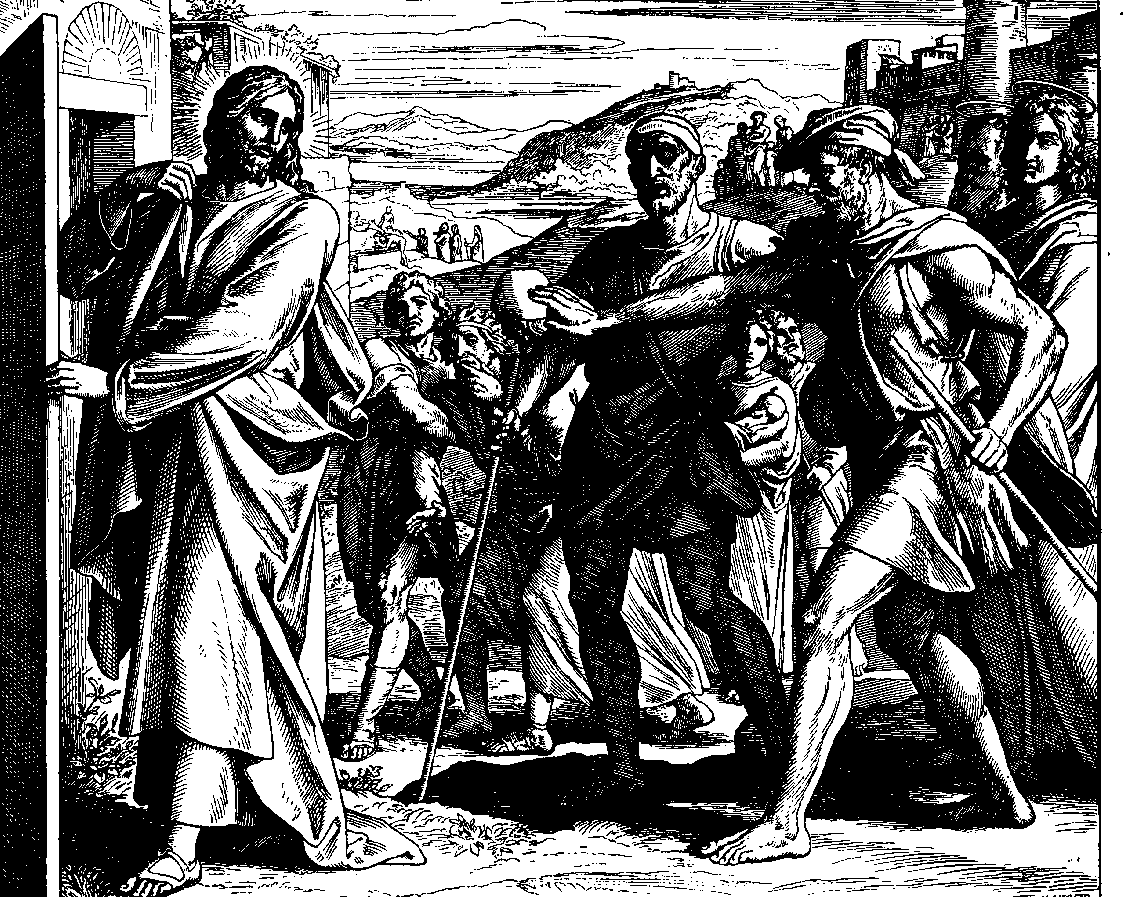
Today, two blind men noisily approach:
| Two blind men followed Him, crying out and saying, "Son of David, have mercy on us!" (Mt 9:27) |
They loudly repeat their flattery as if it were some kind of talisman: "Son of David! Son of David!." And their prayer is only for themselves: save us, give to us, have mercy on us.
Yet, the failure of their material eyesight is an imposing fact. We instantly grieve for those suffering the never-ending night of blindness. But this must not distract us from the real problem, which is their spiritual blindness. For Jesus heals no malady so often as blindness. Indeed, He has been sent into the world for this very cause. The Jews have rejected God, albeit through deceit. They have consented to a Babylonian idol, which they call Adonais and Elohim, the very same name the Babylonians use for their god.1 And let us never forget: the Babylonians designed and built. And the Jews have consented to the prohibition of the Holy Name: YHWH. That Hebrews fled Jerusalem, so they could build their own temple called the "House of YHWH" is proof that this prohibition was not on account of piety. Their spiritual blindness is then confirmed and redoubled, for God has come to them face-to-face, yet they fail to see the Mighty God standing in their midst. And I comment, Isn't this today. How could people say what they say and do what they do if they understood the Mighty God was in their very midst?
John Chrysostom says that this passage concerning blindness is about being converted to an inward way of seeing:
|
.... two blind men followed Him, crying, and saying, Thou Son of David, have mercy on us.
And when He had come into the house, the blind men came to Him: and Jesus says unto them,
Believe ye that I am able to do this? They say unto Him, Yea, Lord. Then touched He their
eyes, saying, According to your faith be it unto you. And their eyes were opened.
Wherefore can it be that He puts them off, and they crying out? Here again Jesus is teaching us utterly to repel the glory that comes from the multitude. For because the house was near, He leads them there to heal them in private. (On Matthew, Homily 32) |
That is, this healing is less about the failure of their fleshly eyes than it is about glory. The underlying Greek is doxa — the fickle and finally false "glory that comes from the crowd" is an instance. What is this glory? In English, we distinguish worldly glory with the variant vainglory. A more familiar world is celebrity, which is inherently false and fleeting. Jesus addresses this nexus between false doxa and true doxa, for
|
.... even among the rulers many believed in Him, but because of
the Pharisees they did not confess Him, lest they should be put out of the synagogue; for they loved the glory [doxa] of men more than the glory [doxa] of God. (Jn 12:42-43) |
There is something about a crowd that has its own verve and dynamism. To quote from a celebrated musical, "Come to the cabaret, old chum! / Life is a cabaret." Isn't this why people go to music festivals and rock concerts? To be part of the buzz and excitement, who even surrender all of their spare time and their identities, announced on tee-shirts and decals all over their cars? That is, the evil one proposes His glory — that we trade our souls, even identities, for the buzz of the world.
In an earlier, pre-electric America, Henry David Thoreau 2 commented on this same phenomenon:
|
.... as our inward life fails, we go constantly and desperately to the post-office.
You may
depend upon it, that the poor fellow who walks away with the greatest number of letters, proud of his extensive correspondence, has not heard from himself this long while. |
You see, posturing in false self-display is no innovation of our era, vividly evident in Facebook, Instagram, and TikTok. It is as old as Eden, where Eve sought a new, though inauthentic, identity. She wanted to be not like Eve, but like God. As the early Church Father Irenaeus commented, How sad! For Eve, in time, would have been granted her wish anyway. She would have matured into that identity authentically, through time spent alone with God in devotion, prayer, and contemplation. That is, the root problem is that she had "not heard from herself this long while."
We might choose life as a solitary living in a hut on the shore of Walden Pond as Thoreau did. Or we might choose a hermitage on a remote Pacific island. For eluding "the glory of the world" becomes increasingly difficult. It is the will of the evil one that false glory should become all that we see .... unto spiritual blindness leading to a night that has no end.
What shall we do?
Our true identities may be found in God alone.
God is the giver of our true calling and vocation,
which is our only path to godly life,
which is our only path to Him,
Who is always calling us to Himself.
Let us be sure to set aside time to hear Him.
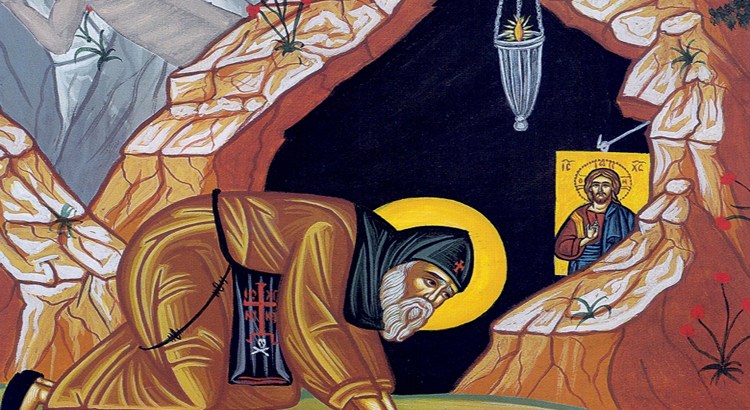
Let us go to the secret place.
Here we commence
our interior journey.
It begins in nascency with silence
and
then becomes resonant with heartfelt prayer.
He is our Father, Who mysteriously longs to hear of our love and gratitude.
He has given everything that is beautiful.
He has given everything that is true,
and
what He gives are the only things that abide.
The journey is sustained each day through Scripture, contemplation, and prayer.
As St. Paul tells us in this morning's Epistle lesson,
| For whatever things were written before were written for our learning, that we through the patience and comfort of the Scriptures might have hope. (Rom 15:4) |
And it is confirmed by messages from angels written on walls of our daily experience. Our first steps and our last in their goodly company are guided by the Holy Spirit. And all depends on our spiritual temperature, on the state of hearts. Let us hear Jesus' words this morning as they are directed to us in earnest: "Do you believe?" (Mt 9:28).
Jesus reveals to the blind men,
"According to your faith let it be to you"
(Mt 9:29).
According to your spiritual temperature,
according to the state of heart and soul,
let it be do you.
For this is the soil from which fragrant godly things grow ....
according to our faith.
God will do the rest.
For God's plan for His human creatures
—
maturing unto the fullness of Divinity
—
never varies.
And though the buzz of the world
can be deafening,
even blinding,
God never fails.
In the Name of the Father and of the Son and of the Holy Spirit.
1
The so-called Babylonian Captivity began in 597 with the conquest of Judah
by the Neo-Babylonian Empire.
By the time of the Return two generations later,
Babylon was under the rule of the Persians.
I use the term Babylonian referring
to both masters of Babylon,
whose patterns of religion were similar.
2
Henry David Thoreau, Walden. Variorum edition. Ed. Walter Harding (New York: Twayne Publishers, 1962).