Luke 24:12-35 (Matins)
Romans 10:1-10
Matthew 8:28-9:1
"Alone with None But You"
Alone with none but You my God, I journey on my way.
What need I fear? When You are near, O Lord of night and day,
more secure am I within Your hand than if a multitude did 'round me stand.
—
From the Prayer of St. Columba
In the Name of the Father and of the Son and of the Holy Spirit. Amen.
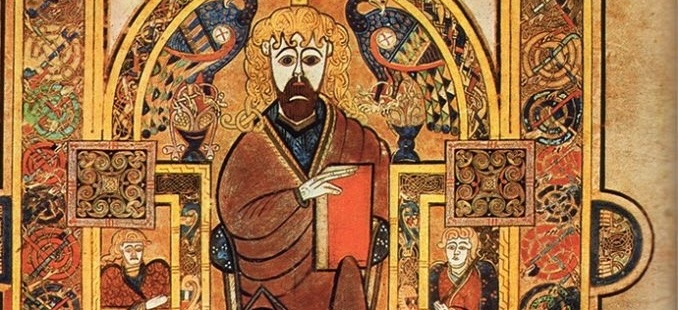
Today, we give thanks for the life of the Orthodox saint,
Columba of Iona,
and,
in so doing, remember an ancient Christian people,
who for centuries have been
shrouded in mystery.
But in our own time,
the fog begins to lift.
These nascent Christians avoided Roman legions
and
missionaries
but were gladly evangelized
by St. Andrew near the Black Sea
and
then
by St. Paul as they passed through Asia Minor on their migration westward
(recorded in the Letter to the Galatians).
What shall we call a Christian people
who practiced their faith for centuries before the First Council of Nicaea,
who took extreme measures to avoid all Roman influences,
whose lives were governed by Apostolic principles?
Certainly,
they were bold
—
sailing through the Pillars of Hercules,
called the Ne plus ultra
("beyond which there is nothing").
And they landed along the rugged coasts of modern-day Ireland.
That they continued to repel Romans is attested by
the fact that Ireland was never invaded.
Archaeologists have discover their artifacts tracing back, thus far, to third century.
In particular,
the subfield of paleography has yielded a detailed picture of their lives,
for they were prolific writers
(and continue to be so).
And what has
survived tells us much:
that they embraced the Gospel ideals taught them by the Apostles
and
especially
to avoid riches and the ways of the world.
According to a leading historian of the Irish,
Dáibhí
Ó Cróinín
|
They never acquired the habit of using coins for currency or charters as
expression of legal title.
1
|
What?!
No money!
No land deeds!
But only the teachings of Christ.
That is all they need:
the teachings of Christ.
Here, truly is an Apostolic lifeworld,
continuing for centuries and centuries,
splendidly isolated.
A major feature of this lifeworld would be the monastery:
worship,
teaching,
and
the copying of holy books.
Their willful isolation
from the world is obvious,
as
Ó Cróinín
points out.
Historians who try to master the Irish system of chronology
found in their Annals are
"baffled .... hopelessly at sea."
|
Ireland [was] never having been part of the Roman Empire, and hence without
any inherited system of imperial or regnal years or their equivalent.
2
|
We understand chronology in the Gospels
by the reigns of emperors and kings.
But in this world,
there were no kings, no reigns, and therefore no eras.
They simply lived and wrote about their daily lives.
Taking all into account,
historians conclude
that there is no counterpart in all European history
for this ancient people and culture.
Ó Cróinín
concludes
The reason doubtless lies in the fact — which can never be too often repeated —
is that Ireland was never part of the Roman Empire.
3
|
.... a perfect Apostolic world .... preserved in amber we might say.
Nor did they have any part in
the Roman Church,
preceding St. Patrick (his name was actually Patricius,
meaning patrician, or "upper class."
They were inclined to build monasteries, not diocesan chanceries.
They organized in monastic communities,
not in hierarchies of bishops, priests, and deacons.
Mindful of the Lord's teaching not to lord over one another (Mk 10:42-43),
they were repelled by subordinate hierarchy
and
strove for equality in all things.
Historians comment on shape of their buildings,
which were round,
and
notice a similar preoccupation with circles and spirals in their graphic arts and
sculpture
—
revealing
their preoccupation with
unity.
Everything is knitted together toward the center which is Christ.
For the credo of their lives was comprised by the Two Great Commandments:
to be at-one with each other
and,
together, to be at-one with the Lord Jesus Christ.
That is all that was needed.
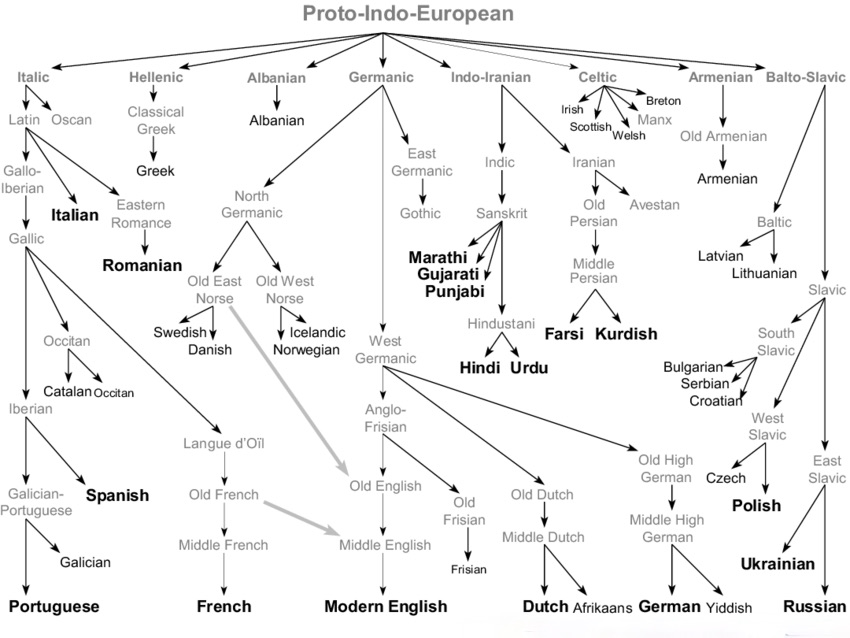
But where did these Apostolic people come from?
They are utterly unlike any of the peoples around them!
Did they come from outer space?!
The language they spoke was in no way continuous with the language groups around them,
which gives away that they were different
and
that they did not mix with anybody else.
Indeed,
their language lies
on the opposite end of the Indo-European spectrum,
more akin to Sanskrit than to
the Germanic languages that would develop into Old English.
Sanskrit?!
Absolutely absolutely astonishing!
They would be dubbed "Celts"
meaning "foreigners you ought to avoid,"
from the Greek term
Keltoi
referring to distant, fierce tribes
in central and western Europe,
which the Romans translated as Celtae.
Previously,
the puzzle pieces that we had pointed to Ukraine and southern Russia
as the region of their origin.
For eighth-century sources located the Picts
(now understood to be an indigenous tribe)
as migrating from Scythia.
4
Elsewhere,
the Declaration of Arbroath,
one of Scotland's ancient founding documents,
asserts
that their forebears
"journeyed from Greater Scythia by way of ... the Pillars of Hercules"
(Gilbralter)
manifestly bringing the Cross of St. Andrew with them.
Where else would St. Andrew's Cross have come from?
Linguists have traced the migration route from the Asian Steppe
to Ireland by studying languages spoken along the way.
But this centuries-long mystery has finally been solved,
not on the basis of
linguistic evidence
or
archaeological artifacts
or
paleography
(which are always subject to debate),
but on
the indisputable evidence of genes, DNA.
In 2015 a group of researchers led by Prof. Dan Bradley of Trinity College, Dublin,
reported,
|
There was a great wave of genome change that swept into Europe from above
the Black Sea into Bronze Age Europe, and we now know, it washed all the way
to the shores of its most westerly island, and this degree of genetic change
invites the possibility of other associated changes, perhaps even the introduction
of a language ancestral to western Celtic tongues.
5
|
In particular, the genetic marker, or mutation, the team settled on
"is so frequent in people of Irish descent that it is sometimes referred to as a Celtic disease."
So it seems the legends and myths were true.
The Celtic people of Ireland and Scotland
descend from ancestors living near to and beyond the Black Sea,
even to Kiev,
the traditional capital of Russia.
Once established in Ireland
they set out in a northern and then eastward direction,
led by St. Columba,
famous for his fiery spirit.
This besetting passion brought Columba to the point of murdering
a man who had seized a psalter Columba had made in the scriptorium.
The sentence pronounced upon him was banishment to the north,
to land of the warlike Picts.
He, in effect, was told why don't you take that anger of yours into the darkness
where it might do some good
and
convert the ferocious Picts.
The more general background
was
St. Finnian building a monastic cell and other buildings that would develop
eventually into Clonard Abbey in County Meath around 520.
This
center of Irish Christianity maintained a steady population of 3,000 students,
producing
the
Twelve Apostles of Ireland
including St. Brendan,
St. Columba,
and St. Aidan.
And these monks
would build the religious thoughtworld of ancient Britain
becoming educators of Anglo-Saxon nobles and kings.
Meantime,
back in Rome,
Pope Celestine I
alarmed to hear of "the Scotti believing in Christ,"
sent
Benedictine missionaries to this Apostolic lifeworld.
His aim, he said,
was to spread "Christianity"
giving away his belief that any Christianity
which was not Roman, was no Christianity at all.
For example,
a few decades earlier,
Pope St. Gregory the Great,
hearing that Benedictine missionaries
were destroying any and all prayers and orders of worship
that did not
not conform to Roman use.
He wrote sternly, "Beware, brothers!
This what the Holy Spirit has done."
But these zealous shock troops were not to be restrained.
Things finally came to a burning point in Britain
at the Synod of Whitby called
in 664 by
High King Oswiu,
who had been educated by the Irish monks,
as had everybody for centuries.
Today, the Synod of Whitby is rightly understood
to be nothing less than a final, decisive conflict between two
opposing thought-worlds
—
the Apostolic faith preserved by these Scythian migrants in the tradition of St. John
and
the Roman faith which had been formed by the imperial and military ideals of Rome.
You know,
when Constantine the Great set up the Roman Church,
he housed its officials in basilicas,
which had been used for judicial institutes.
He began a tradition of canon law
after the example of the Empire.
None of these things occurred in Ireland.
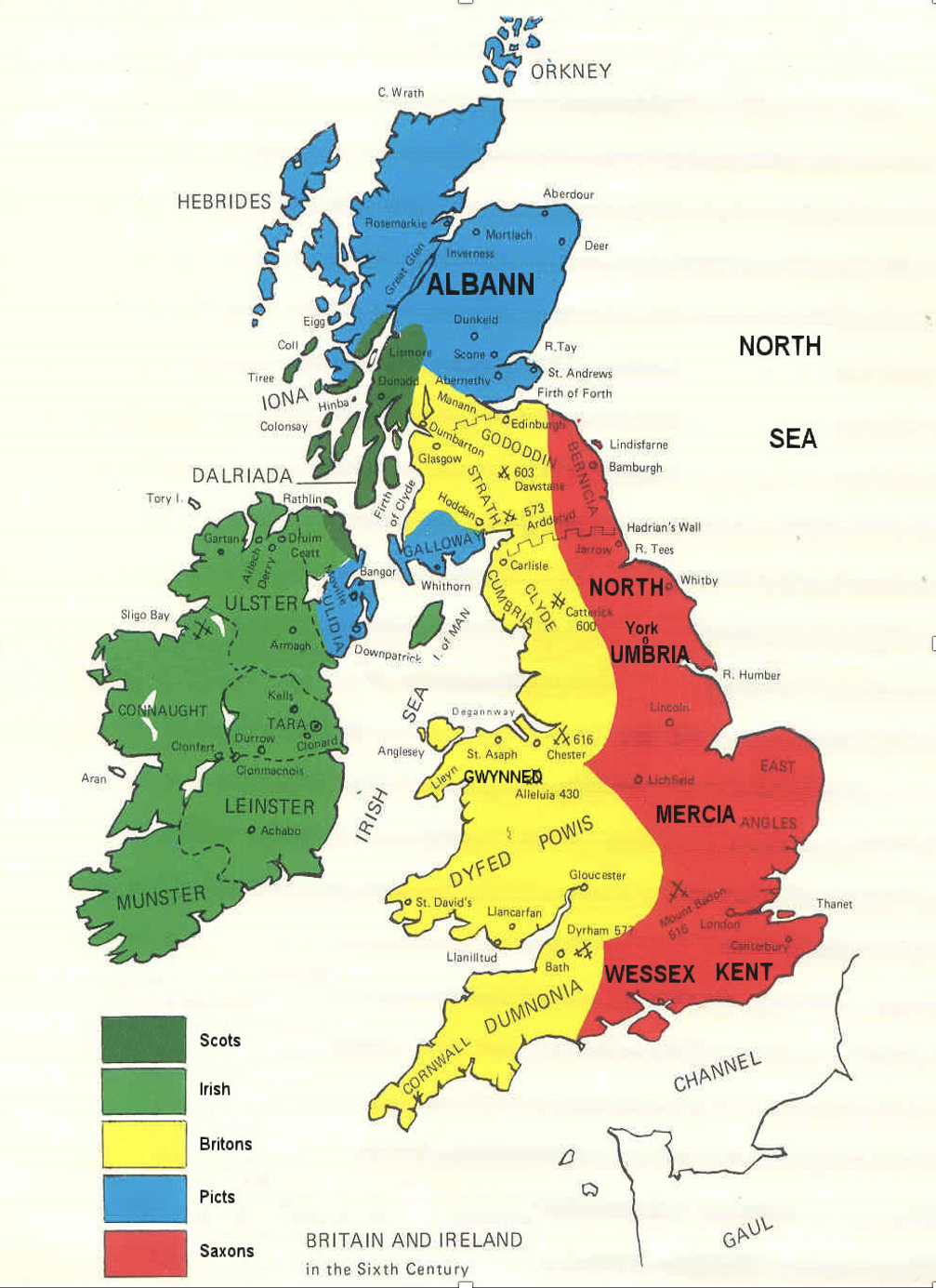
But back at the Synod of Whitby,
the High King turned to his own bishop, Colman of Lindisfarne
(who had succeeded St. Aidan thirteen years earlier):
|
He then ordered his bishop Colman to say first what were the customs which he
followed and whence they originated ....
6
|
Centering on the question of dating Pascha,
an obvious difference between the Irish and Romans,
Colman said that the traditions of his Fathers came to
down to them from St. John the Apostle:
|
"the method of keeping Easter which I observe I received from my superiors who sent me here as
bishop; it was in this way that all our fathers, men beloved of God, are known to have celebrated
it. Nor should this method seem contemptible and blameworthy seeing that the blessed evangelist
John, the Disciple whom the Lord especially loved, is said to have celebrated it."
7
|
By contrast, the Roman position, outlined by a Fr. Wilfred,
a recent Anglo-Saxon convert to
the Church of Rome, adduced the provenance of St. Peter:
|
"The Easter we keep is the same as we have seen universally celebrated in Rome, where the
Apostles St. Peter and St. Paul lived, taught, suffered, and were buried."
8
|
Significantly, Wilfred lays before King Oswiu an imperial chronicle of military conquests:
|
"We also found it in use everywhere in Italy and Gaul .... in Africa, Asia, Egypt,
Greece, and throughout the whole world."
9
|
.... that is,
the world subdues by Rome.
In effect, Wilfred asks, who are the obstinate dissenters,
belittling the religion of the Irish.
They are ....
|
".... the Picts and Britons who in these remotest islands of the Ocean .... foolishly attempting
to fight against the whole world."
10
|
Here is the operative word: fight.
For the Romans present not a theological position,
but an imperial threat.
Let us put aside the inaccuracy of Fr. Wilfred's claims,
for most the world in the seventh century
used
the
dating of Easter in the tradition of St. John.
But the world that mattered to Oswiu is the one crowding in on his eastern border:
the Roman Legions and their spiritual shock troops,
the Benedictine missionaries.
The real subject prompting the Synod of Whitby was power.
At length,
King Oswiu
stated the case plainly.
He turned
to the Irish bishop and asked bluntly,
|
"Who is greater in the Kingdom of Heaven, Columba or the Apostle Peter?"
|
This is the only question that really mattered.
It is the most important question always before any king.
Which is his vassalage?
For a king must constantly scan the world-scene deciding
which lesser kingdoms to subdue in order to force their vassalage under him
or
which more powerful kingdoms he must swear fealty to.
And now he contemplated not kingdoms but the Roman Empire.
This question is incalculably amplified
when it is set in an eternal frame.
All his life Oswiu had scaled his thoughts to fiefdoms and tribes.
He was at the top as the Overlord, or High King, uniting these.
But now he must come to terms with a world empire.
And,
as if that were not enough,
he must contemplate God as emperor
and
St. Peter has His High King.
To get a feel for this I have dug out a Benedictine illumination:
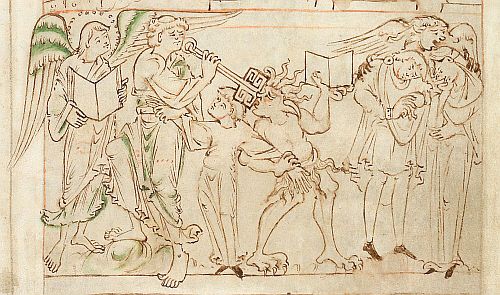
This plate
(which is posted in our written reflection)
depicts the Divine judgment.
At center we see St. Peter holding a man in the handclasp of vassalage,
who by that fact is saved from a demon of Hell.
His diminutive stature does not denote a boy
(children never appear in illuminations)
but rather his lower social status.
(In medieval art diminuitive figures represent the lower class.)
An angel to the left holds an open book
recording the deeds of his life.
The question is obvious:
who can save him?
He has done what he has done.
But,
in the end,
it is St. Peter who holds the keys to the Kingdom
no matter what it says in the Book of Life.
On the right hand side of the illumination
stand a nobleman and noblewoman (judging from their attire and greater physical stature).
But for all their earthly power and connections, an angel of death
(we see his claws)
claims them
holding a book which records their life deeds.
Their appear downcast and despairing,
for they have arrived to the moment of judgment,
and
there is no one who can save them.
They are patently distant from St. Peter's reach.
They have made a horrible miscalculation in discerning their alliances and their fealty.
All along, it was only St. Peter who mattered.
For he alone who decides who will enter the gates of Heaven.
From early on, this was the narrative of the Roman Church
and,
by the way,
still circulates at ground level
and
still today.
A friend of mine who "abandoned the Roman Communion,"
becoming a priest of another communion,
was told by his bishop and chancellor point blank
that there was no remedy:
he would burn in Hell.
In the most ancient
Benedictine illuminations,
Peter is prominently drawn with his keys
referring to
the Roman interpretation of Matthew 16, verses 18-19:
".... you are Peter, and on this rock I will build My church, and the gates of Hades shall not
prevail against it. And I will give you the keys of the Kingdom of Heaven, and whatever you
bind on earth will be bound in Heaven, and whatever you loose on earth will be loosed in Heaven."
|
I am obliged to point out that the pronoun "you" refers to
all of the Apostles not just Peter,
as I mentioned in last week's reflection
discussing the Gospel of John.
And "the rock" signifies an unswerving faith in Christ as the Son of God.
But theology and exegesis of Scripture are not on Oswiu's mind.
Yes, for centuries his lifeworld had been what we would call Orthodox
—
the Apostolic faith preserved by the Irish monks.
But other things are on his mind now,
which have occasioned this famous Synod.
One one side,
he sees his teachers and nurturers and their holy sacraments
—
a centuries-old lifeworld
of unity-seeking, Christ-following, and eirenic saints.
Has there ever been a whole lifeworld of saints,
going on for centuries,
and
thriving under the teachings of the Apostles.
On the other side,
he casts his mind over a vast empire of dioceses and bishop-kings
and
the vast military strength of Rome.
And he chooses for power and the world.
In this he is a prophet.
For not only will these Orthodox monks suffer conquest,
with their holy books and orders of worship destroyed and venerable monasteries
burned,
but the whole lifeworld they nurtured and educated and formed
will be crushed by those same Roman Catholic bishops and priests and monks.
Nary a single holy book or manuscript survived.
Five hundred years later,
following the earth movements at Hagia Sophia in 1054,
Roman contempt for the Orthodox Church
would bare its teeth in the form of military conquest.
People often do not think, when they hear the famous date 1066,
what the Great Schism occurred only a dozen years earlier.
And the fate of Anglo-Saxon Britain,
which was all that remained of the Irish Orthodox lifeworld,
would be sealed.
In the
same interval that was required to wage war on this scale during the eleventh century
is represented by two dates:
1054 to 1066,
the interval required to build those ships
and
amass those armies
and
supply weapons and food and other materiale.
That this campaign was engineered in concert with Pope Alexander II is
a matter of historical record.
11
Norman armies held aloft a papal banner
crossing the English Channel announcing the pope's blessing
—
a banner
which would later appear in the Bayeux Tapestry.
And papal indulgences were granted to all
soldiers fighting on the Roman Catholic side.
Finally, a letter from Pope Gregory VII,
to the newly enthroned King William I of Britain, confirms that
no less an advocate than William's kinsman, Pope Alexander II, had secured the Roman Church's
approval for the invastion ....
not without curial opposition.
12
But enough history!
Let us stop here.
The rest of the story is well-known.
Yes, there is much more to say,
but not on a Sunday morning.
And perhaps
you will not begrudge me this long reflection
on St. Columba Day.
For today is my birthday on the Julian Calendar
—
a fact I did not know when I chose
Columba
as my religious name.
I did not know,
as a Franciscan monastic
in the care of a Franciscan bishop,
that my religious name fell on my birthday on the Old Calendar.
But, you see?
I did not choose it,
but it chose me (Jn 15:16).
Withal,
I have a special duty to remind our Hermitage readers and followers
that our Orthodox forebears thrived in the far West
—
Ireland, Scotland
—
almost a thousand
years before the baptism of Holy Rus'.
And if we peel the onion one more layer,
we find that those forebears came from the region of Kiev,
the place of Russia's Orthodox baptism.
In the Name of the Father and of the Son and of the Holy Spirit.
1
Dáibhí
Ó Cróinín,
Early Medieval Ireland 400-1200.
Second Edition.
(New York: Routledge, 2017), 7.
2
Ó Cróinín, 13.
3
Ó Cróinín, 7-8.
4
Bede, Ecclesiastical History of the English People,
"Of the Situation of Britain and Ireland, and Their Ancient Inhabitants"
Loeb Classical Library. Trans. J.D. King.
(Cambridge, MA: Harvard Univ. Press, 1930), 1.
5
Dan Bradley (Professor of Population Genetics),
Proceedings of the National Academy of Sciences (USA), 2015.
6
Bede, 301.
7
Bede, 301.
8
Bede, 301.
9
Bede, 301.
10
Bede, 301.
11
Catherine Morton, "Pope Alexander II and the Norman Conquest," Le Revue Latomus (34) (Bruxelles, 1975),
362-382.
13
Morton, 362.