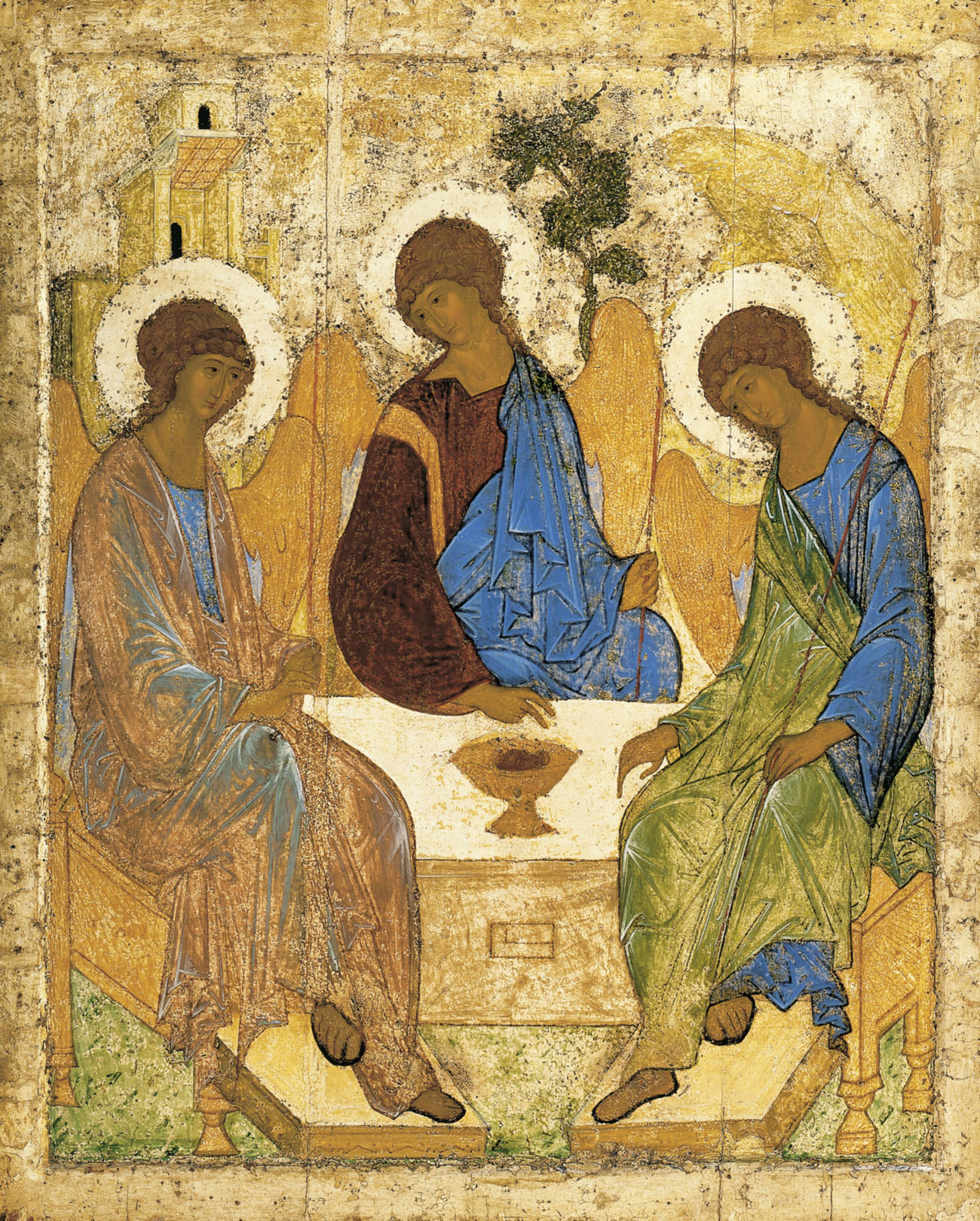
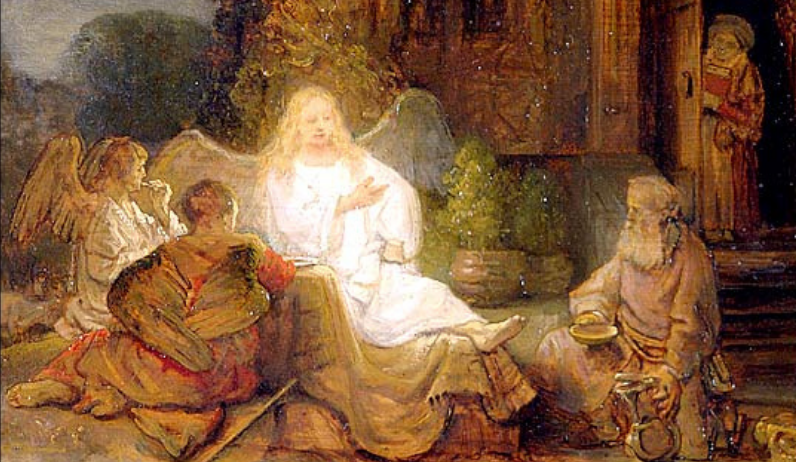
"Many will .... recline with Abraham in the Kingdom of Heaven." The Speaker is the Son of God. Elsewhere, He says that the blessed will be "carried by the angels to Abraham's bosom (Lu 16:23)." For St. Paul, Abraham is a pioneer of our faith:
| What does Scripture say? "Abraham believed God, and it was credited to him as righteousness." (Rom 4:3) |
And he goes on in his Letter to the Galatians,
| Understand, then, that those who have faith are children of Abraham. (Gal 3:7) |
Let me pause for a moment here and say, there was a time when Paul was a true disciple of Moses when he wanted to round up and persecute those who did not submit to Moses' Torah and sacrifices and customs. But then there came a time, encountering the Risen Lord on the Damascus Road, when he became a foremost disciple of Abraham.
This is our spiritual tradition, and this is the Church. Abraham represents God's first Self-revelation to His human creatures following the expulsion from Eden. Abraham represents relationship with God that is familial, nurturing, and caring. As Jesus reveals God as our Father, so Abraham is to take his own place as Father. Indeed, that is what is the Hebrew meaning of Abram: "exalted Father." And the meaning of Abraham is "Father of multitudes," bringing us full circle: "many will recline ...." Moreover, Abraham renounces his princely life in Ur of the Chaldees, called into wilderness after wilderness to be alone with God. Abram and Sarai are first to take up their crosses, foreshadowing Jesus' ministry by a thousand years and more, obedient to God's hallmark calling: "Follow Me." "Put down what you're doing, walk away, and follow me." This was the vocation of Abram and Sarai.
This is our spiritual geography. We are born in the Image of the Father. We are to become ourselves an "exalted father" (or "exalted mother"). And we do this giving the world a wide berth. Else, we pollute that original miracle — to have been made in the Image of the Father and to have been called to the Kingdom of Heaven. As we heard last week, Jesus says you cannot serve the world and serve God at the same time (Mt 6:24). This journey and process of fulfilling the original Image, we call Theosis. And that is function of the Mystery of the Church — a Kingdom of Heaven where all of these lives come together in a collective Theosis, where they are fed with Holy Food, where they are encouraged, and from which they are sent.
The Mystery of Mysteries, the Eucharist, is quite literally a collective Indwelling of God, of His Body and Blood, within all of our lives. In one brilliant moment, the purpose of the human lifeworld is enacted every Sunday throughout the earth.
The central drama enacting this most holy Mystery, called the Divine Liturgy, requires about three hours and is never done willy-nilly but requires exacting preparations and care and supreme reverence and prayerful concentration on the part of, ideally, everyone present.
The Orthodox say over and over during the Divine Liturgy, "Attend!" Modern translation: "Pay attention!" And you do not sit and talk to the person next to you. You do not kneel getting lost in your own interior prayers. You stand: "Attend!"
Theologians emphasize that at a minimum extreme care be taken concerns certain areas:
|
|
I say "at a minimum," for the Orthodox Church understands this Mystery to go beyond mere object-subject boundaries. This is a living, palpable embrace with the Divine. Therefore, this last property, to be rightly disposed, is absolutely paramount. Intention must be rooted in St. Peter's definition of the Church:
|
Coming to Him as to a living stone, rejected indeed by men, but chosen
by God and precious, you also, as living stones, are being built up a spiritual house, a holy priesthood, to offer up spiritual sacrifices acceptable to God through Jesus Christ .... you are a chosen generation, a royal priesthood, a holy nation, His own special people, that you may proclaim the praises of Him Who called you out of darkness into His marvelous light; who once were not a people but are now the people of God, who had not obtained mercy but now have obtained mercy .... Beloved, I beg you as sojourners and pilgrims, abstain from fleshly lusts which war against the soul, having your conduct honorable .... (1 Peter 2:4-12) |
The Church is an ekklesía, an assembly, of living stones who are all conjoined to the Chief Cornerstone. And this joining is inherently holy — even a royal priesthood. We are joined to God, Who says,
|
I am the Lord your God. You shall therefore consecrate yourselves, and you shall
be holy; for I am holy. Neither shall you defile yourselves with any creeping thing that creeps on the earth. (Lev 11:44) |
Indeed, these words go to the core and essence of Peter's conception:
|
.... but as He Who called you is holy, you also be holy in all your conduct,
because it is written, "Be holy, for I am holy." (1 Peter 1:15-16) |
Do we not know this right down to our sinews and nerves and vitals? Do we not experience this, who have lived through this Mystery of Mysteries? For what avails it to receive a particle of God in our very persons, if it should enter an unworthy vessel? Indeed, would it not place us at grave hazard to venture with evil intent into the most intimate Indwelling of God? 1
By the same measure, do we believe that a priest that has committed a grave sin just before the Eucharist is able to consecrate the Bread and Wine? Can those hands which have just carried out filthy purposes ever be the same hands through which the Lord Jesus appears to us?
This is a debate which has engulfed the Church since the fourth-century and continues to rage. In the West this debate goes by the Latin name ex opere operato, meaning that a sacrament is efficacious independent of the intentions, or right disposition, of the minister or the recipient. But how can this be? For such a principle would turn St. Peter's definition of the Church on its head.
The historical background for this debate is not steeped in theology nor is it born of Divine Revelation. But it arises from the gritty world of expediency and practicalities within the Church. A longtime schism in North Africa came about during the persecution of Christians under the Emperor Diocletian. Certain bishops collaborated with the Roman authorities, repudiating the faith, handing over the Scriptures to be burnt, and even turning over lists of the faithful so that the Romans could round them up and throw them to the lions.
When the crisis subsided — and it would be followed by the Constantine's ascent to the imperial throne and the de-criminalization of Christianity — these traitor-bishops sought to be reinstated. But the people did not accept them, rejecting their sacraments as filthy and undoubtedly not valid.
Now, invalid sacraments are not a local thing, limited to the minister and the recipient. Invalid sacraments are like a virus infecting everyone who comes into contact with them and then spreading exponentially. For example, I knew a minister who was not validly baptized who knowingly went on to baptize tens of thousands of the people. Of course, all the people who received these invalid baptisms became themselves defective ministers of baptism whose baptisms were defective. All of these invalidly baptized people (more than a million?) were not Christian.
As another example, a defectively ordained bishop, whose primary sacramental function is ordination, creates a whole church of defectively ordained priests and bishops and, therefore, defective sacraments. If you are not validly ordained, everything you do as a minister of the sacraments is null and void. At length, a whole lifeworld came into being mocking the intentions of the Lord Jesus, Who founded the Church on the sacrosanct persons of the Apostles, and, in particular, confounds St. Peter's theology of a Church comprising the Living Stones.
Eventually thousands of congregations and hundreds of bishops, who were called the Donatists, refused to have anything to do with bishops, priests, and deacons whom they deemed to be invalid. People rioted. People demonstrated. People would have nothing to do with these phony bishops and priests. To stem this tide of protest, Pope Melichiades in Rome empaneled a Church commission (313). A local Council of Arles (314) was convoked. Imperial edicts in 317 were issued all to no avail. In 321 the new Emperor, Constantine the Great, appealed to both sides to exercise moderation, for violent protests had become widespread.
At length, Augustine of Hippo was called in to address the problem. And around the year 400, he wrote a treatise of seven books called "On Baptism, Against the Donatists." As the cause was radical, so the remedy Augustine proposed was equally radical. He held that the Mysteries or Sacraments had nothing to do with the right disposition or intention of the ministers of the sacrament. The minister could be most notorious predator, the most filthy among men, but his sacraments were fine. This principle still encoded in the Roman Catholic Canon Law.2
Here, on eve of the Feast of Ss. Peter and Paul, let us appeal to a higher authority than Augustine of Hippo. St. Paul also carried forward St. Peter's doctrine that living stones must needs be holy. And St. Paul's solution to the grave problem of unholy stones was to rip them out of the Church, to excise them surgically from the Body of Christ like a cancerous tumor. Indeed, St. Paul famously and repeatedly enjoined all "cells" in the Body of the Christ to avoid all such people:
|
But now I have written to you not to keep company with anyone named a brother,
who is sexually immoral, or covetous, or an idolater, or a reviler, or a drunkard, or an extortioner — not even to eat with such a person. (1 Cor 5:11) |
The Orthodox Catholic Church holds that the active and holy faith of both the sacramental minister and the recipient are an indispensable part of the Holy Mysteries.
I can hear my critics: "Wait a second, Father, doesn't St. John Chrysostom say that the Church is not a gathering of the saints but a hospital for sinners"? I answer, Of course! But sinners cannot insist on their lifestyle demanding that everybody else should tolerate it. Of course the Church is a hospital for sinners intended for their recovery, intended for their convalescence .... and perhaps to be quarantined from time to time.
For we are living stones built into a spiritual house.
Should these
stones become stumbling blocks,
they must be removed or radically cleansed,
which is
why Jesus instituted
Reconciliation
as the very first sacrament.
Indeed, He does this at the very moment
that He founds the Church upon
the persons of the Apostles:
| So Jesus said to them again, "Peace to you! As the Father has sent Me, I also send you." And when He had said this, He breathed on them, and said to them, "Receive the Holy Spirit. If you forgive the sins of any, they are forgiven them; if you retain the sins of any, they are retained." (Jn 20:21) |
At the Divine command Receive the Holy Spirit the Church is founded. With the very next word, He gives the sacrament of Reconciliation. If this were not so, how could the Church live one minute without Reconciliation being available? Else, we have many, many filthy stones. But if we stumble, happily a warm-hearted priest awaits who will help you through the process of becoming renewed through the Mystery of Confession and Absolution.
As St. Peter enjoins us,
| .... sanctify the Lord God in your hearts, and always be ready to give a defense to everyone who asks you a reason for the hope that is in you, with meekness and fear .... (1 Peter 3:15) |
"Always be ready" as our Father Abraham was. I ask this open question of all of us: Do we know what our spiritual temperature is? Do we know the state of our souls? It is unnerving if the answer is "No," but perhaps more unnerving if the answer is "I don't know." For at any moment we may find ourselves in the Holy Presence. In Abraham's case .....
| Then the Lord appeared to him by the terebinth trees of Mamre, as he was sitting in the tent door in the heat of the day. So he lifted his eyes and looked, and behold, Three Men were standing by him .... (Gen 18:1-2) |
Now, truly most of us will not receive the Holy Trinity come to visit us in our tents. But is the Holy Trinity less present following certain prayers at this Altar? Most of us will not see angels during our earthly journeys. And if we do .... they will come suddenly and without warning. But all of us will surely come into the Living Presence of God at the end of our lives, And we will see every moment of our lives written across His All-knowing gaze — both the redeemed and forgiven moments and the neglected, forgotten, and unredeemed. To be sure, God is merciful to all of us who present a contrite heart to Him, but we will meet only with His perfect justice if we have no regrets.
We are all on the same train, all traveling down the same track. We do not know when "our stop" will come, however. But we do know to a certainty that it will come. Therefore, let us remember Father Abraham, who walked away from his luxurious life in the region of Babylon. He journeyed into a wilderness in order that he might purify himself seeking Divine acceptance and approval and ultimately intimacy .... as St. John the Forerunner did, as the Apostles did, as Lazarus the beggar did, as many of the saints of God did, and as we must. This is the Royal Pattern set down by the Lord Jesus Who emptied Himself of His Heavenly Glory, and then had nowhere to lay His head. We must. And at our deaths, let us be carried by angels into the Bosom of Abraham, which is the Kingdom of God.
In the Name of the Father and of the Son and of the Holy Spirit.
1
St. Seraphim .....
2
The debate around ex opere operato
continued at least through the sixteenth-century
Council of Trent,
which issued decrees upholding the principle.