Mark 16:9-20 (Matins)
Romans 5:1-10
Matthew 6:22-33
The Lamp Unto the Soul
"Be not distracted!
(Mt 6:31)
In the Name of the Father and of the Son and of the Holy Spirit. Amen.
This morning, following weeks and months, the action stops.
Through many dark valleys and grievous wounds,
after mountaintop experiences and great rejoicing,
after sore struggles and sweet deliverance ....
nothing.
This morning, peace.
Our Gospel lesson includes no parable.
The narrative advances no plot or action.
No new characters appear.
And the word from the Lord is ....
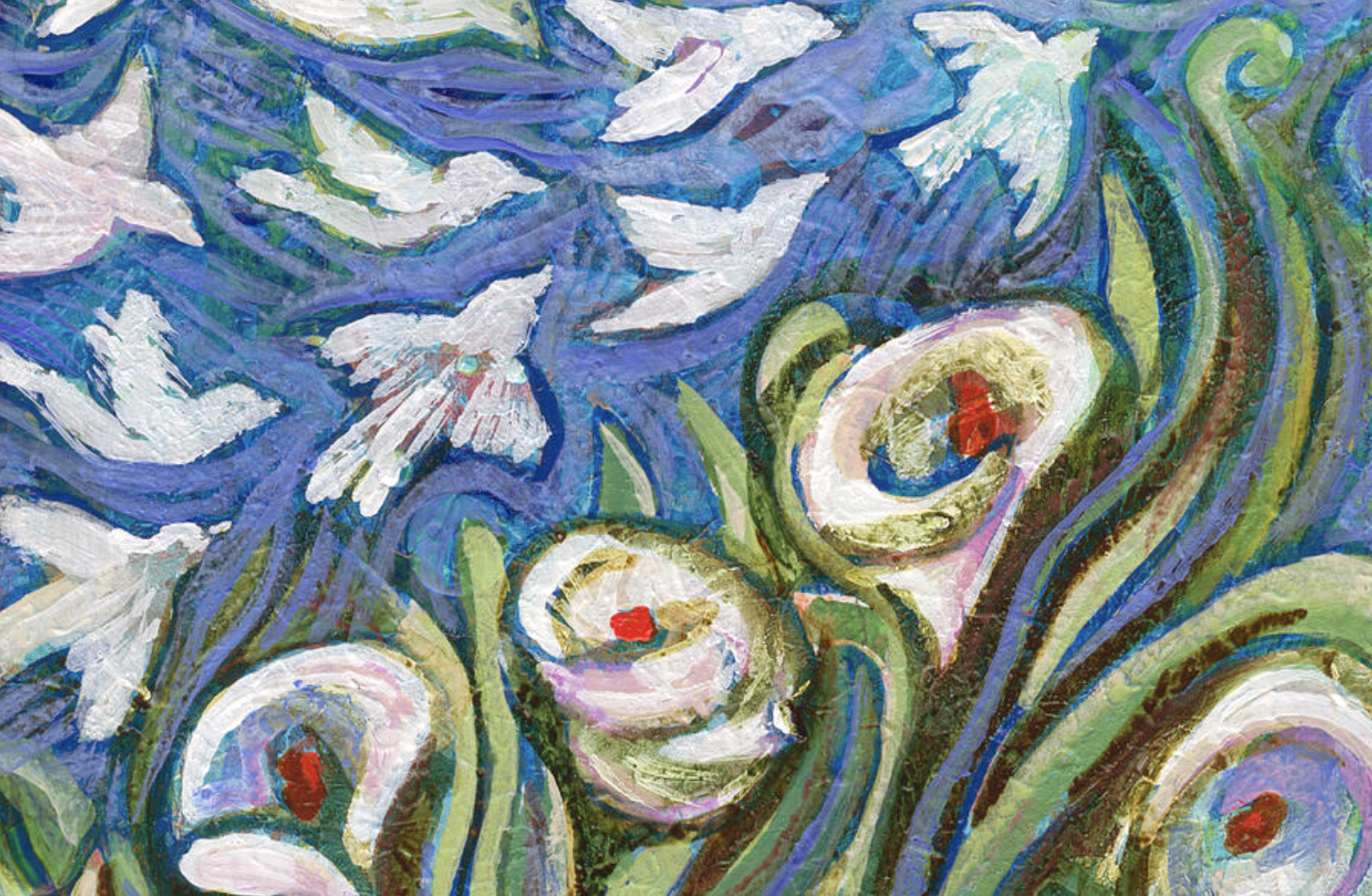
beautifully arrayed birds,
wildflowers with finely wrought blossoms,
and
blessing.
I knew a young man,
who at age twenty-two, received a diagnosis of Multiple Sclerosis.
He deteriorated rapidly.
Now, he had grown up in a comely home on the prairie,
but
he had lost his powers to roam the beloved wild places he knew.
So he decided to enter a new world, formerly invisible to him.
He entered it on his knees with a camera and a powerful lens.
And through this portal,
he saw
a world which had always been round him, but never really saw ....
of intricate wildflowers and tiny, colorful insects and fine-edged ferns and all.
He returned from this world with fine prints which he shared
with others that they, too, might see this hidden world.
The Lord calls us today into His visible yet unseen world:
serene, quiet, prayerful.
This is no place
of respite from busy hours
but
rather our ground of being.
When the Apostles come to Him,
for example,
to tell
Him
.... all things, both what they had done and what they had taught. .... He said to them,
"Come aside by yourselves to a deserted place and rest a while." For there were many
coming and going, and they did not even have time to eat. So they departed to a deserted
place in the boat by themselves.
(Mk 6:31)
|
He does not want them to be distracted,
so
He directs them to a wilderness,
to a quiet hilltop,
or
out to sea in a small boat.
He tells us,
in a cherished teaching,
But you, when you pray, go into your room, and when you have shut your door, pray to
Your Father Who is in the secret place; and Your Father Who sees in secret will reward
you openly.
(Mt 6:6)
|
This is your treasure:
your solitude,
your prayer,
your world alone with God.
This ought to be the foundation of our spiritual lives.
Do we not know this through the microcosm of our own lives?
For we enter this life alone with God.
We depart from this life alone with God.
And all else is built upon this living, breathing
intimacy alone with God.
That's all there is.
When I was received into the Orthodox Church,
I was told that one does not go to the parish church to pray.
The church is reserved for corporate worship.
Perhaps this is why standing is preferred to kneeling.
But what of interior prayer?
I wondered.
But then I remembered a Gospel rule:
does not
the Master direct us to a secret place?
After all,
this is the Jesus we constantly see in the Gospels,
"off camera" so to speak:
the Man of desert places,
the Man of interior prayer.
Often He is alone with His Father.
Yes,
it is true that we take our first steps in religious life
by
"praying with the Church."
This is obligatory.
In fact,
in the West this is called the Divine Office
(from the Latin officium or "obligation").
This is our "school of prayer,"
for it teaches us to discard worldly thinking.
After all,
empirically
unschooled prayer
tends to be self-centered
and
immature religious life usually devolves into unending petitions for our so-called needs,
and
then others give us lists of the things that they want:
"Give me.
Save me.
Carry me.
Deliver me."
Isn't this what you find on most parish prayer lists?
You may even discover,
as Sr. Mary Anne once told me,
petitions for the welfare of soap opera characters:
"O, Lord, make Troy return to Brenda!"
I suppose this is
to be unexpected.
After all,
our culture forms
us in its therapeutic-wellness values
and
its obsession on ourselves.
Nonetheless, prayer is not an opportunity
to petition for more feathers in our worldly nests
—
you know,
our dream house, our dream car, our dream job, or a dreamboat for a husband.
To the furthest contrary,
prayer is the God-shaped place within us
to be filled with the Presence of God,
Who
is finally the only thing that matters,
the Only Thing that is real.
God is
our Creator,
our Providence,
our School of Divine Wisdom.
And our preparation for encountering God
must begin with emptying ourselves of all worldly desires.
And the corollary,
experienced by everyone and everywhere,
is that random impulses and desires unavoidably lead us away from God,
in the end,
far away from the Kingdom of God
to the point where we cannot see it anymore,
nor can find our way back.
In our Gospel lesson this morning,
Jesus enjoins us, indeed He commands us
(and I quote His very words):
|
μὲ μεριμνα̃τε
/
mè merimnãte
(Mt 6:31)
|
Possible translations of this command
(imperative mood)
include
or
But I prefer,
What is the locus classicus for this command,
the place where it is vividly illustrated?
Is it not Jesus' sojourn in Bethany
through an interchange with His exemplar of right conduct,
Mary of Bethany,
and
His counter-example,
which is Mary's sister, Martha?
|
Martha, Martha, you are distracted by many things, but one thing is necessary.
(Lu 10:41-42)
|
In would argue that if were to search the Bible (like a manual) for the rule that must be kept,
it is this sentence.
The words Jesus actually spoke are,
Μάρθα, Μάρθα! μεριμνασ ....
/
Mártha Mártha! merimnãs ....
(Lu 10:41-42)
|
And at the center of this stern lesson,
perhaps mortifying to Martha who already filled with powerful emotions,
is that same verb:
What is the opposite of being distracted?
It is,
|
"the one necessary thing"
(Lu 10:42)
|
I say, the rule above all rules,
for it is the singular,
the this you must not miss,
the
"one needful thing"
as the King James translation renders it.
This morning Jesus has taken us to a deserted place
where are to have a heart-to-heart talk.
He begins by admonishing us not to be distracted,
for this is, after all, our characteristic state.
When I was in seminary I have a Benedictine monk
as my spiritual director,
who organized a group to pray early in the morning,
called "centering prayer."
I have never heard of it .... soon to discover that it was very well known.
The object is to stay focus on the one thing,
perhaps the Holy Name:
Jesus.
And I was shocked to discover that my mind is constantly veering off to many things.
The default state of my mind was distraction.
And I found that it was very difficult to focus in silence for one hour
on one thing.
It took weeks before I had mastered it.
Jesus says,
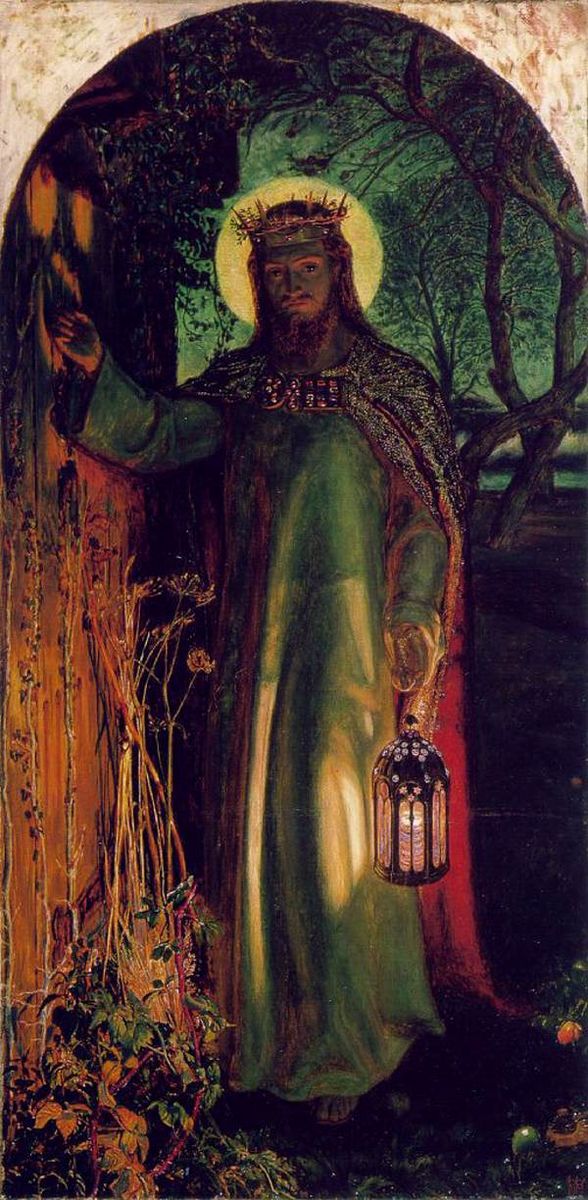
"The lamp of the body is the eye .... if your eye is bad, your whole body will be full of
darkness. If therefore the light that is in you is darkness, how great is that darkness!
(Mt 6:22-23)
|
The one needful thing is "the light."
All that is not light is darkness.
One purpose of prayer is dwell upon the light.
But darkness is constantly invading.
I am not suggesting that ungodly thought were invading my mind
though that's very common for people.
St. Seraphim of Sarov tells us that a favorite trick of evil one
is to invade our minds with filthy thoughts especially when
we draw near to the holy ..... when receiving Communion, for example.
I mean that everything that is not the light is darkness.
Do the Master's
urgent tones?
"Your whole body full of darkness!"
and
"The light that is in you is darkness!"
and
"How great is that darkness!"
You may read all four Gospels over many chapters
and
you will rarely find such urgency
spoken in such absolute terms.
What is this about?
It were as if this was a matter of eternal life and death!
And,
as it turns out,
it is.
☦
Permit me to change focus,
so that we might understand this thoroughly.
Around the time the Nicene Creed was formed,
St. Athanasius the Great,
who was a principal Father shaping that Creed
and who,
on another subject,
was a principal deciding the Canon of Holy Scripture.
He is also called "the Father of the Canon"
and
the "Father of Orthodoxy."
(Wow!)
Yet his greatest work was
On the Incarnation.1
This masterpiece is acknowledged to be one of the most influential
books outside the canon of Scripture itself.
In this little book,
which I believe to be inspired by the Holy Spirit,
we learn
that decades before the horrible events on Golgotha hill,
our
salvation had already been accomplished.
I do not deprecate the Crucifixion (as I have written on many Sundays).
But
Jesus had already righted the ship,
had struck His decisive blow over death,
had renewed the Creation to its former state as in Eden.
And He
did all this by touching the Creation with his Own Person,
actually participating in the Creation as a creature.
He did this silently
whose eternal symbol is an infant lying in a rough-hewn cradle on a cold, winter night.
For God on His throne is utterly above and removed from the struggle.
He speaks, and it is done (Gen 1:1).
May I share some passages from
On the Incarnation,
perhaps the most important book you have never read?
|
97.
For by His becoming Man, the Savior was to accomplish both works of love;
first, in putting away death from us and renewing us again; second, ....
in manifesting and making Himself known .... to be the
Lógos of the Father,
and
the Ruler and King of the universe.
(On the Incarnation, §97)
( 5:24)
|
There it is in one sentence:
at the Incarnation,
He put away death
and
created us again.
And, second,
He revealed Himself.
So important for He is our Exemplar.
In the next section,
|
98.
For He was not .... circumscribed in the body, nor .... was the universe
left void of His working and Providence; but, thing most marvelous,
Lógos as He was, so far from being contained by anything, He
rather contained all things in Himself; .... giving order to all things ....
and giving life to each thing and all things .... being in His own Father
alone wholly and in every respect.
(Ibid, §98)
|
He contained us in Himself and put us in right order.
Let us proceed to the next section:
|
99.
thus, even while present in a human body and Himself quickening
it, He was .... quickening the universe as well, and was in every
process of nature ....
(Ibid, §99)
|
Search for a way to describe this "dwelling of God in everything, and everything dwelling in God"
in so few words
In the §129,
we find this:
|
129.
And besides, the Savior came to accomplish not His own death, but the death of men,
whence He did not lay aside His body by a death of His own (John 10:17-18) —
For He was Life and had none — but received that death which came from men,
in order perfectly to do away with this when it met Him in His own body.
(Ibid, §129)
|
To repeat,
He is Life itself and, concerning death, he had none.
Do you understand?
Death is utterly alien to Him, a non-entity.
Nonetheless, we read,
He perfectly did away with death, which was void of any reality and power.
Why do we spend so much time and attention dwelling upon His Death?
Because to the Jews, blood and death were the main things.
The Zion Temple was is itself a blood and death factory.
This is our legacy, historically.
You understand that the formation of Christianity
was a process of compromise,
vividly illustrated in The Acts of the Apostles
and
in the adventures of St. Paul,
who was
all things to all people:
|
"I have become all things to all men, that I might by all means save some."
(1 Cor 9:22)
|
All that remains,
following His Incarnation,
is for men and women to act upon His renewed Creation,
renewed everywhere and renewed in themselves.
An echoing theme in these reflections
is that we were born into a kind of Eden
in our innocence.
And here is the theology underlying it.
It were absurd for these new creations in Christ to contemplate death ....
as obscene as a child who is morbidly preoccupied with deathly things.
We are to embrace life
and
to embrace the Image of the Father,
that has been renewed in us to the full.
Do you see were born with that Image set upon us.
But in our disobedience we had defaced the Image of God.
Jesus has recreated us in that Image
and
has recreated the world in that Image.
|
79.
.... the most holy Son of the Father, being the Image of the Father, came to our
region to renew man once made in His likeness, and find him, as one lost, by the
remission of sins; and He says Himself in the Gospels, I came to find and save
the lost. Whence He said .... unless a man be born again, .... speaking of the soul
born and created anew in the likeness of God's Image.
(Ibid, §79)
|
We might say, "It is all there waiting for us."
The way has been opened.
All that remains is for us to begin our several journeys.
That is our main occupation.
After all, our earliest name is the Way.
This is Christianity in its fullness, and not anything else.
We must get on with our journeys, fulfilling the Image of Father
that's already been set within us as our form and ideal.
The thing that
prevents us this morning from embracing this empyreal gift
is
the possibility of degrading ourselves this afternoon.
For
Man is an ever-changing creature.
He is distractable.
By virtue of His free will,
He may continue His journey to God
fulfilling the Image of the
Lógos.
Or He may reject these incommensurable treasures
choosing, instead,
hoggishness,
having fallen in love with filth.
Our salvation has been vouchsafed for us:
the way ahead has been cleared.
This is the preferred definition of
sotería,
the Greek word underlying salvation in English translations.
And this is why, above all,
the Master teaches in urgent tones,
we must fasten ourselves on the one thing that is necessary,
as Mary of Bethany did.
We must gaze up upon Jesus, our Exemplar and the Lord of Life.
We must not distract ourselves.
This is the reason why the Jesus Prayer is the royal prayer, non-pareil.
For it is a centering prayer, "deep calling to deep" (Ps 42/41:7).
We must
stay centered on God.
In this
we shall have blessing calling to blessing,
discovering that He always already precedes us:
If I ascend into heaven, You are there;
If I make my bed in hell, behold, You are there.
If I take the wings of the morning,
And dwell in the uttermost parts of the sea,
Even there Your hand shall lead me,
And Your right hand shall hold me.
(Ps 139/138:8-10)
|
Let us conclude this morning by hearing the Lord's injunction
with renewed understanding:
"The lamp of the body is the eye. If therefore your eye is good,
your whole body will be full of light."
(Mt 6:22)
|
And that Light is simply this:
Himself.
He is Life Itself.
And there is no other.
Only distraction and eternal death.
In the Name of the Father and of the Son and of the Holy Spirit.
1
St. Athanasius of Alexandria, On the Incarnation.
English-Greek Edition.
Trans. by Archibald Robertson.
Rex Mundi Press, 2024).