Jn 20:11-18 (Matins)
Acts 16:16-34
John 9:1-38
Made New
"As long as I AM in the world, I AM the light of the world."
(Jn 9:5)
In the Name of the Father and of the Son and of the Holy Ghost. Amen.
This morning,
we observe the final Sunday of Eastertide.
Ascension Thursday is just ahead.
And our Gospel lesson today takes us to new
—
let us say, cosmic
—
heights.
We cast our eyes up to the Heavens,
for our God brought in all into being ....
we say ex nihilo, from nothing.
(The science holds that all came from almost nothing:
the contents of one atom.)
For God is first of all, the Creator.
☦
As children we began the work of surveying the Creation.
In elementary school we all memorized the nine planets
in their order from the sun.
Twenty years ago Pluto was demoted from being a planet
because it had not sufficiently cleared its orbit region
of other objects.
The distinction is a "clean" orbit region vs. a "dirty" orbit region.
Eight clean orbits;
one dirty orbit.
I would like to suggest a different distinction
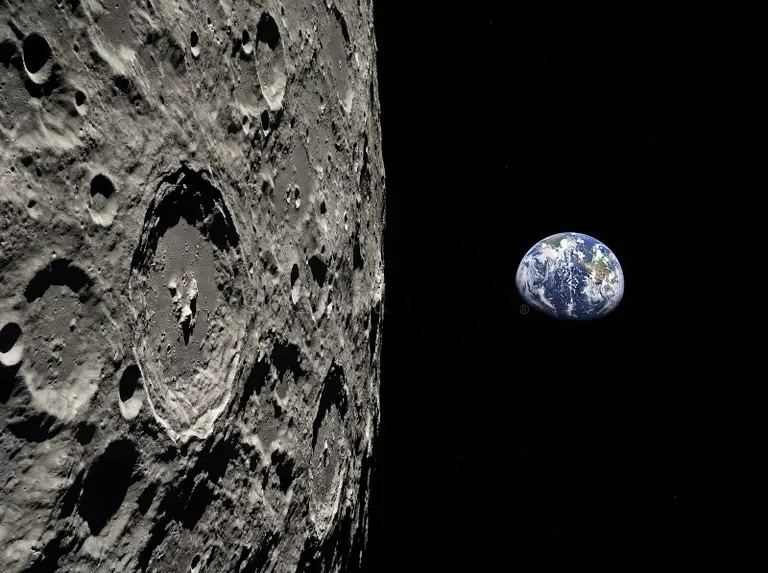
recently attested by Artemis II astronaut, Navy Captain Victor Glover.
When asked,
"What was the most beautiful thing you saw?"
during the mission,
Capt. Glover replied,
"Oh, I'm sorry to be boring on this, but it's the Earth."
The interviewer expressed surprise saying "Wow"!
So Capt. Glover explained:
|
It just stood out. It was so different. The colors, the shapes.
Our planet looks alive. Even though we can't see human structures
and boats and roads, it looks alive, because the swirls change.
And it just — it demands your attention.
When you see it out the window, you have to stare at it.
|
It is evident that Capt. Glover has been overwhelmed
by the experience,
struggling to find the right words,
but we hear him loud and clear.
You just have to stare .... in awe,
for there is nothing else like it in the history of the universe.
If God made anything that is one-of-a-kind,
this is it.
The Earth is surrounded by dead stones spinning in a void,
all orbiting the sun like so much debris.
Then, there is our lone, world overflowing with
myriad shapes and colors all pointing (as Capt. Glover suggests)
to life.
When I recall Pluto's demotion twenty years ago
on account of too much debris,
I am moved to propose
new categories for ordering our solar system.
Let us consider
that there are
seven (or perhaps eight) dead planets
and
one living world.
If Mercury, Venus, Saturn and the rest are to be styled planets,
then Earth must be classed as something entirely different.
for it quite literally has no peer in this or any solar system
.... as far as we can tell,
and we have spent $1.9 trillion looking for life since the establishment of SETI in 1965,
seeing and hearing nothing.
As a school boy,
I was told over and over again
that we are but a speck of dusk
when set against the grandeur of the universe.
But now, having been a teacher of teachers,
I grown bold, and I contradict my confident schoolmasters.
For looking out on the universe from Earth,
we must say that
we are far from being a speck of dust.
We are, in fact, a one-of-a-kind magnificence,
looking out on a graveyard of rocks.
Drawing from sacred precedent,
may I suggest a term
that differentiates us from the planets?
We are the Creation,
for we alone match the picture sketched out in the
first two chapters of the Book of Genesis.
And the rest?
Well, let us be generous, leaving them with their accustomed name: planets,
though the phrase that comes to my mind is
space debris.
For we must admit that
when compared to the staggering beauty of the Earth,
they are no more than unredeemed dust.
It has been said,
the we have the gift of life
—
that animate, stirring, thinking thing we call life,
which is utterly beyond our comprehension.
From the humblest ant preening its antennae and turning his head this way and that,
we are surrounded by this inscrutable miracle,
which is abundantly present here
and
notoriously absent everywhere else.
I say we have life,
but our God alone is life.
We have being,
but He is being.
And He announces this incomprehensible fact
with His Own Living Breath:
|
"I AM Who I AM."
(Exod 5:24)
|
.... the verb to be joined to itself
by the relative pronoun Who
is an eternal, sacred, and
inviolable closure.
Do you see?
It goes round and round,
but nothing may enter.
The Septuagint records this speech-act as
Εγώ Ειμι `ο Ώnu;.
Ego Sum Qui Sum.
(Exod 3:14)
|
which we translate, "I AM HE Who Is."
This subject is far beyond our understanding.
We may be confident that we are superior to life because we can destroy it.
But after Othello kills his wife Desdemona,
he says,
I know not where is that Promethean heat
That can thy light relume. When I have plucked the rose,
I cannot give it vital growth again.
(Othello, 5:12-15)
|
For all of that,
our Holy Gospels have ordained it as
our subject this morning.
So let us attend!
Wisdom!
☦
Following His entry into the human story,
our Creator walks among His creatures.
Staggering!
We would say, "Not since Eden!"
He has made everything
"and without him was not any thing made that was made" (Jn 1:3)
—
all that which moves and that which does not move,
the fertile earth, the restless sea,
the birds of air and their nests and the grasses and twigs
which are the stuff of their creative powers.
He has done all.
But,
of course,
our lesson centers on the crown of God's Creation:
the creature on whom God, mysteriously,
has lavished so much love and caring:
the creature He has made in His Own Image.
Now, in the catalogue of Gospel miracles,
we sometimes hear questions-and-answers or debates after the fact.
But today we have something different.
Jesus comments
before the fact:
|
"It was not that this man sinned, or his parents,
but that the works of God might be made manifest in him. We must
work the works of Him who sent Me, while it is day; night comes,
when no one can work. As long as I AM in the world, I AM the light
of the world."
(Jn 9:1-5)
|
Do you hear the echoes from the Book of Exodus?
Or let us say,
with St. John the Evangelist,
|
In Him was life, and life was the light of men."
(Jn 1:4)
|
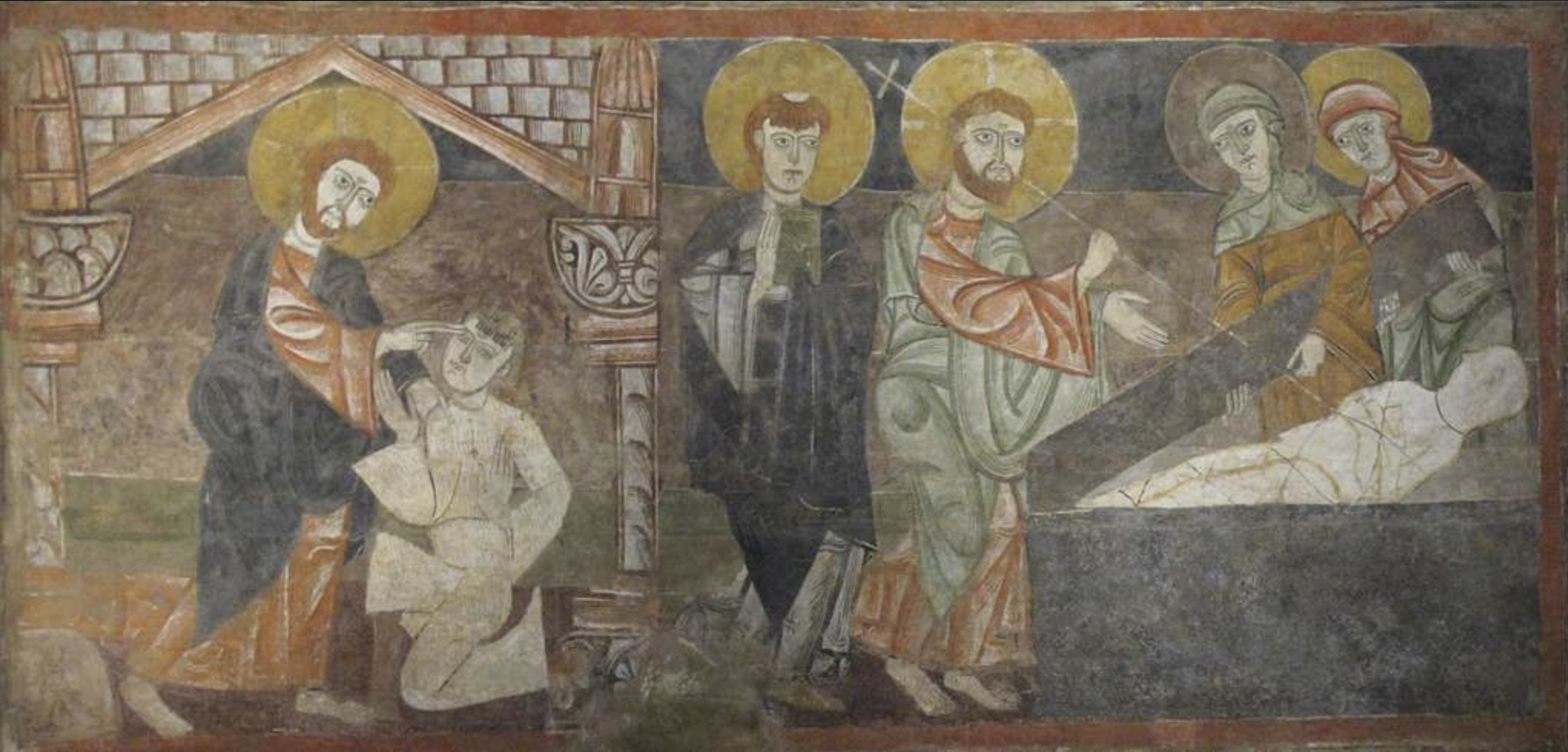
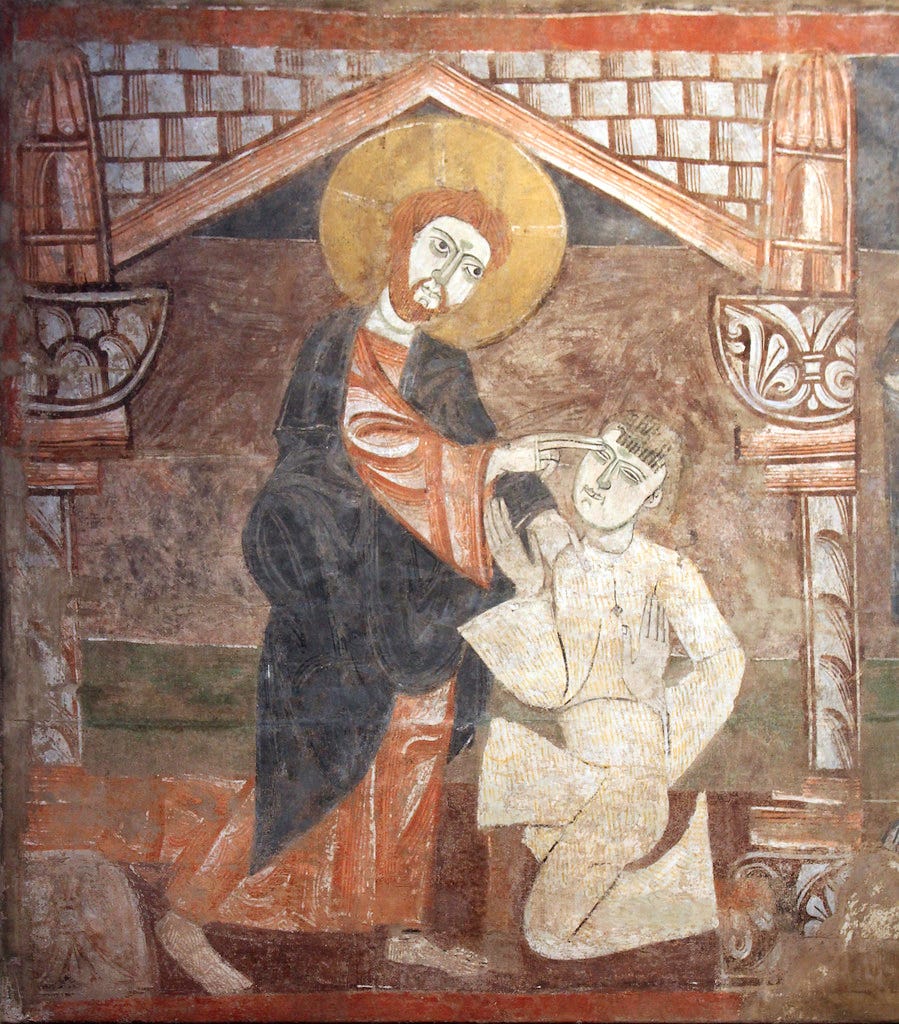
In the icon pictured at the top of this reflection,
the man-born-blind receiving his eyes is depicted side-by-side with Jesus
in the tomb with Lazarus.
Why would this be?
On reflection, we see that Jesus is not healing either of these men.
He is creating them right before our eyes
—
one with mud,
one by define fiat.
Do you recall,
|
"God said, 'Let there be light, and there was light.'"
(Gen 1:3)
|
The man-born-blind was not actually blinded;
he had not lost his sight.
He was uncompleted.
In that sense,
he is the most common thing in God's universe:
Looking up through a clear night sky,
we behold
a vast universe of God's uncompleted works.
(A lesson for us?
Yes.)
Like the planets, partially created,
this man is not finished.
His eyes must be created .... which explains the mud from Genesis 2:7.
Likewise, Lazarus no longer has a body.
We can imagine the state of things when Martha says,
"Lord, He begin to stinketh"
(Jn 11:39).
He is a wrapped bundle of necrotic organs and tissues and noxious gases.
To walk out of that tomb,
he must be created again,
as I say,
by Divine fiat:
"Lazarus, come forth!"
When we dare to gaze upon our God and King and Savior,
we behold
another One-of-a-kind:
the Creator .... Whose Own Person
alone is Life.
And when He inaugurates His roaming, teaching ministry,
He issues one word that encapsulates all:
"Metanoeite!,
Be transformed!
Be made new!
Be born again from on high!"
It is this creating power,
whose essence we shall never understand,
which has made, and then re-made, the Creation.
I say, "Remade the Creation"
with
His Conception and Birth.
Think of it!
the Creator consented to
become organically united to our lifeworld.
He dwelt in us.
We shared the Living Breath of God.
While we rightly wonder with awe
at His
creating body parts
and
even a new creature
before our very eyes,
this (of course)
is nothing compared
to His renovation of our whole world by those very same powers.
Every scintilla of the Creation
instantly
stirred in obedience and was redeemed at His Incarnation.
1
He again breathed life into His world,
saith Athanasius the Great.
With every Christian, I bow to the Holy Cross in profound reverence.
The Cross distills in one incommensurably holy
symbol the fact of our faithlessness and hatred and betrayal
visited upon the Creator of the world .... all perpetrated by His own, most-beloved creatures.
The Cross remains jewel-like in its compression
speaking out to us of His love,
that receiving such extreme cruelty,
He could forgive us ....
even when we expressed no regret, much less need of forgiveness.
Now,
which
icon,
I ask you,
could be more moving and spiritually brilliant than this one:
the God Who loves us come what may
and
His notoriously treacherous children.
But it is not the Cross that has transformed the Creation.
We must not be so obstinate in our blindness.
For God
made us,
dwelt with us in our brokenness,
and
showed us the Way to our true home in His Divine Kingdom.
How can we ignore this
most consequential Gift,
second
only to the Creation itself
.... second chronologically,
but greater,
for it completed the Creation.
However holy was His Sacrifice of three hours .... or three days,
we must not be blinded to His Gift
of thirty-three years:
the Incarnation of God,
which has restored the world to a stirring, living, Divine wonder.
Yes,
our Lord and God and Savior redeemed us with
His Life.
And He demonstrated over and over again during that Most Sacred Lifetime that
death to Him is a nothing ....
and certainly not deserving of the attention we have devoted to it.
He shattered the House of Death.
That is all.
It is over.
But His gift of inimitable Life
continues to elevate us even to the highest summits of our world,
where we are changed and transfigured
unto the likeness of God,
fulfilling His design,
completing His blueprint.
On this Sunday,
anticipating the Ascension,
which models our intended course,
let us admit that we, too, have been born blind,
and
with one, kind touch
He has vouchsafed to us our sight.
For if we are designed to be Divine creatures at birth,
we must receive our sight.
And receiving our Divine sight,
we have the power to see aright.
Jesus tells Nicodemus that without this transformation,
you "cannot see the Kingdom of God" (Jn 3:3),
cannot find the Kingdom of God.
In which case,
we must own that we are but dust.
We are the crown of God's Creation,
but we must not fall into deadly passivity.
Many Western Christians say,
"I can do nothing for myself!
I am a miserable, wretched creature!
But Jesus did it all for me on the Cross!"
This is the
passivity
we must fall into.
The word we translate as salvation
from the Greek word
sotería
means "to remove the obstacles ahead."
Our Savior has cleared the way.
But we must make the journey .... by the awesome grace of God.
We must not fall into the cult of death.
We must bestir ourselves to strive for the Kingdom,
to ascend through high mountain passes,
and
kneel before Him,
Who alone has the power to make us new,
even unto our Divinity.
In the Name of the Father and of the Son and of the Holy Ghost.
Amen.
1
St. Athanasius of Alexandria, On the Incarnation Bilingual English-Greek Edition (Rex Mundi, 2024).