For this reason has drawn a great dividing line across the Creation:
Luke 24:1-12 (Matins)
Acts 9:32-42
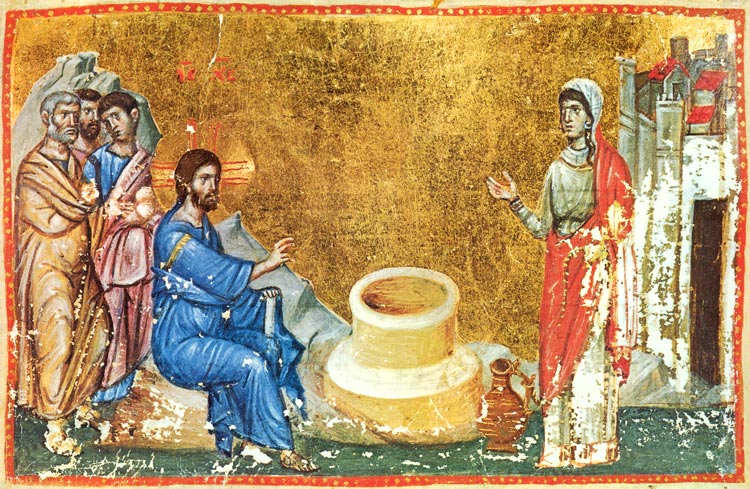
John 4:5-42
This morning we celebrate the Samaritan woman at the well who, following her encounter with God, became an Equal-to-the-Apostles, St. Photini, the first evangelist of our Christian tradition. This, therefore, is the little history of two lives — a woman born and then reborn — and of two religions — a religion regulating life in this world and the other preparing us for life in the Kingdom of God, which begins in this world. The broader history of the Levant, into which Jesus is born, tells the same two-fold story. The remnant of the Twelve Tribes of Jacob are the descendants of "Father Abraham," who left the region of futile Babylon choosing to be guided and led by the Living God.
As our Gospel scene is set, they cluster around Jacob's Well, which is one of their remaining lifelines to the God of Abraham. In the broader frame, the Samaritans are beset by a hybrid Mesopotamian religion, established in distant Judah following the return of exiles from Babylon, that seeks to expand and solidify its authority. They call this religion Judah-ism. This is the great drama playing out across the Levant and this morning in the heart of a Samaritan woman in Shechem (called Sychar), the capital city of the historical Kingdom of Israel.
Now, is this a dusty and irrelevant tale unworthy of our American attention? On the contrary, our time and place and culture are the burning point of pluralism. From our earliest impressions, we have understood Christianity to be inherently diverse. Indeed, we have promoted diversity as if it were a goal ..... or a god. But diverse religions are not pleasing to God: Here is the prologue to the Two Great Commandments:
| "Hear, O Israel: The Lord our God, the Lord is One!" (Deut 6:4) |
Our religion is not a religion of the book, much less of many different books. It is an encounter, an encounter with a Man: Jesus of Nazareth.1 Ours is a personal God, Who calls to each of us. And to miss that call, to miss that encounter, is the calamity of our lives and our eternal lives.
For that personal God has particular plans for each of us. We call these plans our calling or our vocation. It follows that He has plans for the whole world — a Kingdom of God, which is the ideal of human development and our only happiness. He had relied on Adam and Eve to be faithful to this plan. He trusted Abraham and Sarah to carry out this plan. And as surely as He hears our individual prayers and numbers the hairs on our heads, He continues to entrust His dear plans to each of us who, mysteriously, must be the ones to shape the world in His Image. But He will not violate our sovereignty, which is a key to our being made in His Image. We must live out our love and faithfulness to Him in freedom. We must .... else we are no more than flunkies following orders.
For this reason has drawn a great dividing line across the Creation:
|
The heaven, even the heavens, are the Lord's;
But the earth He has given to the children of men. (Ps 115/116:24) |
Remarkable! And if you don't believe it, then consider this: if the past hundred years have taught us anything — with its nuclear annihilation of a quarter-million women, children, and old men in a matter of minutes; with its holocaust of six million Jews who were interned, tortured, and killed; with its ongoing rape of millions of tender boys the world over (by Roman Catholic priests, no less); with our destruction of our planet home uniquely overflowing with His miracle of life — if this century has taught us anything, it is that God will never "take over" no matter how bad things get. Everything is left to us, whom He mysteriously helps in His unseen and particular ways. That is, I do not say that His Divine help and blessing do not stand ready to assist us individually. But I do say the obvious: He will not take control of our world. He will not announce martial law, as it were, and rule over us in a police state enforced by terrifying angels.
Furthermore, it is a mystery that God is omniscient. He knows what will happen next, yet we have the freedom to pick and choose our actions for good or for ill. The human mind finds this impossible. If God know what is going to happen next, how can we be the ones to choose? At least, that is what I would have said fifty years ago and said, It is a mystery. But in this exciting age of physics, quantum mechanics is opening a way to think about this conundrum — for example, the superposition of electrons. It turns out that God sees multiple ways forward in our minds. But I must resist that detour this morning.2 Moreover, we do not know need to know the inner workings of God's Mind. We need only know this;
|
|
It follows that the greatest catastrophe would be to lose God, even to lose our way back to Him and His continuing Self-revelation and calling and guiding: what we term His Will for our lives and for all lives. What Jesus say in our Gospel lesson today?
| "My food is that I be doing the Will of Him Who sent Me." (Jn 4:34) |
My very food, the air I breathe, is to do the Will of the Father.
To lose our connection to God is the most horrible thing one could contemplate, for God never strays. He is always everywhere already Present. You have read the Psalm
|
If I ascend into Heaven, You are there;
If I make my bed in Hell, behold, You are there. (Ps 138.139:8) |
And He made all things and saw that they were good (Gen 1:31). The only way to lose God is to change our focus. We no longer see Him because we are looking at something else. We fasten ourselves, no longer on Him or His Holy Will, but to focus on the perversion of His Goodness. For His only intelligent creatures — the angels and ourselves — are God's only straying creatures. They are able to stray .... and they have: perhaps one-third of the angels of Heaven.
This is why
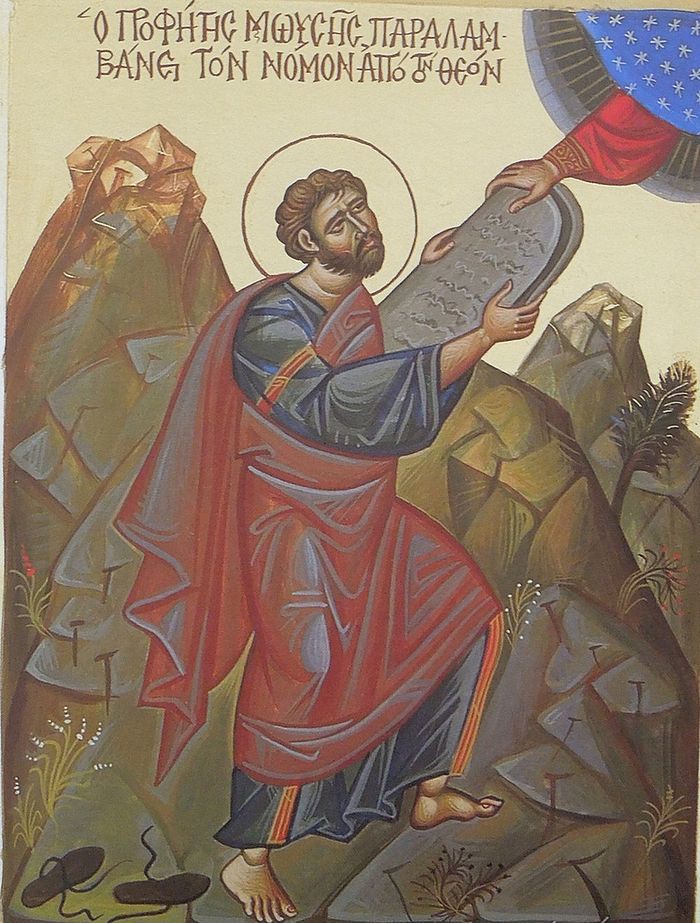
the Decalogue is so dominated by the subject.
|
And God spoke all these words, saying:
"I AM the Lord your God, who brought you out of the land of Egypt, out of the house of bondage. "You shall have no other gods before Me. "You shall not make for yourself a carved image — any likeness of anything that is in heaven above, or that is in the earth beneath, or that is in the water under the earth; you shall not bow down to them nor serve them. For I, the Lord your God, am a jealous God, visiting the iniquity of the fathers upon the children to the third and fourth generations of those who hate Me, but showing mercy to thousands, to those who love Me and keep My commandments. "You shall not take the name of the Lord your God in vain, for the Lord will not hold him guiltless who takes His name in vain. "Remember the Sabbath day, to keep it holy. Six days you shall labor and do all your work, but the seventh day is the Sabbath of the Lord your God. In it you shall do no work .... For in six days the Lord made the heavens and the earth, the sea, and all that is in them, and rested the seventh day. Therefore the Lord blessed the Sabbath day and hallowed it. (Exod 20:1-11) |
Much is communicated here that is often passed over. God is our Creator and the Creator of everything we behold, and He is our safeguard from all dangers. The disastrous background for these Commandments, of course, is Eden — Adam and Eve usurping authority for deciding what is right and what is wrong: Knowledge of Good and Evil. I don't mean knowledge in the sense of knowing but in the sense of an institute of knowledge. Pope Saint John Paul II wrote that Adam and Eve had seized control of moral theology. They would be the deciders.
But for humans to define that is good and what is evil leads to only chaos and degradation (as we plainly see all around us!). The result, predictably, is a landscape of alienation ("the land of Egypt") and construction of a world of sin to which we have become enslaved ("house of bondage"). But for all our treachery, God continues to vouchsafe the good life for us. All this God communicates in the first sentence, teaching us of allegory. And if allegory is a primary feature of the Creation, then the drama of life is constantly replete with Divine meaning.
God admonishes us to be faithful to Him lest the same bondage inevitably eventuate again. He teaches us of intimacy with Him: He works, and we work. He rests, and we rest. We sanctify even time, living into this loving faithfulness. The air we breathe, the living water springing up within us, and every meditation of our hearts are ever fastened upon our Life-giving God. In like measure, enslavement, affliction, and death (which we have learned empirically in the lands East of Eden) would be our eternal lot without Him. That is, the chief threat to our earthly and eternal lives is losing God and fastening our minds and souls on that which is not God.
With what alarm, then, did God behold the return of His particular people from exile in Babylon: — dressed as Babylonians, speaking Babylonian, thinking Babylonian thoughts, worshipping a Babylonian god, and carrying a master plan for a revised Bible, a Persian temple, and performing the rites of Mesopotamian worship. As Prof. Yehezkel Kaufmann of the Hebrew University famously said (even on television), this moment signifies the death of the religion of Israel and the birth of a new religion: Judah-ism.
For centuries this hybrid Babylonian religion was mainly limited (as its name implies) to Judah with the historical Northern Kingdom still hewing to forms of the religion of Israel as we see this morning in the primacy of Jacob's Well. But with the rise of the Hasmonean dynasty, roughly a century before the entry of God's Son into human history, a rebellion broke out against the Romans, and Judah-ism became a rallying cry to unite all Hebrew peoples. And for first time, this alien religion was promoted vigorously with the construction of propagandizing synagogues all across the Levant.
But this loss of relationship with God could not be permitted to stand. And before long, God would be born in an obscure cave midst shepherds in humble Bethlehem. How could we doubt the timing and purposes of this birth?
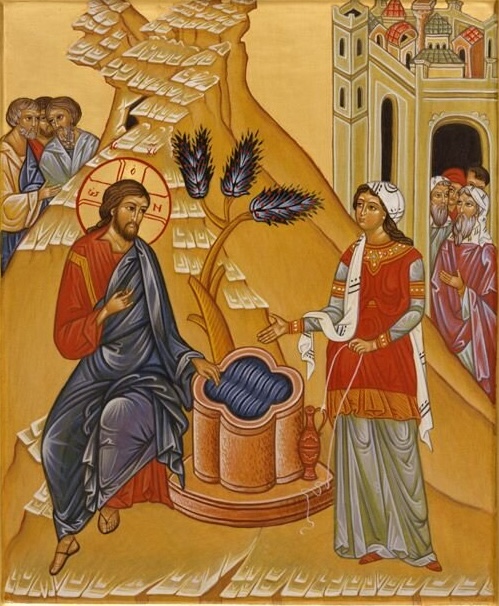
Jesus' encounter with the Samaritan woman
is no parable.
It is a historical fact.
Indeed,
it occurs in the most historic of historical places,
even
the capital city of the Kingdom of Israel,
and
set at no less a place
than than Jacob's Well,
dug by one of the Patriarchs.
The woman asks Jesus,
|
"Are You greater than our Father Jacob, who gave us the well,
and drank from it himself, as well as his sons ....?" (Jn 4:12) |
Well, this would cause any Hebrew to feel chills down his spine! The Patriarch Jacob and his sons, the Twelve Tribes of Israel! .... drank from this well!
We surmise that the people of Shechem are deeply rooted in the Patriarchs and, therefore, conflicted concerning the growing hegemony of Judah-ism, which has been pressing in from the South. For this is the great struggle of the age .... indeed, of all ages, framed in the question, "Who is God?"
| The woman said to Him, "Sir, I perceive that You are a prophet. Our fathers worshiped on this mountain [Mt. Gerizim], and you Jews say that in Jerusalem is the place where one ought to worship [Mt. Zion]." (Jn 4:19-20) |
Ironically, Jesus (which we know to be the fulfillment of the priest-king Melchizedek) answers her by revealing the highly personal and individual God of Abraham, whose locus is not a temple sacrificing animals, but whose Abraham's temple is the human heart and soul and mind:
| Jesus said to her, "Woman, believe Me, the hour is coming when you will neither on this mountain, nor in Jerusalem, worship the Father. You worship what you do not know; we know what we worship, for salvation is of the Jews. But the hour is coming, and now is, when the true worshipers will worship the Father in spirit and truth; for the Father is seeking such to worship Him. God is Spirit, and those who worship Him must worship in spirit and truth." (Jn 4:21-24) |
When Jesus reveals the religion of God to the Samaritan woman, He says nothing of blood sacrifice (the central rite of Judah-ism). Instead, He focuses on Theosis. Indeed, is this pericope not a set-piece showcasing Theosis? Let us shift our focus to the worldly, the gritty, and the practical perspective of the Samaritan woman. Manifestly, she was the first Christian to undergo a general confession, which was the first sacrament Jesus instituted (Mt 16:19; Jn 20:21). After all, He recountd her everything she ever did (Jn 4:29). And she manifestly receives His absolution, for she is light as a feather, is liberated from her life of alienations and secrecies, and seeks renewed ties with everyone in her city. Her enslavement is ended. Here inner doors are opened. And light is flooding in. She has shed her former life and has been reborn. And she advances from there to become St. Photini, Equal-to-the-Apostles and the first Christian evangelist. Can we not say that at this moment she is far beyond any of the Apostles?
The religion Jesus reveals to her is one of purification, sanctification, and unity with the God Who loves us. Truly, God has cleared the way for us to become equals-to-the-Apostles, too. He has opened the gate by His Conception and Birth as St. Athanasius writes.3 For the Creator touching the Creation with His Own Person produced a shock so powerful that it has reset and restored the entire Creation. And after that, He was Present to us as a teacher and a guide and as God: Jesus of Nazarth, the Son of Man.
No longer would the path of every living thing lead to futility and death enforced by a religion vainly attempting to control life in this world. But rather His precious, intelligent creatures would advance toward Him becoming One with Him as He and Father are One (Jn 17:21) .... so long as we hear Him and obey Him (Jn 15:14-15). and never fail to follow Him, Who Alone Is Life. On this holy and eternal principle hangs all the Law and the Prophets.
In the Name of the Father and of the Son and of the Holy Spirit. Amen.