Luke 24:1-12 (Matins)
Acts 9:32-42
John 5:1-15
Paralyzed
"Sin no more,
lest a worse thing come upon you." (Jn 5:14)
In the Name of the Father and of the Son and of the Holy Ghost. Amen.
Christ is risen from the dead!
And we are inspired to go back and re-read
His words and teachings more closely.
For our Teacher is God,
and
He has singled out these lessons for our welfare.
The Church has accordingly set aside five
Sundays to do just that.
We often say that the Teacher taught through parables.
Yet, there is not one parable among the five
but rather His direct intervention in actual lives lived.
And
His corrections apply to our lives, too.
But let us name these five Sundays in Eastertide:
|
On St. Thomas Sunday,
we examine our own boldness of faith,
that it might rise "unto boldness towards Thee"
(Divine Liturgy).
On the Sunday of the Myrrh-Bearing Women,
we take our spiritual temperature.
Are we devout?
Do we seek holiness of life?
On the Sunday of the Paralyzed Man,
we examine ourselves concerning worldly influences.
On the Sunday of the Samaritan Woman,
we ask:
have we
made a good confession
of all our past sins
receiving absolution
from a priest?
On the Sunday of the Man Born Blind,
we ask,
have we been blind to God through no fault
of our own?
Is He now
our Healer and Teacher?
And, finally, on the Sunday of the First Ecumenical Council,
we admit that we have been formed
in many beliefs
including many "Christian" beliefs.
|
For I suppose that the two commandments universally practiced
in our culture are
|
Thou shalt not "judge" anyone.
|
and
But in the process, we
are
likely to have lost our way in the thick fog of misguided charity,
lest we offend someone,
or,
worse,
be condemned or shunned.
This certainly is a foremost spiritual problem of our time.
But from the Lord's point of view it was the problem of the age
two thousand years ago
and
the proximate reason for His Incarnation.
While He certainly cleared the way
for us
to enter the Kingdom of God
(sotería),
there,
nonetheless,
arose a general confusion after His Ascension
—
concerning His identity,
concerning His nature,
and
concerning the purposes of His Incarnation.
This free-for-all begins right away
and,
for example,
dominates St. Paul's Second Letter to the Church at Corinth.
It continues to the present day.
For which among the Enemy's tactics
could be more effective than chaos,
which is his own hellish nature:
pandemonium, or "all demons".
Jesus founded our Church.
He appointed one set of Apostles
(manifestly permitting one self-appointed Apostle to arise
who was consecrated on the Damascus Road).
And appointed the Holy Spirit,
Who would remind us of all that He taught
and
which continues to guide the Church,
all within the bounds of human fallibility and frailty.
On this Sunday we ask:
Which Christianity do you follow?
Which Jesus do you love and worship?
For we must admit,
we have been formed in manifold,
conflicting theologies which have surrounded us
—
through radio,
television,
books,
and
conversations
of men and women
since we could see and hear.
And these Christianities are as unalike
as any myriad imaginings flooding from the teeming mind of man.
Indeed,
the American spirit,
chronically formed in the new and improved,
has been trained to seek novelty
and
to tickle the curiosity-seeker.
☦
Visit the Holy Land,
and you will feel that you have visited
ancient Rome.
Visit the ancient cities
of Ephesus, Smyrna, or any of the "Seven Churches"
(though they might have Turkish names today),
and
you will experience the same feeling.
And through these feelings, we begin to
understand the immensity of the Roman Empire,
culturally and intellectually.
And this
empire was built upon another
—
the ancient, imperial foundation laid by the Alexander the Great
who
had conquered the known world by the fourth century B.C.
And this world of many peoples was acculturated to a Greek ideal
of one language spoken by all,
one education (called Paideia)
to
which upper-class families sent their sons,
and
one set of ideals concerning virtue, morals, and religion.
It is not clear that Jesus deigned to speak the Babylonian language (Aramaic).
My guess is,
He used a large handful of words and phrases
just as many Jews today pepper their speech with large handfuls of Yiddish.
Jesus,
and all those around Him, probably spoke Greek.
Did you know that the language in the street in Rome
was Greek, not Latin.
Latin was reserved for the Senate,
proceedings before the Emperor,
and
in official imperial communications.
The great classicist Werner Jaeger
pointed this out in 1961
(Werner Jaeger, Early Christian and Greek Paideia, Harvard University Press, 1961),
that whenever Jesus quotes Scripture,
He quotes the Septuagint (LXX)
(which is why the Orthodox Church insists
on the LXX for its Old Testament readings
and
monastic worship).
The LXX, a Greek translation of the Hebrew Bible,
was ordered by a Greek-speaking pharaoh of Egypt, Ptolemy II Philadelphus,
the son of a Macedonian general,
who served Alexander the Great,
and his Macedonian wife.
The Levant comprised nearly the whole expanse
of the Eastern Shore of the Mediterranean Sea,
spreading out from
Egypt marking its southeast boundary.
And,
south of the hill country,
Judah
was the gateway to Asia.
The harbor built by the Romans at Caesarea Maritima
was called the greatest harbor of the Eastern Sea.
They erected
buildings that could be seen many miles out at sea
to emphasize this role.
It was inevitable that this great crossroads,
from Africa to Asia Minor,
from Rome to the exotic East,
should be chronically dominated by conquerors.
And it was.
From the Egyptians to the Neo-Assyrians to the Babylonians to the Persians
to the Greeks and to the Romans,
Judah
was strategically located
and
destined to become a place of many diverse cultures.
The crossroads of the world,
we might say.
They heard the latest news from across the world.
They saw the latest innovations.
The Greeks stood out for
their advances in surgery
and
medicine.
The Romans, of course, surpassed all previous cultures
in engineering, military science, and world governance.
But among these latest advances was something that does not easily fall into
a category
of the latest and best,
and
that was
belief in God.
Which is the true god?
And historically,
these conqueroring nations assured that the people they subdued
would worship their various gods.
We know that the Persians insisted on worship of their god
because a stele has survived specifying this as the first
duty of a Persian king.
He is no king at all if his subjects do not worship the Persian god.
And the century following Jesus' death,
the only gods worshipped in Jerusalem were
Jupiter and the Roman pantheon.
Following the return from Babylon in the sixth-century B.C.
(as
we have considered
many times)
Judah-ites were indoctrinated by revision of their Scriptures
and
the
banning the name of God.
Instead,
ambiguous terms like elohim and adonai,
meaning "Lord,"
were introduced.
("Lord" is what the Persians called their god.)
Certainly, the god question was
the most conflicted subject
of all.
That we should read of
"star-led wizards" in dazzling array
journeying to dusty Bethlehem
makes the point of these extremes.
How outlandish!
A caravan of so-called "kings" arrayed in royal spendor
and
transporting treasures
to a hovel in dusty Bethlehem,
a cave where no-account shepherds lives.
Picture yourself in this melting pot of conflicting truth claims.
Perhaps you would not know what to believe.
There were thousands of people,
perhaps tens of thousands,
in this same confused state.
Actually,
the first-century population of the Levant
was in the millions.
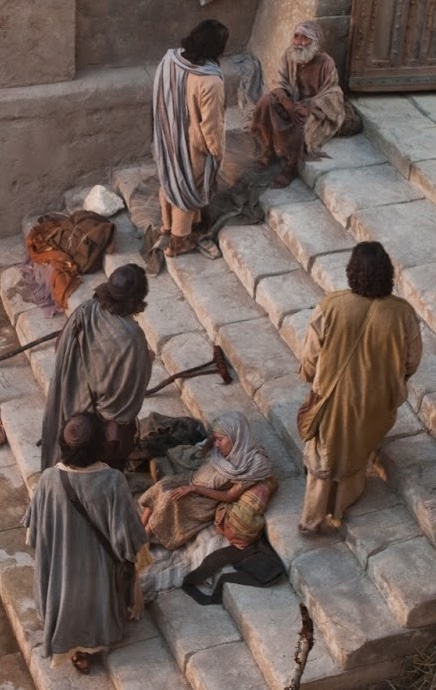
And among these is a paralyzed man.
Yes,
we could say he was a paraplegic,
but
for the purposes of the Gospel's meaning,
we understand him to be spiritually paralyzed,
caught between many beliefs.
The spiritual dimension of his paralysis
is made plain.
He has sought spiritual deliverance from for the past thirty-eight years,
nearly the same amount of time the people Israel
waited for their deliverance from spiritual paralysis.
And like them,
his mind has been has been very much on the world
(cf. the fleshpots of Egypt),
which explains Jesus' admonition:
|
"Sin no more, lest a worse thing come upon you."
(Jn 5:14)
|
Sin?!
This man has been paralyzed .... and through no fault of this own.
Still, Jesus says, "Sin no more lest a worse thing befall you."
For Jesus finds him along with
"a great multitude of sick people, blind, lame, paralyzed, waiting"
(Jn 5:3).
They languish in
this spiritual wasteland,
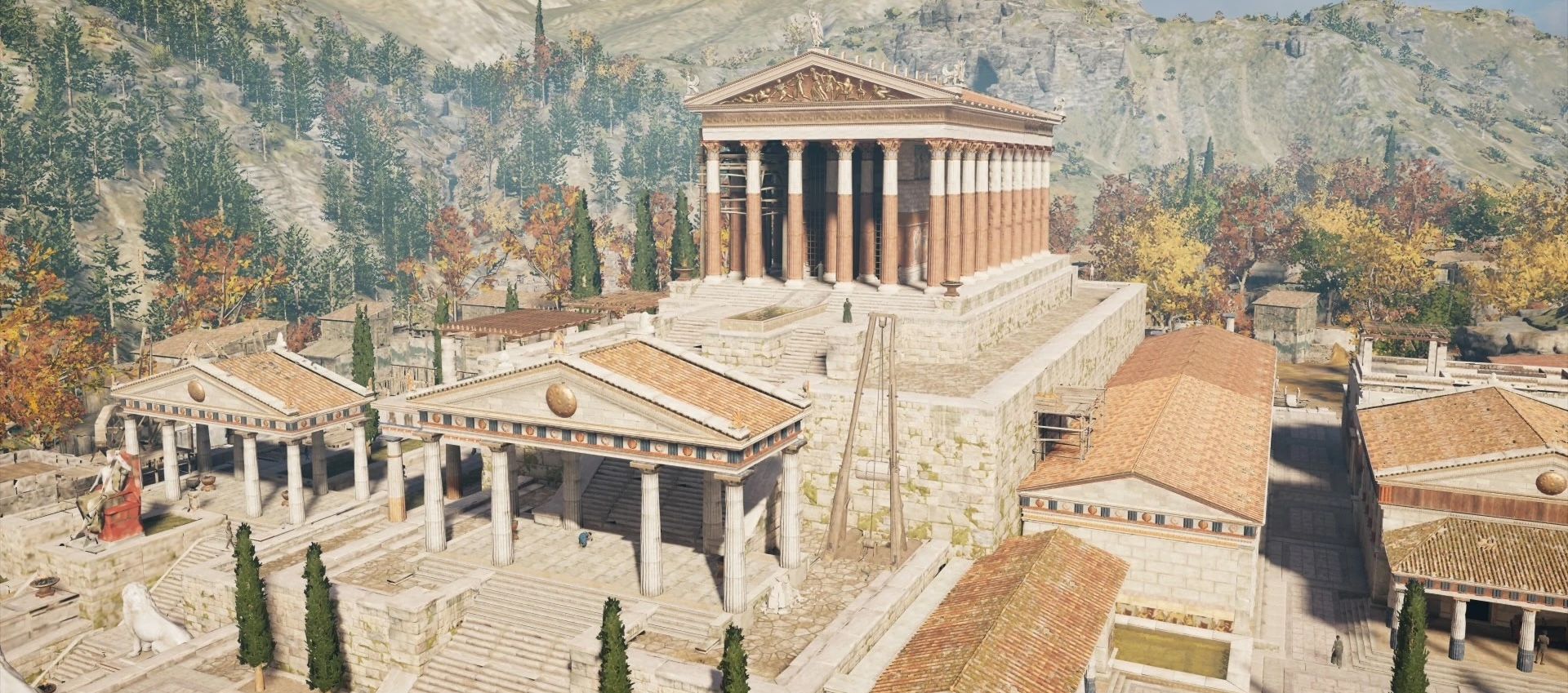
the Jerusalem Asklepion,
a temple to the Greek god of healing,
Asklepios
(as
we have considered in past years).
These temples,
marked by their pools and five porches
or porticoes
(Jn 5:2),
were scattered throughout the Roman Empire.
We should ignore the brief passage concerning
the angel who
stirred the waters.
This was added by a manuscript copyist
at least a hundred years later, and as late
as four hundred years after Jesus visited this Asklepion.
Moreover,
this gloss does not clarify but rather muddies the issues
this pericope has raised.
You know the content:
an angel periodically disturbing the water
sets off a stampede,
each man for himself,
for only one will be healed.
What kind of spirituality is this?
If this is a kind of "spirituality,"
it is a me-first spirituality,
like blood sacrifice,
which Jesus
mocked
through His parable of the Good Samaritan.
Jesus would take no delight in this might-makes-right free-for-all.
The strongest and fastest is healed.
Everybody else is just going to have to lose.
Jesus' foremost desire was to reveal a Kingdom of God whose
invitation list includes everyone born into the world.
But let us return to this multitude of incurable people.
They are casting their minds everywhere
and
on everything
as desperate people do.
We know very well,
but perhaps you had not heard:
Haiti is principally a Roman Catholic country.
The quip is "80% Roman Catholic but 100% Voudou."
You see,
when you are desperate you hedge your bets.
And Haitians, to be sure, are desperate,
like our friends and neighbors who seek a remedy for incurable cancer
at health food stores.
Such people are apt to believe anything,
calling to mind a
quotation
attributed to G. K. Chesteron:
When a man chooses not to believe in God, he does not thereafter believe
in nothing. On the contrary, he is fit to believe anything.
|
Is this not our situation today with
people "trying out" many Christianities?
So many go from church to church
listening for a message that "speaks to them"
as if our faith could ever be founded on simply "feeling good."
For it does not "feel good"
to tear ourselves away from a me-focused, comfort-seeking life
in order to
live the life God has in mind for us.
Indeed,
the first word of Jesus' ministry
and
His absolute requirement:
Metanoeite!,
which means "Make a complete turn-about!"
Now,
why should God wish us to deny ourselves,
as He says repeatedly in the Gospel?
Why would He wish us to be last?
Why would He wish us to tear ourselves away from
a me-first, comfort-seeking life?
Because This is not it.
When I was a chaplain in the oncology ward of Holy Family Hospital,
this was a theme to which I returned again and again:
This is not it.
If fact,
God has prepared a formation for us which leads to our despising this life:
its corruption,
its unfairness,
its brutality,
its evil.
We become disgusted with this life.
We come to
revile it.
He wants us to let go of this life
and
set our eyes elsewhere.
We must take our situation seriously.
For many are called
(Mt 22:14),
but few find the way into eternal life with God
(Mt 7:13-14).
Paralysis?
Spiritual paralysis is perhaps the most common
ailment of the American soul.
So many gaze upon the horizon of the New,
waiting for the exciting "next thing."
Meantime,
our calling God is speaking into our own hearts,
today and this minute.
But will we hear Him?
Perhaps
we do not recognize Him
standing right beside us
as He stood beside the paralytic at the Asklepion.
He might say,
"Sin no more."
Remarkable!
Yet,
it would not be remarkable
for us to recoil at this Stranger's words,
to swell in our pridefulness,
and
to tell Him to mind His own business!
For we are embattled,
paralyzed,
and perhaps have been so for thirty-eight years.
As we look around at the many desperate and hopeless
paralytics all around us,
we do not see Him,
standing right there,
even on the steps of the "temple of our unbelief,"
which is
the most imposing monument in twenty-first-century America.
Its members of countless.
This is spiritual paralysis.
Yet, we are so close to God Who waits.
We are so near to opening our hearts to Him Who loves us.
We are so close to saying,
"Yes,
Lord,
I will sin no more."
But we will not.
In the Name of the Father and of the Son and of the Holy Spirit. Amen.