Mark 16:9-20 (Matins)
Acts 6:1-7
Mark 15:43-16:8
On the Sunday when we contemplate the Myrrh-bearers, let us reflect on myrrh as it appears in the Holy Scriptures. This will not take long, for the mention of myrrh is rare, not because it is an afterthought. Quite the contrary. But because it is precious, superlative, in that sense, a rarity.
Let us begin with the Scriptures known to the Hebrew thought-world before the Advent of God.
It appears once in the Psalter:
|
You are fairer than the sons of men;
Grace is poured upon Your lips; .... All Your garments are scented with myrrh and aloes and cassia .... (Ps 44/45:2-8) |
Incidentally, this is not our familiar Aloe vera, which we use to heal burns, but the resin from a large tree that grows in India and other parts of south Asia Aquilaria agallocha also known as Sandalwood. A scented spice is made from this.
Myrrh appears once in the Book of Esther at a high point, when the fairest of all the young women, Esther, is being prepared for King Ahasuerus — a twelve-month preparation of rare perfumes including myrrh.
Myrrh appears seven times in that most mysterious Song of Solomon, each time filling the air of that visionary bower with rare perfumes.
For the sake of completeness, I will mention that myrrh appears once in Proverbs, where Solomon's anti-vision is depicted: the bed of adultery perfumed with myrrh.
Myrrh appears only once in the Book of Exodus. I mentioned a "high point." Here is a higher high point. Myrrh is an ingredient in the anointing oil for the Ark of the Covenant.
And it appears twice in the Book of Genesis — once when Joseph, the son whom the Israel "loved more than all his children" (Gen 37:3), is sold by his brothers to Ishmaelite traders, "with their camels, bearing spices, balm, and myrrh, on their way to carry them down to Egypt" (Gen 37:25). And once when Benjamin, the second son whom Israel loved above all the others (when Jesus was believed dead) is required by the mysterious stranger who governed Egypt, who is the anonymous Joseph:
|
And their father Israel said to them:
"If it must be so, then do this: .... carry down a present for the man —
little balm and a little honey, spices and myrrh, .... (Gen 43:11) |
It appears nowhere else in the Old Testament.
There are three mentions of myrrh in the Four Gospels. Only three. And they are all mysterious. First, in Matthew, we read of three almost-divine μάγοι / mágoi who bear myrrh:
|
.... wise men [mágoi] from the East came to Jerusalem saying ....
"We have seen His star in the East and have come to worship Him ...." And they had come into the house, they saw the young Child with Mary His Mother, and fell down and worshiped Him. And when they had opened their treasures they presented gifts to Him: gold, frankincense, and myrrh. (Mt 2:1-11) |
The Gospel text reveals treasures: gold, frankincense, and myrrh. Costly, fitting to be given by to offer royalty and by kings. Who exactly are these figures so out of place in a hovel, who fall down in mud and dung-stained hay in order to worship a Child? Biblical commentators have been debating this question for two thousand years. It is sufficient to say that they peered into the Heavens and divined the birth of a Child Whom they named "King of the Jews."
The next occurrence is in the Gospel of Mark, in which Jesus dying on the Cross refuses a drink of wine mingled with myrrh. Both wine and myrrh were analgesics. They dulled pain. Yet Jesus refused these painkillers — another mystery concerning Who Jesus was and what His work might be.
Finally, we read in the Gospel of John:
|
And Nicodemus .... also came [to prepare Jesus body for burial],
bringing a mixture of myrrh and aloes, about a hundred pounds. (Gen 5:24) |
Incidentally, the weight of this mixture which Nicodemus has purchased is about seventy-two pounds according to our weights and measures — about half Jesus' body weight.
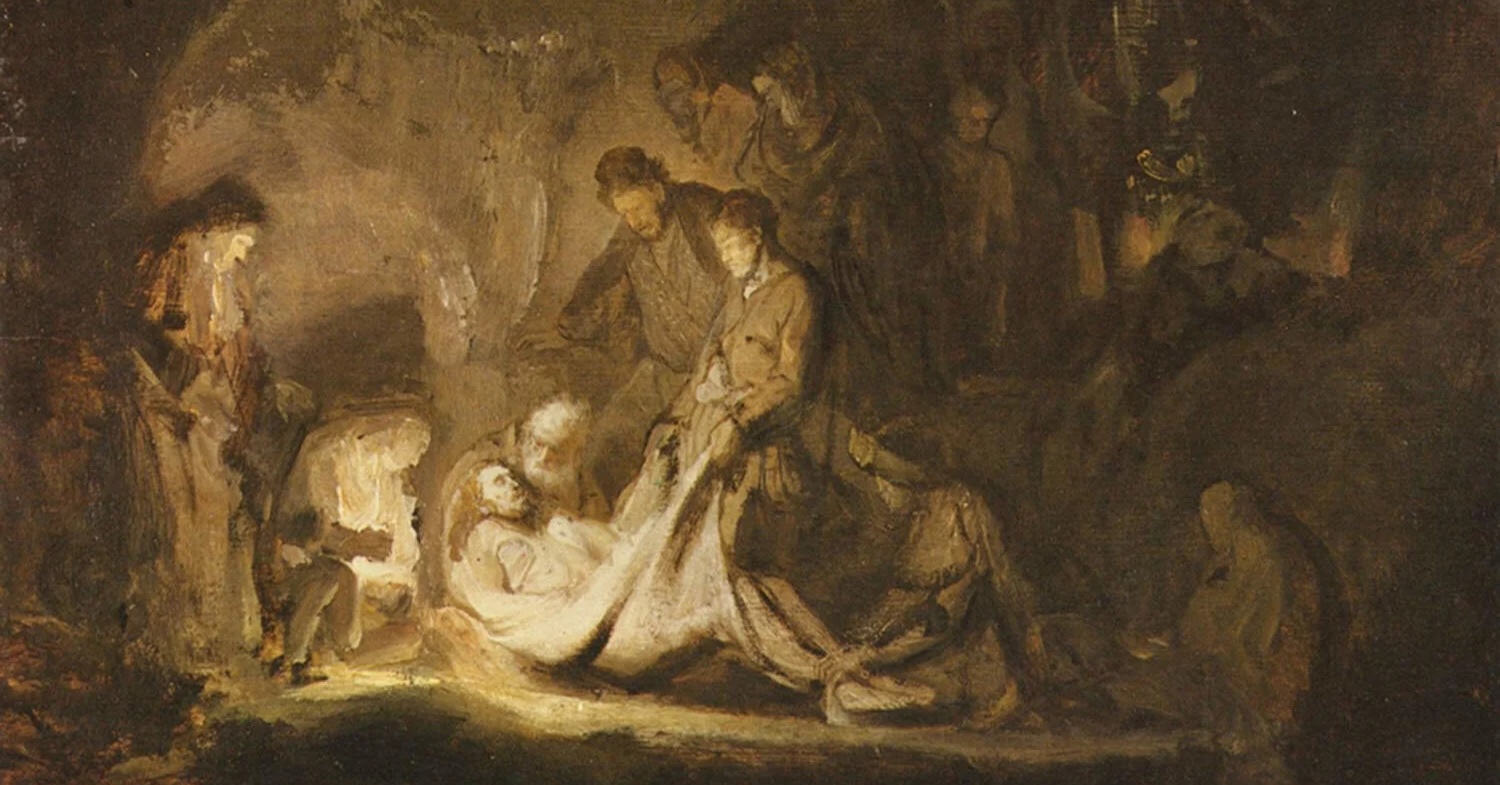
Now here is another riddle. The preparers would have had little more than one hour to complete this solemn work. The sun sets in Jerusalem around 5:00 P.M. at the Vernal Equinox. The myrrh would have had to be laboriously worked into every fold of the winding cloth from top to bottom. And later it would have cured producing a hard shell. In any case, following the Resurrection, Peter "saw the linen cloths lying there" (Jn 20:6), not a shell, not a mass of gooey resin. We ponder this reverently.
The Holy Hierarch St. John Chrysostom commented on this scene:
|
.... for they [Nicodemus and Joseph of Arithmathea] still regarded Christ as merely man.
Thus, they brought spices which are most likely to preserve the body for a long while and not permit it quickly to become the prey of corruption, a procedure which indicated that they thought nothing out of the ordinary of Him, except that they were displaying very tender affection toward Him. — John Chrysostomos, Sermon, S.P.E., vol. 14, ed. "Gregorios Palamas," Thessaloniki, 1981, 678. |
We do not know very much about Joseph of Arimathea. Chrysostom speculates that he was a secret member of the Seventy. We know more about Nicodemus, who could not get past his material explanations of spiritual things. His literal interpretation of άνωθεν / ánothen, "being born from on high," which he pictures as a crawling back into the womb, stands out. And this burial scene is analogous. At fantastic material cost, Nicodemus has come up with a way to stop the decay, erecting a wall (so to speak) to hold back the inevitable invasion of the sea, to stop (or at least slow to down) the physical corruption of Jesus' material body.
But, having exhausted our Scriptural sources, let us consider the Sacred Tradition of myrrh and myrrh-bearers. These arise from the Menaion, Octoechoes, and Pentecostarian. Here, myrrh appears (as in the epigram with which we began) in a spirit of mystery, solemn reverence, and devotion, not unlike Psalm 44/45, Exodus, Esther, an allegorical reading of the Song of Solomon, and in Genesis.
But let us also consider our own participation in Sacred Tradition. We are first-class witnesses of the mystery of myrrh. For surely that is precisely what we are when we venerate myrrh-streaming icons. That is our role when we venerate an icon that is actually streaming myrrh. After all, the Holy is not time-bound. We do not assent to the doctrine that miracles are bound by historical periods as some so-called Christian For when we experience myrrh streaming from holy vessels, as Met. Jonah did standing midst the ruin of the Monastery at Valaam, or when we behold myrrh streaming from holy icons as they do in our Russian Orthodox Church Abroad — in the Church of St. Tikhon of Zdonsk in San Franciso or in the Church of Myrrh-steaming Iveron Icon in Kailua. At these moments, we are standing before the palpable Presence of God.
This myrrh proceeding from nowhere and out of nothing violates our Laws of Physics. It is fragrant like the moment of a flowering bloom, but unlike a flower, its fresh scent of roses continues perhaps for years.
A volunteer at the Hermitage, Rukin Jelks (religious name, Daniel), told us that Fr. Nectarios had anointed his little girl's bedroom door lintel with myrrh streaming from the Holy Icon and that afterwards the lintel it continued to stream myrrh.
And contrary to the laws governing the material, this myrrh does not wither nor ever turns rancid. Some mornings I walk past our Altar and the fragrance from the cloths which the Icon touched is filling to room. Other mornings it does not. Why? I do not know.
Last year on the Sunday of the Myrrh-Bearing Women, we considered that nearly all the Myrrh-bearing Women have the same name, which is also the name of the Lord's Mother: Μαρία / María. And, of course, there is yet another Mary, Mary of Bethany, who has chosen "the one thing that is needful," has "chosen that good part" (Lu 10:42). And, Jesus adds, "it shall not be taken from her." What is that good part, that one thing that is necessary, the without-which-there-is-nothing? It is single-minded faithfulness, which we call devotion, that chief characteristic of that person we name devout, the goal of every Christian: to be devout. And to be devout means to turn you back on the "many things" Martha frets about (Lu 10:41), which is the world, and to make a whole-hearted decision for God: the love and devotion of heart and soul and mind and strength, which God requires. There are two Great Commandments. This is far more than a possession. It is your life, your all, your identity. Surely, it cannot be taken from you. This is the "treasure in Heaven which does not fail" (Lu 12:33).
Equally remarkable is one of the origins of the name Mary — the Egyptian word mry or mer. It seems that these Marys have mysteriously become united to God's grace in its manifestation of myrrh. They are myrrh.
All this we celebrate on our feast today. For becoming One with God's grace is what our Christian journey is all about. Let us understand myrrh, then, as being an abiding mystery, an ever-yielding spring becoming in us "a fountain of water springing up into everlasting life" (Jn 4:14).
In the Name of the Father and of the Son and of the Holy Spirit. Amen.