Matthew 28:16-20 (Matins)
Acts 5:12-20
John 20:19-31
The Twin
And Thomas answered and said to Him, "My Lord and my God!"
(Lu 6:33)
In the Name of the Father and of the Son and of the Holy Ghost. Amen.
Bold words!
Never before heard!
And never surpassed afterwards.
"My Lord and my God!"
Yes, Jesus had been called "Son of God."
But, remember, angels were styled Sons of God.
No one on earth had ever addressed Jesus by His rightful title: God.
If the Father's standard had been
that men and women should "believe in Him" (Jn 3:16),
this marks a high point in the unfolding Incarnation.
Why, then, is there is no authentic Gospel According to St. Thomas,
he being the most credible one?
The answer is straightforward.
None of Twelve wrote Gospels wholecloth with the sole exception of St. John the Theologian,
and
his was a
literary masterpiece
of a different order
and,
then, written at the end of his long life.
After all, Jesus wrote no Gospel .... Jesus did not write anything.
And He did not instruct His Disciples to write Gospels.
Thomas would follow the Master's instructions to the tee.
That later Gospels should appear under his name
—
for example,
the Gospel of Thomas
and
the Infancy Gospel of Thomas
—
is a measure of the respect and prestige accorded his name.
This was no faint-hearted disciple.
This was not a man
lacking the three things Jesus required above all:
unswerving belief,
the courage of a lion,
and
abundant love.
May I take a little detour?
I believe the focus on "Gospel manuscripts" is wrong-headed.
The keystone Q-source
has never come to light because it never existed.
The early Gospel stories
were circulated
in an oral tradition.
There were no notes,
no books,
no manuscripts.
Only decades later were
manuscripts written down.
This overall picture
supports the view
that collections of narratives
and
parables
were carried about
during the 30s, 40s, 50s, and 60s A.D.
as feats of memory.
Some were guided by the Holy Spirit.
Some were not.
For many centuries in the English tradition,
the spoken word alone was accounted to have reality,
you might say Divine power.
A written document
(which we now hold to be the reliable version)
was esteemed a poor second to spoken sentences.
Have you heard the proverb,
"The weakest ink exceeds the strongest memories."
As late as the Middle Ages,
contracts and oaths were held to be binding
only if they were spoken with the living breath,
the holy spiritus.
This oral-tradition supposition received important support from
Harvard professor Albert Bates Lord,
who
wandered
through isolated mountains in the Balkans during the 1950s
with a tape recorder
(The Singer of Tales, Cambridge, MA: Harvard University Press, 1960).
There he met men who could still recite
thousands of lines of epic poetry as feats of memory.
And our puny memories?
It seems our technologies, from the printing press to digital reproduction,
have badly eroded our once-prodigious capacities.
But the Apostle Thomas never saw this oral culture of criss-crossing evangelists
faithfully retelling (or heretically contradicting) the Gospel truth.
We get a little window into this world
of story-tellers
in the eleventh chapter of 2 Corinthians,
where St. Paul must impeach the authority of the so-called "super apostles"
(2 Cor 11:5).
Is not our own culture bristling with claims
to authentic Orthodoxy
on the part of pretenders.
Met. Jonah of St. Demetrios Monastery has a name for it:
Cyberdoxy.
Are you committing yourself to Cyberdoxy
or
Orthodoxy?
But Thomas was no "blogger."
He was no poster of opinions
on Facebook or Instagram.
Certainly,
he was no revisionist ....
which is why we
rigorously ground everything we believe
in the canonical Scriptures,
in the Church Fathers,
and
in the verifiable history of the centuries proximate
to the birth of Christ.
Certainly, we read outside the Canon to familiarize
ourselves with the era and culture.
Where,
for example,
does the doctrine of Ever-Virgin Mary come from?
The earliest surviving mention of it
is
from the uncanonical Protoevangelion of St. James.
Thomas was a good soldier.
He followed the orders of the Master
proclaiming the Good News to the ends of the earth
(Mk 16:15, Mt 24:14, and remembered in Acts 13:47).
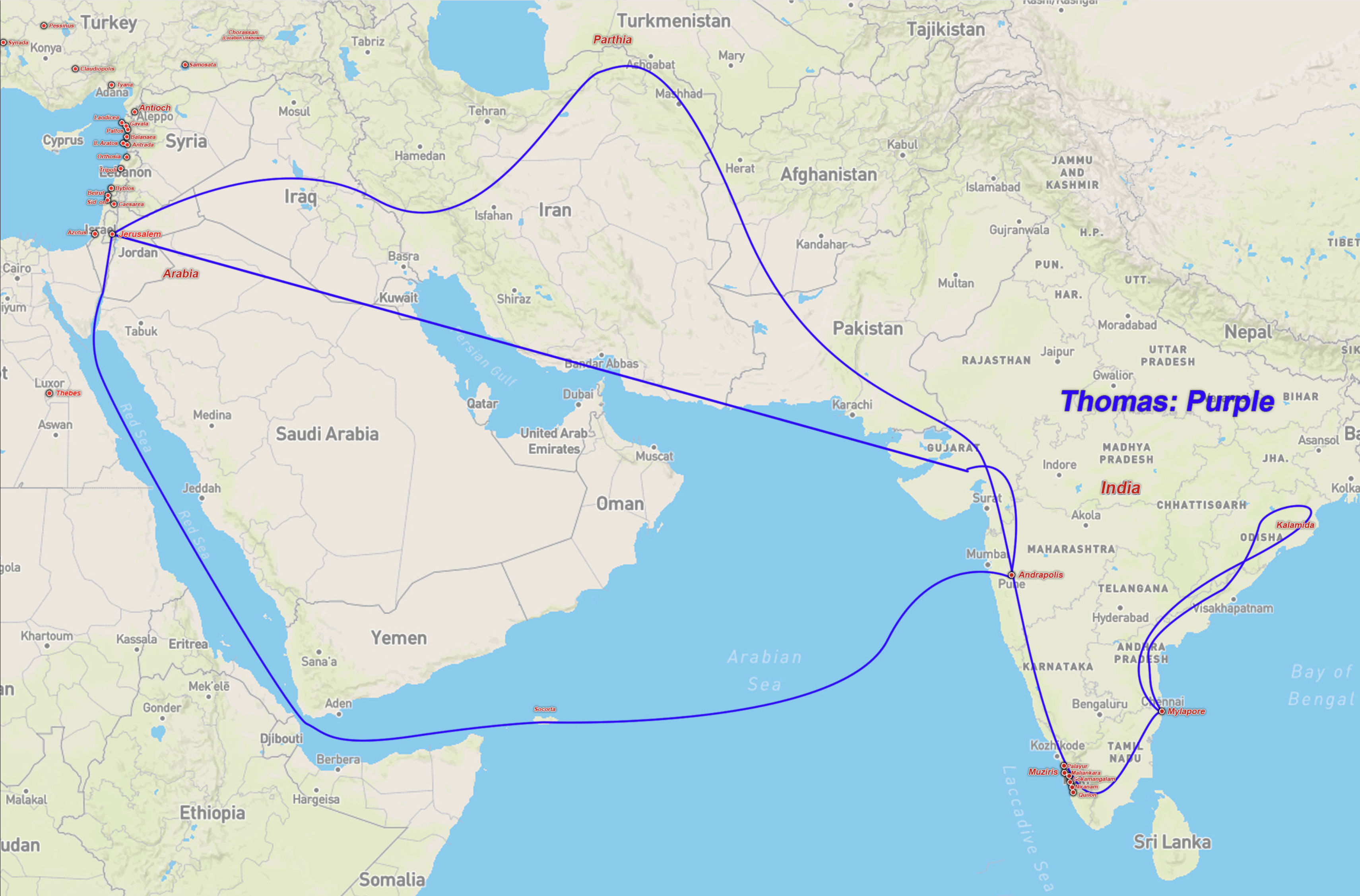
And no Apostle traveled nearly so far
—
along the west coast of India
and then up the east coast.
He is presence is felt still.
You know,
the Franciscan Sisters of St. Francis,
from which this community arises,
had many sisters from India.
I knew one of them well,
Sr. Anjali.
What you mentioned St. Thomas,
a hush could felt coming upon her spirit.
She was a daughter of St. Thomas
as I imagine there were many sons and daughters of St. Thomas
especially in the State of Kerala.
No Apostle boldly faced so many challenges
venturing into a subcontinent
speaking over a hundred different languages
written in indecipherable orthographies.
And, it is said, Thomas journeyed to China
(if the stories can be believed)
which would have presented another order
of linguistic difficulties with each pitch in syllable having a different meaning
and
expressed on paper using impenetrable glyphs.
What can we call such a man if not intrepid?
And certainly his life was constantly at risk.
In the fourteenth century,
a pious legend was concocted in the West featuring the Blessed Virgin Mary.
In this story Thomas arrives too late
to witness the Assumption
obviously reprising the story in St. John's Gospel
of Thomas arriving too late to see the Risen Christ.
I'm surprised that our proverb does not say,
"Tommy-come-lately."
But we do note that Thomas' lateness
attests
the incredible distances he would have had to travel to be present
for the Dormition.
The Synoptic Gospels do not mention any form of a "Doubting Thomas" story.
The Church Fathers do not mention it.
I should clarify:
there in no mention of a "Doubting Thomas"
until the Middle Ages in the West.
St. John does not make that accusation.
But the story of St. Thomas dissenting from
the other ten disciples is only attested in St. John's Gospel.
What we do know about Thomas is
that he was formidable.
We know,
Jesus was fond of nicknames:
"Cephas," the rock;
"Boanerges," sons of thunder;
"Zelotes" (Kananaios), the zealot.
But the nickname that stood out for its
special affection was reserved for the Apostle Thomas.
Do you know what the Lord called him?
"Didymus," Twin,
my other self,
the man after My Own Heart.
And this is remembered three centuries later
recorded in the fourth-century Nag Hammadi Codices,
where Jesus is recorded as saying,
|
"Now, since it has been said that You are my Twin and true companion, examine yourself ...."
(NHC, II,7 138,7-138,12)
|
For Thomas did not vacillate.
His faith was bold.
He had no moments of doubt.
The nickname "Doubting Thomas"
(as I have said)
would not appear until
about a twelve-hundred years later,
no earlier than the thirteenth century.
So we offer a slight revision of the letters:
Redoubtable Thomas,
which means
strong, bold, formidable.
A castle's redoubt
was its core
and
place of strongest defense.
Had Jesus not named him
him "Twin,"
My identical brother.
We have invented a meek and mild Jesus
in recent centuries.
But Jesus was, if nothing else, a bold man.
He rioted in the very center of Judah-ite authority,
the temple,
making a whip of cords with which
to beat men (Jn 2:13-17),
men who were minor officials.
He told the authorities of the temple,
that He would destroy place ....
to them the most sacred place on earth (Jn 2:19).
He said,
"Do not think that I came to bring peace on earth. I did not come to bring peace but a sword!" (Mt 10:34).
He said,
"I came to send fire on the earth, and how I wish it were already kindled!" (Lu 12:49).
He said,
"The Son of Man indeed goes just as it is written of Him, but woe to that man by whom
the Son of Man is betrayed! It would have been good for that man if he had never been
born" (Mk 14:21).
He would wish that he had never been born!
Strong language.
The threat of threats:
You would wish you were never born!
And His Forerunner, St. John says,
"His winnowing fan is in His hand, and He will thoroughly clean out
His threshing floor, and gather His wheat into the barn; but He will
burn up the chaff with unquenchable fire."
(Mt 3:12)
|
The words of the Lord's unerring Forerunner.
Jesus would not have said of John,
"No great prophet born of woman,"
if He did not credit John's words.
This Jesus was well attested in the Gospels.
And,
as I have said,
the Twelve
would all betray
the Master.
This was the sentence pronounced upon all of them,
for they all "dipped with [Him] in the dish" (Mk 14:20).
They are betrayed Him.
They all ran at His arrest.
What do we call men
who run when their commanding officer is arrested?
We call them traitors.
(By his own report, John alone did not run).
But we in the modern period do not like bold men.
What is our word of them in the present culture?
Toxic.
Perhaps we forget that Jesus' Father is a Warrior-God:
YHWH, Who wrests an intricate, orderly creation out of unrulable chaos,
and
the Son,
Who commands "even the wind and sea, and they obey Him" (Mk 4:14).
As we open our Gospel lesson,
what is depicted in the upper room?
First let us examine the setting.
What is its primary feature?
It is the locked door,
secured even though everyone is present.
Clearly,
this was not done to foil a thief.
The Gospel is plain:
the door is locked out of "fear of the Jews" (Jn 20:19).
But, then, there is the Apostle who disdains such fear,
who despises such weak-kneed cowardice.
This is the Apostle who walks about in the public square,
defiantly daring anyone to arrest him.
He is filled with pain
—
disgusted at his own treachery
and
even more disgusted at his fellows,
who continue to tremble.
They had abandoned the One for Whom they pledged to die:
But he [Peter] spoke more vehemently, "If I have to die
with You, I will not deny You!" And they all said likewise.
(Mk 14:13. Emphasis mine.)
|
And most prominently,
Thomas had made this pledge:
Then Thomas, who is called the Twin, said to his fellow
disciples, "Let us also go, that we may die with Him."
(Jn 11:16)
|
You recall the scene,
this moment of division among the Disciples.
Jesus announces He will go to Jerusalem.
They all recoil at this:
The disciples said to Him, "Rabbi, lately the Jews sought
to stone You, and are You going there again?"
(Jn 11:8)
|
As a sidenote,
these disciples and Jesus clearly are not Jews,
or
they would not (as they did in the Upper Room)
be contradistinguishing a separate group as "the Jews."
Yet they all, in their moment, had declared that they would never abandon Him.
They had spoken words of valor.
But now these men of courage,
tempered in fire like steel,
must now live with the fact that they turned out to be lukewarm
in the moment of truth.
Now, there is no way to set things right,
for the Master is gone.
And now they are shown to cower with the curtain drawn
and the door locked.
We can well imagine the bitter atmosphere
in that Upper Room,
this place of recriminations,
of imputed blame and accusation.
No wonder Thomas chose to get a breath of fresh air.
He could stand it anymore.
And upon his return,
perhaps hours later,
he exhibited the same disgust with which he left.
Was there any credible thing anyone could say?
And now this:
"We have seen the Lord!"
You know,
that same Lord for which Thomas grieved,
Who was gone
and
would never be seen again?
Thomas surveys the room.
It is unchanged.
The locked door attests to their
over-heated imaginations.
Any minute, they feared, the temple police would break in.
And now this latest report, in Thomas' opinion outlandish.
And he rejects their far-fetched claims out of hand.
His vivid and detailed language reveals his contempt for their fantasies:
|
"Unless I see in His hands the print of the nails, and put my finger into
the print of the nails, and put my hand into His side, I will not believe ...."
(Jn 20:25)
|
Do you see how empirical he is?
He seems to say,
"Show me reality, you day-dreamers!"
He insists on details.
His insistence on precision gives his mind away:
"the print of the nails" he says twice.
At no time, does he doubt the Master.
After all,
when Jesus had announced His departure for Jerusalem,
only Thomas declared solidarity with Jesus.
When the Lord does appear,
this time to all eleven of them,
Jesus sees the teachable moment.
He is Rabbonai, the Teacher.
He echoes Thomas' vivid language,
and in so doing, enunciates a principle that forever after goes to the heart
of the Christian experience:
|
"Blessed are those who have not seen and yet have believed."
(Jn 20:29)
|
The Teacher looks ahead.
In the fullness of time almost none of us will meet Jesus.
(I do not discount the holy men and women who have actually spoken to Him,
but most of us will not.)
And using this moment,
He articulates a cornerstone for His Church:
Blessed are those who have not seen and yet have believed.
And Thomas?
He instantly falls to his knees
and
declares those words which
we must ever etch upon our hearts when we approach the King of kings at the Eucharist:
|
"My Lord and my God!"
(Lu 6:33)
|
It is a fact,
that in all Scripture,
this stands as the highest and most exalted
address accorded Jesus.
Nowhere is it recorded that Thomas touched Jesus,
much less His wounds.
Nowhere is it averred that Thomas required proofs in order to believe.
The Teacher seizes the perfect moment to hold aloft belief.
This not just belief in the sense of assent,
but
also belief in the sense faith,
which is loyalty.
This is the kind of belief on which our eternal life is founded:
For God so loved the world that He gave His only begotten Son,
that whoever believes in Him should not perish but have everlasting life.
(Jn 3:16)
|
Belief, faith, loyalty.
Thomas denied himself every comfort.
He endured every kind of danger and weather.
He walked to the ends of the earth ....
all in faith, all in belief
—
hi ssent belief and his loyalty belief.
We who argue over the doubting Thomas .... can
we manage to give the Lord one affordable gift
in which Thomas excelled?
We are not asked to
risk our lives.
We are not asked to
walk thousands of miles.
We are not asked to
learn many languages
and
to place overselves at constant hazards ....
as the Sisters did in Haiti.
We are not asked to
do any of these things.
But will we give Him our undivided attention and our faith,
even our simple belief?
When the Lord becomes Present each Sunday under appearance of bread and wine,
will we kneel before Him
and,
with our hearts bursting and tears flowing from our eyes,
say,
"My Lord and my God!"?
The Most Holy Mother of God graced this placed with Her Divine Presence.
We saw the myrrh arising from nowhere.
We inhaled the never-fading scent
(itself a miracle)
and
fell to our knees.
We pressed our foreheads to the ground.
And I mean no disrespect
when I say
this nothing compared to the appearance
of our Lord Jesus Christ
in this very place .... and His feeding us with His Own Most Precious Body
and
His Own Most Precious Blood.
Let us raise our voices in praise of St. Thomas.
He was foremost among the Apostles fulfilling the Master's every command.
He is a saint for our time of un-belief
—
a culture where God is regularly mocked
and
already people are arrested in Canada and in England
for their witness to the Lord Jesus.
Pray for us Redoubtable Thomas,
Twin of the Lord,
for we have need of your strength, boldness, your fortitude, and your faith.
A long struggle lies before us,
and
the weather is turning ugly.
I hope I remain alive long enough to have a part in the fray.
Pray for us, Redoubtable Thomas,
for you were a mighty fortress stretching over much of God's earth.
In the Name of the Father and of the Son and of the Holy Spirit.
Amen.