John 20:11-18 (Matins)
Hebrews 6:13-20
Mark 9:17:31
Ascent
"Blessed are the pure in heart,
For they shall see God."
(Mt 5:3)
Here on the Fourth Sunday of Great Lent,
we contemplate once again spiritual instruction
from the turn of the fifth-to-sixth century
written
in a monastery of the Sinai wilderness.
These teachings were collected into a codex, or book.
We know little about its author,
but not nothing.
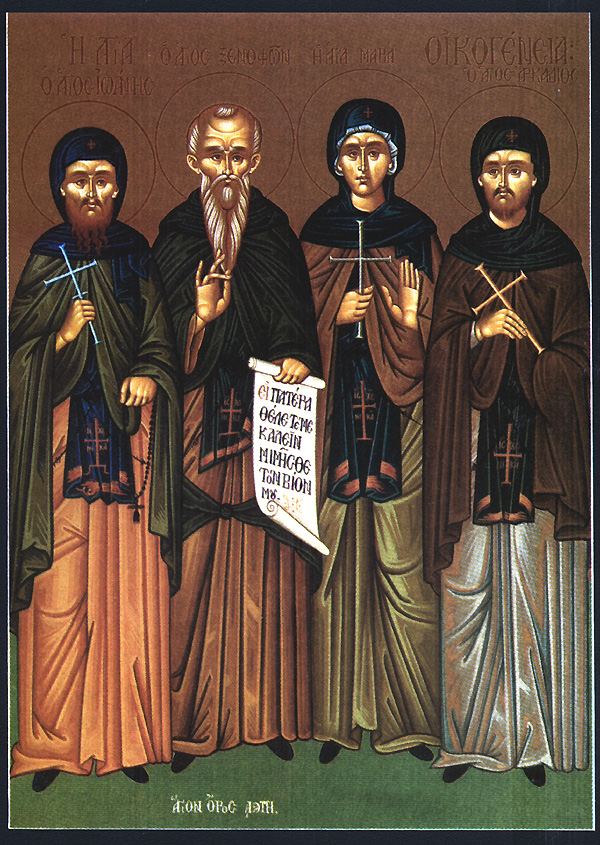
He was born
about a quarter-century after Constantine's Edict of Milan
in Constantinople.
His parents
were
Xenophon and Maria,
venerated by the Church as saints.
They named their son John
(perhaps after the Theologian).
His brother they named Arcadius
(the Greek word for Paradise,
which we call Eden).
Both were well-educated
and
sent off to Beirut for advanced studies.
During their voyage to Phoenicia,
their ship was wrecked.
Arcadius, by twists and turns, ended up in Jerusalem,
where he sought out the shrine of the Holy Sepulchre
to offer prayer for the safety of his brother.
There he would meet a holy man who invited him to visit the monastery.
Arcadius found a home here and was readily accepted by the brothers.
Meantime,
his brother
John came safely ashore at an unknown village along coast of the Sinai wilderness.
He sought out a monastery
(which would become St. Catherine's)
and was welcomed by the monks.
In time
he became a monk himself.
By this time,
their parents,
receiving no news from Beirut,
lived in daily anxiety
and
prayed fervently
that
whatever happened to them,
they would present lives pleasing to God.
After some years,
news of the shipwreck reached them in Constantinople.
They begged God that John and Arcadius might have survived
and
that all would be well
and
that someday the four might be reunited.
This was their daily prayer.
Then, on a day,
they received a vision.
They saw John seated on a throne
with a scepter in his hand
and
a crown set upon his head.
And
they saw Arcadius wearing a diadem of stars,
holding a Cross in his hand.
They interpreted the Cross to signify Jerusalem
and
immediately set off on a pilgrimage.
Upon arriving,
they encountered the same man
who had welcomed Arcadius.
By now he had become abbot.
He invited the pilgrims to sup with him,
and
they accepted with pleasure.
During the meal the saints were deeply impressed with the manner of the
monks they met.
"Reverend Father,"
Xenophon said,
"what marvelous disciples you have!
What modest and reserved behavior!
I am moved just to look at them.
I have prayed that my sons might look like this."
And the man replied,
"These are your sons."
Their parents did not recognize them,
so much had holy life transformed them.
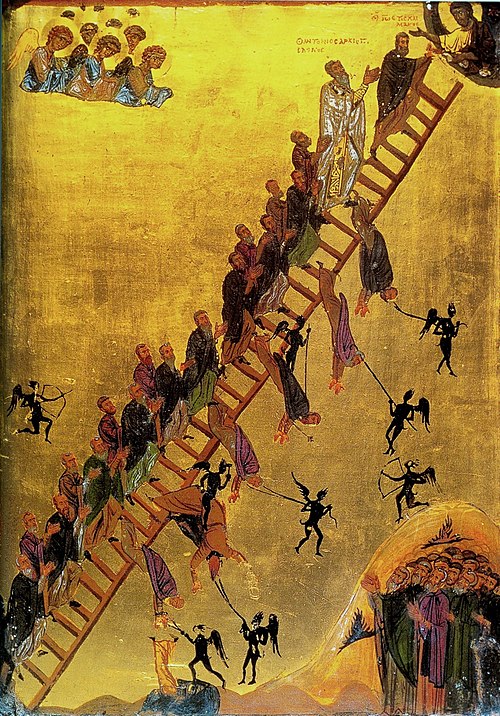
Of Arcadius nothing more is known.
But,
by the grace of God,
his brother John had made a detailed record of their spiritual journey,
which has survived to the present day like so many treasures guarded within
the spiritual fortress, St. Catherine's Monastery of the Sinai.
The Fourth Sunday in Lent
is set aside throughout Holy Orthodoxy to honor
this sacred text,
entitled
Κλι̑μαχ
/
Klīmax
/
Climax.
And its author's name would be
forever after
bound up with his book:
John Climacus.
Raised in a wealthy family of Constantinople,
John would have been trained in the Greek Paideia,
and there
would have read Aristotle's Poetics,
in which Aristotle wrote that at the heart of tragedy
lies a triangle
whose essence is rising action, leading to a climax,
and
then,
owing to the
the hero's
hamartía
(known to Christians as sin),
ends with a tragic fall.
The Greek word Klīmax
derives from the verb
κλινώ
/
klinó
meaning to lean
suggesting a ladder.
And certainly John had this in mind
as
he described progress toward God's Kingdom
in terms of "rungs,"
thirty rungs.
Latin translations of the book
settled on Scala
(ladder
or
even
staircase)
as the title of the book.
But we should not lose sight of John's overall
conception,
for certainly a fall from this ladder
is the tragic fall.
For this ladder
—
climbing it
or
(more often,
falling from it)
—
is what human life it about.
And to the ancient world
—
as John would have known reading the Greek tragedians and philosophers
and
by virtue of his Christian education
—
life was about ascent,
ascent to nobility of life and virtue
or
ascent to holiness.
Sadly,
most
men and women,
giving in to
their passions,
fall from this ascent,
and their lives become
"might-have-beens"
or,
worse,
their lives become trash.
Yet, climbing the ladder rung by rung is something anyone can do.
About forty years ago,
a brother of the Abbey of Christ in the Desert
introduced me to a new concept:
"the rage of the monk."
This was a strange concept to me,
but then I matured and saw that this is common
among men.
Certainly
it was active among the brothers of St. Catherine's monastery.
Many hated John
and depreciated him.
His gentle ways,
his gifts of insight and articulation,
his steady serenity,
and,
most of all,
the faithful who were devoted to him
infuriated the brothers.
For John simply to let this pass would have been cruel,
for a dangerous spirit of envy had entered into his brothers.
So John took the spiritual fight
directly to the demons
and
starved them off.
He remained absolutely silent for one year.
He saw no pilgrims.
He accepted no conversations.
This deprived the demon envious of fuel
and
gave the brothers time to recover themselves.
In this noiseless space they realized that they needed John,
that God had sent him to help them in their own ascent.
Let us also seek guidance from this wise and gentle man.
For the paths to Heaven are not many, but one
—
one ascent.
From the time of the Fall from Grace,
the very same traps and pitfalls await each of us and all.
We realize that many who encounter this little reflection
will not obtain a copy of John's book,
a volume of 274
pages in the recommended
Holy Transfiguration Monastery edition.
So we set out the section headings from this landmark work.
And we pray it will spur the reader on
to turn these remaining weeks of Lent
into a holy conversation with Brother John
—
the very same conversation
which counseled countless saints on their way to the Kingdom of Heaven.
The way to Heaven is not shrouded in mists and holy secrets.
This most important of all learnings has been revealed with clarity,
taught with exactitude by God Incarnate,
and
then passed down by the Apostles, the Holy Fathers, and the saints through the centuries.
Today we celebrate a gift
received from a saintly guide
—
St. John of the Ladder.
This same guidance was ardently sought by sixth-century monks living in a monastery of the Holy Land
and
heard heart-to-heart from this hero.
When they heard his words, they knew them at once to be true .... as we will today.
For they were not revolutionary words.
They were never-before-heard words.
God has already inscribed His ways and counsels upon our hearts.
The precepts are familiar.
We are strangers in a strange land
(or, more precisely, a land made strange by our polluted thoughts
and corrupt actions).
Yet, within each of us remains the pure boy or girl that God had created from the beginning.
Our task as men and women is to be rid of these impurities,
to let them leach out physically and spiritually.
And soon
we will find that the purified people we long to be ....
are the people we already are,
and
were at our birth .... though the years may have caused our memories to fade.
It is such people,
the truest expression of ourselves,
of which the Kingdom of Heaven is made.
Otherwise,
Heaven would not be Heaven.
It would be false,
not true.
The false world does exist.
It is here on earth.
We pass it off as acceptable .... though it is not.
And beneath that false world,
ruled by the father of lies,
is madness and grotesquery.
Let us take hold of godly counsel which was already ours,
for any of us journeying to Heaven might have written it.
It is a travel log detailing what the pilgrim encounters along the way.
That is all.
We give thanks for St. John Climacus,
who took the time to make this record.
What follows are section headings from
his book called
Klímax.
We pray that by contemplating these general headings,
you will be moved to learn more about each one (following the link above).
Let us take hold of a sobering principle:
no will ascend to Heaven who ignores this path of ascent.
For cleansing oneself of the world
is an essence of the Kingdom of Heaven.
☦
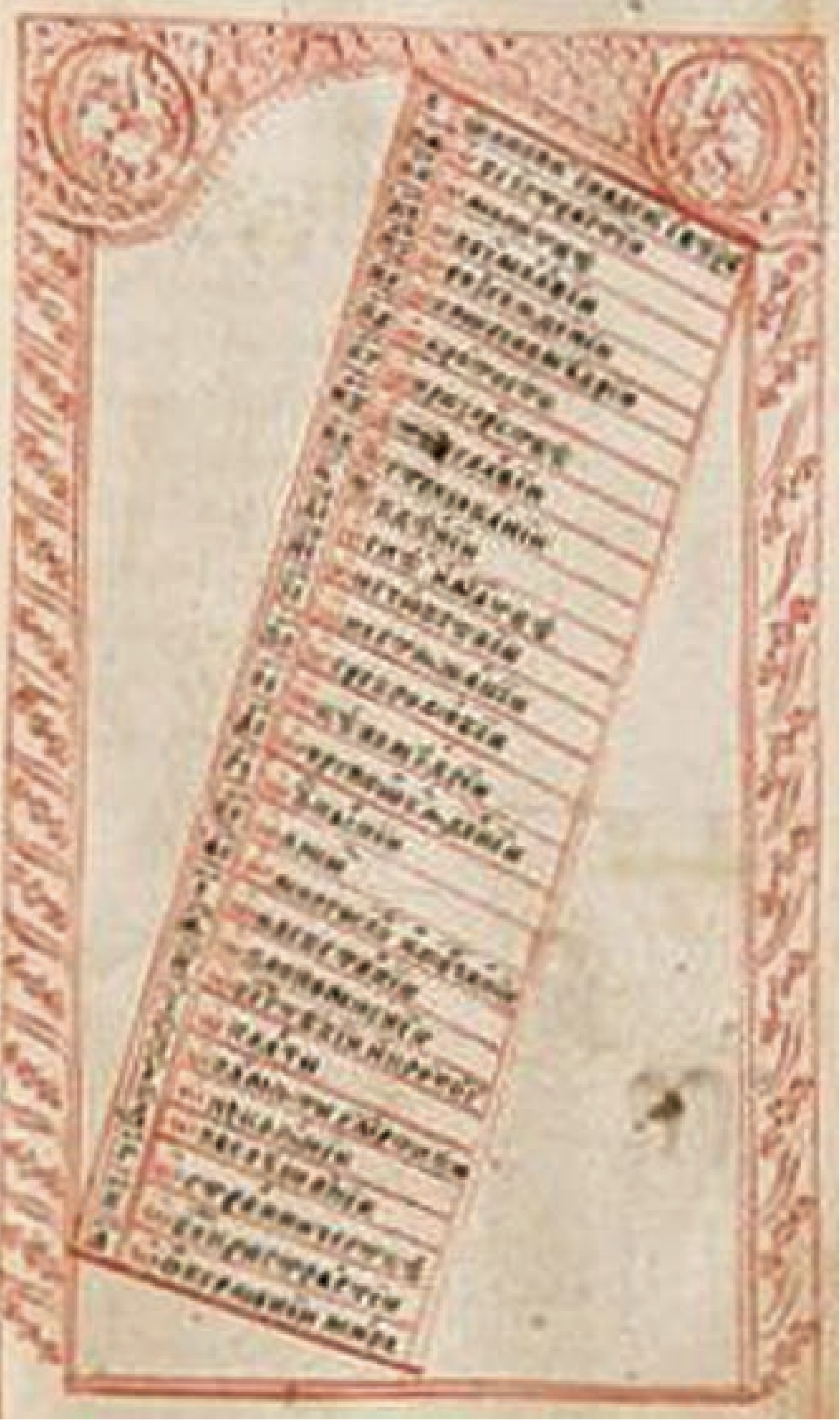
1-4: Renunciation of the world & obedience
1. Be an ascetic.
2. Be one detached from material things.
3. Be a stranger in a strange land on pilgrimage.
4. Be a devoted son under care of a spiritual father.
5-7: Penitence
5. Be a slave (like St. Paul) & prisoner in the House of Death.
6. Be a hermit awaiting departure from earthly life.
7. Be a mourner in the night seeing joy in the morning.
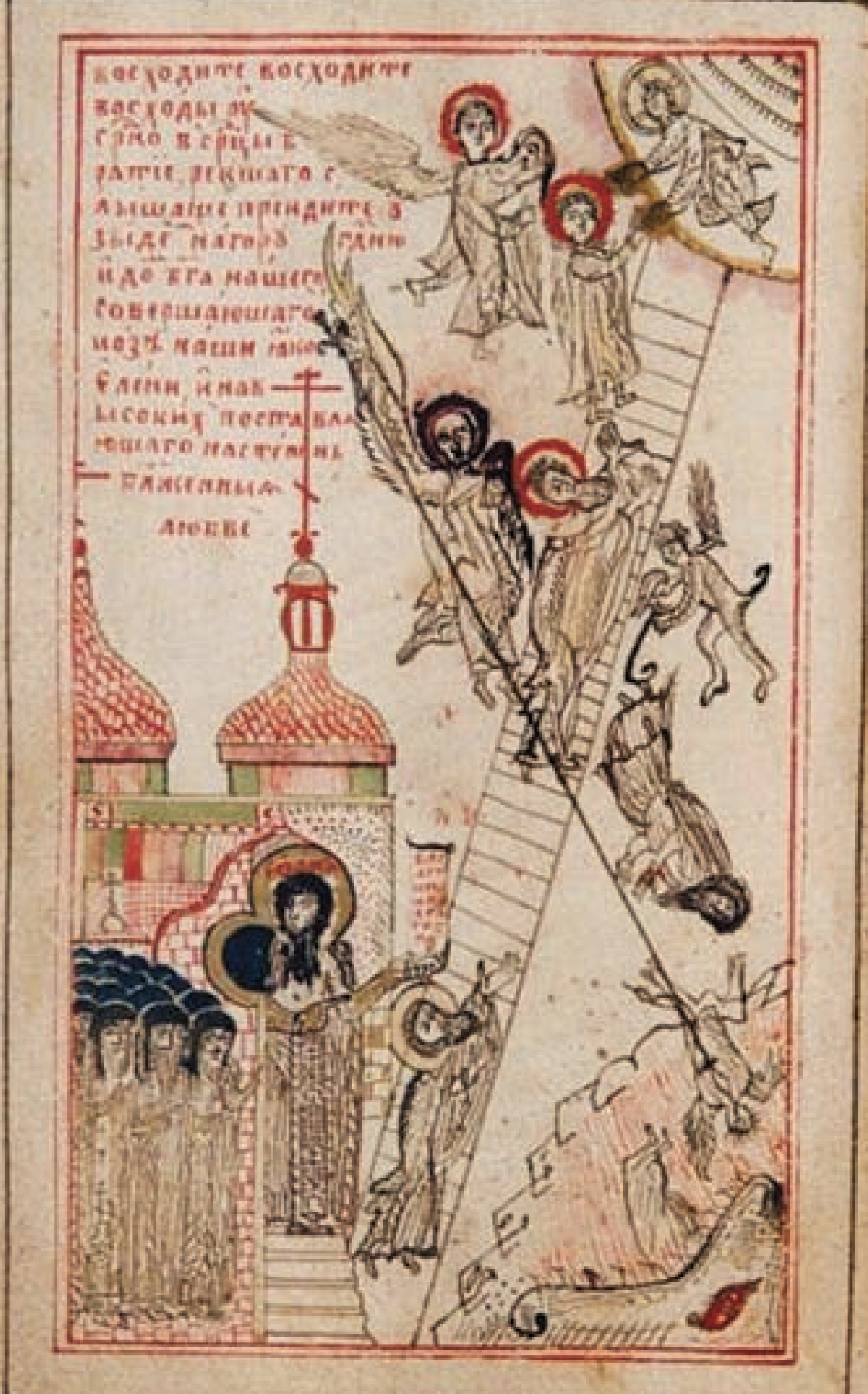
8-17: Defeat of vices and acquisition of virtue
8. Be one who is lowly and meek.
9. Be one who regrets past wrongs.
10. Be one who has slandered.
11. Be one who has given tongue free reign.
12. Be one who has lied.
13. Be one who is despondent and egoistical.
14. Be one who has given in to appetites.
15. Be one who has polluted purity feeding on garbage.
16. Be one who has loved possessions.
17. Be one released from worldly things all its enticements.
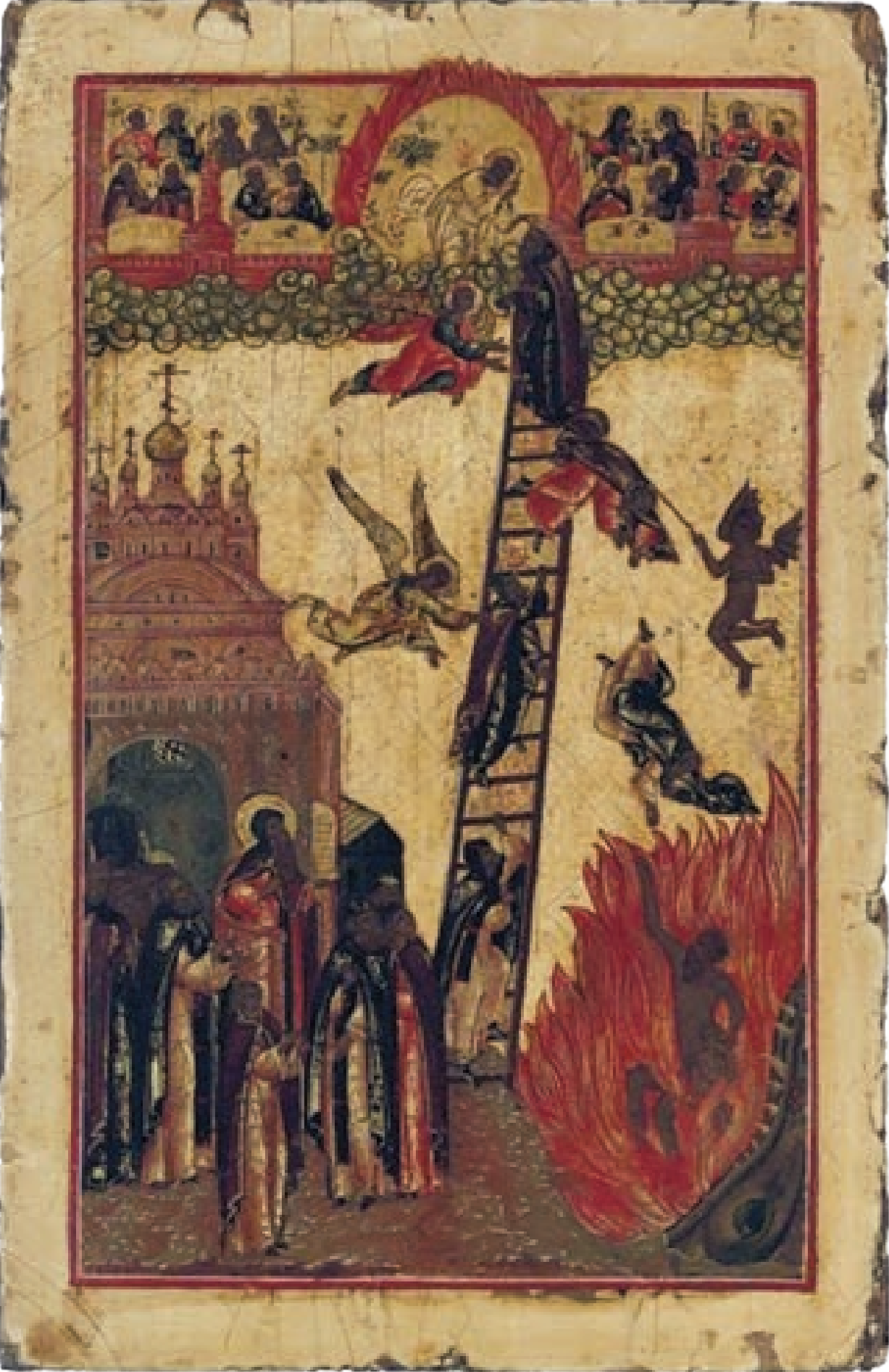
18-26: Avoidance of the traps of asceticism (laziness, pride, mental stagnation)
18. Be one awakened from listlessness and apathy.
19. Be one who prays and sings with the congregation.
20. Be one practicing physical and spiritual vigils.
21. Be one overcoming childish fears & cowardice.
22. Be one seeing and rejecting vainglory.
23. Be a master over filthy images & thoughts.
24. Be one who is meek, simple, and sincere.
25. Be one who has risen above the passions and nearing Heaven.
26. Be one who has risen above earthbound life and struggle.
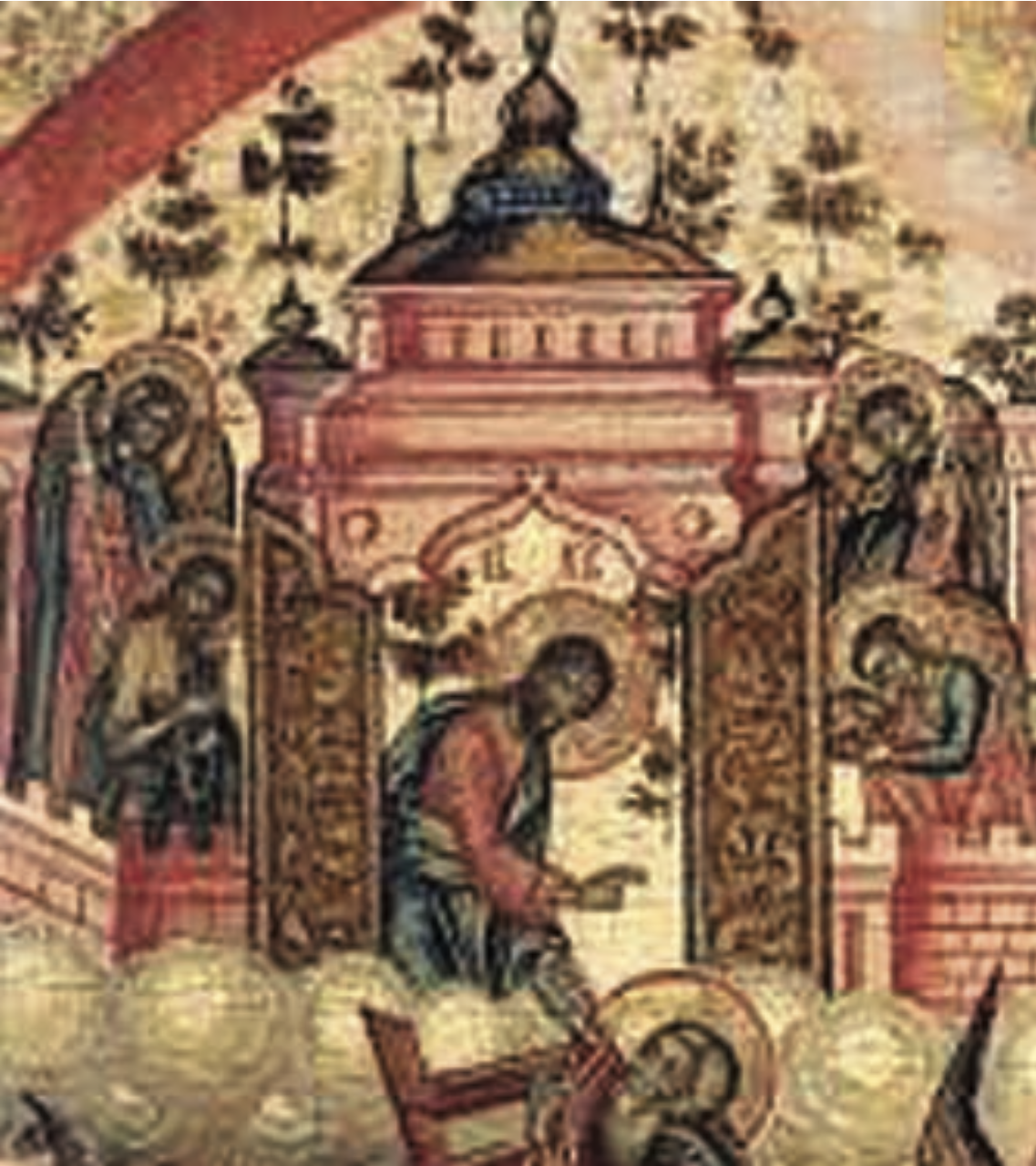
27-29: Acquisition of hesychia (spiritual peace), prayer, and apatheia (dispassion)
27. Be one who is serene.
28. Be one who is holy & well-practiced in prayer.
29. Be one who is resurrected, who is Godlike in dispassion & perfection.
30. Entrance into the Kingdom of Heaven and union with the Most Holy Trinity.
☦
Why should everyone be naturally drawn to ascent?
Why do we yearn to transform our lives in order to climb to High Heaven?
The answer is not shrouded in mystery or mists.
For this instinct is set within us from our birth.
It is only much later in life that we see we must escape from the pollution
of the world,
ruled by the lower angels
and
where the passions grow out of control
mold or fungus,
which never see the light.
This is why people once sought a high hill to build their homes,
where the air is clearer
far above the miasma and fever of the world.
But that is not enough.
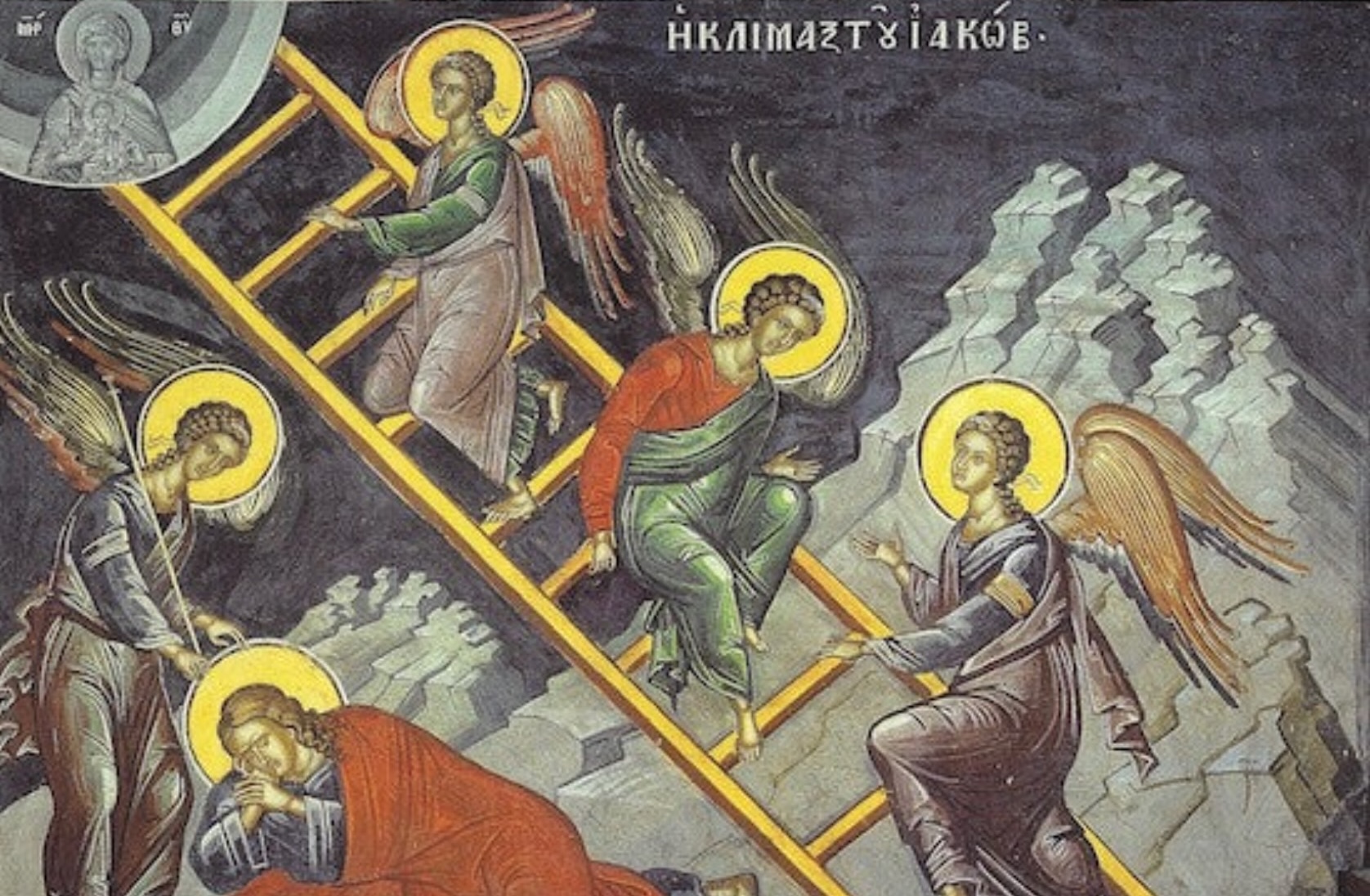
For in our founding story,
Abraham's grandson,
another seeker,
discovered a ladder.
Angels were ascending and descending.
And he cried,
|
"Surely the Lord is in this place, and I did not know it!"
(Gen 28:16)
|
Let this also be our cry!
For the Lord surely is present
and
is all around us.
But we cannot know Him until we clear
ourselves of the filth and fog of our passions,
which seek to choke us and weaken us until we no longer see God .... or,
worse,
we no longer care.
Let us, then, ascend
as our ancestors ascended
(and ever will ascend)
towards a world of personal nobility, towards virtue, and towards life.
In the name of the Father and of the Son and of the Holy Spirit.