John 20:1-10 (Matins)
Hebrews 4:14-5:6
Mark 8:34-9:1
The Great Contra Mundum
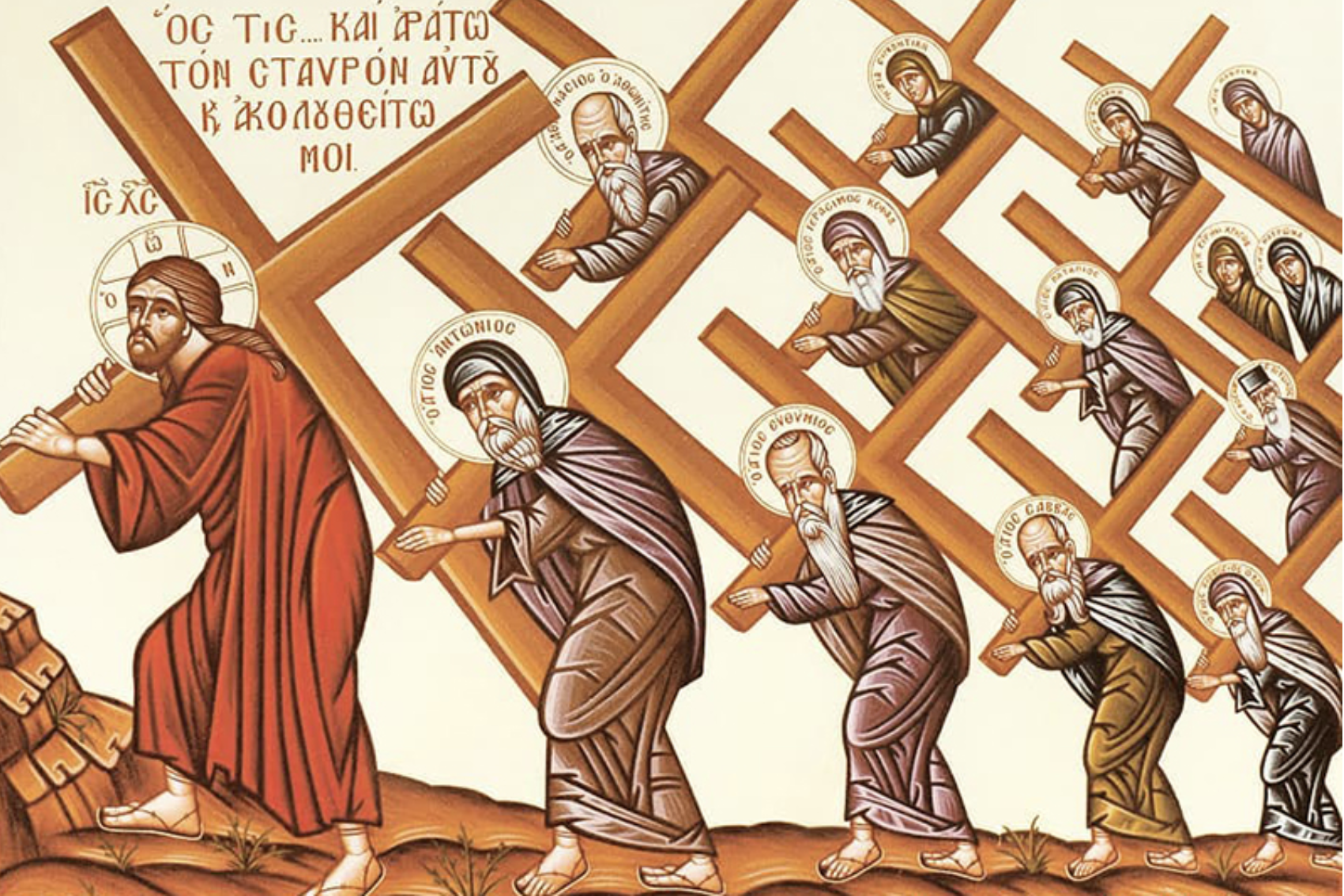
"Whoever desires to come after Me, let him deny himself, and take up his cross,
and follow Me."
(Mk 8:36)
In the Name of the Father and of the Son and of the Holy Spirit.
Amen.
When Jesus issued this condition for becoming His follower,
He spoke as through a loud speaker,
for the Greek word
σταυρός
(staurós),
or
the Latin
crux,
translated as cross
had commanding power.
It had power to remind Roman citizens of who they were,
for
Romans were rarely crucified.
And
it had power to remind the lower class and slaves and non-Romans of the absolute
authority that ruled their lives.
Indeed,
the cross was the life story and epitaph of nearly every slave.
In a second-century B.C. play by Plautus,
one of the characters,
a slave,
says in resignation,
"I know that the cross will be my tomb; there my ancestors have been laid
to rest, my father, grandfather, great-grandfather, great-great-grandfather."
(Plautus, Miles gloriosus, Loeb Classical Library No. 163, 372-373.)
|
For a slave could be crucified for any reason whatever.
These coded messages continued to be loudly broadcast
for centuries
until the early 300s A.D., when
the Emperor
Constantine adopted the cross as his personal impresa and seal,
at which point
crucifixion ceased by imperial decree.
Until then,
for the lower classes the cross was a symbol of degradation and hopelessness
and
for the upper classes an extremely dangerous word
and
certainly a distasteful ordeal for all involved
—
including
witnesses,
guards,
and
executioners.
Simply stated,
crucifixion was the ne plus ultra
of cruelty, torture, and humiliation.
To grasp the conditions Jesus had set for discipleship
—
which is, after all, everything to any Christian,
and even today
—
we must understand what the Master meant by "taking up your cross."
For it is not a cross
that He has specified,
but your cross.
What could He mean?
Now let us be clear from the outset.
One could draw the conclusion
that the shadow of the cross falling upon your life
—
which was already the case among slaves, lower classes, and criminals
—
marked out Jesus' disciples as being distinctly "a congregation of the downtrodden."
Do you see what I mean?
Today,
some people look back on the "Jesus movement"
and
see it as an assembly of under-dogs, slaves, and condemned people.
But that is not true.
The first followers the Master
called
—
Andrew and Peter,
John and James
—
were owners of fishing boats,
we would say of "seafood companies"
(or their families were).
In 1986 the so-called "Jesus boat"
was discovered
buried in mud along the shores of the Sea of Galilee.
Today,
it is still held
as representative of commercial fishing vessels of the first-century Levant,
which we know quite well from the Gospels.
It is generally agreed that one successful outing for such a boat
would have contained a catch that was worth a fortune.
Now, we work for Hilo Fish Co. as one of our many enterprises.
This is a central clearing house for nearly all fisherman on the island.
Their fish is butchered there and then sold to the hotels, restaurants, and food markets.
The fisherman go out for days in boats that they own.
If one were to come to dock with his boat full of fish
(and these boats are roughly the size of the Jesus boat)
this would represent a fortune to him.
Jesus' followers included Matthew-Levi and Zacchaeus,
who had been members the Equestrian class, just below the Senatorial class
in Roman society.
St. Luke's mastery of Greek and Greek literature marked him out as learned man.
Saul of Tarsus was a student of the renown Gamaliel.
And
the wealthy, young ruler,
who felt attracted to the Master
but
not bring himself to the sticking point,
was probably a Sadducee,
that is,
of Jewish nobility.
In the end we see how Pontius Pilate defers to Jesus
and
seeks a way out for this Man of prepossessing qualities.
This no mere king.
This an emperor and more ....
No,
Jesus followers
was no rabble (or even a rebel) movement.
Yet,
the condition of membership was to take up the cross
—
a symbol of ultimate humiliation and degradation.
It this not
a most strange initiation into this mysterious society.
As I say, the most abject among the multitudes who followed Him
already lived under the shadow of the cross,
nor could they ever escape.
Moreover,
as one who came out of Nazareth
and
was born in the year 4 B.C. (according to the Gospels),
Jesus seemed to be an authority on the subject of the cross,
for what were the most notorious crucifixions in the history
of the Levant
were carried in the year of His birth
just three miles outside his village of Nazareth.
You can picture meeting Him,
who learned that He was from Nazareth,
snapping to attention.
"Nazareth?!
That was the place!
And when were these crucifixions done?
In the year of His birth!"
Jesus life from the beginning was dyed in the deadly colors
of crucifixion.
The most notorious crucifixion in the history of the Levant
—
about 2,000 Judahites had fled to Nazareth in the far north.
And there they had been trapped.
And together they were crucified along a roadside,
with their families gathered before each cross.
There they were butchered
before the condemned men
to be their dying memory.
That is,
the
cross signified
the cruelty
and
futility
and
brevity
of life.
Could there be a more potent sign
of the pointlessness of human existence?
Much closer to our own time, the philosopher Thomas Hobbes
described the natural state of human life
as being
"solitary, poor, nasty, brutish, and short" (Leviathan, 1651).
True enough in the eyes of those who actually live in the streets
of suffering humanity.
Yet,
before them stood a man who seemed to be in all respects far above
and
way beyond
the gritty world.
Indeed,
to those who daily followed Him
—
seeing Him feed the multitudes in the wilderness,
seeing Him in the posture of Moses giving New Laws equal to the Kingdom of Heaven,
seeing Him heal thousands of people in miraculous fashion,
and
witnessing Him raising the dead three times
—
He was plainly not of this world, to say the least.
Did the average person of long-since Hellenzied Israel and Judah
have a category for such a Man.
Oh, yes.
He was a deathless god.
He was the Son of God (attested forty-two times in the Gospels).
For Who else could do such things?
And there was something else:
He had the words of life (Jn 6:68)
as no one ever had spoken them before,
redolent of the graciousness of angels.
"Taking up your cross,"
then,
was a prophetic,
even Divine,
act
of rejecting the world
and
the
worst that the world could inflict.
Boldly taking up your cross said,
"I too am above and beyond the world.
I am a citizen
of deathless Heaven .... not of this world."
And if death were nothing to Him
—
and they could plainly see that it was
—
then picking up your cross was a declaration
that death was nothing to you, as well.
What was St. Athanasius'
device?
It was
Contra Mundum.
Yes, he was remembered as "Athanasius the Great" by posterity.
But the
impresa
he chose for himself was
Contra Mundum
—
Against the World.
The cross is the great contra mundum.
And Jesus reveals a deeper dimension (remembered by the Beloved Disciple):
"No one has ascended to Heaven but He Who came down from Heaven,
that is, the Son of Man Who is in Heaven. And as Moses lifted up
the serpent in the wilderness, even so must the Son of Man be lifted up,
that whoever believes in Him should not perish but have eternal life."
(Jn 3:13-15)
|
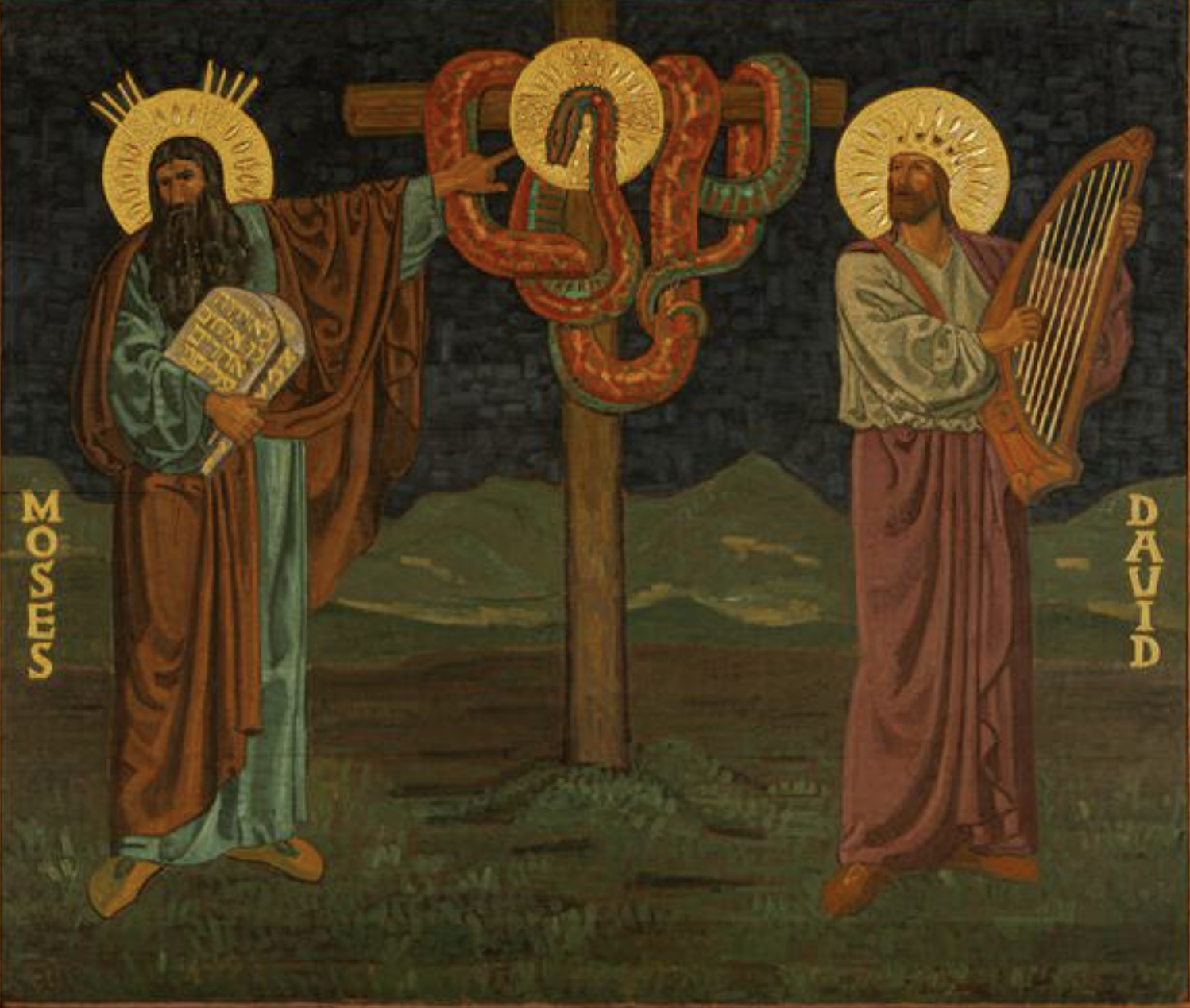
Jesus' refers to the story of Moses told in the Book of Numbers (21:4-9)
of the saving power of the
proto-cross,
which Moses held high aloft
—
a cross whose cross-bar was a a bronze statue of a serpent.
Or
we might way a bronze snake
fixed upon a pole
(one of the meanings of the Greek staurós).
In a prophecy of His own Life-giving Cross,
Jesus tells of the power of Moses' cross to heal and to protect.
For God had punished the Israelites who had been murmuring
against Moses.
And caused asps to be present in that wilderness.
And they bit the Israelites.
And many were dying.
But held aloft his bronze serpent cross,
which healed them and protected then against future snake bites.
Notice that this clear prefiguring of the Cross of Christ
(Jesus Himself makes this connection)
has
nothing whatever to do with the rite of blood sacrifice.
The bronze serpent is singular
while
bulls and goats and doves were so
common as be synonymous with blood sacrifice.
There's no mention anywhere of sacrifice of a snake.
Now here is Moses, the offerer of sacrifice par excellence
lifting up this cross in a way contradistinct from sacrifice.
That is,
this cross
(and by extension the cross of Jesus)
does not mean sacrifice.
What does this cross mean then?
It means life signified by its healing and warding properties.
And it means Divine Wisdom signified by the serpent.
The serpent traditionally signified Divine wisdom.
He is
the master of hidden knowledge dwelling in the secret places.
Remember that Jesus sends His Apostles out to be "wise as serpents" (Mt 10:16) ....
the "wisdom of the serpent."
And the Rod of Asclepius
was known in the first century.
You may recall some of my
reflections on the Aesclepion.
You know,
the rod with the serpent entwined on it,
worn on the lapels of nurses and doctors,
conveying wisdom associated with healing.
To continue to see Jesus' cross
as a kind of Jewish altar where blood sacrifice was
offered
is perverse in the extreme.
But back to the main thread.
Do you view the Life-giving Cross
to be the ultimate insult to the ruler of this world?
(like unto spitting on his name at your baptism)?
The demons affirm that it is.
Do you embrace it as a sign that you are above and beyond
the dog-think world?
Do you prefer to suffer in solidarity with most women and men
on earth
rather than seek
pleasures in a bubble of selfishness and egoism?
Do you view the Cross as the Gate to Paradise (Lu 23:43)?
If these things are so,
then
you are a Christian.
Anything other than this is not Christianity.
We embrace the Cross and offer a prayer:
May my materialist life be crucified.
May my every thought which is not on Thee, my Lord, God, and Savior, be crucified.
May this be the holy and venerated site of the crucifixion of the old woman or old man
(which I can barely stand to recollect).
|
Read the Gospels and believe!
And while you're at it, re-read the vows you
made to God
on the day of your baptism
—
holy, lasting vows.
In the Name of the Father and of the Son and of the Holy Spirit.