Luke 24:1-12 (Matins)
Romans 13:11-14;4
Matthew 6:14-21
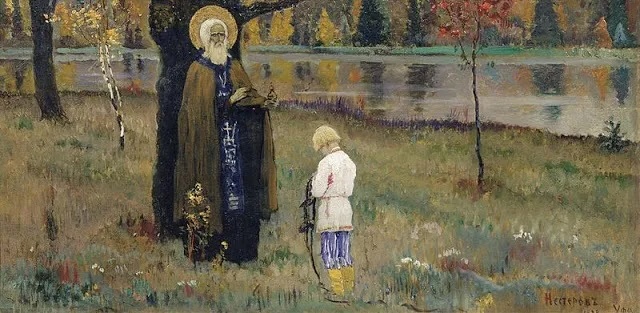
My earliest recollection of that distinctive wisdom which is unmistakably Orthodox is this brief sentence: Beyond prayer lies only madness. No doubt, I paraphrase after it lying about in my faulty memory for so long. But this is the essence: All that lies beyond the safe pastures of prayer is madness. I do not know the exact provenance. I read it as an epigram to a book bearing the attribution, "An Orthodox Monk." I do not know from which tradition it proceeds, but I would say it must be Russian Orthodox with its terse statement and trenchant meaning.
Do you know this life of madness? Have you, at times, strayed beyond the goodly bounds of prayer and wandered into the world? I do not mean praying the Hours though surely this is a royal instance of the prayer life. I mean ending the conversation with God, the regular practice of God's presence, which marks the beginning of a soul's death.
The world surely is mad. It will creep into your life and soul with deadly inevitability. One attempt to capture this madness in literature is Fyodor Dostoevsky's The Brothers Karamazov. Getting to know these brothers and their father is a deeply unsettling experience. Theirs is the fever of the world from which there is no escape. Their passions lie deep within every human, always tending toward madness, which surely will lead to further madness and disease and destruction. The only sanctuary from these velocities of chaos in world, within the scope of this masterpiece, is the Optina Monastery, where Abba Zosima carries on the life of prayer and penitence.
In the West "life of penitence" may sound odd. Surely, this elder has long since made his general confession .... perhaps a half-century ago or more, when he offered himself as an aspirant, postulant, and novice in a monastery. His sins since must now be only small fractures in the way of perfection.
But, you see, he is in it. We are all in it. The madness that howls in the night beyond the monastery walls is our madness. And the pain of madmen is ours to feel and to grieve. At a turning-point, storms of passions collide in the monastery waiting room. Unexpectedly, Abba Zosima prostrates himself before a raging, old man, possessed by demons of every sort, and his son, who is helpless to escape his father's madness. The elder will later relate that his own monastic vocation traces back to murderous passions. And all his life as a confessor, he has been asked to hold the murderous passions of others. Zosima looks upon the son with compassion and pain and sees that the poisonous atmosphere which the young man breathes in has arisen from the elder's own excesses and everyone's.
Are we not all madmen? Perhaps we have not all committed murder, whether in our hearts or actions. But have we not permitted our passions to hurt others and deeply hurt them? Have we not drunk of the world's poisons of our own free will and therefore have participated in a kind of communion with evil? Have we not chosen for ourselves, pushing others away (or beneath us)? Have we not used people to satisfy our own ambitions or longings? Have we not lived in such a way that deprives others of a home or of food to eat? Remember, the money supply is finite. Every dollar I keep is a dollar you cannot have.
Forgive me. For in my mad pain, I have hurt many, many people. And in my thoughtless egoism, I have hurt many, many people. And in my choice for myself, I have hurt many, many people.
O Lord Jesus, Only-begotten Son of God, have mercy on me a sinner.
In the Name of the Father and of the Son and of the Holy Spirit.