In the Name of the Father and of the Son and of the Holy Spirit.
First, let us ask, "Why does St. Matthew's narration of the Nativity begin with a genealogy?" We might conjecture that the occasion of Jesus' Birth calls for a reading of His lineage. You know what that is: royal trumpets blare, and then a little man in splendid vestments reads the royal line .... about great king so-and-so and great king such-and-such. but Matthew does not do that. He knows very well that the genealogy in his Gospel is not complete.
We will pass over the problem that Jesus' ancestors are not so great. First, there is Judah, who had a taste for prostitutes and then falls into having relations with his daughter-in-law. Of course, there is King David the Adulterer-Murderer, from which King Solomon's birth arises. The line also proceeds through Rahab, who is not an Israelite and by profession is a prostitute. And the story of Ruth, King David's great-grandmother, albeit written in coded language, was not the sort of thing you could talk about at family gatherings. What sort of lineage is this anyway?
And this record, such as it is, is not correct. Levi-Matthew surely would have known this. Certainly, the source materials are available to him — the Books of the Chronicles, the Books of the Kings. What is more, he had been a high Roman official responsible for what? .... the completeness and correctness of very important imperial documents, which are the tax rolls. Perhaps nothing, the scope of the Province of Judah, was more important to Rome than these documents.
But Matthew's eyes were not on historical exactitude. They were on a higher Truth, on a sacred symmetry. We know that seven is the number of perfection. Elsewhere in this same Gospel, Jesus will use this number to point to an impossibly high standard (18:21). Here, "two times seven" suggests elevated perfection: fourteen generations from David to the Babylonian Exile; fourteen generations from the Exile to the Birth of Jesus.
Do you see, he departs from one kind of seeing — his former "seeing" — and commits himself to another kind of seeing. And we discern these two kinds of seeing are deeply etched upon his character. They are seen in his two-fold name Levi, the publican, and Matthew, the Disciple, for example. Actually, it its more complicated than that. For he descended down through an ancient priestly line, yet he had put his religious life behind him and made a bid for "upward mobility" in Roman society, becoming a member of the Societas Publicanorum of the Equestrian class (just below the Senatorial class). Now, let's be clear: this was not simply a case of "going along to get along." This was a profound alteration of life, involving not merely a change in beliefs and values (which is a considerable change), but a pulling-out-all-the-stops, life-consuming pursuit of high position in the Roman world.
Now, this would not have been unusual for his time. I'm afraid the Hollywood movies have fallen down on the job of depicting first-century Jerusalem. They have left out all the Jewish boys who tried their best to look Roman and act Roman. Jerusalem had been Hellenized for centuries, with Jewish sons trained in the Greek Paideia in gymnasiums, and some even sent to Rome (that impossibly high attainment) to finish their educations and to expand their social connections.
Yet, Levi-Matthew would walk away from this hard-won prestige and wealth. When he wrote the narrative of the rich, young ruler, perhaps he did so autobiographically. The version he wrote with his pen (a reed or quill) presents the negative case: the young ruler walks away, rejecting Jesus, which prompts the Master's comment that all such men that refuse God are doomed.
Yet, Matthew would write the positive version of this story with his life — accepting Jesus' demand for material poverty, taking up his cross, and following the Master. From then on, he would see the world through Jesus' eyes. When Jesus enjoins His followers to "render unto Caesar what is Caesar's and unto God what is God's" (Mt 22:21), He does not mean simply paying taxes (Levi-Matthew's specialty), but giving one's all. Compare Jesus' remarks about serving God or Mammon (Mt 6:24). It is not possible, Jesus says, to do both. Matthew knew the truth of these teachings to a certainty.
From then on, the kind of seeing would he adopt would be through Jesus' eyes. That is, he laid aside the kind of seeing to which worldly men are inured: seeing all things through the lens of ego, possessions, and social connections. That is, Levi-Matthews had a fundamental breakthrough: worldly seeing will lead you to all the wrong conclusions and finally will doom you. Jesus' kind of seeing will lead you to life. He alone is the life-giver.
Let us jump over the genealogy for a moment to the verses just after it. They have to do with the former of our two lenses, which is human reasoning:
| Then Joseph her husband, being a just man, and not wanting to make her a public example, was minded to put her away secretly. (20) |
But God's perspective will open our eyes to revelation, seeing face-to-face, with the human filters removed, no longer through a glass darkly. And this elevated view is also expressed in Matthew's narrative:
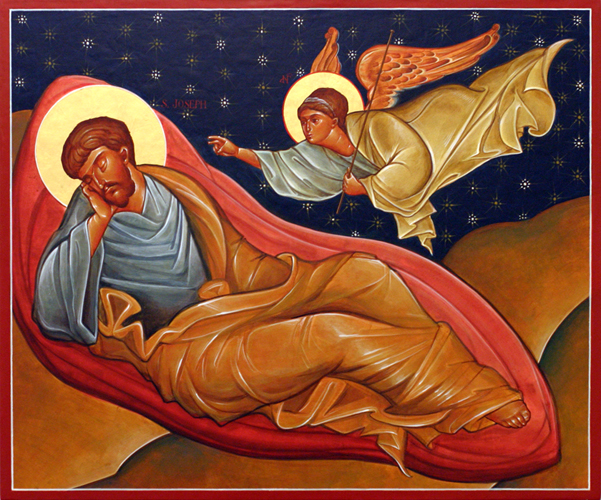
| .... behold, an angel of the Lord appeared to him in a dream, saying, "Joseph, son of David, do not be afraid to take to you Mary your wife, for that which is conceived in her is of the Holy Spirit. And she will bring forth a Son, and you shall call His name Jesus, for He will save His people from their sins." (21) |
As is the case with God, the angel communicates much more than Joseph is able "to process," we would say. but this is one the main points of the passage: God does not require our understanding, much less our consent. He requires our faith. And Joseph was faithful. Indeed, that has become his name: the faithful one.
Now, the Magi from the East represented a superior kind of human reasoning. They were renown for mastery of astronomy. They made their calculations and set out on their journey. Their plans were set. But the angel of the Lord intervenes:
|
Then, being divinely warned in a dream that they should not return
to Herod, they departed for their own country another way. (2:12) |
As has often been remarked about this sentence, this "other way" suggests more than just "an alternative route." It suggests another way of seeing and being.
Now, the Birth of God-with-us is the greatest release of cosmic energy in the history of the universe. It is no mere implosion of a star and creation of a black hole. That would be nothing compared to the Birth of God into the world. It is the Creator of the entire universe entering, for the first time, His Creation. The Early Fathers wrote that at this moment our whole world underwent a profound renovation following the wreckage of Eden. The télos of human life was flipped from a destiny of death to one of life (cf. Athanasius, De Incarnatione). The effects of Eden's curse were healed. Continuity between Heaven and earth was restored. (As we considered last week) a marriage between Heaven and earth was plannned. But did anyone see it? Did anyone hear it? Here on this island, if there is an earthquake even fifty miles away, the house rolls and rumbles. The greatest release of cosmic energy in the history of the universe, but did anyone detect it.
But the One Who would guide us, who proclaimed Metanoeite! (which we might translate as "Transform your way of seeing!") would raise us up and dust us off and enable us to see God.
When the Magi venerated Him laying down their material gifts, we have a precise reversal of the Christmas of Santa, the "giver-of-all-for-all." That is, we too must lay down our all for Him.
The angel in Matthew's Gospel does not say that Jesus will save us from want as Santa might. The angel does not say that Jesus will save us from oppression as might be expected in a post-Maccabean Jewish culture. The angel says that "He will save His people from sin" (its not a plural noun in the original Greek but a singular noun) which is quite different from any material or corporeal gift we can imagine. That is, He will give us new eyes and a new way of seeing. He will save us, that is, from ourselves .... as Matthew discloses in his narrative of the rich, young ruler.
Jesus will frequently deploy the formula, "He who has eyes to see let him see." And it is a fact that Jesus will heal blindness more often than any other infirmity. In that sense, what the angel communicates to the unknowing Joseph is that Jesus will save us from our blindness. In this we might aspire to see ourselves as God sees us. This is captured in the Greek word hamart&iacutre;on, translated "sin" (Mt 1:21), which means "to miss the mark." And what is the mark? It is what God intends for us to see.
We have come to call the Birth of Jesus "the Christmas Miracle" (the original Christmas Miracle) denoting impossibility by the lights of our material world. But the miracle is that have not seen God, Who has always been all around us all our lives. My first bishop told me that he would not ordain a man until that man saw the world theologically, until he saw God everywhere and in each thing. For until then, the bishop said, all else is useless.
But let us turn to our Gospel reading this morning. The genealogy provided by Matthew is generally faithful to the historical facts, but it does not let factual precision in what is, after all, a messy world interfere with the truth either. For example, three consecutive kings of Judah are omitted and another one later in the genealogy. For Matthew's concern is the symmetry:
|
.... from Abraham to David are fourteen generations, from David until the
captivity in Babylon are fourteen generations, and from the captivity in Babylon until the Christ are fourteen generations. (17) |
The organizing center is Babylon. All the rest revolves around the Babylonian Exile:
|
.... from David until the captivity in Babylon are fourteen generations,
and from the captivity in Babylon until the Christ are fourteen generations. |
We recall that Ezra also saw the Exile as Judah's defining moment. And in a sense it was, for Judah-ism was invented there. As Levi-Matthew well knew, in the century-and-a-half preceding Jesus birth, this new religion, with its utter loss of relationship with God, had predominated the Hebrew thought-world. And now it had rendered God's people nearly lost to Him. Spiritually speaking, they had become blind. Jesus was sent into the world for the "lost sheep" — a declaration found only in Matthew's Gospel. The whole Hebrew lifeworld has become blind and lost. Indeed, the Incarnation of God's Son tests this proposition: for God is right in their midst — "God with us" to use Matthew's formulation (23) — yet they cannot see Him.
And this is Matthew's word to us on Christmas. He had seen the Temple religion through the eyes of his culture, even as a man standing in the priestly line, but it did not speak to Him. He did not see God. He would say all the devout Jews cannot see God. He walked away from this world of the blind and never looked back/
But, then, on a day, He met God .... literally. He saw Jesus with his own eyes and knew Him to be the Son of God. Nothing would be the same after that. He would gladly divest himself of his former glory, following Jesus Who emptied Himself in order to be born to us. Matthew's whole way of seeing and being would be forever transformed .... as His Holy Gospel attests.
As was formerly the case with Levi-Matthew, we as a culture cannot see God. The lens of materialism will not admit of Divine light. It detects only matter. Anything else, we say, is a fairy tale. Yet, on the Nativity of His Most Holy Birth, let our souls declare that we do see God. He is no distant King as first-century Judah-ism averred. He is a no strange god before whom terrified goats are slaughtered. He is Life and the Author of Life. He is God with us. And His teachings could not be more plain: we need to get out of our own way; we need to clear the clutter of our egos; we need to see ourselves and each other as God sees each one. And one more thing — we need to love Him as He loves us.
He gives us these few precepts to guide us on our way. Seek not to be first, but rather last. Seek not to lord over others, but be a servant. Burn down the world of your possessions and self-exaltation, and He said, "Learn from Me, for I am gentle and lowly in heart, and you will find rest for your souls" (11:29).
Soon He will lie in the chill of a dark night,
surrounded by outcasts,
emptied of all power and prerogative,
but
beloved by God.
He bids that we lay down our burdens and our strivings
and
our passions
and
follow Him
so that we too,
and
everyone,
might become the beloved of God.
This is His gift on a silent, cold night.
Come to Him.
And let us be friends of God.
In the Name of the Father and of the Son and of the Holy Spirit.