John 20:1-10 (Matins)
Colossians 3:4-11
Luke 14:16-24
The Acceptable Time
"For I say to you that none of those men who were invited shall taste my supper"
(Lu 14:24)
.sp
In the Name of the Father and of the Son and of the Holy Spirit.
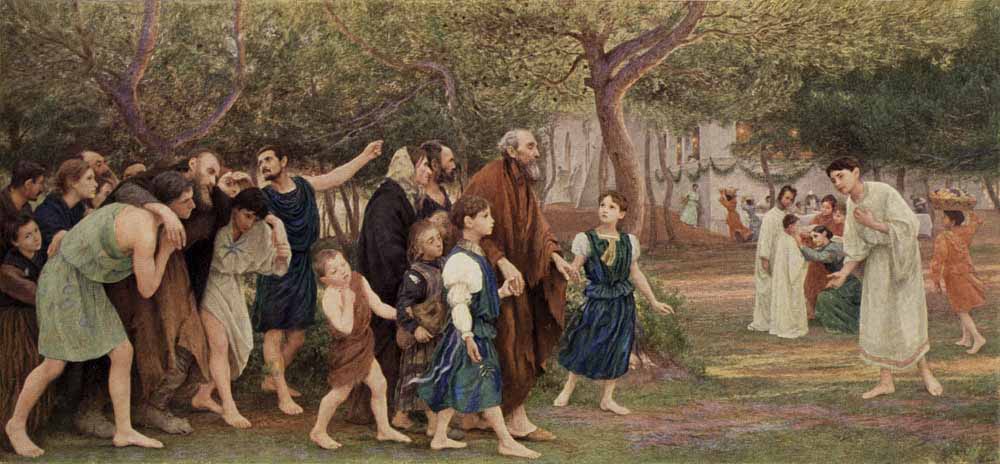
A certain Man has "prepared a Table before us,"
recalling a most familiar and comforting Psalm.
I say, "before us" because no matter how many people He
invites, "still there is more room" (22).
And it is His overpowering will that His "House be filled" (23).
Indeed,
He
"compels" (23) His guests to come.
We might say,
He makes me to lie down in green pastures.
Manifestly,
He obliges all humanity to come to His Feast.
For these intentions are clear,
even insistent:
He is determined that His "House may be filled" (24).
Let us pause to observe that this
aspect of the story
is what
the parable is mainly about,
for most of its verses are preoccupied with an ever-expanding guest list.
We are impressed with the size of such a mansion.
No one can calculate its breadth and depth,
for it is a house that might easily accommodate the whole human lifeworld.
He must have
countless servants
to
receive so many guests
(not to say those additional servants who must go out in order to herd them all in).
And
His many kitchens are such that they are able to furnish food for all the tables.
Who has ever heard of such magnificent hospitality?
More to the point,
who dares to
slight so great a Man as this?
Yet, His invited guests say that other demands must come first:
|
But they all with one accord began to make excuses.
(18)
|
What demands are these that could possibly take precedence
over so great a feast and so great a man?
They are these:
"I have bought a piece of ground" (18),
"I have bought five yoke of oxen" (19),
"I have married a wife" (21).
Surely,
"excuses" is the right word,
for these all are quotidian, pedestrian, and certainly inadequate.
St. Luke has carefully framed his parable of the Great Supper.
It is preceded by Jesus' advice for how to conduct yourself at a feast
(Lu 14:7-14).
And it is followed by His plenary dismissal of any and all excuses
(Lu 14:25-33).
"Have you married a wife?"
He asks.
I say unto you, "If you put a wife or your mother and father or your children
before Me,
you are not worthy to become my disciple."
As I say, this is the first next passage we come to in St. Luke's Gospel.
And a great revelation comes crashing in:
this "certain Man" is no ordinary man,
no ordinary king (as He appears in St. Matthew Gospel).
This is none other than God-in-our-midst!
This is God Who has issued an invitation to His supper!
And there might be none Who durst ignore Him!
Clearly,
urgency is implied by the invitation.
For a feast of this scale must have been under preparation for weeks.
And when it is ready,
it is ready.
Time is fleeting.
He announces:
|
"Come, for all things are now ready."
(Lu 14:18)
|
Now,
This is God's Kairos,
His Acceptable Time.
Like the rich farmer who was planning new barns,
God's time has overtaken us,
and
it might not be resisted.
We have received the most important summons of our lives,
yet we drift
as if in a trance.
We become absorbed in an illusion:
the illusion that the world around us is the "real thing"
and
that God is only a distant possibility.
After all, isn't this the mindset of the Sadducees and of the Sanhedrin?
Most of them are "this-world" oriented,
even mocking those who believe in angels and any talk of a "Kingdom of God."
Meantime,
the truth is that God and His Kingdom constitute the only reality.
The so-called substantial world before us is patently and demonstrably an illusion.
We cannot even be sure we agree on the same picture
when we look out on so-called "reality."
A long time ago,
a philospher posed the color problem.
We cannot be sure that when we see a blue sky that
the color Sr. Marty sees is not what I would call yellow
and
the color Sr. Mary Anne sees is not red.
It could be a case of constant coincidence.
There is certainly a great filter inside each of us known as perception,
which certainly mediates and alters the data
collected by
our five senses.
The Scottish philosopher Thomas Reid in the eighteenth-century commented
that, for example, we claim to "see" right angles,
yet in point of fact,
a right angle cannot be scribed upon an orb which is the shape of our eye.
Some kind of mathematical transform must be taking place.
We inescapably must interpret data that is reported by our sense and then propose a picture.
As William Wordsworth, being mindful of Reid,
wrote in 1798,
.... of all the mighty world
Of eye and ear, both what they half-create,
And what perceive; well pleased to recognize
In nature and the language of the sense ....
(Tintern Abbey, 106-109)
|
Wordsworth avers that we take cues from the phenomenal world
("the language of the sense")
and
participate in the ongoing creation of reality.
It is undoubtedly the case that each person's reality
differs from everyone else's.
We encounter this every day.
We three, who live in a monastery,
must make allowances for each other.
They certainly believe I see world differently.
And we take all this in stride.
Our so-called world is there ..... and it is not there.
I mentioned to Sister recently,
no matter how hard I try, I cannot convey my thoughts
clear enough in these reflections
that people understand them.
That clear picture is always beyond my reach to render.
(And of course I always lack the time I need to revise them.)
But setting aside the problem of human perception,
let us at least agree
that the world and ourselves are made of such stuff that will not last.
The ultimate illusion
—
that there is anything substantial and lasting called "Me"
—
is laughable.
Meantime,
to our great hazard,
we ignore the changeless, enduring, and eternal God,
Who has invited us into His substantial, stable, and lasting Kingdom.
As St. Paul says, we shall all be changed in a twinkling
and
be given a new (and incorruptible) "tent" in which to dwell.
But let us return to Luke's Gospel.
When we remind ourselves of the declared purpose
of the Incarnation,
which is
to gather the Lost Tribes of Israel,
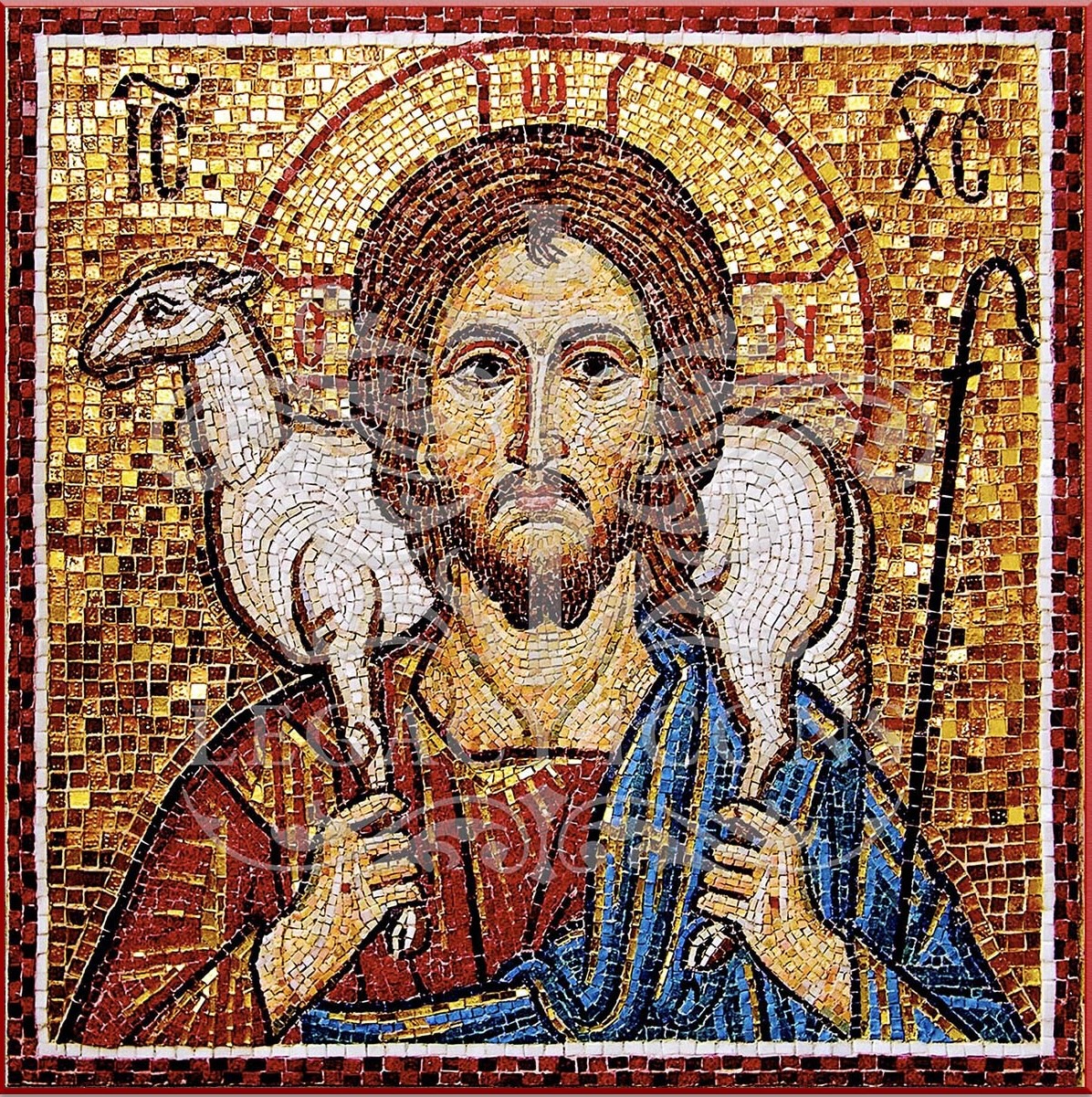
we realize that this supper if actually the great gathering of the flocks.
(Everybody is included.)
And this certain Man
turns out to be the Good Shepherd
overseeing all.
The formerly lost flocks are being gathered in to a place of warmth and welcome.
And there is room for all.
What is more,
God's plenty will supply each person's needs.
This week,
you see,
we have already come to Jesus' other sheep fold mentioned last week.
We suppose that the guest list must begin with Judah:
the Sanhedrin, Zion Temple dignitaries, the priests and Levites, the Sadducees and Pharisees.
And, certainly, these men would have expected the first invitations from God.
But how
shocked
they would be
to see people of low estate
invited to the banquet:
the poor, the blind, the lame,
and
beggars of every sort.
And here a second kind of disaffection from God comes to bear:
this time not a trance,
this time not drifting,
but
rather pridefulness which breathes deep of worldly exaltation.
The so-called upper-class will refuse any banquet
that includes the lower-classes.
To these disaffected few,
the upper-class,
Jesus does not ingratiate Himself,
will not
entreat them to come back.
In fact,
the Lord of the Feast of our parable takes no steps to "reach out,"
but quite the opposite:
|
"For I say to you that none of those men who were invited shall taste My supper."
(Lu 14:24)
|
Do you hear
the finality in these words.
We do well to take heed.
And we recall that elsewhere
to says to the so-called faithful,
|
" .... Lord, Lord, you call Me Lord. I say that I never knew you."
(Mt 7:21)
|
Now, these words none and never have a frosty sound.
They are bitter to hear especially when they issue from the lips of God.
One
now
hears
howling winds,
with no other soul in sight.
For this is essence of Hell:
alienation from God,
alienation from others,
and
alienation finally from ourselves.
Isn't this where the trance of the world and where pridefulness finally lead?
But we do not need to debate,
for we have an expert witness.
His name is Lucifer.
He has run the full course of Heaven and earth.
Indeed.
no one has covered this ground with the same
skill and thoroughness:
from illusion (that he might replace God) to pridefulness to alienation and on to bitterness.
He also has issued an invitation to every one ever born into the world.
It's constantly before us.
And there is no limit to his guest list either.
He is well able to accommodate everyone.
And to many this invitation is the "hot ticket,"
worth vying for.
The essence of an invitation is its demand for immediate attention.
To put it off is to slight, even to insult,
the One
Who sent it.
"All things are now ready!"
He says.
We must not delay!
His Feast continues to be freshly prepared for us even today.
And it is no less urgent two thousand years later.
I say, "freshly prepared today."
Who is this "certain Man" Who offers His magnificent Feast to all mankind?
Clearly, this event is impossible and therefore otherworldly.
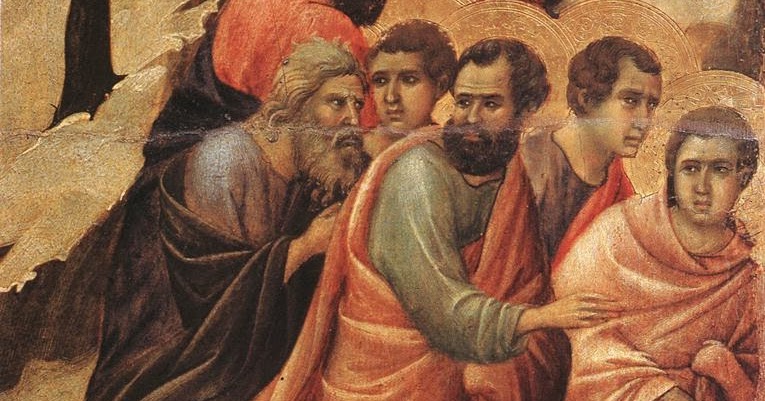
Yet, those closest to Him have rejected it and in doing so have rejected Him.
It began with Jesus inviting His followers to unite with Him (Jn 17:21)
which He made real in a ritual of offering of His Body and Blood (under appearance of bread and wine).
St. Luke's Gospel records this Divine invitation in the form of a parable
(the parable before us today).
But St. John prefers the starkness of historical narrative to relate the same event:
|
From that time many of His disciples went back and walked with Him no more.
(Jn 6:66)
|
By the twists and turns of God's so-called coincidences,
this chapter and verse in St. John's Gospel would turn out to be "666,"
the "number of the beast" (Rev 13:18).
For the Gospels would not be divided into chapters and verses
for another fifteen centuries.
St. Matthew elaborates:
the Great King offers His Son to the world as a Bridegroom effecting the Marriage of Heaven and earth.
Come to the Feast to receive Him,
your Bridegroom, all ye blessed dwellers on earth!
You see,
St. Matthew makes it more explicit.
How many abandoned the Son of God?
Were there thousands? .... or tens of thousands?
We cannot say.
We can say that this marked a great crossroads
in the all-important, and all-too brief, period
we call "the Advent of God."
The connection between this historical event
with our Gospel lesson
is obvious.
He continues to invite us to the Feast of His Body
and
Blood,
that we might be One with Him.
This is the secret meaning
of the Theotokos of the Sign.
For the Mother of God was the Sign
of this corporeal and actual Divine Unity.
She is the pinnacle and the essence
of what is meant by the Great Supper.
She and God's Son, for nine incommensurably holy months,
were One Body, One Blood, and One Beating Heart.
That
we,
in our lowliness,
might be invited into this most holy unity is too much to comprehend.
Let us bow our heads, then,
and say simply,
"Yes, Lord."
Upon receiving Him (really and truly we affirm),
let us say,
"Amen."
And, after this Mystery is completed,
let us continue to guard our words and so say only,
"Thank you."
In Greek we say,
"ευχαριστία
/
eucharistía."
For that is our one word for this transcendent rite,
sublime for its simplicity.
Eucharist.
Right this minute,
and minute-and-minute
during the twenty-four hour day,
and
every day,
every week,
every year,
during the past many centuries
this Feast is now ready.
at each and every tick of the clock.
There is a priest somewhere
who is elevating the Mysterious host.
At every tick of the clock
there are sacred ministers somewhere
serving the Mystery.
It is and has been ready somewhere on earth,
ever-holy
and
ever-present,
for two thousand years.
My brothers and sisters,
do not delay!
Come to the Feast of Heaven and earth
lest we offend the Founder of the Feast.
Come.
And let your words be few:
"Yes."
"Amen."
and
"Thank you."
In the Name of the Father and of the Son and of the Holy Spirit.