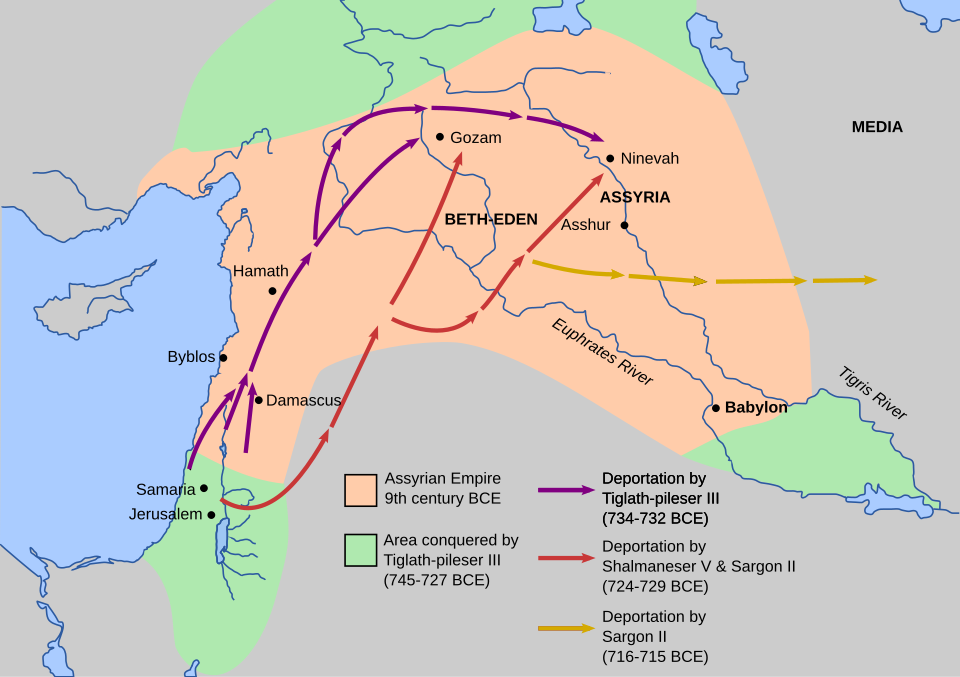
To explain this reversal of our expectations, we need to turn our attention away from the Northern Kingdom's venerable antiquity and focus on its later years.
Do you see the difference? The Northern Kingdom is named for an ideal — the Twelve Tribes of Israel, but the Southern Kingdom names itself after itself. It would as if you sisters founded a country and named it "To the Greater Glory of God," but I founed a country and name it "Stephen" (not even honoring the Church).
As preeminent archaeologist Israel Finklestein has written,
|
Although Israel was dominant for most of the time the kingdoms Israel and Judah coexisted,
it remained in Judah's shadow in both the Hebrew Bible and consequently in the attention of modern scholarship. (The Forgotten Kingdom, 2013) |
Israel is larger by far, more prosperous, more numerous in terms of population. Yet, it is treated in the Bible as little more than Judah's equal .... in fact, far less than that: its inferior. Why is that? Because the Judeans wrote the Bible.
The consensus view among biblical archaeologists is that both the stories of the Patriarchs and the stories of Moses were transmitted from the Northern Kingdom to the Southern Kingdom. And, of course, Jesus and the Twelve (with the exception of Judas Iscariot) were all from the Northern Kingdom, as were the Mother of God and her parents Joachim and Anna. With this storied lineage, where does the widespread Judahite disdain for Samaritans come from? After all, Shechem in Samaria is the capital of this revered kingdom. And why does Jesus say in our Gospel appointed for today,
|
"Were there not ten cleansed? But where are the nine? Were there not any found
who returned to give glory to God except this foreigner?" (Lu 17:16-18) |
The Greek word underlying "foreigner" here is αλλογενης / allogenes , literally "[someone from] other than this nation."
To explain this reversal of our expectations,
we need to turn our attention away from the Northern Kingdom's
venerable antiquity
and
focus on its later years.
In the latter eighth century, the Neo-Assyrian Empire utterly destroyed the Northern Kingdom, which was coterminous with the Ten Tribes of Israel (forever after called "the Ten Lost Tribes.) The Assyrians then undertook a resettlement program, deporting the Israelites to Nineveh and beyond and planting Assyrians (ethnic Mesopotamians) throughout the former kingdom giving them, of course, the upper-hand.
Those who were not deported collectively became known as "the Samaritans." To the Judahites, the Samaritans were at least doubtful, therefore, probably intermarried with Assyrians, and undoubtedly immoral. Consider the case, for example, of the Woman at at Well. She freely commits the sin of fornication and (it is implied) serial adultery. In any case, Samaritans lived on the edges of the Judahite society and its cult called Judah-ism.
You know the history here. Following the Assyrian dismemberment of the Northern Kingdom, only the Southern Kingdom remained comprising the tribes of Judah and Benjamin. Tragically, this last remnant of the Hebrew people, (one tribe and its much smaller sister) would a century-and-a-half later be conquered by the Babylonians, seeing the deportation of one-third of their elite class to Babylon. The return of these Judahite people decades later marked the birth of Judaism. In the words of Prof. Yehezkel Kaufmann of the Hebrew University in Jerusalem,
|
"The [Bablylonian] Exile is the watershed. With the Exile, the religion
of Israel comes to an end, and Judaism begins." |
The Southern Kingdom did not, however, endure a resettlement program. And two-thirds of the original population were not deported. It is in this quite diverse Hebrew thought-world, where Jesus taught and preached — Essenes and Pharisees and Sadducees and who knows what other groups were not mentioned in the Gospels.
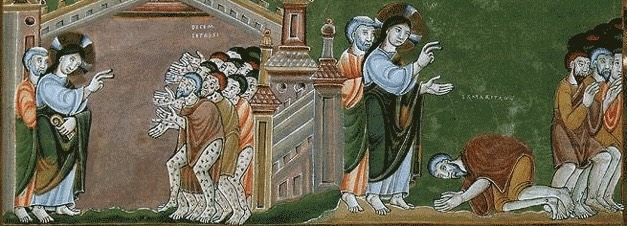
Our Gospel lesson this morning is set in the historical Northern Kingdom (We read that Jesus "passed through the midst of Samaria and Galilee"). There, He encounters ten lepers. (He repeats the word "ten" for emphasis.) Before we point out the obvious — that the setting for the narrative and the number ten inevitably refers to the Ten Lost Tribes — let us first review the first-century understanding of leprosy.
Above all, leprosy signified an outer disfigurement revealing an inner spiritual pollution in the first-century Judahite imagination. The victim was, by that fact, seen as permanently separated from God. Lepers were limited to group like themselves existing on the edges of society.
Included in the medical literature of classical antiquity, for example, we find this: leprosy may be treated by applying the blood of virgins or of children to the infected skin (Luke Demaitre, Leprosy in Premodern Medicine: A Malady of the Whole Body (Baltimore, MD: Johns Hopkins University Press, 2007), 268). Clearly, this was seen as a disease of the soul — that the patient had sunk into immorality to the point where you could smell it — which, of course, alienated God.
We in the modern period look upon this as superstition. But we read all Biblical passages understanding that they must read at the literal level and at the spiritual level.
We learn from the Early Church Fathers
that to understand any single passage,
we must look for similar scenes and words elsewhere in the Bible,
called "glossing Scripture with Scripture."
Consider this scene from the Book of Numbers:
Miriam and Aaron are talking behind
their brother Moses' back.
The Lord hears this and appears to them greatly provoked
for the sake of His love of Moses:
|
"I speak with him face to face,
Even plainly, and not in dark sayings; And he sees the form of the Lord. Why then were you not afraid To speak against My servant Moses?" So the anger of the Lord was aroused against them, and He departed. And when the cloud departed from above the tabernacle, suddenly Miriam became leprous. (Num 12:8-10) |
God does not point His finger with a lightning bolt proceeding from it. He departed. Then Miriam became leprous. This is reprised in our Gospel lesson. Jesus sees them. We understand that something has happened. But it is only when they depart, that they realize they are healed.
This moral conception of leprosy was confirmed by the disease's respiratory symptoms. Our modern word "respiratory" contains a kernel of the ancient belief that our breath (Gr. pneuma, L. spiritus) is a constant reminder of our Divine nature — we might say, "with every breath we take." You see, the reason we are animate and sentient and not a lumb of clay is that God breathed His life into us. How do we know this power to endow us with life is Divine? Because nothing and no one else can do it. This domain alone is God's.
We recall that God created the world with His breath:
| Then God said, "Let there be light." (Gen 1:3) |
And, of course, Jesus brings the Church into being by breathing on the Apostles:
|
And when He had said this, He breathed on them,
and said to them, "Receive the Holy Spirit." (Jn 20:22) |
.... in the Vulgate translation, Spiritus (or breath).
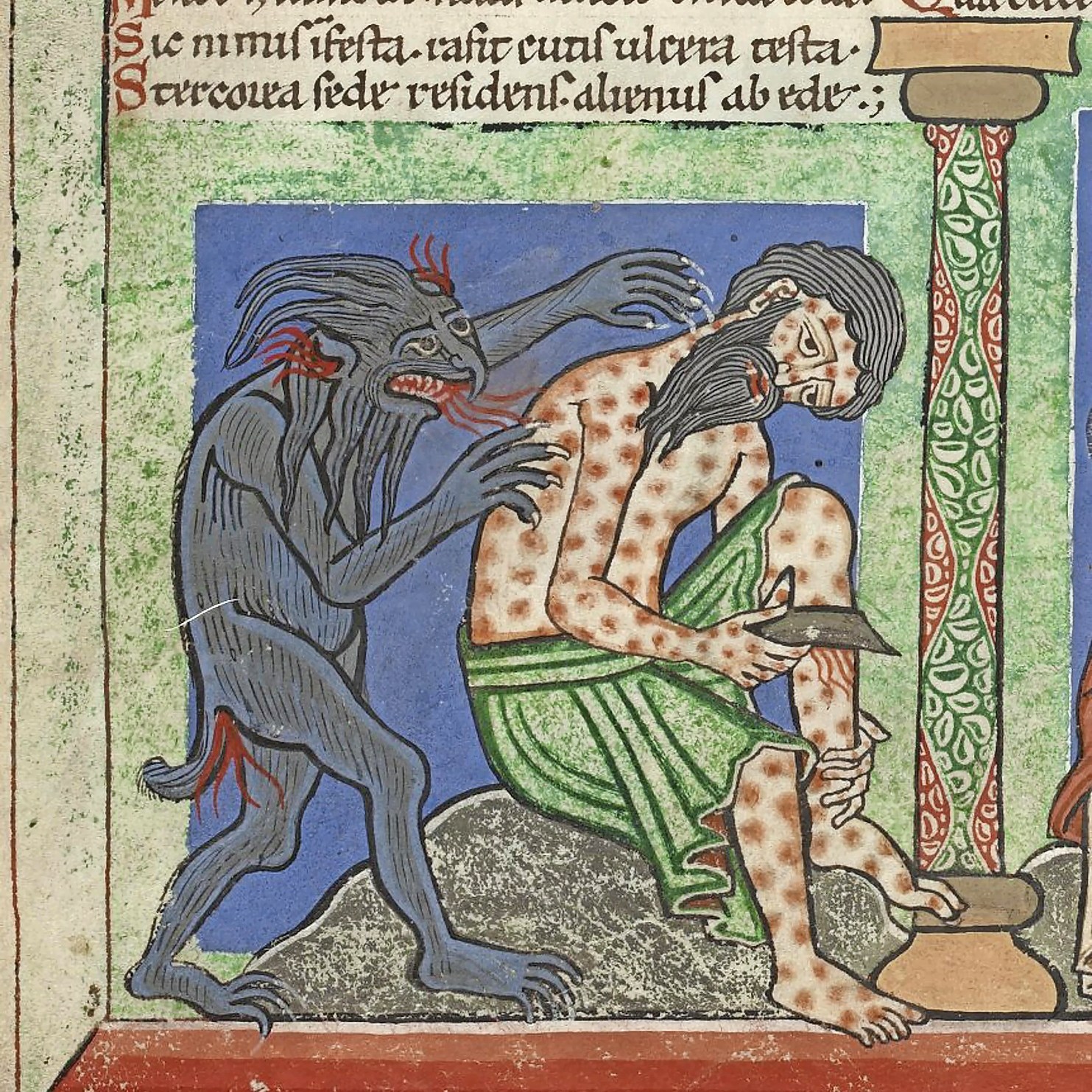
The breath of one suffering from leprosy had a putrid odor. Here is evidence that a spiritual death is taking place within them. Moreover, the gateway of the pneuma or spiritus, the nose, in a leper is rotting away. The conclusion was unmistakable to first-century diagnosticians: these men had let demons into their lives through immoral living. Anytime, we begin to live immorally, demons take up residence. We carve out a place for them by driving God out, and they instantly fill that void in our spirit. They opened an entrance point for demons, and now the demons had completely taken over — on the bottoms of their feet, under the hair of their scalps, everywhere.
Being healed, then, was not only restoration of one's former purity and innocence, it involved a second creation of their bodies, for their old body had mostly rotted away. And perhaps these lepers had heard that Jesus had created eyes for a man who was born without them (Jn 9:6-7). Jesus can make new life out of clay! If his eyes, why not our bodies?!
But let us return to the main thread.
|
.... ten men who were lepers ..... lifted up their voices and said,
"Jesus, Master, have mercy on us!" (Lu 17:12-13) |
When we consider that their ailment is incurable, we are struck by the offhanded way in which Jesus healed:
| And so it was that as they went, they were cleansed. (Lu 17:14) |
Certainly, He does not hold the circumstances of their local history against them ("what goes into a man"), but He does take issue with their behavior ("what proceeds out of a man," Mt 15:11). In particular, He objects to their striking passivity. It is almost as if they were trained to behave this way, for they all behaved exactly the same way (except the one). And they have. They have been trained in the Judahite cult: a sacrifice is offered for all; all receive its putatively healing and atoning effects; no one falls down and prostrates himself, and no one voices their thanks to God. Indeed, in this they have been trained since their youth.
This is the way with blood sacrifice religion: passivity. It were as if the Sisters were anxious about some terrible thing, and I said, "Don't worry. I sacrificed a goat. You're covered." And that's word: "covered." There is no intersection with the person. There is nothing personal about this. Passivity might be said to be the natural response, for the sacrifice has been offered for the many, not for you.
But one man does behave correctly. One does understand what God has done for him. And this man's heart and conduct are the main reasons for this passage, for he exemplifies the Kingdom-of-Heaven religion, which Jesus is revealing to the human lifeworld — the religion of personal encounter with God, of God's caring and love, and ultimately of intimate union with Him. What do I mean by intimacy? Well, there is scarcely anything in the imagination that could surpass becoming one with someone else — one bone, one blood one flesh, one shared heart. Isn't this the nature of love.
Many years ago, a girl told me that she had fallen in love with me. She loved me so much, she said, that she wanted to climb inside me and become one with me. What is that union called — and is our word for it. We call it marriage — "one bone, one flesh" .... what God hath joined together (Mt 19:5).
Have you heard of "the marriage of Heaven and earth"? This is why Jesus is presented to us as the Bridegroom. This is love! This is what the Mother of God experienced during her pregnancy literally: same flesh, same blood, save bone, one heart beating in unison.
Jesus cannot ignore the human history into which He has been born. Jesus is born at a certain time and place in history because the religion of God has almost been lost. The religion given to Abraham and the Patriarch is almost lost. (And certainly the Persian religion is not an acceptable substitute.)
This is the thought-world to which He must become intelligible. But petty issues of ethnicity or who descended from this man or that are manifestly of no consequence to Him. He has been sent to gather the Lost Sheep of the House of Israel, i.e., all of Jacob's children. That He famously will later reveal that He has sheep of another fold, or flock (Jn 10:16) is the subject for a future reflection. It is enough to say this morning that Jesus has come to gather God's own, all of us were born with the Image of our Father set upon us, because God loves His children. Jesus has come to reveal to the purpose of our lives, that the strivings of our lives mainly have to do with coming Home to Him.
We like to say that Christianity is about love. The Beloved Disciple tells us that "God is love" (1Jn 4:8). But are we alive to the One Who loves us best? His calls and texts come in every day. But will we take them?
Thinking back to our own youths, are we sitting by telephone table in the front hall waiting for it to ring because that special someone might call? Is He the first thing on our mind when we rise, and our last thought before drifting off to dreams? Do we give God first place in everything? To requite His great love for us .... this in only to make a start.
In this season when the "phone is about to ring"
announcing that Jesus has been born into the world,
do we stand with rapt attention,
are we filled with the glow of wonder,
are we moved to write Him a love letter ....
that what this spiritual season is for.
Advent.
He is coming.
And I can't wait!
In the Name of the Father and of the Son and of the Holy Spirit.
Amen.