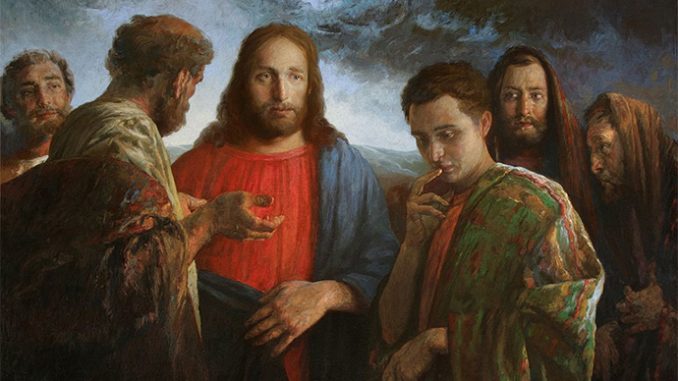
In our brief Gospel lesson, a young man steps forward before the Master. He is the ruler of a synagogue. He could be a Pharisee, but more likely, because of his rank and inherited wealth (he is young), we would say that he is a Sadducee. He asks the question of questions: "What must I do to inherit eternal life?"
The form of his query reflects his state of life. He has inherited all that he needs for this life. Now, he wants to know how he can inherit the next life. Jesus' answer is remarkable because it is an essence, a distillation of an entire lifetime searching for God.
It is divided into two sections. First, it rehearses the Ten Commandments establishing guardrails for living a well-regulated life over a span of decades. And then, in one sentence, The Master jumps to the present moment which points to eternity. For the Kingdom of God has drawn near to this searching young man. God's Now has descended. And this young man stands before His Maker and Judge.. What will he do? How will he choose? As the first-century Teachings of the Apostles say "Two ways there are, life and death" (Didache, 1). He stands at a crossroads .... at the Crossroads. Protesting that he always kept the Ten Commandments will avail him nothing now. Either he says "Yes" to God, or he says "No." There can be no retreat to half-way, "Later."
Our holy faith is intrinsically a Now kind of faith. What are the words announcing the arrival of the King of kings? They are these:
| "Turn around! You're going in the wrong direction! The Kingdom of Heaven is at hand!" (Mk 3:2. My translation.) |
What are the words that inaugurate Jesus three-year royal progress throughout the Levant? They are these:
| "Turn around! You're going in the wrong direction! The Kingdom of Heaven is at hand!" (Mk 1:15, Mt 3:2. My translation.) |
The single word around which the others orbit is the imperative verb Μετανοει̑τε! / Metanoeíte! St. Paul would say, "Be transformed in your mind!" In our parlance we might say, "Turn around and open your eyes! You'll never see God or His Kingdom from there!"
And what are the final words spoken by Jesus of Nazareth on earth? They are these (according to St. Luke):
| "This day you will be with me in Paradise." (Lu 23:43) |
The constant theme of God's teaching among us is that the Kingdom of Heaven, Paradise, the Bosom of Abraham has drawn near .... is here ....is now. Do you hear the urgency, the immediacy?
When you pray, says this:
| "Our Father .... Thy Kingdom come .... on earth as it is in Heaven." (Mt 6:9) |
And of His Father, He tells us that we are to be united with Him even as He is One with the Father (Jn 17:21). This is the goal of life: God and His Kingdom now. The Master keeps our eyes always fastened to this Now and decidedly not on a distant mountain or on ancient tablets carved from stone. For if the young man should turn his back on God, the Ten Commandments will not save him.
For us, too, the Kingdom of Heaven is not a later thing. It is not a next-world thing. It is breaking in all around us. It descended upon both the rich man and the beggar Lazarus in a twinkling. It appeared before the Prodigal Son virtually at the same time his heart broke and he sought his father's forgiveness. Its Divine light fell solemnly upon the proud Pharisee and penitent publican in a decisive moment showing one to be justified before God and the other convicted by his own word and heart. And it is this decisive Now, this "acceptable time," which has descended upon the rich, young ruler.
In general, Jesus' teachings do not include statutes and rules for some imagined future time, let's say of whole lifespans and generations, of life on earth. This has led many commentators to conclude that He taught His follows to expect His imminent Return. But He did not promise this. It is a fact that He did not leave any code of conduct for life on earth. In fact, He seems to wave off the code we have, which chiefly is the Ten Commandments:
|
but the things which come out of him, those are the things that defile a man" (Mk 7:15). |
And of course Jesus regularly does things on the Sabbath that infuriate the Pharisees.
But this is the point of the Sermon on the Mount (Mt 5): God's revelation of a new world and a new life here and now that supplants the Decalogue, taking all things to place far above the Ten Commandments. Of this world, Jesus takes little note saying "Render to Caesar the things that are Caesar's, and to God the things that are God's" (Mk 12:17) or "You cannot serve God and Mammon" (Mt 6:24). He represents these as discontinuous spaces: you cannot get There from here.
I must briefly share that phrases like "beyond the Ten Commandments" make me nervous. You see, my journey as a seminarian and priest began about thirty years ago in the Episcopal Church, whose bishops chronically preached on "going to a new place beyond the Ten Commandments." They did not mean beyond, though. They meant dispensing forbidden lifestyle permissions that would replace certain commandments (continuing an effort as old as Charles Darwin).
I gladly departed from that company for the Roman Communion and was assigned to a three-year tutorial under a very distinguished mentor: the retired Rector of the Pontifical North American College in Rome. A few years earlier, he had been selected with other foremost teachers to compile and compose a landmark of Roman Catholic teaching: The Catechism of the Catholic Church, 1992 (which reads more like spiritual writing than a nominal catechism). He told me that at one stage in this project his committee was obliged to send a draft of the book to every bishop of the Roman Catholic Church requesting possible modifications (called modi). These modi flooded in from all over the world with the majority demanding removal of the Ten Commandments from book. "Haven't we gone to a higher place?!" the bishops demanded.
This presented him and his colleagues with a dilemma. These, after all, were the "authentic teachers" of the Roman Catholic Church, the bishops. The crisis was resolved when an elderly man shuffled into the room where the committee met and placed the Gospel Book at the head of the table and began reading:
|
Now a certain ruler asked Him, saying, "Good Teacher, what shall I do to inherit eternal life?"
So Jesus said to him, .... "You know the commandments: 'Do not commit adultery,' 'Do not murder,' 'Do not steal,' 'Do not bear false witness,' 'Honor your father and your mother.'" (Lu 18:18-19) |
The elderly man observed that Jesus does not merely mention the Commandments as a category, but He singles out each one, articulating each, emphasizing each. The elderly man was the final authority in matters concerning the faith. He was the Prefect of the Congregation for the Doctrine of the Faith, Cardinal Joseph Ratzinger. He had spoken; the matter was settled.
Without question, the Ten Commandments represent the foundation of the faith — our starting point on the journey of theosis. But in the unforgettable words of St. Paul:
| For we have not here an abiding city, but we seek after the city which is to come. (Heb 13:14) |
And our Lord's word to Rome's imperial governor affirmed
| "My Kingdom is not of this world." (Jn 18:36) |
We might say that the Decalogue is not the goal of life, but it is necessary. Whether they were given by God or not is immaterial. They manifestly are endorsed by God. The Lord says,
|
"Do not think that I came to destroy the Law or the Prophets.
I did not come to destroy but to fulfill." (Mt 5:17) |
Clearly, a debate stands behind this statement, a debate which Jesus decisively ends with these words.
And remember that the Zion Temple authorities' charge against Christians, for which the proto-martyr Stephen will pay with his life, was
|
".... for we have heard him say that this Jesus of Nazareth will destroy
this place and change the customs which Moses delivered to us." (Acts 6:14) |
The followers of Jesus were from the historical Northern Kingdom. They were steeped in the religion of the Patriarchs. Yet, the Patriarchs never heard of Moses, never read the Book of Exodus, and had no idea what the Ten Commandments were. These things were all part of the cult of Judah. Not once in the Psalms of David do we hear the phrase, "the Law of Moses" or "the Torah" though we do read of "A Law of the God of Jacob" (Ps 80/81:4) and "the law of the Lord" (Ps 1:2).
A half-century of scholarship based on the Dead Sea Scrolls (discovered 1946-56) and associated archaeological and epigraphal work agree that the Torah was introduced into the Hebrew thought-world by the Persian governor Nehemiah and his reforming scribe Ezra and even then did not catch on across the Levant. Writes the preeminent scholar John J. Collins (Holmes Professor of the Old Testament Criticism and Interpretation at Yale), we see scarcely any mention of the Torah until the mid-second-century B.C. when the Maccabees seized upon it during a time of war as an instrument of unity. And from that moment we find it everywhere in the historical record.
The Book of Genesis most certainly was not written by Moses as everything in it predates him by unimaginable epochs. Clearly, Moses enters the story in the Book of Exodus. But the Genesis scroll was found in a cave in Qumran among the other Dead Sea Scrolls as a separate and individual scroll.
Where does that leave us in practical terms? Let us go back to Jesus's Sermon on the Mount, where He addresses the Law of Moses head-on. First, He allays fears concerning His putative dismissal of Moses:
|
"Whoever therefore breaks one of the least of these commandments, and teaches men so,
shall be called least in the Kingdom of Heaven; but whoever does and teaches them, he shall be called great in the Kingdom of Heaven. For I say to you, that unless your righteousness exceeds the righteousness of the scribes and Pharisees, you will by no means enter the Kingdom of Heaven." (Mt 5:19-20) |
Then He proceeds from the Commandments on an ascent:
|
"You have heard that it was said to those of old, 'You shall not murder, and whoever
murders will be in danger of the judgment.' But I say to you that whoever is angry with his brother without a cause shall be in danger of the judgment. And whoever says to his brother, 'Raca!' shall be in danger of the council. (Mt 5:21-22) |
You know the rest. Jesus places an incommensurable distance between the Commandments and conduct of life in the Kingdom of Heaven: the standard of murder is elevated to a standard of unkindness; the standard of adultery is elevated to a standard of "straying eyes"; the concession of divorce is elevated to no concession (except for the cause of sexual immorality).
Jesus will steadfastly refuse to be drawn into the Moses debate. Why should He. It is enough to say that the Ten Commandments are necessary for salvation. Unless you keep them faithfully, you are irretrievably be lost. But they will not of themselves open the gates of Heaven to you. If we tell ourselves, "I am basically a good person, and I have kept the Commandments all my life," this Gospel lesson is for you.
And to the rich, young ruler He, similarly, poses this same incommensurable distance:
|
He said to him, "You still lack one thing. Sell all that you have and distribute to
the poor, and you will have treasure in Heaven; and come, follow Me." (Lu 18:22) |
To many today, the sentence "You still lack one thing" signifies a possible new addition to their many possessions. They look over the inventory of their property and say, "Hmmm. Let's see. What's missing." But Christianity is not about addition. Christianity is about subtraction. It is not about having. It is about doing. And the central doing in Christian life is theosis, the business of making one's life holy:
| "For I am the Lord .... your God: ye shall therefore be holy, for I am holy." (Lev 11:45) |
And holy life begins by emptying ourselves. The definition of salvation / sotería, after all, is clearing the clutter. And this cross we must take up — "Take up your cross and follow Me." — is the instrument upon which our former lives (Eph 4:22) must be crucified. And above we hold aloft this banner: We follow God, Who emptied Himself of all — a Sovereignty and Heavenly glory more expansive than the cosmos — in order to dwell with us, performing the most profound subtraction in the history of Heaven and earth.
The faith.
It is now.
It is here.
It is ours to have .... or not.
But one thing our Lord and God makes clear:
it is not for later.
In the Name of the Father and of the Son and of the Holy Spirit.
Amen.