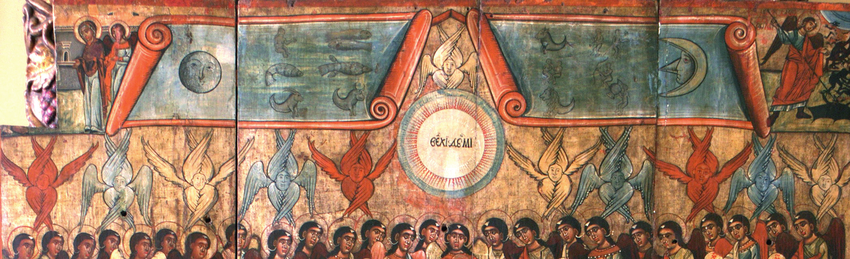
We read in the Book of Revelation,
|
Then the sky receded as a scroll when it is rolled up,
and every mountain and island was moved out of its place. (Rev 6:14) |
Here is the sublime! Is this not an elemental intermingling of things which God has ordained to be inseparable: the Word and the Creation? He has established this Periodic Table of Two as surely as He has revealed His-Son-Who-Is-Himself as the Logos and then called the Creation into order according to His Word.
His Word on earth
|
is living and powerful, and sharper than any two-edged sword,
piercing even to the division of soul and spirit, and of joints and marrow, and is a discerner of the thoughts and intents of the heart. (Heb 4:12) |
Who would dare to approach it? Who durst pick it up? But we must, for putting it down or, worse, ignoring it is far more hazardous.
How do we read these words, which mysteriously is the Book of Life? We approach them with reverence, with a heart full of Divine love, and respectfully heeding the guidance of the Fathers. Let us go back to the Early Fathers and learn of them. Then shall we offer the sacrifices of righteousness and oblations and wholeness of life.
Let us begin this morning by going back to the basics by asking first-order questions. How do we understand what we read? Certainly, unwritten rules are present with each written thing. A cookbook, for example, is divided into "chapters" called recipes. And within these divisions are found lists of ingredients and procedures for managing the . We would get lost seeking a plot or characters or a setting ..... well, perhaps a setting such as "Recipes of the Old South." But the writer of the cookbook and her readers get along just fine because they understand the rules.
The Boy Scout Manual is unlike a cookbook. It is another kind of book. And if you open it without grasping the rules, you will not understand its purposes. It sets out the scope of approved activities and then provides general guidelines. It is not procedural, nor can it be read for deeper spiritual meanings. But its signals are clear to those who follow the rules.
Books concerning human events — for example, histories and biographies — are usually written chronologically, but there are variations. They never settle into the simplicity, we might say the stability, of a cookbook or a manual. For the complexity of the human person immediately bursts these inadequate boundaries. And, mysteriously, they can never be truly complete because readers will always dispute any one perspective. This in itself has meaning. Biographies of the same subject are written over and over again decade after decade, are they not? Histories too are completely rewritten from scratch. Ken Burns recently offered an entirely new take on the American Revolution. But haven't histories of the American Revolution already been written? Mysteriously, each attempt is deemed inadequate. And even now Burns' work is shown to fall short. No single writer manages to get it fully right. This in itself has meaning: our ability to complete a Boy Scout Manual and our utter inadequacy in completing stories of human has meaning.
The truth of this is undeniable. And, here, I think of the Cappadocian Father, St. Gregory of Nyssa, who observed that the human person is an Image of God. And because God is inscrutable, unknowable, and indescribable, humans, finally, are too. As a practical matter, I look around, and I see millions of people who pay therapists considerable sums to tell them who they really are.
I have shared many times that identity is the central human dilemma — which is particularly relevant at the present time, when so many young people do not know even what gender they are. The Christian would say, echoing the Fathers, that our only stable identity is our Savior Jesus Christ. He alone knows the Way and the Truth and the Life ..... these three are all about identity aren't they? It is He and He alone Whom we must follow. All other paths will lead not to coherency and understanding, but to chaos.
Now we have considered cookbooks, manual, and biographies. But let us make the jump to the Holy Bible, which derives from the Greek word βιβλια / Biblia meaning books. It is a long, long jump. For not only do these Books relate human events and biographies, but mysteriously they are God's primary instrument of Self-revelation, together with the Logos, which also points back to language.
On reflection, we might say that He might have selected some other medium for this purpose. The ancients, for example, held that music played on strings had a Divine dimension. Or He might have given us a very large collection of icons. After all, St. Luke wrote the first Christian icon, which depicted the Most Holy Theotokos. This became known as the Portaitissa, the Gate-keeper, "the Way in." And it depicted the Hodegetria, "the One Who points the Way," rendering the Child Jesus on her lap, Who points the Way. It is a fact that two copies of this very icon, one made in the twentieth century and one made in the twenty-first, have streamed Holy Myrrh — violating the Laws of Physics, being true instances of Divine Grace and Presence in our midst. As I say, God did have to choose words as His special medium.
But He did choose Words. He chose The Word as a manifestation of His Son, Who mysteriously is Himself. And He chose words to express His Will for the conduct of human life. He chose Words as an endlessly deep ocean of meanings through which we might have Union with Him.
I say endless. For each time I read a passage in the Gospels, I see something new. I've been reading them all my life. And here in my mid-seventies, I continue to see something important which I never saw before.
This is His declared purpose: that we should read and understand.
|
"But blessed are your eyes for they see, and your ears for they hear;
for assuredly, I say to you that many prophets and righteous men desired to see what you see, and did not see it, and to hear what you hear, and did not hear it. "Therefore hear the parable ...." (Mt 13:16-18) |
As I have shared on many Sundays, St. Luke continued to render icons, though in words in his sacred masterpiece, the diptych, Luke-Acts.
We have commented that God's masterpiece, the human person, always manages to elude description, that it cannot be adequately described in one dimension through one lens, say in a single biography. How much more does this principle apply when the subject is the God-man? The Bible offers four biographies of our Lord and God and Savior Jesus Christ, no two of which are alike in all respects. Commentators have tried to encompass these Four incommensurably holy Books, but this too cannot be done, for the subject always eludes them. They are engaged in an endless task that has gone on so far for two thousand years .... and counting. These men and women have composed essays, a word which means "to try." I too have humbly offered thousands of such essays. I have tried. But the essayists never quite get it right. In fact, no analytical expedition has ever managed to ascend above the clouds to the summit of this "Everest." Yet, we are obliged to try, for God has seen fit to place the Logos and logoi before us as a means to knowing Him.
What is this Path we somehow must embark on, yet never adequately advance on?
And then there is the Book of Genesis. To what shall we compare this inscrutable book? It is not philosophy as it precedes the first Greek philosophers. It is not history as it precedes Herodotus. It is not politics as it precedes Thucydides. It is not science though the physicist and Nobel laureate Arno Penzias described its opening verses as "a precise though poetic description of the Big Bang Theory." Astonishing!
I call Genesis incommensurably holy and venture no words beyond these. Who wrote Genesis? We call it one of the Books of Moses, but, certainly Moses did not write Genesis. For Moses was not present at the dawn of time, before all ages.
Scholars have argued whether these books are works of fiction or non-fiction greatly underestimating them. For they are both, ..... and more. From the time of St. Paul and the Alexandrian Jew Apollos, interpreters of Scripture have recognized that this sacred literature both depicts real people and events that existed historically and they have a transcendent, spiritual meaning, which we call allegory, which means "other than what is spoken in the agora or marketplace." "Other speaking" refers to the cares we take to protect the Divine things from being trampled upon, from being soiled. These words must be hidden, spoken in secret, as we just heard the Master say a few moments ago — so that they are protected from the callous, the reckless, and the willful, those who have eyes but do not see and ears but do not hear.
Origen, who is called the Father of Biblical Interpretation (b. 185), posits a two-fold reading of the Bible: the literal (or historical) and the allegorical (or spiritual). Thus, God's people really lived among Egypt's fleshpots; really were liberated, making a mass exodus; really walked through the Red Sea; really spent forty years in the desert; and really entered the Land of Divine Promise. At the same time, it is equally true that they were enslaved in sin; freed from those fleshly bonds; were baptized in the sea; were purified in the wilderness through prayer and fasting; and they entered into One-ness with God, which is His desire for mankind. Thus, we say that this Bible story is historically true, and it is spiritually true. It is both non-fiction and something far above quotidian life.
Origen comments that at all times the primary level of meaning is the spiritual level. He also describes a third level, called the moral (or tropological) level — which is to say, "the moral of the story."
Thus, the Parable of the Prodigal Son depicts spiritual transformation such that we recognize ourselves. First there is the adolescent who is rash and sensually indulgent. We progress to becoming the older son, whose life is well-regulated but who is intolerant and accusatory. Finally, we arrive to becoming the patient, wise, and loving father. Here is a brief example allegory. And this parable contains a moral: one should respect his elders and heed their advice.
We are left with Origen's famous three-fold interpretation of the Bible, whose books are literally true, allegorically true, and which usually have a moral. And we obey the dictum: we must not fail to bring this three-fold awareness to bear whenever we open the Bible.
About a century-and-a-half later, Cyril of Jerusalem substantially developed a fourth level of interpretation: the eschatological (also called the anagogical) level. This considers the Bible as being about the final judgment (eschatology refers to the scales of justice and anagogy means "leading up to"). We might say that this is the constant background of the Bible from the Creation of Man in Eden to the Final Battle in Revelation. Everything takes places in its span of life, which leads to and ends in a culmination. We are judged. Has our life been Heavenly or hellish? Have we been faithful or unfaithful? Have we accepted and requited God's love, or have we rejected God ..... or worse: have we been indifferent?
We might interpret the Parable of the Prodigal Son primarily through the lens of eschatology. We behold a young man utterly lost in sin. He loses all that he has, body and soul. He comes near to death and is sick at heart. But he experiences a breakthrough. His heart breaks, and his spirit becomes tender and humble. You know the all-important text:
|
The sacrifices of God are a broken spirit,
A broken and a contrite heart — These, O God, You will not despise. (Ps 50/51:17) |
And the son proceeds on into the arms of mercy, of his own father and into those of our Father in Heaven, Who is always mindful of all things and Who awaits each one of us as His son or daughter.
Have we not solved a great riddle here? The Cross is the intersection of perfect justice and perfect mercy. God's justice is perfect. It does not err, nor can it be suspended. You cannot bend what is perfectly just. But there is a hidden dimension in justice, which is our love of God and His love for us. And when our hearts break in genuine contrition, we are able to go directly to the Father and His aspect of the Son, and pass beyond the reason for justice in the first place. Can you meet with God's mercy in any other way? I don't think so.
Not every Biblical passage is as rich as the Parable of the Prodigal Son, which brilliantly displays all four levels of interpretation, which we term Patristic exegesis. Some poignantly focus on one level of meaning. This morning's Gospel lesson I consider to be starkly illuminated in the light of the Eschaton:
|
Then [Jesus] spoke a parable to them, saying: "The ground of a certain rich man
yielded plentifully. And he thought within himself, saying, 'What shall I do, since I have no room to store my crops?' So he said, 'I will do this: I will pull down my barns and build greater, and there I will store all my crops and my goods. And I will say to my soul, "Soul, you have many goods laid up for many years; take your ease; eat, drink, and be merry."' But God said to him, 'Fool! This night your soul will be required of you; then whose will those things be which you have provided?' "So is he who lays up treasure for himself, and is not rich toward God." (Lu 12:16-21) |
All the elements are here: the literal anecdote, the allegory of selfish life in the material world. Jesus even spells out the moral of the story: the rich man is all for himself (did you notice Jesus' repetition of the pronoun "I"?). And he is not rich in the things of God. In fact, he is oblivious to God. Does he not quote Isaiah — "Eat, drink, and be merry!" — and gets it completely wrong. Indeed, he has it backwards! The correct words of the prophet are quite sobering:
| "Eat, drink, and be merry, for tomorrow we die!" (Isa 22:13) |
He also manages to edit out the next line from Isaiah:
|
"Surely for this iniquity there will be no atonement for you,
Even to your death," says the Lord God of hosts." (Isa 22:14) |
Chilling! How in the world could you clip out of that, "Eat, drink, and be merry" and do a little jig? Willfully ignoring God and the warning of God's prophets, this man stands on the threshold of hell, where many rich men who selfishly luxuriated in God's bounty await him. And we recall such a man in Luke's Gospel, enveloped in the fires of hell, about whom Jesus said,
|
"If they do not hear Moses and the prophets, neither will they be persuaded
though one rise from the dead." (Lu 16:31) |
After all, it was not the rich man's ground that yielded bountifully but God's. I might add that the rich man did not invent grain .... or we might say "string beans and tomatoes." These are God's. Tragically, he turned out to be a corrupt steward of God's riches. The counter-example is provided in the Book of Exodus: the granaries of Egypt and Joseph who protected God's bountiful yield for the benefit of all.
God's blessings are not for any one of us. They never are. I suppose I learned this from my earliest youth because I am an identical twin. From the beginning I learned that it is never my birthday, it is never my Christmas, it is never my gift. These blessings are to be shared.
He is the God and Father of all. In what is perhaps the most mind-bending of all His miracles, He manages to make each one of us "the special one" though His children number beyond counting. How can we all be the special one? We just are. And we can best thank our Father in Heaven by making His special gift a gift to others, thereby emulating Him.
During this season of Thanksgiving,
let us receive God's blessings
and
remember that He bestows His bounty on us
—
He has such high hopes for us!
—
that we might
have the holy privilege
of shedding His grace and love upon everyone,
such that we are able.
In the Name of the Father and of the Son and of the Holy Spirit. Amen.