Matthew 28:16-20 (Matins)
Ephesians 2:4-10
Luke 8:41-56
Divine Radiance
And immediately her flow of blood stopped.
(Lu 8:44)
Then her spirit returned, and she arose immediately.
(Lu 8:55)
In the Name of the Father and of the Son and of the Holy Ghost. Amen.
He is God-Among-us.
He was sent because
we had become lost (Mt 10:6).
We had forgotten the purpose of our lives.
We did not know where we were going or where
we came from.
We did not even know who we were.
Truly,
to a lost people
these words of identity
would be the very first we would want to know.
And what are these words?
That we are gods (Ps 81).
This is the essence of Jesus came to tell us.
This is the kernel of all His teachings.
We are Father God's lost children,
whose true and everlasting Home is His
marvelous Kingdom of Light.
The Incarnate Son,
therefore,
took
careful pains
to set paths before us which would lead to Him:
the First-born Son,
the Eldest Sibling,
our own precious Brother.
And by this, He revealed to us that
our family ensign and crest is
Life,
that our Royal Family alone is the Author and Overseer of
animate,
sentient,
holy
Life.
And today's Gospel lesson sets out a royal example.
Such a thing cannot be hid,
Jesus suggests (Mt 5:14).
Even the local synagogue ruler,
who has been told that Jesus must be depreciated,
runs to the Lord of Life in desperation.
Along the way a woman,
hearing of His sovereignty over disease
and
death, touches Him and is healed.
But He gives His followers to know that the giving of Himself exhausts Him,
that lifeforce,
which He calls
δύναμις
/
dúnamis,
passes from Him to them.
You see,
there is subtraction on His part,
and addition on the part of those to whom He minsters.
By this
they are given to know something very important:
that
Jesus is not other,
but rather organically part of their web of life.
He is one with them.
What He does, therefore, they can do:
preach the Kingdom,
heal,
raise the dead,
make disciples.
Do we not read of all these things in the Book of Acts?
If but Peter's shadow fell upon them,
they were healed.
His disciples
are not passive
and
chronically ministered to.
They are not carried along a sandy beach.
But rather they are sons of God
and,
by that fact,
bringers of light and Heavenly ministry:
"The Son of Man did not come to be served, but to serve,
and to give His life a ransom [not a sacrifice] for many."
(Mt 20:28, Mk 10:45, Jn 13:1-17)
|
And who is the son of man
if he
is not you and I and everyone following our Exemplar as the Master intended.
For with Thee is the fountain of life: in Thy light shall we see light.
(Ps 35/36:10)
☦
Many years ago, I lectured on scientific subjects in various parts of the world,
traveling more or less constantly.
One night I sat in Hong Kong's airport waiting for a flight to California.
I was too tired to read or write, so I simply sat gazing.
Across from me sat a group of Buddhist monks.
They were calm and collected as one would expect.
But there was something else,
one aspect of their presence which could not be willed nor hidden:
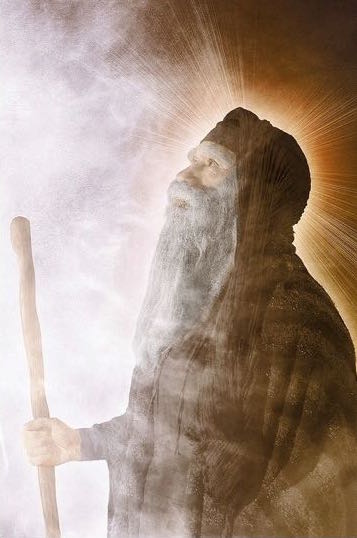
these monks gave off light.
There was an unmistakable radiance.
And I sat there contemplating it,
and then called it back to mind many times during the intervening forty years.
I humbly offer the lesson of this encounter:
we are intrinsically light-bearers.
(I mean this literally as well as figuratively.)
That is our native state.
Have you ever walked into a room to watch an infant napping?
But this Divine light dims as we are dominated and finaaly overtaken
by our carnal appetites.
In the end our light is snuffed out
and the transformation
over the course of a lifetime
from light to darkness is completed ....
or it is not.
If we say "No" to our many animal appetites,
our lifetimes instead would chart a course from lightness into darkness then into light.
It all depends upon us.
It is our choice
and
our choice alone.
Now, I continue to admire all those who choose
the path of light,
denying their base passions.
This is the essence of Buddhism.
What Buddhists call the Four Noble Truths are all
about ridding ourselves of cravings and all manner of dissatisfactions.
And this denial of the animal self
will cleanse our spiritual pathways,
will free us of pollutions,
will permit our inner light to shine.
For this is the great difference between the human creation
and
the other animal creatures.
All others are weighed down by the shackles of desire,
caught up in the deadly rivalry
of a food chain.
Of all God's creatures,
humans alone radiate light.
I lament the tragedy of Buddhism, therefore.
To progress so far down this noble path of enlightenment
and
to miss the One Who is Divine Light,
Who said,
"I am the light of the world. He who follows Me shall
not walk in darkness, but have the light of life."
(Jn 8:12)
|
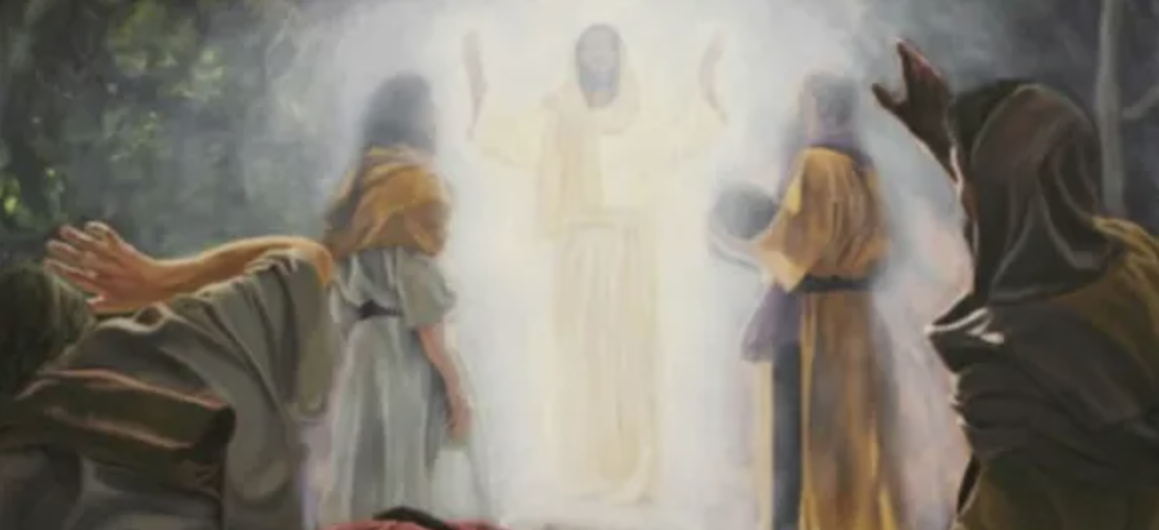
And those who followed Him up the Mount of Transfiguration
saw with their own eyes that the ascent
upward,
above the world,
means a return to our natural state,
where all is bathed in Uncreated Light.
Many years later,
one of those witnesses would write,
In Him was life; and the life was the light of men.
And the light shineth in darkness; and the darkness comprehended it not.
(Jn 1:4-5)
|
At the beginning of his book,
Zen and the Birds of Appetite,
the Trappist monk Thomas Merton set the following versicle:
With no bird singing
The mountain is yet more still.
|
This mystery bespeaks an emptiness that is fullness,
for which
the soul longs.
It is the nothing that is everything.
Anyone who has experienced this mysterious nothing,
perhaps on a windless mountaintop or in a desert at night,
has ventured into this truth.
The silent mountain Merton considers is the self
—
emptied of all noise,
void of all thoughts,
rid of all desires.
As Merton writes,
There is no body to be found. The birds may come and circle for a while ...
but they soon go elsewhere. When they are gone, the "nothing," the "no-body"
that was there, suddenly appears. That is Zen. It was there all the time, but
the scavengers missed it because it was not their kind of prey.
|
And what is the prey that draws chattering, pecking birds,
crowding out silence with their compulsive movements and unbridled desires?
They tug with each other over scraps of worldly debris,
driven on by darting minds.
It exhilarates them.
They seem to exalt in it.
And so do we covered with debris in our incessant pursuit of worldly
stimulations.
For so many of us are full of their kind of food.
What is this food for which we would forsake the Friendship of God?
What are these pleasures
for which we would allow the Divine Light within us to be polluted
and finally to die?
We don't want the chattering birds to come near to us,
much less to become chattering birds ourselves.
What we really want is the ineffable and beautiful stillness which is inside us.
As Merton wrote,
"It was there all along."
This emptying of ourselves
is called kenósis.
It is the first thing Jesus did
in His Self-denying love in order to enter our lifeworld (Phil 2:7).
To follow Him, we must do the same,
crucifying the "old man" that the "new man"
might be born (Eph 4:22):
And He said to them all, If any man will come after me, let him deny himself,
and take up his cross daily, and follow Me.
(Lu 9:23)
|
He did not mean service
(though certainly we serve).
He meant, "Deny your self, and follow Me."
Inevitably,
His Me is the replacement for your self.
When I went to Haiti, I met many, many people who had denied themselves and who did indeed follow Him
hour-by-hour,
day-after-day.
For example,
I met a priest-monk from Italy of the Order of St. Camillus,
a healing order.
He was intelligent and strikingly handsome and winning.
People were drawn to him.
He would have succeeded very well in worldly ways.
He seemed to be possessed of supernatural powers as he took on one impossible task after another:
rector of a seminary,
provincial superior of a religious order,
president of a public health ministry,
founder of a large and impressive hospital
(with himself as general contractor),
and
a medical practitioner himself.
He was also
a day-laborer who drove a dump truck back and forth to distant Port-au-Prince,
so he could run the hospital there, too.
He drove this heavy vehicle over dirt roads through high mountains that were slick with clay in the rain
and
did not have guard rails to protect him from a thousand-foot drop.
At any time, he could be killed or robbed on the roadways
or
fall victim to predators,
even the police who prowled the roads demanding extortion money.
Many times I sat in the seminary chapel for his celebrations of the Eucharist.
One might reasonably expect to find an
exhausted, withdrawn man whose face was wan and dimming.
But that is not what you saw.
His Masses were luminous
and
bespoke an impossible lightness of being.
Each word he said was replete with grace.
And, yes, he himself shone with unmistakable radiance in those celebrations which began before dawn.
Some years ago, I attended a fund-raiser in New England
that culminated in
a slideshow depicting the past twenty-five year history of a ministry in Haiti.
Nearly all of the pictures were of a nun who had built up this ministry
for a quarter-century as its administrator.
She was this apostolate's animating spirit.
She is the reason people gave money (and gave and gave and gave) and even traveled to a remote
corner of Haiti to be near to her.
And in the dark during the slideshow I heard them:
"She's radiant!"
they whispered to each other.
"Beautiful!
Her face gives off light!"
Even the camera had captured it.
And it was true.
The radiance that shone off of her face after forty years of spiritual life
through China, India, and Haiti
was vivid and obvious.
Exactly, what had happened to this woman over a lifetime?
In 1962,
the American culture was about to enter a path of more and more and more lifestyle permissions,
more and more and more personal liberties,
and
more and more and more stimulations of every kind,
until it has reached a point of the scarcely-to-be-believed ....
she chose a path of less and less.
She rid herself of every chattering bird.
Through vows of poverty, chastity, and obedience,
she cut off the passions before they could take hold and form her.
Like the Italian priest and so many others,
she had become a saint,
a light-bearer,
and
a disciple of the shining Son of God.
For she had read the Scripture,
and
she believed its truth:
|
"I AM the Lord thy God. And because I AM Holy, you are to be holy."
(Lev 11:44)
|
Encountering the face of God on top of Mt. Sinai,
Moses' face shone with a radiance so great that no one could look upon him.
Atop the Mount of Transfiguration,
Jesus unveiled His true Self in the greatest Theophany of the New Testament:
|
"And His face did shine like the sun".
(Mt 17:2)
|
And He enjoins us to let our light so shine upon men that even God the Father feels its glory (Mt 5:16).
Jesus is the way, the truth, and the life.
He is our path into light.
God made the world by first ordaining light,
and
He made us to see that same brilliant light when we leave that world.
Light is our essence, our deepest nature, and our only true home.
All else is darkness,
which devilishly yearns to snuff out the light.
Spiritual life.
It begins by fixing your gaze upon light
as
Moses had in the Midian Wilderness.
And it culminates
on the heights of Sinai and thence to the Mount of Transfiguration
until we become all light,
Uncreated Light,
like unto Him,
Who bids us follow.
My brothers an sisters,
as we prepare ourselves for the Nativity
Fast,
let this season be our deeply committed journey into light.
For He again is born unto us.
And we even now can discern that the darkness is
beginning to loose its hold and disperse:
Long lay the world in sin and ever pining
Till He appeared, and the soul felt its worth.
A thrill of hope, the weary world rejoices,
For yonder breaks a new and glorious morn!
|
Come!
Let us greet that dawn!
let us draw near to Him!
For He has been waiting for you and for me.
And He will wait until the last,
until the very last.
In the Name of the Father and of the Son and of the Holy Spirit. Amen.