The Word of God. The actual phrase written down in St. Luke's Gospel is
| `ο Λόγος του Θεου / `o Lógos tou Theou |
These words stir our imaginations to the heights of Heaven touching the most sacred places: the opening chapters of Genesis, the portions of the Psalter, "the mountain of God, the House of Jacob" in Isaiah (2:3), and then rising to a blinding brilliance in the Prologue of St. John's Gospel:
|
In the beginning was the Word [Logos], and the Word [Logos] was with God, and the Word [Logos] was God.
The same was in the beginning with God. All things were made by Him; and without Him was not any thing made that was made. In Him was life; and the life was the light of men. And the light shineth in darkness; and the darkness comprehended it not. (Jn 1:1-5) |
These words point back through the mists of pre-history
and soaring up to mountain peaks forbidding human intrusion.
Yet, we are afforded brief glimpses:
|
The earth is full of the goodness of the Lord.
By the Word [Logos] of the Lord the Heavens were made, And all the host of them by the Breath of His mouth .... Let all the earth fear the Lord; Let all the inhabitants of the world stand in awe of Him. For He spoke, and it was done; He commanded, and it stood fast. (Ps 32 (33):3-9) |
What should we call this awesome display if not Words of Power? Our poor verbiage stumbles and falls before this Majesty.
That the Disciples were acquainted with such concepts is certain. For in extremis they had said,
"Who then is this?"
|
And they feared exceedingly, and said to one another,
"Who can this be, that even the wind and the sea obey Him?" (Mk 4:41) |
In another Gospel, we read,
| "Who can this be? For He commands even the winds and water, and they obey Him!" (Lu 8:25) |
Well might we reply, "Let all the earth kneel before the Lord in fearful adoration!" For here is the Logos! Here is the Word of God!
Did they remember all this when the Risen Christ turned to them and said,
|
"Peace to you! As the Father has sent Me, I also send you."
And when He had said this, He breathed on them, and said to them, "Receive the Holy Spirit. If you forgive the sins of any, they are forgiven them; if you retain the sins of any, they are retained." (Jn 20:21-23) |
Who could doubt it? They are commissioned to ascend to His Holy Office — ".... as Me, so you ...." (Do you hear the sameness being suggested?) And He imparts this power by breathing on them. Jesus founds His imperishable Church, implanting the sacraments within the Persons of the Apostles (and their successors) with living, vibrating Words of Power.
In our earliest record of God approaching humankind following the expulsion from Eden, we read,
|
After these things the Word of the Lord came to Abram in a vision, saying,
"Do not be afraid, Abram. I am your shield, your exceedingly great reward." (Gen 16:1) |
Notice it does not say, "the Lord came to Abram," but rather the Word of the Lord came to Abram."
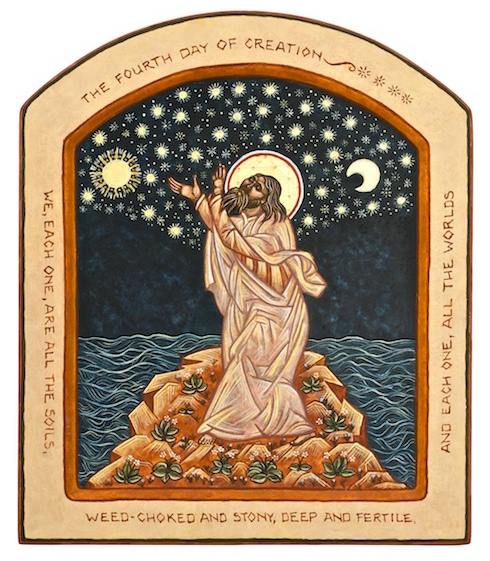
We find something similar during the Creation story. God does not create light as a single, atomic action. Rather,
| In the beginning, God said, let there be light! |
God said .... Our attention is directed to His Word and then to light and the Creation that arises from it ....
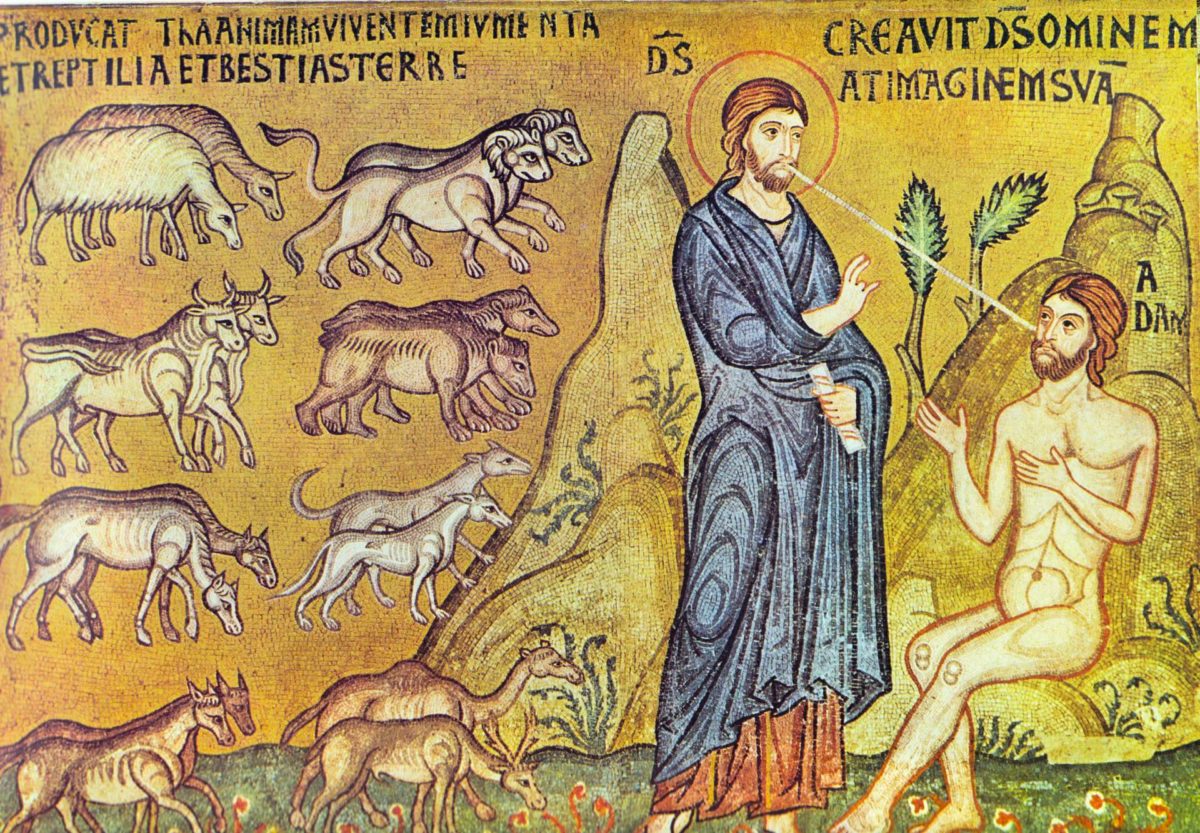
For a reason that is never explained, God pauses in His Creation of the beasts of the field to ask Adam to complete it:
|
Out of the ground the Lord God formed every beast of the field and
every bird of the air, and brought them to Adam to see what he would call them. And whatever Adam called each living creature, that was its name. (Gen 2:19, Emphasis mine) |
Recall that at Baptism when you name the child, he or she becomes present to God, becomes visible in a special way. Personhood is established. Adam names each living creature. This no ordinary, declarative act of speech. Our attention is directed to the power of Adam's Word: "Whatever he called [it] .... that was its name." This is what is known as a speech-act. It is the words themselves that engender a new and palpable reality.
Throughout the Holy Scriptures, we find that the formula "the Word of God" or "the Word of the Lord" designates a Divine act: God's power alighting on His chosen vessel, which is followed by that greatest marvel, God Himself speaking to His people:
|
And the Word of the Lord came to Isaiah, saying, "Go and tell Hezekiah,
'Thus says the Lord, the God of David your father: "I have heard your prayer, I have seen your tears; surely I will add to your days fifteen years.... "'" (Isa 38:3-5) |
Or
| Now Samuel did not yet know the Lord, nor was the Word of the Lord yet revealed to him. (1 Sam 3:7) |
In this latter passage, the tropes of meter and parallelism mark an equation:
| Divine knowledge = the Word of the Lord |
They are one and the same. And this Divine communion with God is called, "the Word of the Lord."
All of these things form the spiritual background for our Gospel lesson this morning. Jesus describes the "Word of God" as living sparks of Divine fire scattered throughout our lifeworld, which He calls seed. Should we permit our lives to be filled with distraction and unworthy debris, then these sparks, however holy and powerful, dim down and become cold. Alternatively, should we practice daily mindfulness, God's seeds stir and grow that we too should experience that communion with God known by the prophets, which is power to see and feel His Word and Will.
People tell me, "I simply want to know God's will for my life."
I reply, "Do you pray?"
They say, "Well, kinda."
"Pray the Divine prayers, and God will become known to you. Mindfulness is the thing."
He is a calling God. He calls every human creatures whom He has made. But we must attend to His Word in a state of readiness. What is that signature phrase of God's to describe unreadiness: "Their heart was not right .... They were not steadfast" (Ps 77 (78):37-38).
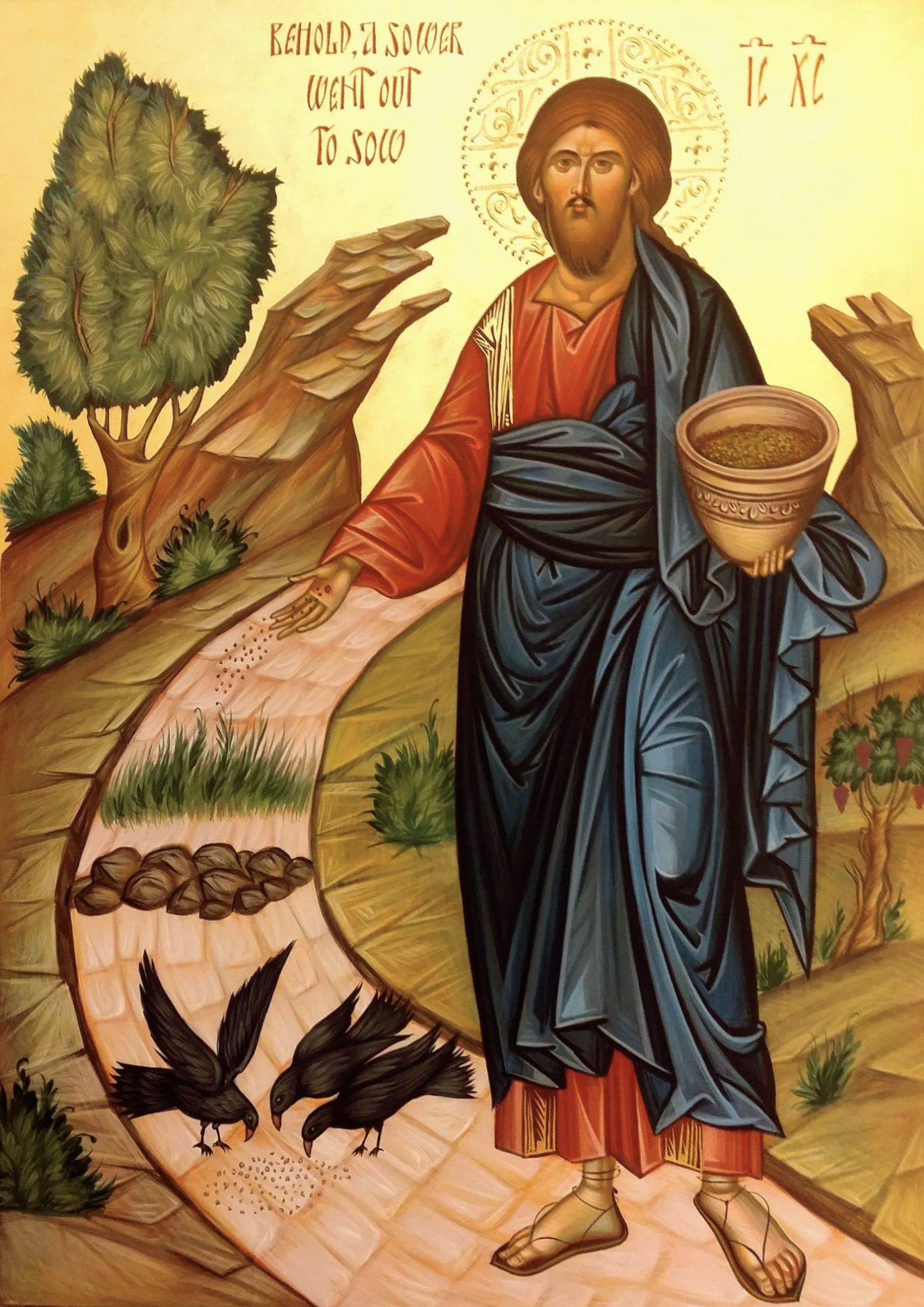
When Jesus enunciates these principles in His Parable of the Sower, we already know them through experience. When we stray, we separate ourselves from God and by that fact create vacancy within ourselves which invites demons. Not only does nature abhor a vacuum, the spiritual world abhors a vacuum, as well. As soon as God and His angels depart, demons flood in.
Sadly, this vacancy is all too common. We create vacancy by abandoning daily prayer, by ceasing our conversation with God, which had been so natural in young childhood. In adulthood our distracted, superficial lives, ignoring the Holy Spirit and the angels of God, never becoming mindful and rooted. We drift into a life mindful instead, of carnal desires. "Daydreaming," Sr. Mary Anne says, meaning drifting away from godliness. To borrow St. John's language, we choose the world, the flesh, and the devil over God. We say that we have not chosen this sort of mind. Well, when we drift into a profane mind, we have chosen it. And His Words of Power perish, according to our Parable this morning.
Jesus says it this way:
|
"Those by the wayside are the ones who hear; then the devil comes and takes away the Word."
"The ones on the rock .... have no root .... and in time of temptation fall away." "The ones .... are choked with cares, riches, and pleasures of life, and bring no fruit to maturity." |
Or, as the St. John the Theologian would later write,
| And the light shineth in darkness; and the darkness comprehended it not. |
You see, intimacy with God awaits each one of us. It is the natural order of things. His Word is scattered through the world. It is that magic and shimmer before which we stand in awe at dawn, at dusk, at certain moments, and we might say, in certain places.. One night Moses was attentive to it in the Midian wilderness. And he removed his sandals.
There is nothing remarkable about a burning bush in the deserts of the Middle East. Lightning strikes, and you have a brush fire. What is remarkable is that fire burned but did not consume. Now, how long must you gaze upon burning wood before you realize that it is not being consumed? Mindful. Attentive. Discerning.
Jesus marks the high point of this passage in Luke with the sentence,
| "The seed is the Word of God." |
Jesus draws our attention to this with repetition. Please consider my more literal translation:
| A seed sower went out to sow his seed. As he sowed his seed .... |
Consider the repetition which one discerns instantly in the Greek:
|
.... σπείρων
του
σπειῑραι
τον
σπόρων ....
(.... speirón tou speraî ton spóron ....) |
It is this repetition of one word in three forms which centers our attention upon sporos, the Greek word for "seed." The form σπερμάτικος (spermátikos) was a rich word in Classical Antiquity. The Judeo-Hellenic thought-world for centuries held that the λόγος σπερμάτικος (Lógos spermátikos), literally, the "seminal word," or "seed of reason," lay at the heart of all moving, conscious beings. Certainly, it formed the kernel of St. Justin Martyr's writings (early second century). It was this spark which was the crucial difference between lively, animate life and insensate lifelessness. Jesus suggests that the Divine seed is our share in the Holy fire. And we should note that in first-century Greek (the language of choice for Jesus), the words for "sower of seed," "sowing of seed," and the "individual seed" are virtually the same. That is, the Sower [Logos] and the Seed [Logos] are one.
Notice its dynamic properties. The seed is constantly being scattered as God brings new life into being. God is One with the seed. We participate in His Holy Fire by attending to it and finally by fixing our gaze upon it and opening our hearts to God's word, which is it most royal planting field of all.
As the Logós spermátikos is the lively spark of rationality and of intellect, it is opposed to the generative seed of the body, the seed we see and touch. You see, two different seeds. The ancients would have seen such material seed as being little different from the stuff that generates the dog or the goat. But the seed or spark underlying mind and soul alone belong to God, This is God's realm, God dimensions of reality, which are the Kingdom.
As St. John of Damascus would write six centuries later, the entrance of God into the human lifeworld did not take place through generative seed, developing "bit by bit" as a human would, but rather through the indivisible unity of the Divine seed, perfect, One:
|
And so after the Holy Virgin had given her assent, the Holy Ghost came upon her ....
the Wisdom and Power of the Most High, the Son of God, .... overshadowed her like a divine seed and from her most chaste and pure blood compacted for Himself a body animated by a rational and intellectual soul as first fruits of our clay. This was not by [generative] seed but by creation through the Holy Ghost .... (The Orthodox Faith, 3.2) |
As Jesus articulates at the conclusion of the parable, the Word of God and the Lógos spermátikos are two aspects of the same indivisible reality.
This distinction — between material seed and spiritual seed — we hear echoing through the Gospels. The Spiritual Seed, the Word of God, and the faithful people who receive it and reverence it .... these constitute the Kingdom of Heaven. Again, ..... whole, One, indivisible. Once you participate in the Holy Fire, you are part of this perfect unity. And we remain in it through prayer and mindfulness. Nothing can penetrate. We are surrounded by angels with flaming swords so long as we remain lively participants.
Repeatedly, Jesus and the Apostles preach of a Kingdom of God which is family. As the Apostle Paul said on Mars Hill, "one blood .... offspring of God" (Acts 17:26,28). As the medievals would say, "Who might claim noble blood when we all descend from the same parents, Adam and Eve?" (And I hasten to add that contemporary geneticists hold that all human on earth life proceeds from one woman joined to one man.)
We are one blood and then children of God by adoption, predestined to claim our royal lineage by living with our Heavenly Father in His Kingdom. I say, All are predestined for Heaven. Yet, in a mystery, our own sovereign power of will give us power to contra-dict, that is, issuing words against God. We may stray from the path, or we hold to it. We drift, or we remain fixed on the Holy Fire. It is always our choice, minute by minute, hour by hour.
Do you see? We need do nothing. We are born already on the path. All we need do is follow it. It is our distracted minds that must choose to stray. This is an active choice.
Perhaps those of you who have not committed grave sin do not know this: sin is intrinsically repulsive. How well I remember transgressing the first time. It was a horrible experience. And I felt terrible after I had done it. Yet, I went back for more, and went back again. After awhile I could not hear the alarms of conscience. The choice to remain faithful is ours alone to make.
Yet, how do we succeed in securing our predestined happiness? Jesus announces the answer with unusual directness and clarity. No one can miss it:
| But He answered and said to them, "My mother and My brothers are these who hear the Word of God and do it." (Lu 8:21) |
As if ensuring that we get it right, He repeats it a little later:
| But He said, "More than that, blessed are those who hear the Word of God and keep it!" (Lu 11:28) |
This is family: one blood and offspring of God. Ours to have unless we choose to reject it. Here is the Kingdom of Heaven: Who hear the Word of God and keep it!
Did you know that the "keep of a castle" is its stronghold and last defense.
Let nothing pollute this pristine goodness and purity! We become distracted at our great hazard. Do not let the debris of unwholesome curiosity settle on you and snuff out the holy flame.
We must guard our thoughts! This is core Orthodox teaching: Guard your thoughts! In the Monastery of St. Demetrios overseen by Metropolitan Jonah, the monks confess their thoughts .... sometimes multiple times every day. For this is the battlefield where our souls hang in the balance: the direction of our thoughts from minute to minute, which end up deciding everything.
Be ever mindful to His Divine command:
| Hear the Word of God! And keep it! |
As He did the prophets, God made each of us to be holy vessels (Eph 2:21, 1 Cor 6:19, 1 Peter 2:5). He exhorts us to become lamps that give light to the entire household (Mt 5:15). He calls us to be shining cities upon a hill (Mt 5:14). For the whole world was made with the Word of God, and it continues to shimmer in its Divine power.
Yes,
I know
many have covered their souls and bodies with the rubble and ruin of evil distractions.
But God's pure Light cannot be hid (Mt 5:14).
And
God's Power will have the last word
as it had the first.
This morning, Jesus admonishes us to receive it as holy
and
to reverence it as if it were the fate our lives.
For that is surely what it is.
In the Name of the Father and the Son and the Holy Spirit.
Amen.