John 20:1-10 (Matins)
2 Corinthians 9:6-11
Luke 6:31-36
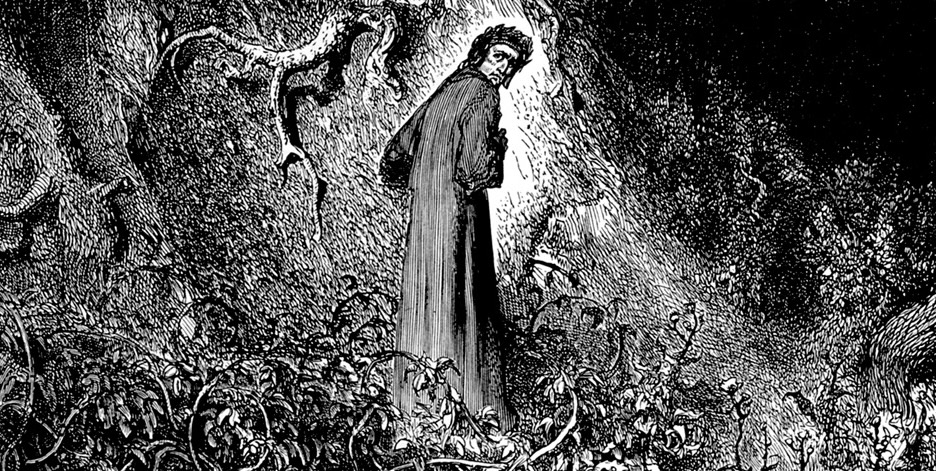
Lost in a Wood
"For even sinners do the same."
(Lu 6:33)
In the Name of the Father and of the Son and of the Holy Ghost. Amen.
Our Gospel lesson this morning
contemplates the conduct of sinners.
In a brief passage,
consisting of only six, short verses,
fully half of them are preoccupied with this subject:
"For even sinners love those who love them" (Lu 6:32).
"For even sinners do [good to those who do good to them]" (Lu 6:33).
"For even sinners lend to sinners to receive as much back" (Lu 6:34).
|
These are words, of course, spoken by Jesus in His "Sermon on the Plain,"
which gives us a glimpse into how people behave in the Kingdom of God.
The subject is basic in Scripture.
The first crossroads we encounter in
the Psalter
(that mainstay of monastic life)
confronts us in the opening verse of Psalm 1:
|
Blessed is the man that hath not walked in the counsel of the ungodly, nor stood in the way of sinners
(Ps 1:1).
|
The lay of the land is clearly marked off right away:
godliness vs. the way of sinners.
Sinners are expressed as a way
suggesting
restlessness and as many lonely paths as there are sinners.
Did you know that over centuries
this solitariness,
this restlessness,
this chaos
(for all these ways diverge,
is how Hell is described?
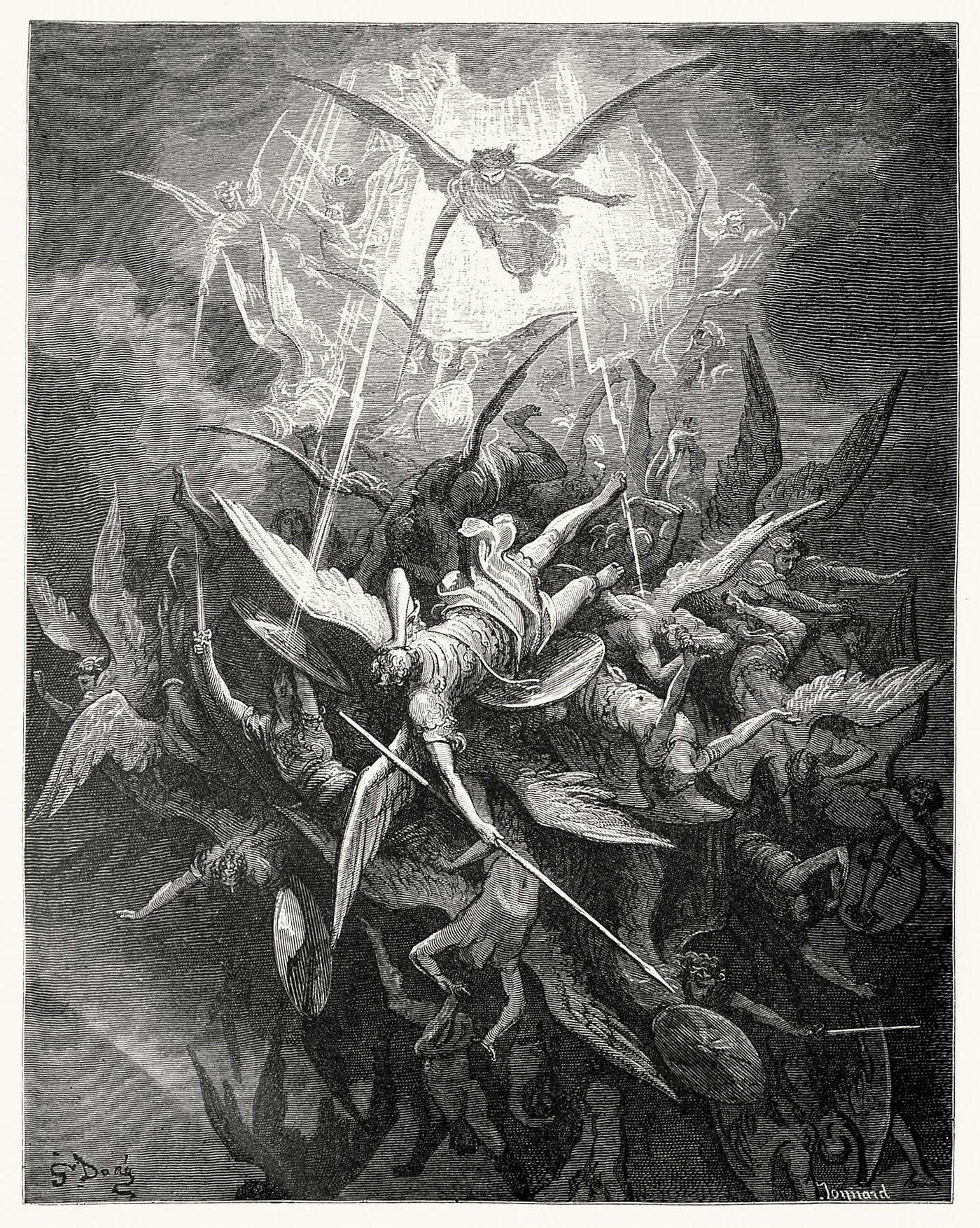
Consider this excerpt from
Milton's Paradise Lost,
depicting the confused fallen angels
just after their expulsion from Heaven.
They are dazed.
They now must take their first steps
without our guiding God:
By false presumptuous hope, the ranged Powers
Disband; and, wandering, each his several way
Pursues, as inclination or sad choice
Leads him perplexed, where he may likeliest find
Truce to his restless thoughts, and entertain
The irksome hours ....
*
*
*
And found no end, in wandering mazes lost.
(Book II, 522-27,561)
|
They are lost,
which helps us to understand the nature of Hell.
Dante,
in his great work The Inferno,
describes
the antechamber to Hell
as being
"lost in a wood."
And, of course, there is Hell's other name:
Perdition,
which means "utterly lost."
More than 1,600 years earlier,
St. Paul wrote of "slaves to sin"
(Rom 6:20).
But is sin really an enslaving general?
That is not how the Master sees it.
He
speaks of sin simply as a wrong path
and
contemplates it in terms of discernment,
of finding the right way ahead.
And He constantly speaks of "eyes that see and ears that hear."
As Christians our vocation is discernment
and
coming to a right judgment on things.
This notion was deeply etched
in the thought-world of Jesus.
In the fifth-century B.C., Sophocles described Oedipus
as one who, ignoring admonishments from the divine,
preferred to trust his own intellect,
which would lead to his destruction.
Aristotle established the concept forever
in his Poetics.
In both widely read works,
the failure to discern aright
is termed
ἆμαρτία
/
hamartía.
Do you know this Greek word?
Our translation is sin.
That was the word used by Sophocles and later by Aristotle.
And it is the same Greek word used in Psalm 1
(Septuagint)
as well as the word used by
Jesus in the original Greek text of our Gospel lesson.
As many of you know,
the verb form means,
"to miss the mark."
You see, this all about discernment.
In particular,
one meaning from the
Cambridge University Greek Lexicon (2021)
is relevant this morning:
to fall short in understanding,
in a judgment or calculation;
to fail to discern the meaning of an oracle
(which was the ancient Greek way of saying "the Divine."
Isn't this a constant theme in the Scriptures?
Why else were given this very large book
if not to read critically,
to read deeply,
the discern?
The serpent supplies
Eve with new perspectives for discerning God's commands.
And
she rationalizes her way to wrong judgment.
Adam fully knows she has transgressed.
He understands the command they have received.
But he chooses Eve over God.
He choose against God.
Then there is the faulty discernment of Abram and Sarai.
When the child promised by God does not appear,
they go back and revisit the Divine words.
Sarai, in effect, asks Abram,
"What exactly did He say?
Are you sure you got it right?"
And they rationalize their their way
to novel innovation.
They decide that
what God really meant is that Abram should produce a child through Sarai's slave,
Hagar.
In both instances these misjudgments lead to disaster.
Everything has depended on hitting the mark,
but they have failed.
They have missed the mark.
In both Greek and Biblical examples,
the pattern is the same:
discernment with the soul, which is faithfulness,
versus
discernment with the intellect, whose machinations are endless.
Our model for the former is the Lord Jesus,
Who was obedient to the point of death,
even death on a Cross (Phil.2:8).
He said,
"Not My will but Thine be done" (Lu 22:42).
The intellect does not intervene.
Faithfulness has the last word.
Our model for the latter,
for rational discernment,
is Eve.
The command is simple:
not to eat of the tree of knowledge of good and evil.
The Authority is the Most High God.
But she permits her mind to become overactive
and
then
follows its unsteady dictates without question.
Forever after,
she will set the pattern for sinning.
We know it is wrong.
We understand the subject.
We understand what is involved.
But we do it anyway.
Our faith is founded on God's love.
He is infinitely merciful.
We can be redeemed from our personal perditions.
We can be lost but also found!
But what does that redemption mean?
Will everything be as it would have been
had we never sinned?
Ask Eve.
Ask King Saul when God's blessing falls off of him.
Or in the scope and scale of our lives,
asked the man or woman who has deeply wounded
a sacred trust through adultery.
Can things ever be as they once were?
Let us consider the case of God's call.
"Following God is the last, great adventure,"
a wise and holy sister told me while I was at seminary.
And it is all the more exciting when we consider that God
has called us at a particular moment for a particular purpose.
God doesn't call us for no reason.
God doesn't do anything for no reason.
The mature Christian realizes that
God needs us.
He needs our particular charisms for a purpose.
He needs us
now, not later.
Divine appointments come through the miracle of timings.
Should we refuse Him,
that moment is lost,
that appointment was not kept.
Should we dither or vacillate,
the great timing of many threads will not converge
where our life is
at this kairos,
this acceptable moment..
And this moment, once lost, cannot be retrieved.
It is lost forever.
Think of a GPS device while we are driving.
God orders us to turn right.
But we do not turn right.
We drive on past.
We go far afield.
He says,
"Well, okay, you're in a different configuration.
We'll provide you with a new configuration now,
and guide you from there."
We know from experience that He will do this.
He will meet us where we are.
But things will not be same had we been obedient.
They cannot be.
For the moment is lost.
This is the whole point of missing the mark.
This is why Jesus preaches this morning
that we must be attentive.
And we must be obedient.
What does the Prophet Samuel say to King Saul
as he approaches with the sheep he was forbidden to take as plunder?
"Is this not the bleating sound of disobedience?"
Otherwise,
we are not in it.
We have become those "problem children" taking up the rear.
God will deal them after their fashion.
But we are not in it,
if we are not attentive and obedient.
The "problem children" say to each other,
"What does it matter?
We're not hurting anyone.
This is our private affair.
You mind your business,
and
I'll mind mine.
Meantime,
who has been harmed?"
This is a common sentiment.
We like to think that we are alone,
but that is simply not true.
We are never alone.
Our life and its many threads are connected to many others
and
their many threads.
The Franciscan saint Padre Pio wondered how God is able to be present to this colossal tangle
of countless threads,
let alone managing their complex timings,
let alone being fully present to each of them.
And then
one day he considered his mother's needlepoint.
On the under side,
the side facing us,
we see an indecipherable tangle.
But on the side his mother could see,
a simple and beautiful scene was depicted.
God sees both sides at once.
And when we are attentive and obedient,
He is able to use us.
He is able to fold our threads into His marvelous weave,
which we call the Will of God,
which we call the Kingdom.
But if we are not faithful,
if we have missed the mark,
then
we are not part of God's mighty works.
We begin to stray from Him farther and farther until we are utterly lost.
And the lives around us are ennobled in direct proportion to our own nobility.
And
they are degraded by the same measure that we degrade ourselves.
We might say,
"That's invisible."
But its narrowly invisible.
It is visible to God.
It is visible to His Holy Ones.
And it visible to our loved ones who have predeceased us.
They see.
In the
The Brothers Karamazov,
the Elder Zosima
kneels before the raging sinner Dimitri
and
begs his pardon.
The effect is electric.
And I confess that I did not understand this
until the Elder later explained it.
We live in a world that has been poisoned.
Everyone drinks from this cup.
Everyone in some measure is delirious from this poison.
Consider for a moment Tyler Robinson,
Charlie Kirk's alleged assassin.
It has now been learned that he immersed himself in the most extreme and degrading pornography,
day-by-day,
hour-by-hour.
And it is known that he was romantically involved with a man having psychotic fantasies,
who was encouraged by society to express those delusions,
maybe protecting his fantasies by law.
Both these young men drank from this cup of poison every day.
Tyler Robinson's parents were sound people,
but our children, by virtue of our culture, are becoming inebriated
by this poisonous brew
imparting toxic hallucinations.
And as they rage, their souls slowly die.
And we are no blameless in this horrible spiritual murder.
We bear some measure of responsibility for this crime of poisoning.
For if we have sinned during our earthly journey,
We have poured our poison in to the common cup of culture.
If we have said nothing as the cup became more and more lethal,
where share in blame.
Our world has reached an unprecedented extreme in spiritual toxicity.
The material degradation of everything is a direct consequence:
the oceans, our atmosphere, everything.
And what do the Westernized countries say?
How do they respond to this indisputable fact?
For many thousands of years,
since
the Greek tragedians and Aristotle,
men and women have strived to hit the mark.
They have universally praised virtue and pursued laudable life.
Have you seen those families
—
who held up virtue
and
encouraged their children to pursue laudable lives
as mother and father had?
These people feed the whole world with their wholesomeness.
In the epics of Homer,
hamartía referred to a javelin that failed to hit its intended target.
To attain virtue,
one must train.
One must practice virtue.
You cannot just decide,
"Tomorrow morning I will live a virtuous life."
This requires longtime formation and daily practice.
Ten thousand years later,
in our own era,
we have all but outlawed hitting the mark.
Instead, the two great commandments of our culture are
"Do not judge anyone!"
and
"Live and let live!"
no matter
how degraded that so-called life should become.
If we should practice discernment,
if we should censure others who have missed the mark,
we ourselves will be condemned for judging them.
For the greatest virtue of our age is to eschew virtue as being judgmental.
And the most laudable discernment of our time is to reject all discernment.
The results are in.
Few people have the capacity to discern.
When we were children (we in our eighties) were surrounded by it.
People were constantly weighing things in a process of critical thinking.
Now this is all but against the law,
and
our children don't even know how to do it.
They are told,
"You don't need to think.
Just plug in these pre-approved clichés."
When I first joined the Technical Staff at Bell Laboratories,
I found myself subjected to a frank and candid judgment every six months.
At first I did not like it.
I was not used to be calling to account.
"What are you doing?
What have you accomplished?"
But it did not take long to see that this was my life-line.
I advanced rapidly because I could see the needle move
and
what made it move.
Because it was a laboratory, the subject matter was factual.
This process was a dynamic, finely-tuned set of guide posts
that ensured I did not lose time in advancing toward that
universal goal called excellence.
There might not be anything special about me.
But I have never before been handed this opportunity:
day-by-day,
week-by-week,
measure my advancement toward excellence.
Without such sign posts,
how will we find our way to the Kingdom?
If all the sign posts are removed by the social will,
how will our children find their way?
Instead,
we are surrounded by a toxic vapor.
We cannot see the way ahead.
And the day is almost done.
Surely, we are lost in a wood.
But
Christian life is all about this needle:
virtue.
We are surrounded by saints who will respond to sinful life.
They do not condemn us,
but neither will they let us perish in our sins.
That is,
they follow and emulate a Master Who is attentive,
Who frankly rejects sinful life,
and
Who will draw attention to our sins,
and
Who,
thanks be to God,
judges us.
Our judge stands on His threshing floor.
His fan is already in His hand.
He will separate the wheat from the chaff,
and
He is gathering His good ones,
His faithful children.
They belong to Him Who is Alone Good.
And the chaff?
Well, you know, He is merciful.
But He will not wait forever.
In the Name of the Father and of the Son and of the Holy Ghost.