Luke 24:36-53 (Matins)
2 Corinthians 6:16-7:1
Luke 5:1-11
Forsaking All Others
So when they had brought their boats to land, they forsook all and followed Him.
(Lu 5:11)
In the Name of the Father and of the Son and of the Holy Ghost. Amen.
Let us paraphrase our epigram this morning:
|
"So they ceased their vain wanderings
forsaking all else."
|
We know these words.
Everyone has heard them growing up.
Many, in hushed, sacred, candle-lit spaces,
have spoken them.
And
the English words of our Gospel lesson today echo them:
WILTE thou have this woman to thy wedded wife, to live together after Goddes
ordeinaunce in the holy estate of matrimonie? Wilt thou love her, coumforte her,
honor, and kepe her in sickenesse and in health? And forsaking all other kepe
thee only to her, so long as you both shall live?
(1549 Book of Common Prayer)
|
These are immeasureably holy words,
unlike any others we are likely ever to speak.
They were revered by the King James Bible translators (1611),
most of whom had spoken them at a most sacred moment in their lives.
For when or where else
do you utter permanent, unbreakable, and holy vows
before God ....
unless you become an ordained priest or a consecrated monastic.
And what,
in all the world,
is more sacred than Holy Marriage?
..... ordained by God in Eden as the proto-Church:
two people joined in holy love
and
together loving God with all their heart, mind, soul, and strength?
From marriage
(according to God's Will)
proceeds the only miracle commonly seen on earth:
the living creation of God's Image in children.
And didn't God make each and every one to be adore-able?
We adore the Image of God in children.
Family is God's building block for the entire human lifeworld.
And uniquely family is His formation for our spiritual development
preparing us to
enter His Kingdom of Heaven,
which He has styled, Family,
having "one God and Father of all" (Eph 4:6).
Writes St. Paul,
"But you received the Spirit of adoption by Whom we cry out, 'Abba, Father.'"
It turns out that religious life is family.
And family is how we have prepared for religious life.
Marriage is the all-important moment we stop living our selfish lives
and
are born into a whole new creation.
Says the Lord Jesus,
Wherefore they are no more twain, but one flesh. What therefore God hath
joined together, let not man put asunder.
(Mt 19:6)
|
We put away childish things and self-indulgences
and
mature into God's Image:
in compassion, in empathy, in patience, in agape-love,
After all,
few will lay down their lives for their friends,
meeting the high standard of the Master,
but for their family,
few will fail to do so.
What does the alternative look like?
Well,
there are sports cars and Armani suits and hundred-dollar haircuts.
But the people who have been formed in God's kind of love
say,
"No. No. And no.
The need is too great among all the others I see around me."
This is God's school of love,
preparing us for His kind of Love,
which is the Kingdom of Heaven.
That is,
the Lord Jesus calls all of us into
consecrated, holy life.
I often say,
"Jesus calls us to burn our whole world down!"
Well,
you enter marriage burning down your whole world:
the selfish world,
the petty world,
small life.
And when you burn it down, you realize that it didn't
add up to hill of beans in the first place ....
not when its flames illuminate the Kingdom of Heaven
in a dark world.
In our Gospel lesson,
we witness
the Disciples graduating from that school
and
going
to the next level.
They have been formed in family-only love.
They have done well.
And
now they have been chosen by the Son of God
(do you see God's insistence on Family
even in His Divine Self-revelation?) ....
called by the Son to continue the process of forsaking
—
forsaking
their livelihoods,
their worldly strivings,
their worldly identities.
They now are to
to complete themselves in the self-denying transformation
which is the mind of Christ
(Rom 2:12).
But what of their marriages?
Will they forsake their wives and children?
We learn that their families are being called to this higher life, too.
In his
First Letter to the Church at Corinth,
St. Paul affirms
that they continued to honor their marriage vows.
Certainly,
we see that St. Peter continues to care for his mother-in-law (Mk 1:29-31).
And we read in St. Paul's Correspondence:
Do we have no right to take along a believing wife, as do also the other apostles,
the brothers of the Lord, and Cephas?
(1Cor 9:5)
|
Indeed, St. Paul writes to his spiritual son, Timothy,
that it is not possible for an unmarried man
to be consecrated as bishop.
Yes, the heirs to the Apostles must be married men:
A bishop then must be blameless, the husband of one wife, temperate, sober-minded,
of good behavior, hospitable, able to teach.
(1Tim 3:2)
|
The one chosen for bishop must be the husband of one wife,
that is,
he cannot have been divorced and remarried.
And if we are to take the example of the contemporary Orthodox Church,
most priests are married,
about 90% of Orthodox priests in the U.S.
This was also true in the Western Church, in the Roman Catholic Church.
The ill-fated experiment of an all-bachelor priesthood
was not begun by the newly created Roman Catholic Church
until
after the twelfth century (Second Lateran Council).
You see,
this is not a theological decision.
This was a practical remedy.
The Church was swamped with law suits
as sons of bishops sought to inherit Church property.
Since the seventh century (Sixth Ecumenical Council),
bishops have been chosen from among unmarried men
(usually monks).
But at the parish level,
the Kingdom that is constantly becoming is not to be led by bachelors,
but by blameless, temperate, sober-minded, hospitable, and mentoring fathers.
In a word, the Kingdom begins as family
and,
at length,
enters into God's midst
as family.
Consider the opposite principle,
which is the dark kingdom.
Here are the deepest depths of selfish life,
of "me-first" and egoism,
populated by those who betrayed and will betray
to attain perceived advantage,
all ruled
by the prince of pridefulness,
which is first of the deadly sins.
Our Gospels
might have told a different story.
Jesus could have just appeared in the company of men
as a mysterious king.
He could have landed, say, at Caesarea-Maritima,
one of the great harbors of the ancient world,
in a splendid, golden ship.
Or He could have descended from the Heavens in the sight of many
as He would later depart.
These are the likeliest scenarios.
Are they not.
But the Father willed that the Son be born
into family ....
and
a struggling family, to judge by the mean circumstances of His Nativity.
Remarkable!
Absolutely, unexpected!
It is imperative that the holy man not be a complete solitary.
It is in the very fabric and weave of Christian life
that we have need of each other.
In every depiction of the godly life,
we find love.
But
solitary love is most often a self-absorbed kind of life.
You dwell endlessly on yourself.
God Himself is not a Solitary.
He is a
Society of Love,
a Love among Three,
which is the most elemental mathematical expression,
from which all other expressions derive.
Do I believe
that the same language
chosen for the Rite of Holy Marriage composed in 1549
should also be echoed in the King James Bible account
of the Call of the Disciples'
in 1611,
accidentally?
Do I believe that is just a coincidence?
No, I do not believe that.
Holy Marriage is nothing less than new life
imbued with God's love.
We are called to imitate God
in His very Properties:
long-suffering, kind, above envy, modest, serene, loving, holy.
The phrase "forsaking all others" suggests
a
crossroads,
which is to say there is one path ahead
which will lead you to God
and
all others which will not.
This is why to focus on anything else but the soul of the beloved is folly.
The failure to behold the beauty of someone's soul
will lead you to disaster.
For marriage is intrinsically holy
and
the failure to recognize the fact
that you have stepped onto sacred ground
is playing with fire.
But let us not dwell on negatives.
For the right choice
means happiness, fulfillment, and enlightenment
to the greatest degree.
For the object is not to choose one's material equal
—
in body, mind, or material wealth
—
but to discern
another living soul
which God has
brought to you.
We do not slam the door in the face of those whom God has brought to us.
And, certainly, we do this at our own great peril
when the one we refuse turns out to be God's gift to us of our spouse.
But how will you know?
By the way,
we are asked this all the time by young women:
"How will I know when I have met my special one?"
We reply,
"You will admire the beloved
and
love the beloved
far above any other love that you have known.
You will not have to try.
It will just happen.
Your mind will be fixed and cannot be moved.
The beloved will
value things which alone have value
and
will lead you into life which alone is worth living."
It is too bad that American society from its inception has
viewed the relationship with God as being a private matter.
We can understand this prudentially in a pluralistic society:
the First Amendment is a proscription intended
to protect the sanctity of one's beliefs from persecution
by others.
It is a fact, however, that
the Founding Fathers, by and large, did not believe
in a God Who could hear our prayers.
They were Deists, which was the intellectual fashion
among "the better sort" in the eighteenth century.
But
Benjamin Franklin said
that without religion no society could survive but
would quickly devolve into libertinism and general lawlessness.
Without God we quickly degenerate into libertinism (taking indecent liberties)
and
a general lawlessness.
Ring any bells?
The unintended consequence has been to view the life in Christ as
an adjunct to everyday life
—
a hobby, if you will,
to be dabbled in with a sense of moderation
during your private hours.
Isn't that true?
People shop for churches as if they were looking for a pair of shoes.
And seeing religious life as a sidelight,
it was bound to become isolated from the mainstream.
As we have seen, though, it is intrinsically the main thing.
There nothing we can do about!
The life in Christ in the main thing:
forsaking all others.
☦
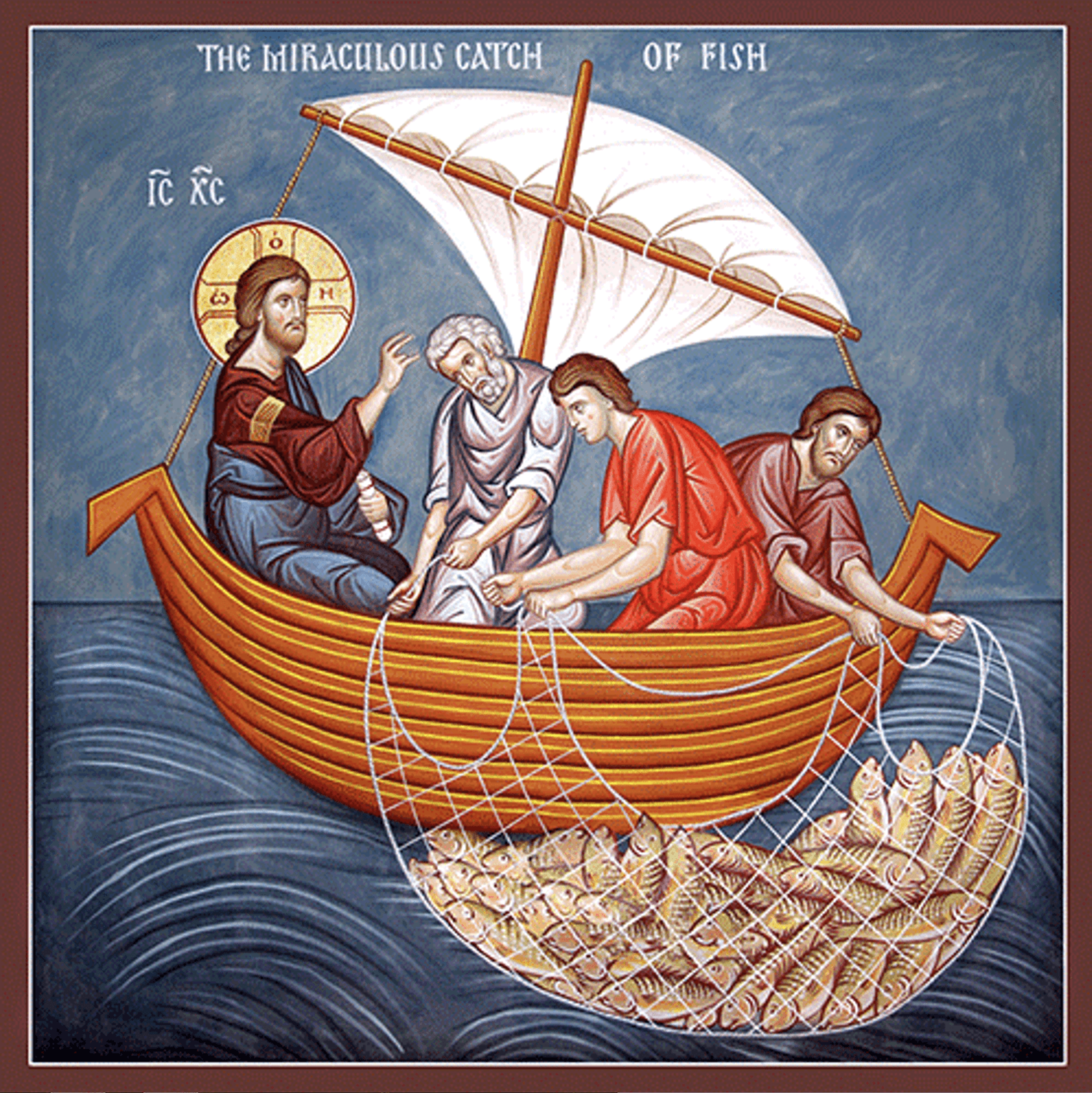
Today's Bibles often place a heading over our lesson:
"The Call of the Disciples."
Yet, over the decades I have heard readers refer to it
as
"The Great Draught of Fishes."
The picture of one boat almost sinking, and then two,
under the weight of a miraculous catch
of fish
dominates the imagination.
I think of the passage we shared last week:
"Eye has not seen, nor ear heard,
Nor have entered into the heart of man
The things which God has prepared for those who love Him."
(1Cor 2:9)
|
I am reminded of the Lord revealing His intentions for us
with a sense of ebullience:
|
I have come that they may have life, and that they may have it more abundantly.
(Jn 10:10)
|
And what is abundant life
beyond even our furthest imaginations?
It is love.
It is
mind-bending, heart-stretching love
—
a Kingdom of Love ....
"and of that Kingdom there will be no end" (Lu 1:33, Nicene Creed).
When I was a chaplain serving a Roman Catholic medical center,
I was assigned to the oncology ward,
where I witnessed people approaching the Gate of Heaven.
Amidst the quiet of this place,
almost a holy quiet,
a room was set
aside for a woman in her nineties who did not have cancer.
She did not ail from anything.
She was simply dying.
Each morning I would come into her room
sharing in the Rosary.
Her children were gathered around the bed,
themselves senior citizens.
This was no place for socializing.
(You know how it is at family gatherings .... men talking
about baseball and women discussing recipes and grandchildren.)
But her mind was elsewhere.
At one point,
she turned away, staring down as if in aphasia.
And this caused a disturbance among her children who felt snubbed.
So I told them,
this is not personal.
She is tuning out our world,
so that she be completely attentive to another.
She remained in this posture for a day or so.
Her children were still there, but silent.
Then,
all of a sudden,
she stirred.
She sat up.
And with her face looking upward
and
her hand outstretched,
she cried out in joy, "Robert!"
(the name of her predeceased husband).
And she departed,
her body falling lifeless
onto the pillow.
Our vows are long, long vows.
And of His Kingdom there will be no end.
But the best part is still ahead.
And of that
happiness and joy and abundance,
ear has not heard nor eye seen.
He loves us.
He alone is goodness.
Follow His paths, for they, and no others, will lead us to safety.
The rest
(I say with a sense of relief)
we surrender into His Hands
forsaking all else.
In the Name of the Father and of the Son and of the Holy Ghost.