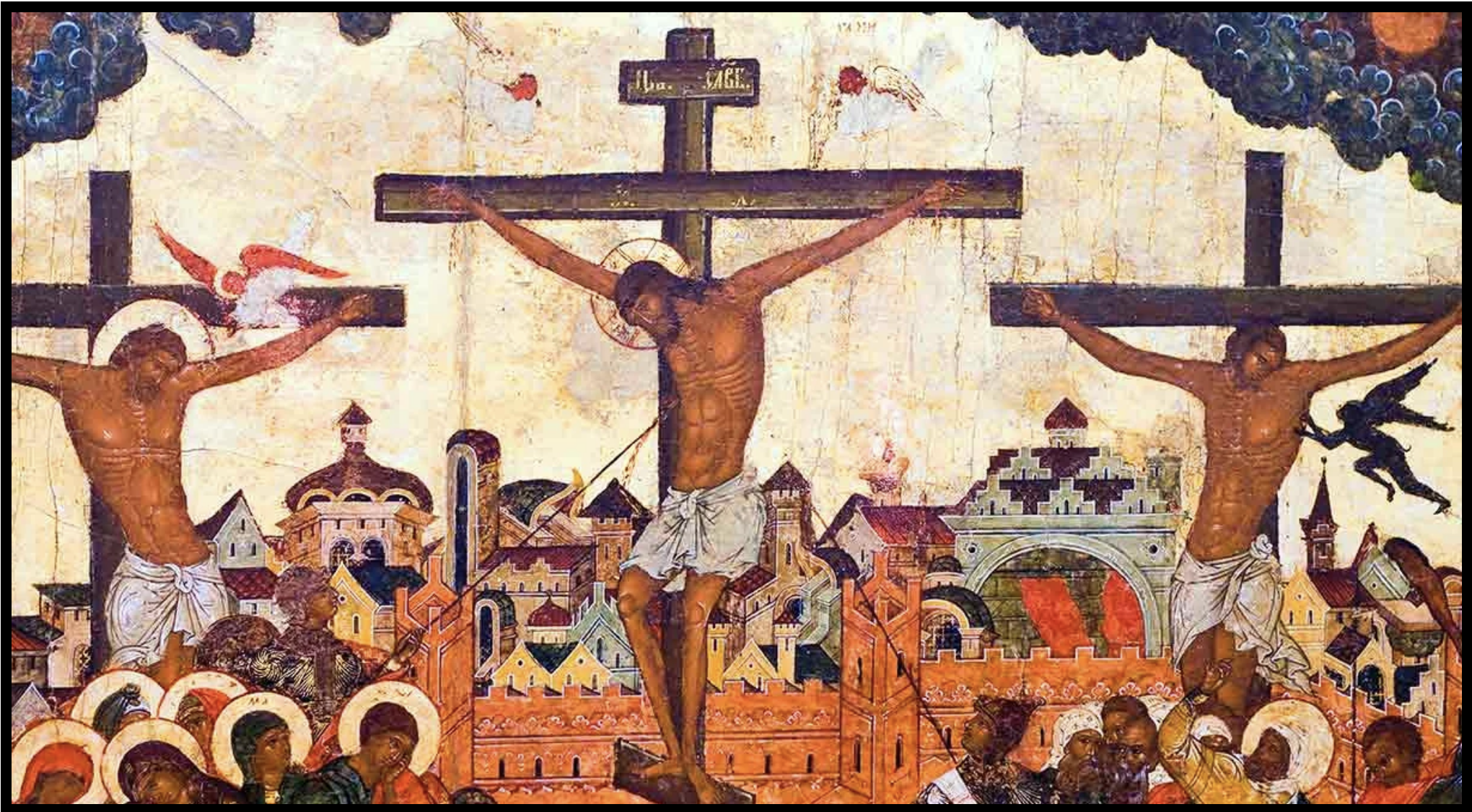
John 12:28-36 (Matins)
1 Corinthians 1:18-24
John 19:6-35
At the Crossroads
Pilate said to them, "Shall I crucify your King?"
(Jn 19:15)
In the Name of the Father and of the Son and of the Holy Ghost. Amen.
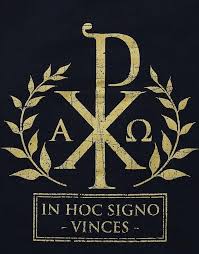
Today we observe the Universal Exaltation of the Precious and Life-giving Cross.
In this, we continue a kind of national holiday of the
Eastern Roman Empire,
called Byzantium.
Before the exertions of the Emperor Constantine and of his
mother, the Empress Helena,
the Church was
slow to adopt the Cross
enthusiastically as its symbol.
As St. Paul had commented centuries earlier, a stumbling block to faith for Jews and just plain
foolishness to intellectuals (1Cor 1:18-25)
as we just read in our Epistle lesson.
But the Emperor adopted the Cross as his personal device
ordering that it be clearly displayed upon the armor of his legions
and
publishing the Cross as his motto:
which he had heard from on high
and
saw a Cross emblazoned across the sky
on the eve of a decisive military battle:
"By this Sign you shall conquer,"
expressed in Latin,
the official language of the Roman Court.
He was determined that the Cross no longer be seen in its aspect of
of public humiliation,
but rather as a banner of bold conquest.
We can understand how the sensibilities of a world-conquering general
might differ from those of a Church
whose central message was inner transformation.
Not smoking battlefields and the cries of attack,
but the quiet of inner contemplation achieving serenity.
Military victories can be settled in an afternoon.
But the reshaping of the human heart and soul very often requires years
or even lifetimes.
And if anything stands out to Westerners
as they stream into the Orthodox Church by the thousands these days,
it is this:
conversion does not happen in an instant
as frontier preachers had promised
(for them it had to,
for their revival tent
would be folded up that same night).
And the Crucifixion of Jesus did not instantly clear a debt
demanded by a Father with blood on His hands.
No.
Conversion is a journey
among friends.
It is journey to the most important Friend.
Jesus said,
"I call you my friends" (Jn 15:15)
It is a process whereby a Kingdom is created from "living stones" (1Peter 2:5),
who by-and-by resemble God's Son.
For this is the goal:
that we be adopted as the children we were born to be,
that we come to the fullness of the original Image placed upon us at birth,
the Image of God.
Did not
the Apostles call their movement The Way?
You see, it's a journey.
At the beginning of the journey is heard
"a voice crying the wilderness."
The Forerunner exhorts us to
change everything:
our thoughts,
our desires,
our habits,
our plans,
our whole direction in life.
Metanoeite!
he cries.
Be changed!
A little later our quotidian lives stop.
We encounter the Living God ..... or He encounters us.
From His lips are heard that same word:
Metanoeite!,
now not spoken as an exhortation,
but issued as a Divine command.
"Burn down your whole former life!"
He says.
It is not possible to serve Mammon,
living in the "world system" (as Christians say these days),
and also
claim that you are following God.
We stand at a Crossroads
(another meaning of the Holy Cross),
and we remember the Baptist's admonition:
"His winnowing fan is in His hand, and He will thoroughly clean out His threshing floor,
and gather His wheat into the barn; but He will burn up the chaff with unquenchable fire."
(Mt 3:14)
|
We must choose which we shall be:
chaff or wheat,
tares or grain (Mt 13:24-30),
goats or sheep (Mt 25:32-33).
This is the constant message of the Christ.
We must choose.
It must be ourselves who pronounce the Final Judgment.
And the journey between now and the last days
(or the end of our lives)
is the only important thing:
for ourselves, for the children we are rearing,
for our family and loved ones.
The journey to God ....
This is the most important thing.
Jesus says, the only necessary thing (Lu 10:41-42).
Now, the Synoptic Gospels may differ in detail, but they all tell the same story:
the exhortation to change,
the encounter with God,
the acceptance or refusal of the call,
the Cross.
Should we accept God's call,
the road ahead will lead to His good Kingdom.
Instantly and dramatically,
we enter a fellowship of angels and saints and
others like ourselves who together are called
The Way.
Together,
we begin a transformation
after the example of the Master,
who points to the Cross as our salvation.
|
"And he who does not take his Cross and follow after Me is not worthy of Me."
(Mt 10:38)
|
For the journey and the Cross turn out to be one and the same.
The Cross is the instrument on which our former lives are crucified (Gal 2:20).
We die to our former world and become a new creation in Christ (2Cor 5:17).
And, bearing our Cross, we find that we renew ourselves in this life
everyday
—
refusing the world,
stripping away its filth,
becoming more and more like Him.
Like the Gospels,
our
individual lives might vary widely in detail,
but no one might evade this call from God
nor elude this Cross.
We all hear His Divine command from within:
Be changed!
Do we not see the restlessness of the world which has refused God?
C. S. Lewis wrote that
"Human history is the long, terrible story of man trying to find something other than God which will make him happy."
And certainly, change
is the subject of countless books and blogs and YouTube streams,
whether it be diet, exercise regimen, or new "life philosophies."
And it is perennially the main theme in every election season:
change!
But this
juggernaut, too, inescapably must lead
to God's Crossroads.
For this crisis, this crucial moment, is built into our lives.
We cannot change the subject.
When we are young,
we are consumed with the question,
"What is the purpose of my life?"
And,
it returns,
if we have not addressed it,
in our twilight years.
We ask, "What did it all mean?"
We must choose.
Either we choose for Him, or we choose against Him.
There is no neutral position, no half-way.
"So because you are lukewarm, and neither hot nor cold,
I will vomit you out of My mouth."
(Rev 3:15-16)
|
The call to change declared by John the Baptist was heard by all
those in the Levant during the first century AD:
|
Then Jerusalem, all Judea, and all the region around the Jordan went out to him ....
(Mt 3:5)
|
They all went.
That's 600,000 people according to the reliable census ordered by the Romans.
(And the population of the
the wider region,
coterminous with the Roman Province of Syria,
was six million.)
By any measure John's ministry was earth-shaking.
And those who came repented, seeking new life
—
symbolically washing away their shames and regrets
in ritual drowning,
so they could
be reborn into a new journey to God
attired in the white tunic which awaited
them after their baptism..
Seeking the pristine and the pure,
these people followed John in a kind of "back to the garden" movement,
for He Himself bespoke the freshness of Eden.
And they followed Jesus, for He was the Lord of Eden.
Was there any doubt about this?
Did not
Satan (Mt 4:3)
and
the demons of Hell (Mt 8:29)
and
those who survived a near shipwreck (Mt 14:33)
all say,
"You are the Son of God"?
But the Cross is a very different proposition.
After all,
a journey back to the garden
or
encountering the Lord of Life in approachable, human form
is a pleasant thing,
"A green thought in a green shade" (Andrew Marvell).
But the Cross, erected on a stony hill, is not.
Far from the cool of the evening where one converses with God among groves,
the Cross signifies being stripped bare before all eyes,
being beaten, almost flayed alive,
and
then nailed,
hands and feet, to a cruel instrument of execution.
This is no ritual drowning,
but a brutal and protracted assault
ending in a slow death.
Alice Von Hildebrand
in her forward to Transformation in Christ
wrote, there is a very great difference between
being in love with the idea of conversion
and
conversion itself.
You know "falling in love with conversion."
You buy little icons for house.
You get the popular books.
You attend discussions where "the essence of Orthodoxy" is discussed.
But this is not conversion itself
in which you burn down your whole world.
In this insight,
we see God's call afresh.
You cannot answer God with
insubstantial changes to your comfortable life.
No.
You must discard that former life.
It will mean parting with friends.
Perhaps
it will mean parting with family members.
I will share that when I arrived to the point of real conversion,
ready to turn away from "living in the world,"
those around me said to each other,
"He's become a religious fanatic."
Interesting that real life
should be demonized.
Isn't this precisely backwards?
Where the path to dark kingdom is held up
to be the healthy norm,
And Kingdom of God is labeled as "Hell."
Now at an old age I can say
with the confidence of experience
that the "old life"
collapses anyway.
No one has to burn it down;
it collapses from its inner rot.
Ask any worldling who has encountered God.
God will surely have His Way.
He will have His shake-up.
We might call it a crisis, a catastrophe, the "day my whole world ended."
For no reply to God,
is a reply,
is a choice.
And it is the choice most people make:
eternal death.
Ask the parents of adult children who have been lost to the
ghastly culture of degradation and death.
Offspring covered with tatoos and body piercings who are addicted
to drugs
and
riddled with sexually-transmitted diseases.
For where God is not there can be no life.
And life is beautiful.
All roads lead to the Cross.
It is the Great Compass of the world
and
looms over every journey
as well as
wanderings by the way.
It is on every horizon,
in every season,
and
eternally changeless.
For its cardinal points
in Greek,
spell "ADAM,"
who is the beginning of all our journeys,
and
point ahead to the end of all journeys,
which
is the "New ADAM"
—
our God Who hung upon a Cross,
the One we refused,
the One the people chose to be crucified.
Hear Him,
for He speaks.
But these are not words of anger.
These are not words of condemnation.
Even with His last breath,
He reassures us.
He tells us that
on the other side of this all-consuming ordeal
lies Divine Life.
|
"Assuredly, I say to you, today you will be with Me in Paradise."
(Lu 23:43)
|
Let us return to original question.
What is the Church's message:
the Cross
or
transformation through a journey called
Theosis?
I did not understand this riddle until
I saw the puzzle pieces clearly.
For I had pictured the Western Cross
used for execution of the condemned.
But that is not what the Emperor Constantine saw.
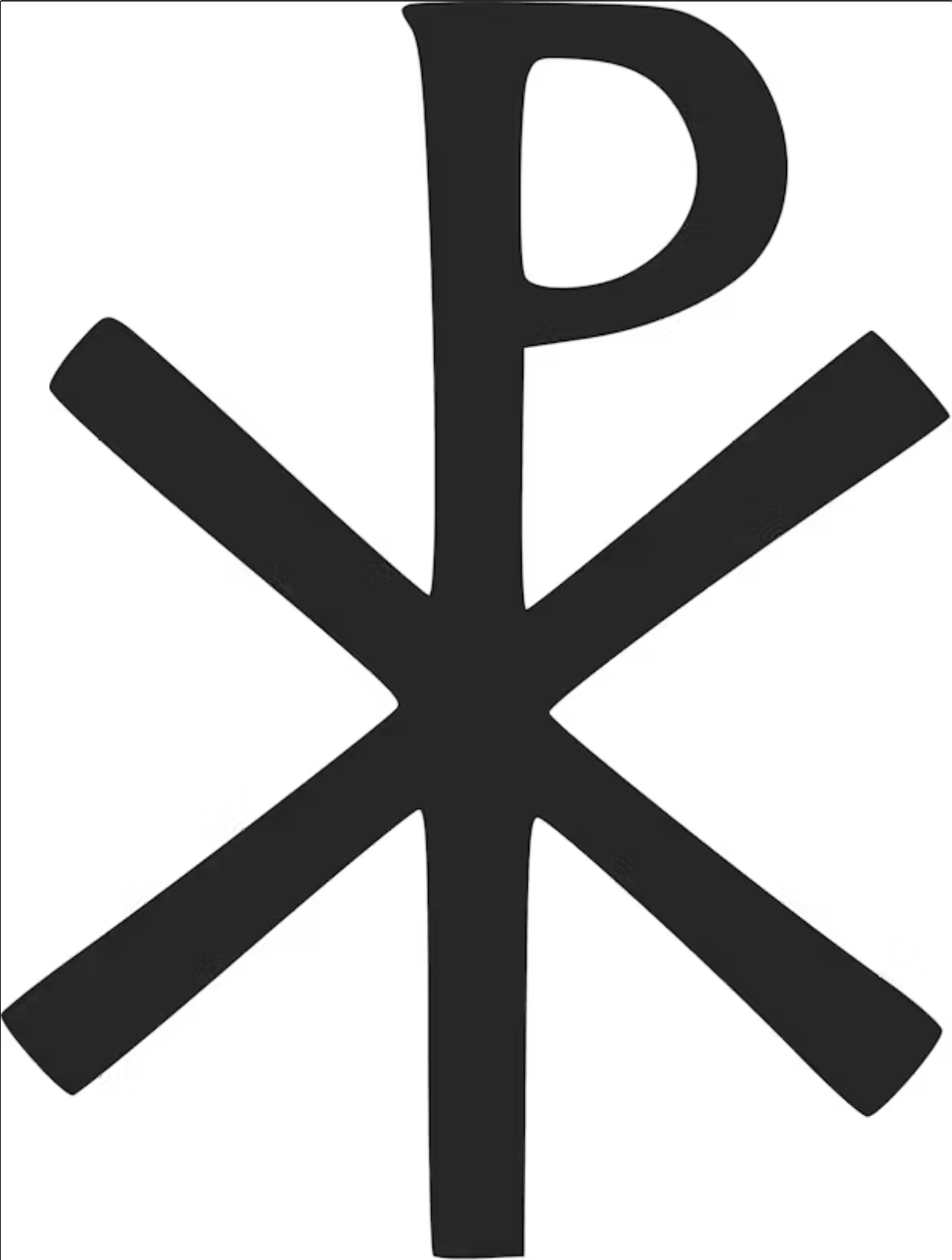
He saw a great Chi-Rho
(in English, an enormous "X" with a "P" drawn through it).
These are the Greek letters that begin the word Christ,
called the Christogram.
What the Emperor saw is that Christ is the Cross,
nor can they ever be separated.
He is eternally one-and-the-same with
His Self-sacrificing love,
which is the Life's Blood of the world,
Precious and Life-giving.
And this is the Life,
this is the sacrifice
He asks us to make our own.
☦
What does this life look like?
People come to visit our enclosed community.
They have come to see something.
Usually they
focus on outward, material aspects of our lives.
One volunteer from an Orthodox parish
—
pointing to our monastic compound, orchards, and planting fields
—
demanded to know,
"Who paid for all this?"
Our reply is simple and direct: "God has done this."
If I am pressed for details
—
our large buildings, the certified organic farm,
thousands of feet of buried water line and valve boxes,
hundreds of feet of road,
thousands of feet of fencing installed in a jungle
—
I reply, "Two elderly nuns and their hapless chaplain have built all.
For God chooses the weak, the foolish, and the lowly (1Cor 1:27),
that in all things God may be glorified through Jesus Christ,
to Whom belong the glory and the dominion forever and ever" (1Peter 4:11).
There can be no doubt what has happened here ....
unless you believe that nuns now in the eighties and their feeble
chaplain did all without the mighty power of God.
"And you receive no pay?
"That is true. We are adopted children of the Most High (Rom 8:15).
Shall a laborer extort his mother and father?"
"And the Church gives you no support?"
"That is true. The Church does not give to monasteries and parishes; we give to the Church" (Heb 7:8).
"And the farm has run in the red for ten years?"
"That is true, by the grace of God, for 'in Him we live and move and have our being' (Acts 17:28)."
"I just don't understand this," they say and walk away.
But the world is out-of-focus.
What most people call "life on the margins" conforms to the Divine Will
to "live simply that others might simply live."
Simplicity is the acceptable life in God's perspective.
As of 2023, 735 individuals held more wealth in the U.S. than 50% of the population.
The stark truth is that capitalism is a zero-sum game.
What is that?
Imagine ten jelly beans:
if a few hoarders should take eight (and the top 20% do),
that leaves two jelly beans for all the rest of us, which have to be shared.
During the COVID epidemic, wealth held by billionaires increased 70%.
And so,
to accommodate their upward adjustment in wealth,
more families were forced out on to the streets.
Perhaps this is difficult for most people to understand,
but this is what a zero-sum game is.
It is absurd to blame poverty on the poor, for it is the rich who make poverty necessary.
It is not possible for
everyone to be rich.
We cannot have a constant influx of more jelly beans.
There is a finite number:
that's all there is.
This is beyond debate.
It is an immutable, structural feature of our economic system.
As I say, a zero-sum game.
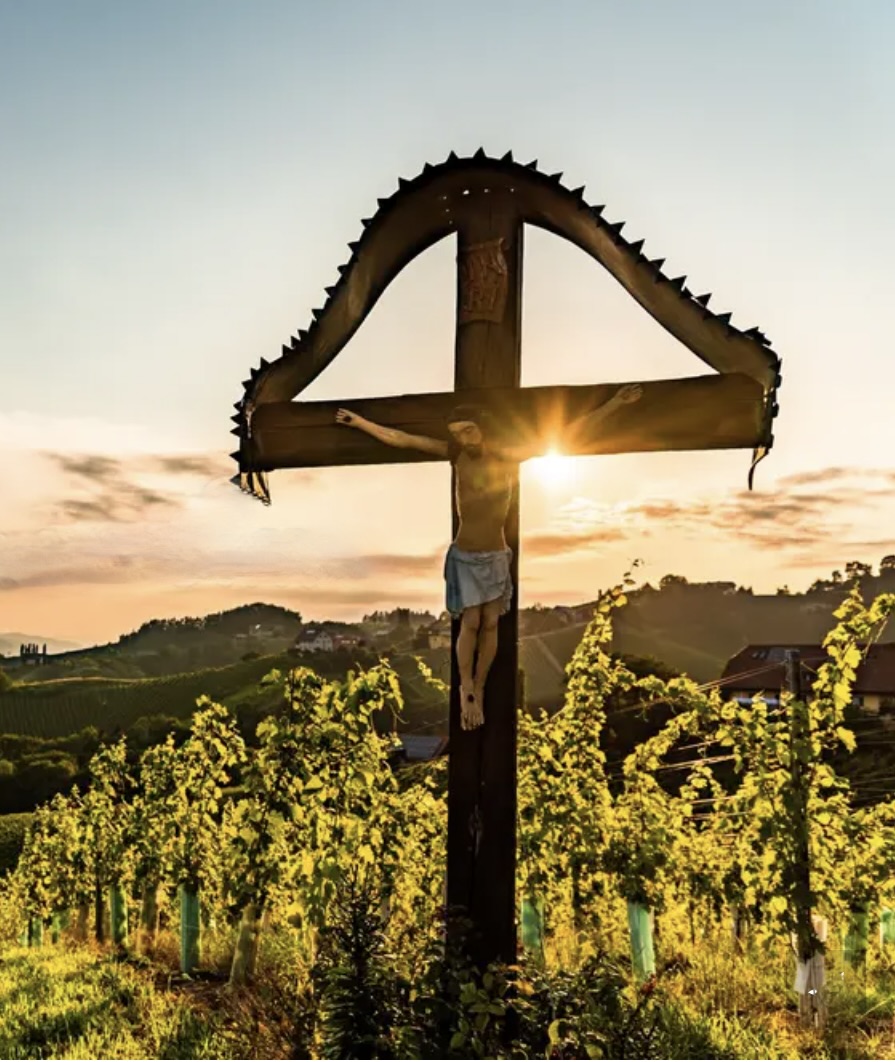
Nonetheless, we must all labor in the Vineyard.
In that Vineyard a Watchtower has been set.
It is the Cross, the universal Compass for all mankind.
We might call this a moral compass.
And from that Cross, God watches.
He watches us.
And His gaze is perfect, missing nothing.
And the sun is setting.
Glory to God!
Glory to Him Who watches in our twilight!
But as it is written:
"Eye has not seen, nor ear heard,
Nor have entered into the heart of man
The things which God has prepared for those who love Him."
(1Cor 2:9)
|
And how do you love God? He has said it: "Take up your cross, and follow Me."
In the Name of the Father and of the Son and of the Holy Ghost.